St. Brendan the Navigator
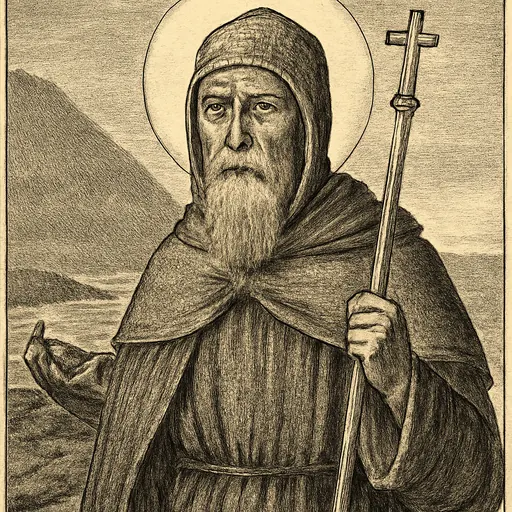
St. Brendan the Navigator (about 484 to 577) was an Irish monk and abbot from County Kerry who founded the monastery of Clonfert. He is famous for the Voyage of St. Brendan, a medieval tale of a seven-year sea journey in search of the Promised Land of the Saints. He is a patron of sailors and travelers, and his feast day is May 16.
Who was St. Brendan the Navigator?
Brendan was an Irish monk, priest and abbot of the 500s, one of the founders of the monastic Church in the west of Ireland. The Catholic Encyclopedia gives his dates as 484 to 577. He was born near Tralee in County Kerry and died at Annaghdown in County Galway, and he is buried at Clonfert, his best-known foundation.
He is remembered worldwide for one thing: the Navigatio Sancti Brendani, the Voyage of St. Brendan. It is a Latin tale of a long sea journey, and it is a work of religious imagination more than a ship's log. Separating the man from the story is the main task of any honest life of Brendan.


The earliest text to mention him is the Life of Columba by Adomnán, written between about 679 and 704, which mentions him visiting St. Columba on the island of Hinba. Don't confuse him with Brendan of Birr, another Irish abbot of the same generation.
The life of St. Brendan
The Catholic Encyclopedia, drawing on Irish annals and later lives, gives this outline. Bishop Erc baptized him at Tubrid, near Ardfert. For five years he was fostered and taught by St. Ita, "the Brigid of Munster," and Erc later ordained him priest. Between about 512 and 530 he built monastic cells at Ardfert and at the foot of Mount Brandon, the great hill on the Dingle Peninsula that still bears his name.
He founded churches and monasteries across the west of Ireland, among them Inishdadroum in County Clare and Annaghdown, and the Catholic Encyclopedia reports missions to Wales and to Iona. His greatest foundation was Clonfert, in County Galway, in 557 (some sources say 563). He died at Annaghdown, where later tradition says he founded a convent for his sister Briga, and was buried at Clonfert.
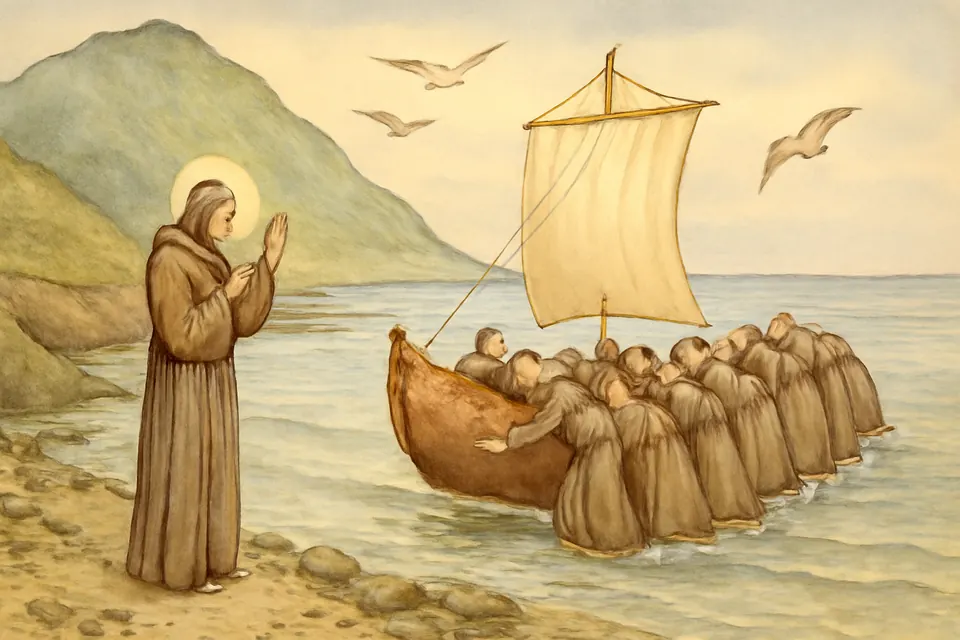
The Voyage of St. Brendan
What the Navigatio is
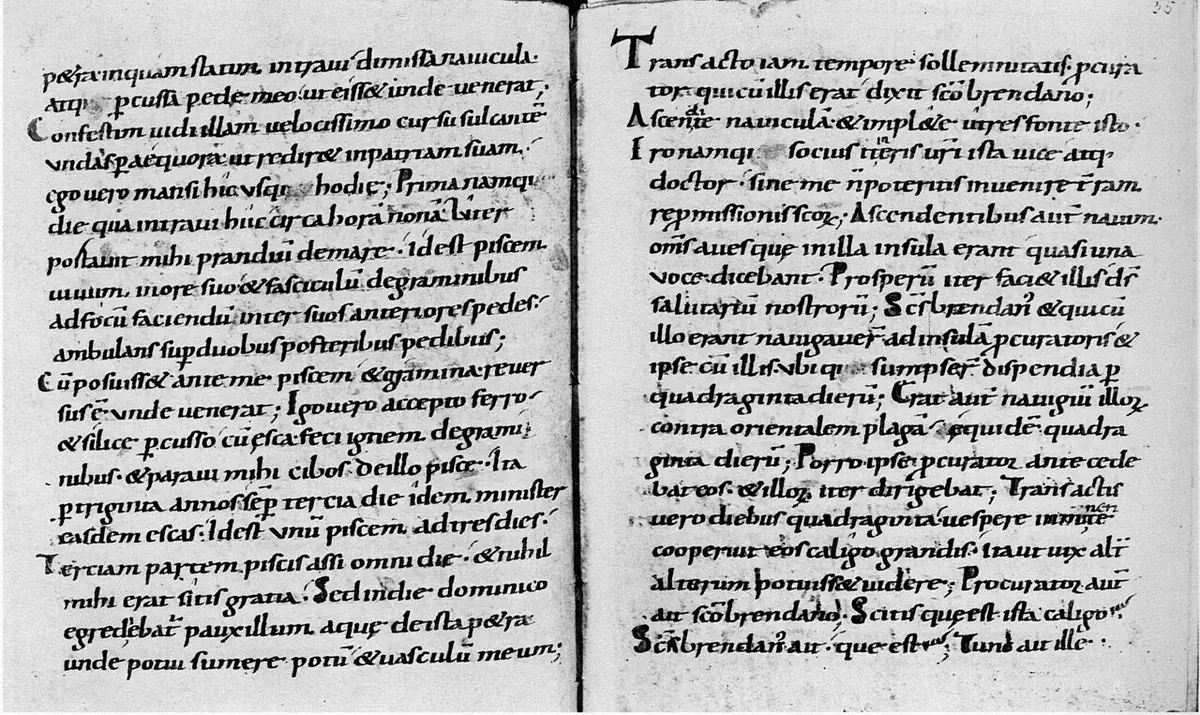
The Navigatio survives in more than a hundred medieval manuscripts. Scholars date its composition anywhere from the late 700s to the 900s, and the oldest copies are from around 900 to 1000, so it was written two to four centuries after Brendan's death. It belongs to an Irish genre called the immram, a tale of a voyage from island to island. Old Irish calendars already kept a feast of the "departure of the family of St. Brendan," and around the end of the 700s Aengus the Culdee invoked "the sixty who accompanied St. Brendan in his quest of the Land of Promise."

The story
In the tale, Brendan hears of a Promised Land of the Saints far to the west. He and fourteen monks fast for forty days, build a boat of hides stretched over a wooden frame, and set out; three latecomers join them. For seven years they sail a yearly circuit of islands, keeping the Church's feasts in the same places each year. They land on an "island" that turns out to be a huge fish, Jasconius, and celebrate Easter on its back. They find an island of birds that sing the hours of prayer, a silent community of monks, a pillar of crystal in the sea and an island of smiths who hurl burning slag. At last they reach the Promised Land, are allowed a brief look, and return home.
All of this is traditional. The tale is full of liturgy and monastic obedience, and it reads as a parable of the monk's life as a pilgrimage. Readers have also seen icebergs and Icelandic volcanoes behind the crystal pillar and the smiths' fire, but that remains guesswork.


Did Brendan reach America?
Medieval mapmakers took "St. Brendan's Island" seriously. The Catholic Encyclopedia lists charts from 1367, 1375 and 1424 that place it near Ireland, Madeira or the Canaries, and Martin Behaim's globe moved it far out into the ocean. Islanders in the Canaries and the Azores told Columbus they had seen it. Belief in the island was finally given up in the 1800s.
Then a new theory arose: that Brendan, or Irish monks like him, reached North America. Writers in the 1800s built the case on Norse sagas and a passage in the Navigatio describing unfamiliar plants and animals. Geographers such as Alexander von Humboldt classed the story with other geographical legends, and no reliable evidence that Brendan crossed the Atlantic has ever been found.
In 1976 the British explorer Tim Severin built a 36-foot boat of oak and ash covered with ox hides, named it Brendan, and sailed from Brandon Creek in Kerry by way of the Hebrides, the Faroe Islands and Iceland. He reached Newfoundland in June 1977 and told the story in The Brendan Voyage (1978). The voyage proved that a leather boat could cross the North Atlantic. It did not prove that Brendan did. The boat is now displayed at Craggaunowen in County Clare.


Why St. Brendan is the patron of sailors
His voyage, legendary or not, made him the saint of those who go to sea, and he is invoked by sailors, boatmen and travelers. The dioceses of Kerry and Clonfert keep him as their patron because he founded churches in both. See our patron saints page.
Symbols of St. Brendan in art
Look for:
- A small boat crowded with monks, often with a sail.
- A whale or giant fish, sometimes with the monks camped or saying Mass on its back.
- An abbot's staff and a monk's habit.
Medieval German manuscripts and printed books loved the whale scene, as on this page. Modern Irish art shows him as an abbot, as in Harry Clarke's window in the Honan Chapel in Cork.


Feast day, Clonfert and places named for him
His feast is May 16. See our feast days calendar. Mount Brandon, Brandon Bay and Brandon Point in Kerry keep his name. At Clonfert the small cathedral that stands on his monastery's site, now a Church of Ireland cathedral, has a famous carved Romanesque doorway from the 1100s.


Prayer to St. Brendan
No prayer written by Brendan survives, and none with a citable traditional origin is found in the standard Catholic prayer books. A prayer widely shared online as the "Prayer of St. Brendan," about leaving the safe harbor for the open sea, is a modern composition. Catholics in Ireland simply ask St. Brendan to pray for them, especially before journeys and voyages.
Frequently asked questions
Did St. Brendan reach America?
There is no reliable evidence that he did. The idea rests on the Voyage of St. Brendan, a religious tale written down two or more centuries after his death. In 1976 and 1977 the explorer Tim Severin sailed a leather boat from Ireland to Newfoundland, which showed that such a crossing was possible, not that Brendan made it.
When is St. Brendan's feast day?
May 16. He is commemorated that day in the Roman Martyrology and in Ireland, where the dioceses of Kerry and Clonfert honor him as patron.
What is St. Brendan the patron saint of?
Sailors, boatmen and travelers, because of his voyage, and the Irish dioceses of Kerry and Clonfert, where he founded churches.
Is the "Prayer of St. Brendan" really by him?
No. A prayer often attributed to him online, about leaving the safe harbor and setting out on the sea, is modern. No prayer by Brendan himself survives.