Our Lady of Sorrows

Our Lady of Sorrows is a title of the Virgin Mary that honors her grief over the sufferings of her Son, Jesus, above all as she stood at the foot of the cross. Catholics remember Seven Sorrows of Mary, from Simeon's prophecy that a sword would pierce her soul to the burial of Jesus. The devotion was spread by the Servite Order, and her feast day is September 15. She is the patroness of Slovakia.
Who is Our Lady of Sorrows?
Our Lady of Sorrows is not an apparition or a shrine image but a way of looking at the Virgin Mary: as the mother who suffered with her Son. The Gospel of John says that "his mother" stood beside the cross of Jesus while he died. Catholic devotion has gathered that moment together with six other griefs of her life into the Seven Sorrows of Mary, and honors her under the Latin title Mater Dolorosa, the Sorrowful Mother.
The idea starts with a sentence in Luke. When Mary and Joseph presented the infant Jesus in the Temple, the old man Simeon told her, in the Knox translation, "as for thy own soul, it shall have a sword to pierce it." That sword is the oldest symbol of Our Lady of Sorrows, and painters later multiplied it into seven.
Pope Benedict XVI, preaching on her feast at Lourdes in 2008, put the Church's view simply: at the foot of the cross "the prophecy of Simeon is fulfilled: her mother's heart is pierced through."


The Seven Sorrows of Mary
The standard list goes back to the responsories of the Servite Office for the feast, as the Catholic Encyclopedia gives them. Four are narrated in the Gospels. The other three rest on the Passion accounts and on long Christian tradition, and it is fair to say so plainly.
- The prophecy of Simeon (Luke 2:34-35). Simeon blesses the child and warns Mary that he will be "a sign which men will refuse to acknowledge," and that a sword will pierce her own soul.
- The flight into Egypt (Matthew 2:13-15). Warned in a dream, Joseph takes Mary and the child by night to escape Herod's massacre.
- The loss of the child Jesus in Jerusalem (Luke 2:41-50). The twelve-year-old Jesus stays behind in the Temple, and his parents search for three days. When they find him, Mary says: "My Son, why hast thou treated us so? Think, what anguish of mind thy father and I have endured, searching for thee."
- Meeting Jesus on the way to Calvary. The Gospels do not describe this meeting. Luke 23:27 mentions women who followed Jesus mourning; the meeting with his mother is a tradition, kept as the fourth Station of the Cross.
- Standing at the foot of the cross (John 19:25-27). "His mother, and his mother's sister, Mary the wife of Cleophas, and Mary Magdalen, had taken their stand beside the cross of Jesus." Jesus gives her to the beloved disciple: "Woman, this is thy son."
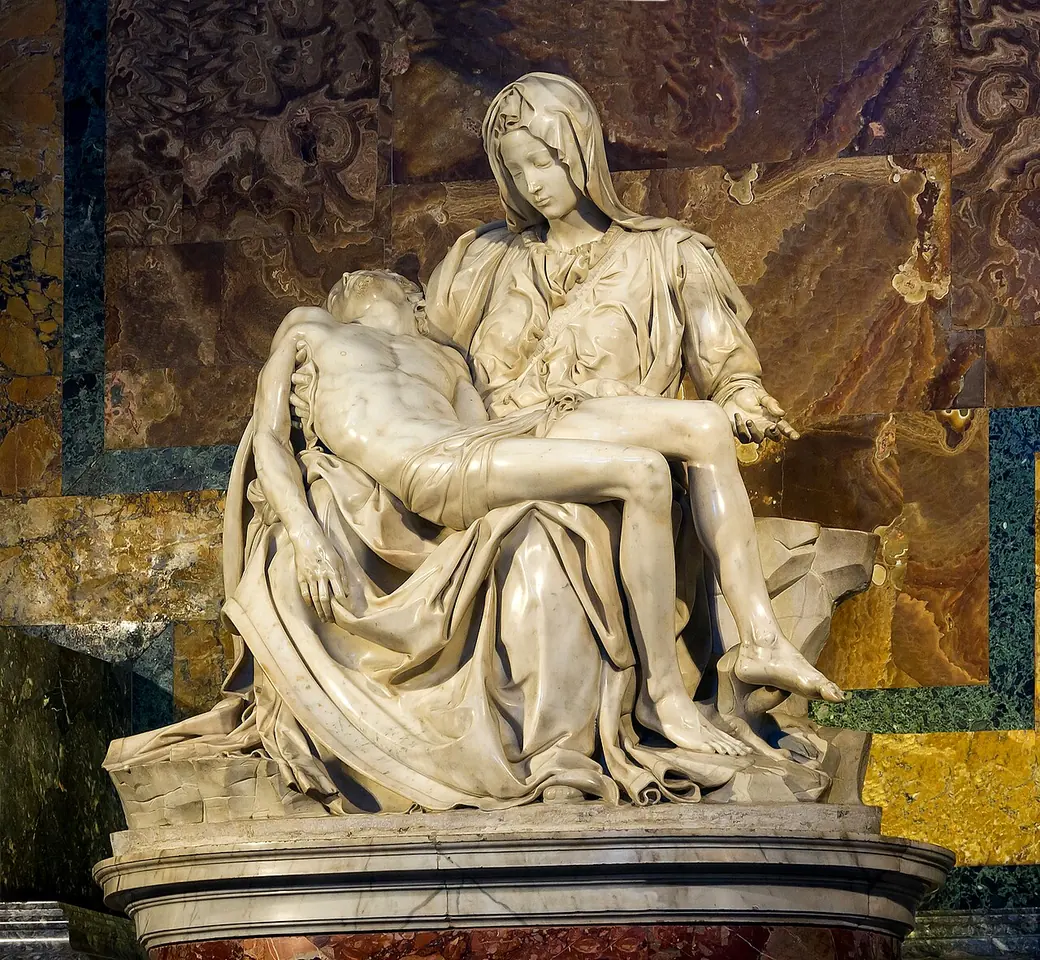
- Jesus taken down from the cross (Mark 15:42-46; John 19:38-40). Joseph of Arimathea and Nicodemus take down the body. Mary's presence is not stated; the scene of her holding her dead Son, the Pietà, is a later devotional image.
- The burial of Jesus (John 19:40-42; Luke 23:55). The women from Galilee watched where he was laid. Tradition places his mother among them.

How the devotion grew
The Servites
The devotion owes most to the Servants of Mary, or Servites. According to the Catholic Encyclopedia, seven young men of patrician families in Florence, members of a lay confraternity of "Praisers of Mary," withdrew from the world in 1233 and later settled on Monte Senario, eleven miles north of the city. They took a black habit and the Rule of St. Augustine. The order spread through Italy and beyond, and in 1239, the same source says, its founders took "the sorrows of Mary, standing under the Cross, as the principal devotion of their order." A later Servite, St. Peregrine Laziosi, is now invoked by people with cancer.

Two feasts
The first feast of Mary's sorrow at the cross was not Servite. A provincial synod at Cologne in 1413 set a "Commemoratio angustiae et doloris B. Mariae V." to make reparation for the iconoclasm of the Hussites. It spread through northern Europe under names like Compassio or Transfixio, and in 1727 Pope Benedict XIII extended it to the whole Latin Church on the Friday before Palm Sunday.
The Servites received a second feast of the Seven Sorrows in 1668, kept in September. Pope Pius VII extended it to the whole Latin Church on September 18, 1814, after his return from exile in France. In today's calendar the feast is on September 15, the day after the Exaltation of the Holy Cross. When the General Roman Calendar was revised in 1969, the Friday feast was dropped as a duplicate, and the September feast took the title Our Lady of Sorrows. Spain, Mexico, the Philippines, Malta and other countries still keep the Friday of Sorrows, Viernes de Dolores, at the start of Holy Week.

The Stabat Mater
The great hymn of the feast is the Stabat Mater dolorosa, a medieval Latin sequence in rhymed three-line verses. The Catholic Encyclopedia reports that it was "well known to all classes by the end of the fourteenth century." Its author is unknown. The poem has been credited to popes, Franciscans and others; the only two ascriptions the Encyclopedia thought probable were Pope Innocent III and the Franciscan poet Jacopone da Todi. The opening words echo the Latin of John 19:25.
It entered the Roman Missal in 1727 with the Friday feast. Today it is an optional sequence at Mass on September 15, and the stanzas are often sung between the Stations of the Cross. Composers from Josquin and Palestrina to Pergolesi, Haydn, Rossini and Dvořák have set it. The Encyclopedia counted over sixty English translations; the most used in hymnals is Edward Caswall's, from his Lyra Catholica of 1849:
At the Cross her station keeping, / Stood the mournful Mother weeping, / Close to Jesus to the last: / Through her heart, his sorrow sharing, / All his bitter anguish bearing, / Now at length the sword had pass'd.

Our Lady of Sorrows around the world
Slovakia. The National Shrine of the Seven Sorrows is a baroque basilica at Šaštín in western Slovakia. The Holy See called the feast that Pope Francis celebrated there on September 15, 2021, the "Solemnity of the Blessed Virgin Mary of Seven Sorrows, Patroness of Slovakia." About 60,000 people came. In his homily Francis said: "Mary, Mother of Sorrows, remains at the foot the cross. She simply stands there. She does not run away, or try to save herself, or find ways to alleviate her grief."


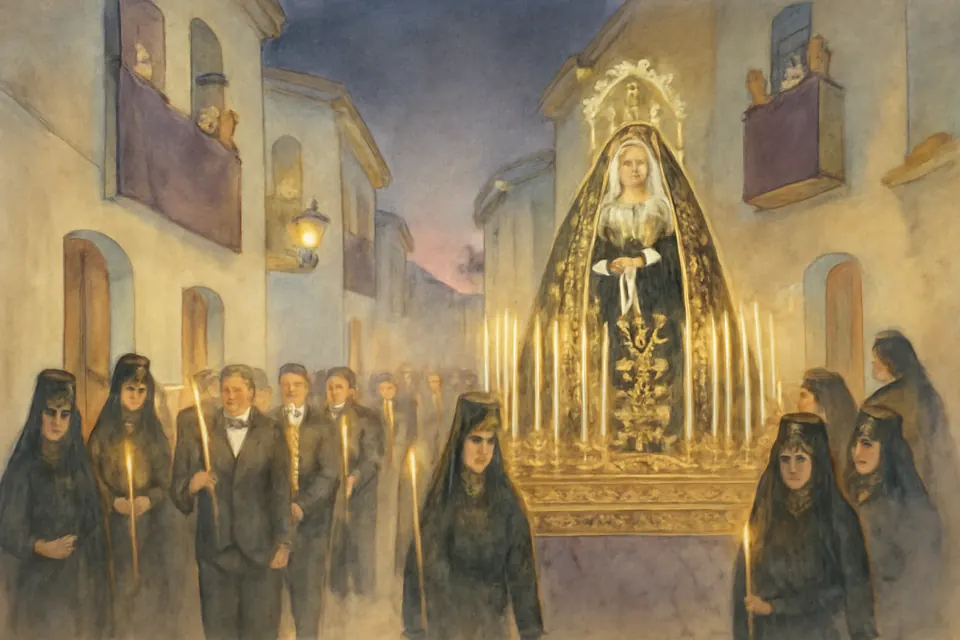
Spain and Latin America. The Spanish world honors the Sorrowful Mother in carved and dressed statues, Dolorosas, with glass tears and velvet mantles, carried through the streets on the Friday of Sorrows and in Holy Week. The Catholic Encyclopedia traces the related devotion to Our Lady of Solitude, Nuestra Señora de la Soledad, which remembers Mary alone on Holy Saturday, to Queen Juana of Castile, who mourned her husband Philip I after 1506.


Rwanda. At Kibeho, where the local bishop recognized apparitions of the Virgin to three young women, Alphonsine Mumureke, Nathalie Mukamazimpaka and Marie Claire Mukangango, on June 29, 2001, the sanctuary was named the "Shrine of Our Lady of Sorrows."
The United States. Servite friars came to Wisconsin in 1870, and Father Morini founded the monastery of Our Lady of Sorrows in Chicago in 1874, according to the Catholic Encyclopedia. Its church on the West Side, now Our Lady of Sorrows Basilica, also houses the National Shrine of St. Peregrine, and its Sorrowful Mother Novena drew worshippers from across the country in the first half of the 20th century.
Miracles and Our Lady of Sorrows
Our Lady of Sorrows is a devotion, not a single event, so it has no miracle of its own in the sense that Lourdes or Fátima does. Particular shrines have their own stories. The Kibeho apparitions are approved by the local bishop. Cures and favors credited to the Šaštín Pietà and to Spanish Dolorosa images are reported by their shrines, and the founding of the Servites after a vision of Mary on the feast of the Assumption in 1233, as the order tells it, is traditional.
Symbols of Our Lady of Sorrows in art
You can usually recognize the Sorrowful Mother at a glance:
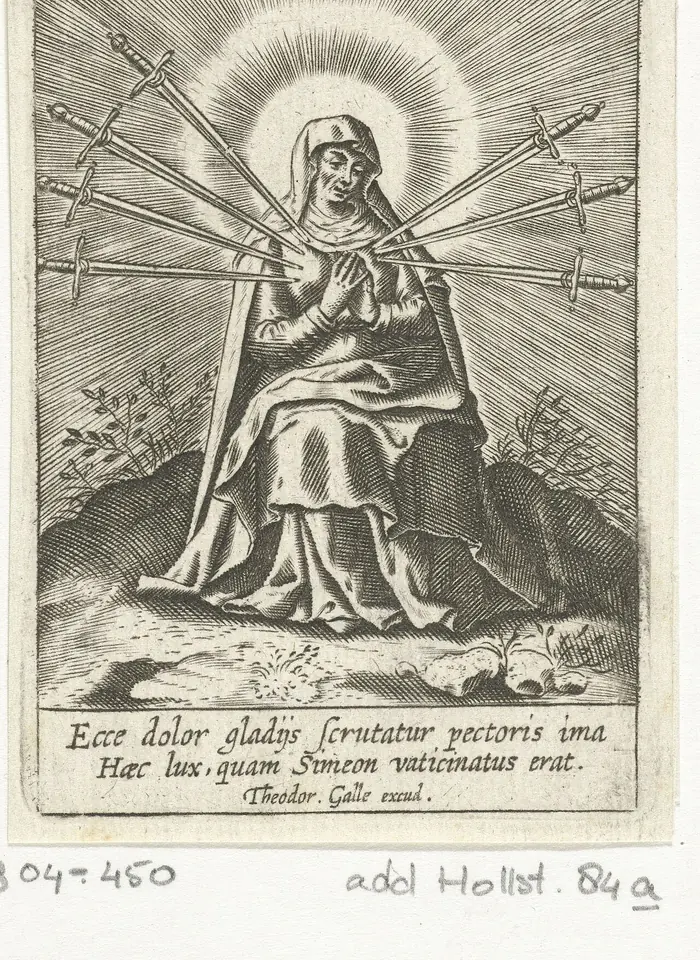
- One sword or seven swords in her heart or breast. The single sword comes from Simeon's words in Luke 2:35. From the late Middle Ages artists added more until there were seven, one for each sorrow. Benedict XVI called this "the traditional symbol of the seven swords."
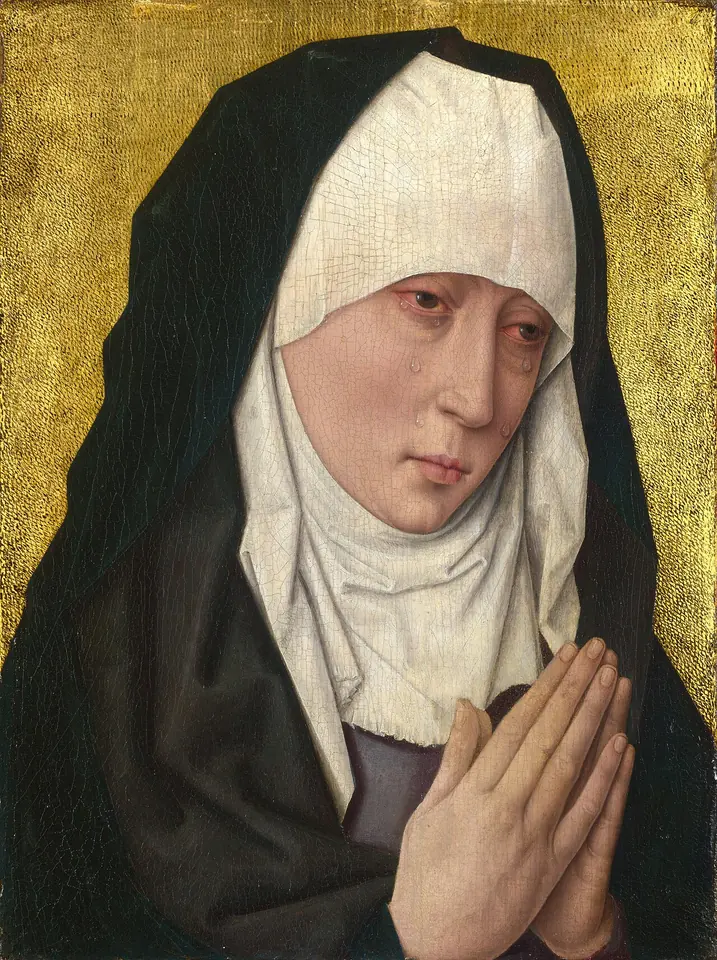
- Tears. Flemish panels show reddened eyes; Spanish sculptors set real glass tears in the wood.
- Dark clothing. A dark blue or black mantle over a white veil, often with a lace handkerchief in her hand in Spanish images.
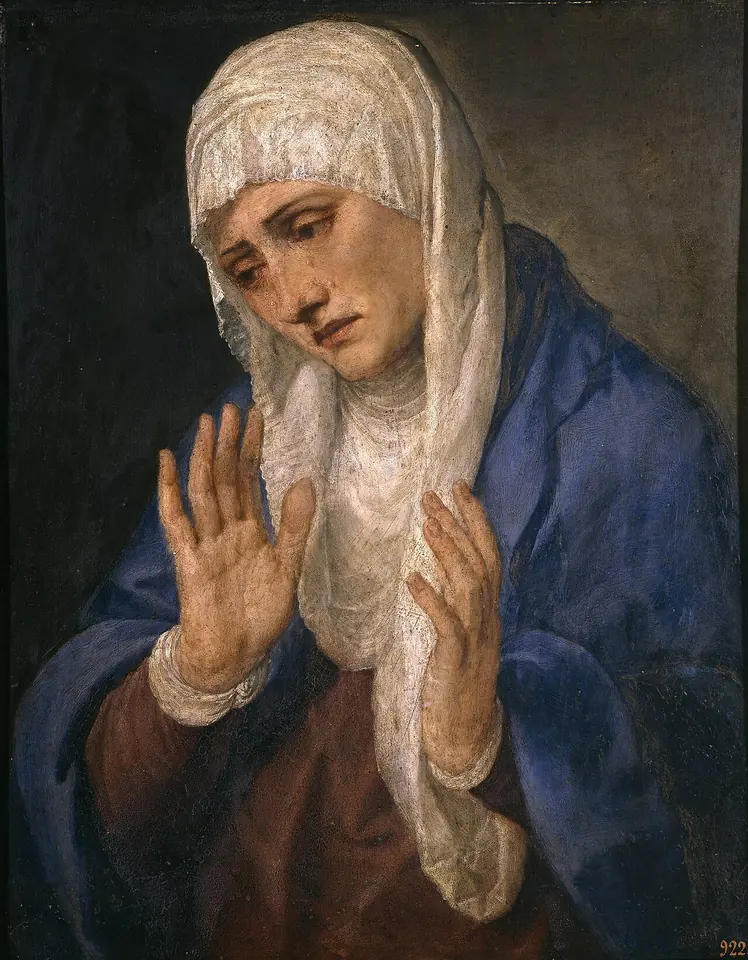
- Hands clasped, wrung or held open in grief, as in Titian's Mater Dolorosa with her hands apart.
- The Pietà. Mary with the dead Christ across her lap, the sixth sorrow, as in Michelangelo's marble in St. Peter's.
- At the foot of the cross with St. John, in Crucifixion scenes.

Images showing one heart pierced by a sword also stand for the Immaculate Heart of Mary, as on the back of the Miraculous Medal. Isenbrant's Bruges panel, above, is one of many that frame her with small scenes of all seven sorrows.

Prayers to Our Lady of Sorrows
The Stabat Mater is itself a prayer. Its later stanzas turn from describing Mary to asking her for a share in her grief. In Caswall's translation:
Let me mingle tears with thee, / Mourning Him who mourn'd for me, / All the days that I may live: / By the Cross with thee to stay; / There with thee to weep and pray; / Is all I ask of thee to give.
It closes:
Christ, when Thou shalt call me hence, / Be thy Mother my defence, / Be thy Cross my victory; / While my body here decays, / May my soul thy goodness praise, / Safe in Paradise with Thee.
Catholics also pray the Seven Sorrows rosary, a Servite chaplet of seven Hail Marys for each of the sorrows, and the Via Matris, a walk through her sorrows modeled on the Stations of the Cross. See the feast day calendar for September 15 and nearby saints, including St. John, who stood with her at the cross.
Frequently asked questions
What are the Seven Sorrows of Mary?
The prophecy of Simeon (Luke 2:34-35), the flight into Egypt (Matthew 2:13-15), the loss of the child Jesus in Jerusalem for three days (Luke 2:41-50), meeting Jesus on the way to Calvary, standing at the foot of the cross (John 19:25-27), Jesus taken down from the cross, and his burial. Four of them are told directly in the Gospels; the meeting on the road, the deposition and the burial with Mary present come from tradition built on the Passion accounts.
When is the feast of Our Lady of Sorrows?
September 15, the day after the feast of the Exaltation of the Holy Cross. It is an obligatory memorial on the General Roman Calendar. Many Catholic countries also keep the Friday before Palm Sunday as the Friday of Sorrows, the date of an older feast.
Why is Mary shown with seven swords in her heart?
The sword comes from Simeon's words to Mary in the Temple, that a sword would pierce her soul (Luke 2:35). Artists first showed one sword, then seven, one for each of the Seven Sorrows. Pope Benedict XVI called the seven swords "the traditional symbol" of the depth of her suffering.
What is the Stabat Mater?
A medieval Latin hymn about Mary standing at the cross, beginning "Stabat Mater dolorosa." Its author is uncertain; Jacopone da Todi and Pope Innocent III are the two serious candidates. It is the sequence for Mass on the feast of Our Lady of Sorrows and is sung at the Stations of the Cross. The best-known English version is Edward Caswall's "At the Cross her station keeping" (1849).
What is the Seven Sorrows rosary?
A chaplet of seven groups of seven Hail Marys, one group for each sorrow, prayed while meditating on that sorrow. The Catholic Encyclopedia names the "Rosary of the Seven Dolours" among the devotions of the Servite Order, which spread it, together with the Via Matris, a "way of the Mother" through her sorrows.
Sources
- Catholic Encyclopedia (1912): Feasts of the Seven Sorrows of the Blessed Virgin Mary
- Catholic Encyclopedia (1912): Stabat Mater
- Catholic Encyclopedia (1912): Order of Servites
- Edward Caswall, Lyra Catholica (London, 1849), Feast of the Seven Dolours: Stabat Mater
- Gospel of Luke, chapter 2 (Knox translation, New Advent)
- Gospel of John, chapter 19 (Knox translation, New Advent)
- Benedict XVI, Homily for the sick, Lourdes, 15 September 2008
- Francis, Homily at the National Shrine in Šaštín, 15 September 2021
- Holy See Press Office: Holy Mass at the National Shrine in Šaštín, 15 September 2021
- Agenzia Fides: Jubilee Year for the 25th anniversary of the apparitions in Kibeho
- Declaration of the Bishop of Gikongoro on the Kibeho apparitions, June 29, 2001 (summary, Miracle Hunter)
- Wikipedia: Friday of Sorrows
- Wikipedia: Our Lady of Sorrows Basilica (Chicago)