St. Isidore the Farmer
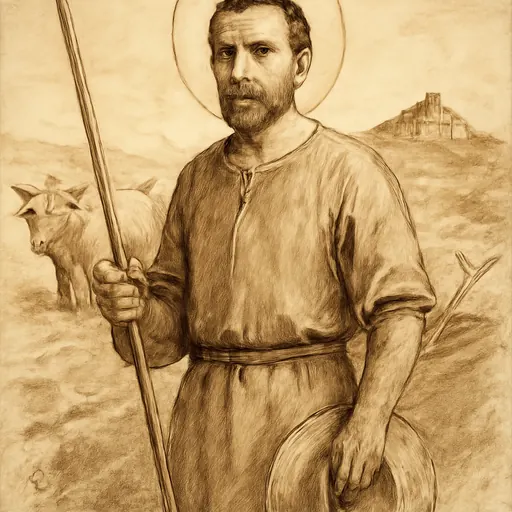
St. Isidore the Farmer (about 1070–1130) was a farmhand near Madrid who went to Mass every morning before work and shared what little he had with the poor. Legend says angels plowed his field while he prayed. He is the patron saint of farmers and of Madrid, and his feast day is May 15.
Who was St. Isidore the Farmer?
Isidore (in Spanish, Isidro) was a farm laborer who lived near Madrid in the late 11th and early 12th centuries, when the town had only recently passed from Muslim to Christian rule. The Catholic Encyclopedia (1910) gives his birth as about 1070 and his death as May 15, 1130. Some later accounts put his death decades later.
Almost everything known about him comes from a life written in 1265 by John, a deacon of the church of San Andrés in Madrid, more than a century after Isidore died. It reads as a collection of miracle stories. Behind them is a plain life: a poor hired hand who worked the same land for years, prayed, and gave away what he had.

He spent his working life on a farm outside Madrid belonging to a landowner named Juan de Vargas. He is sometimes called "Isidore the Laborer," from the Spanish labrador, a man who works the land.
The life and legends of St. Isidore
Mass before work
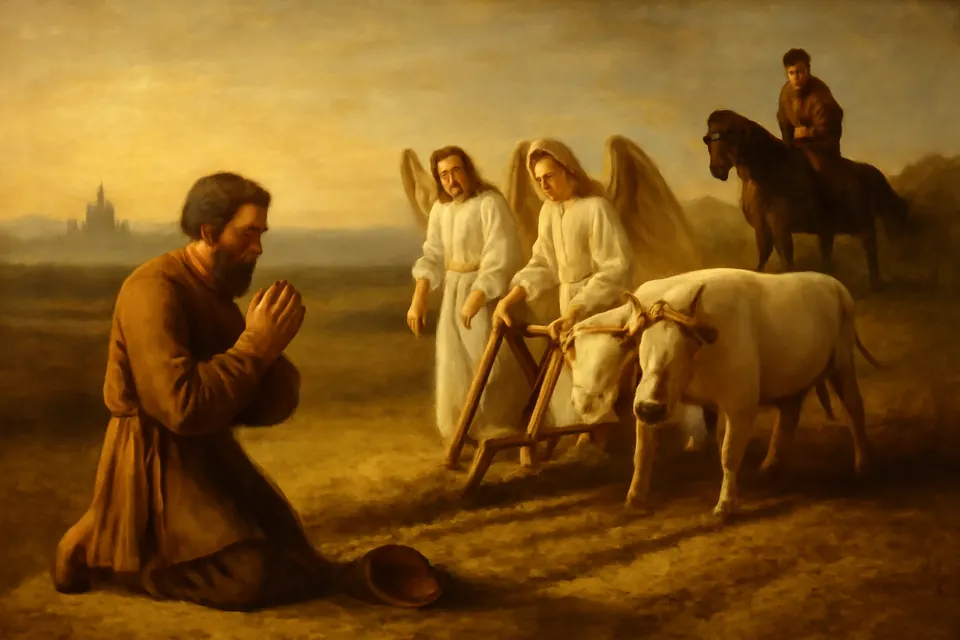
Every morning, the Catholic Encyclopedia says, Isidore heard Mass at one of Madrid's churches before going to the fields. The other laborers complained to their master that he was always late. Juan de Vargas went to see for himself.
The angels at the plow
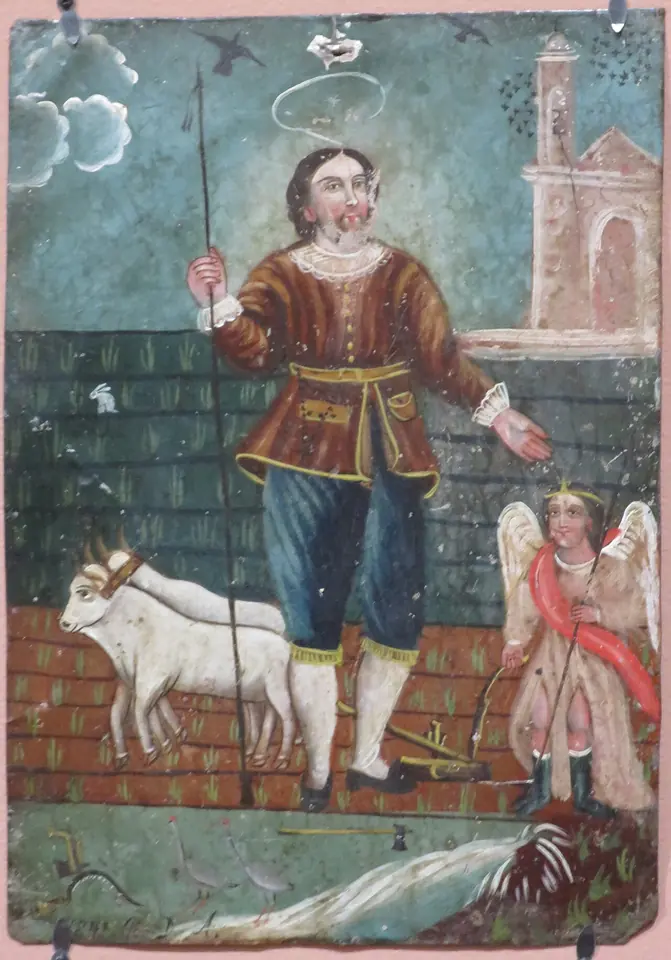
According to the legend, the master found Isidore at prayer while an angel did the plowing for him. Another time he saw an angel plowing on either side of Isidore, so that Isidore did the work of three men. The story is traditional, and it is the one nearly every image of him recalls.
The same old life says Isidore brought his master's dead daughter back to life and made a spring burst from dry ground when the master was thirsty. Both are traditional.
María and the well
Isidore married a young woman named María Torribia. They had one son. The Catholic Encyclopedia tells how the boy fell into a deep well, and at his parents' prayers the water rose to the top and brought him up alive. The couple then vowed to live in continence and lived in separate houses. Their son died young.


Feeding the poor
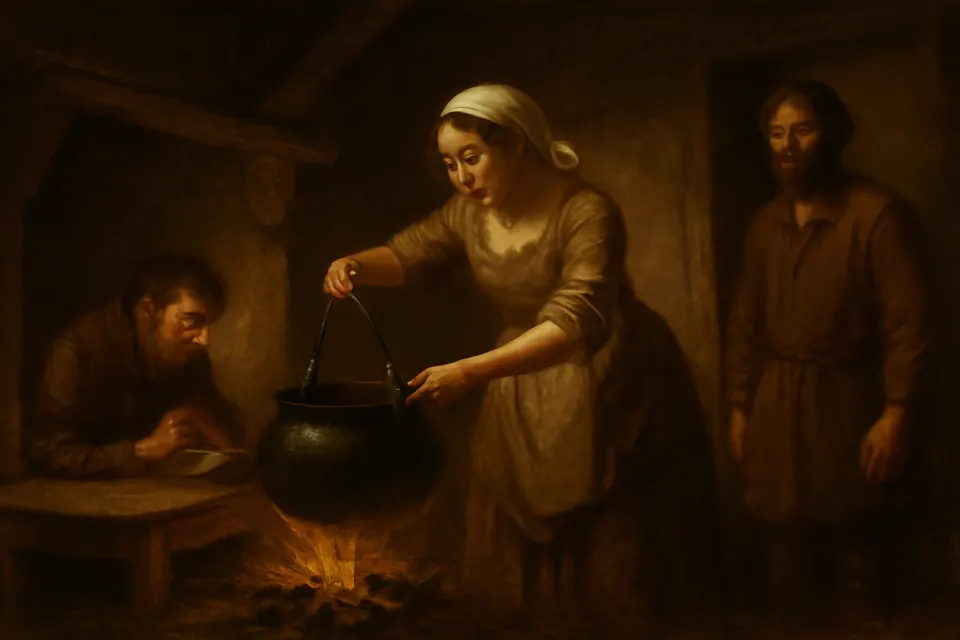
The couple were poor but fed others poorer still. The Catholic Rural Life novena retells a story from Madrid: one Saturday, after María had served all the food in the house, a hungry latecomer arrived. Isidore asked her to look in the kettle again, and she found it "as heavy as if nothing had been taken out of it." The story is traditional.
His wife, Santa María de la Cabeza
María outlived Isidore. In Spain she is called Santa María de la Cabeza, "of the head," because her head was carried in processions to pray for rain in times of drought. She was never formally canonized, as the Catholic Rural Life novena points out, but her cult was approved in the 17th century and she is honored as a saint across the Spanish-speaking world.

Miracles after his death
- His body found incorrupt: traditional. Forty years after his death his body was moved from the cemetery into the church of San Andrés, and the medieval life says it was found intact.
- The way to victory at Las Navas de Tolosa (1212): traditional. The Catholic Encyclopedia says he is said to have appeared to King Alfonso VIII of Castile and shown him a hidden path through the mountains.
- The cure of King Philip III: reported. Philip was cured of a deadly illness after touching the relics, and in thanks gave a costly silver reliquary. His recovery helped push the cause forward.
Gregory XV canonized him on March 12, 1622, in one ceremony with St. Ignatius of Loyola, St. Francis Xavier, St. Teresa of Ávila and St. Philip Neri.
Why St. Isidore is the patron saint of farmers
He was one. The Catholic Encyclopedia calls him "the patron of peasants and day-labourers," and Madrid, León, Zaragoza and Seville took him as patron. In the United States, a decree of the Sacred Congregation of Rites dated February 22, 1947, made him special protector of the National Catholic Rural Life Conference and of American farmers. Farming communities across Spain and Latin America bless fields, seeds and animals on his feast. See the full list on our patron saints page.
Symbols of St. Isidore in art
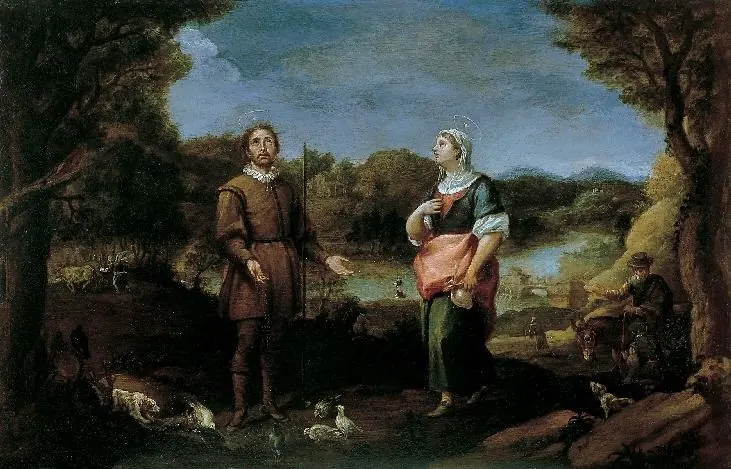
Isidore is a bearded man in the plain clothes of a Spanish farmhand, often with a hat. Look for:
- A plow, goad or spade: his work.
- A yoke of oxen: usually white.
- Angels at the plow: the most common scene, as in the Mexican retablo above.
- A well with a child: the rescue of his son.
- A spring of water: the fountain he made for his master.
- His wife María, often holding a jug or a lamp.
Feast day and the Pradera de San Isidro
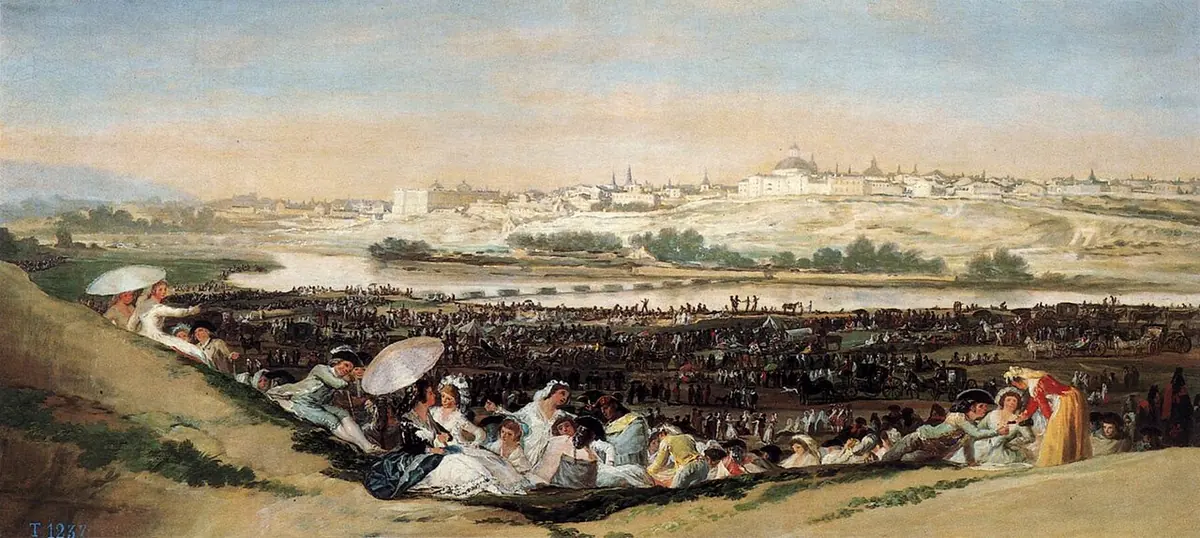
His feast is May 15, Madrid's great city holiday. Crowds gather on the meadow of San Isidro across the Manzanares River, a scene Francisco Goya painted in 1788, and the images of Isidro and María are carried in procession. See his neighbors on our feast days calendar.

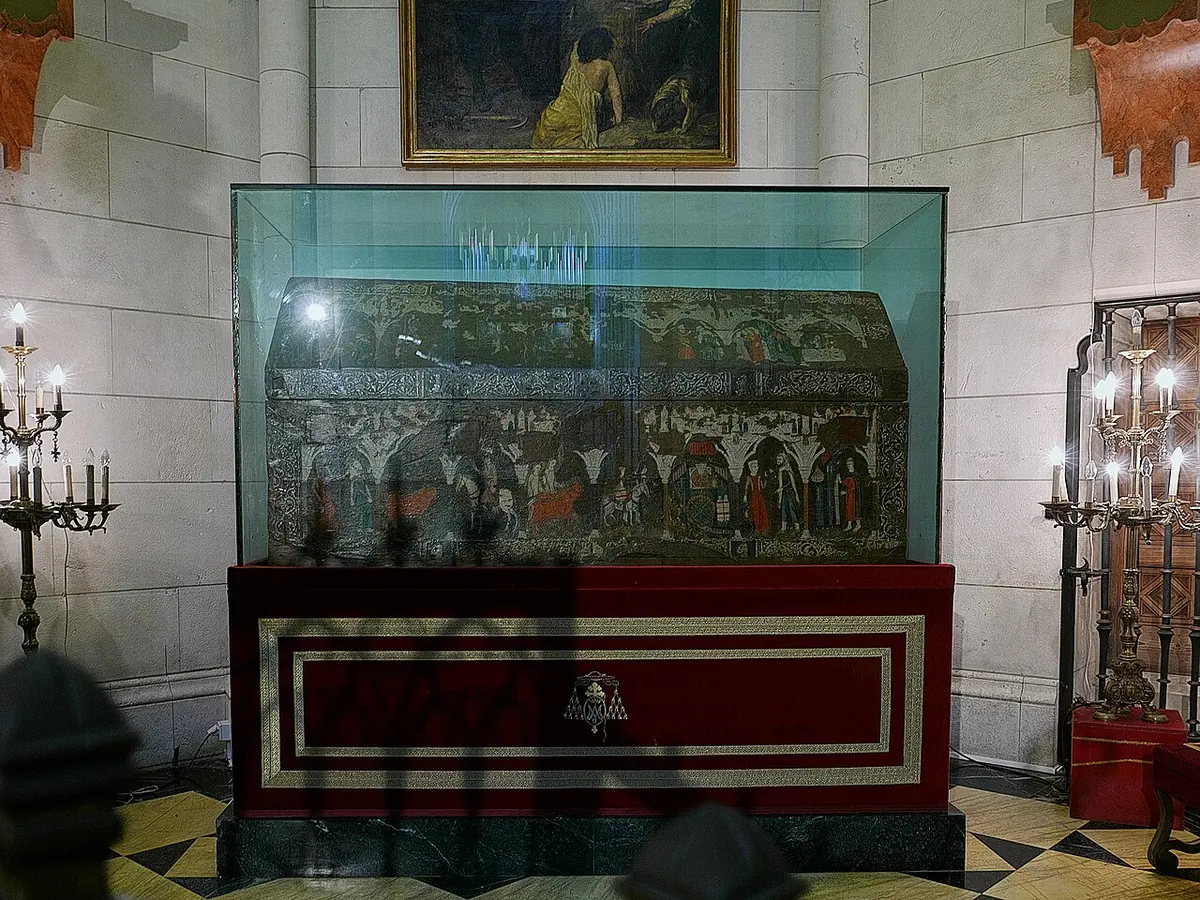
His body lies with María's relics in the Real Colegiata de San Isidro, a Baroque church in central Madrid, where King Charles III had them moved in 1769. The painted wooden coffin that held his body in the Middle Ages, decorated with scenes of his miracles, is now in Madrid's Almudena Cathedral.

Prayer to St. Isidore the Farmer
The National Catholic Rural Life Conference printed this prayer in its novena to St. Isidore, included in The Rural Life Prayerbook (1956):
O God, who taught Adam the simple art of tilling the soil, and who through Jesus Christ, the true vine, revealed Yourself the husbandman of our souls, deign, we pray, through the merits of Blessed Isidore, to instill into our hearts a horror of sin and a love of prayer, so that working the soil in the sweat of our brow, we may enjoy eternal happiness in heaven. Through the same Christ our Lord. Amen.
The same booklet suggests that seeds be blessed in the parish church on his feast or the nearest Sunday.
Frequently asked questions
When is St. Isidore the Farmer's feast day?
May 15, the day he died. It is Madrid's biggest city festival and an optional memorial in the United States. Before the 1969 calendar reform, American Catholics kept it on March 22.
Why is St. Isidore the patron saint of farmers?
He spent his whole working life as a hired hand on a farm near Madrid. The best-known story about him says that angels plowed while he was at Mass, so he is shown with oxen and a plow. In 1947 a Vatican decree made him special protector of the National Catholic Rural Life Conference and American farmers.
Who was St. Isidore's wife?
María Torribia, known in Spain as Santa María de la Cabeza ("of the head") because her head was carried in procession to pray for rain. She was never formally canonized, but her cult was approved in the 17th century and she is honored as a saint in Spanish-speaking countries.
Is St. Isidore the Farmer the same as St. Isidore of Seville?
No. Isidore of Seville was a bishop and Doctor of the Church who died in 636, centuries earlier. The farmer of Madrid is said to have been named after him.