St. Bernardine of Siena
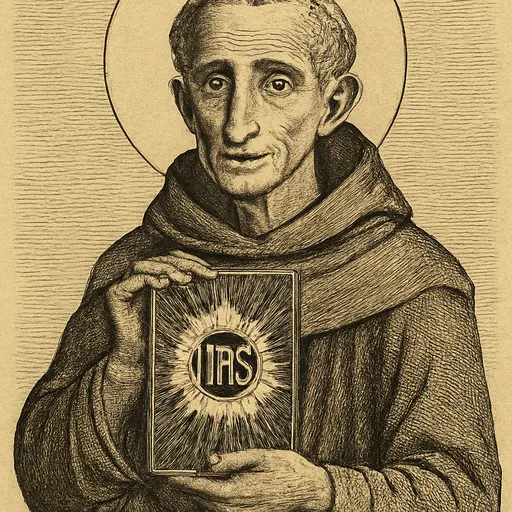
St. Bernardine of Siena (1380–1444) was a Franciscan friar and the most famous preacher in 15th-century Italy. He spread devotion to the Holy Name of Jesus with a painted tablet bearing the letters IHS, and in the 20th century the Vatican named him patron of advertisers. His feast day is May 20.
Who was St. Bernardine of Siena?
Bernardino degli Albizzeschi was born on September 8, 1380, at Massa Marittima, a Sienese town his father governed. Orphaned at six, he was raised by aunts in Siena. In 1400, when plague returned to the city, the twenty-year-old and ten companions took charge of the great hospital of Santa Maria della Scala for four months. The Catholic Encyclopedia (1907) says the work so damaged his health that he never fully recovered.
He gave away his inheritance and joined the Franciscans in 1402, choosing the stricter branch called the Observants. He was ordained in 1404. For about twelve years he lived quietly, and nothing much is recorded. Then, in Milan at the end of 1417, he began to preach, and for the next quarter-century he walked the length of Italy.


The preacher of Italy
Crowds of up to thirty thousand gathered in market squares to hear him, and his sermons often lasted three or four hours. Pope Pius II, who had heard him as a young man, wrote that people listened to him "as another Paul." In 1427 a Sienese fuller named Benedetto took down a whole Lenten series word for word on wax tablets, so we still have forty-five of his sermons in his own lively Tuscan: full of jokes, mimicry and stories from the street.
He preached against gambling, usury, vanity and the feuds between Guelph and Ghibelline factions that kept Italian towns at war. Cities held bonfires of dice, cards and finery after he left, and some wrote his reforms into law. He declined three bishoprics, Siena, Ferrara and Urbino, saying that all Italy was already his diocese. He led the Observant friars in Italy from 1438 to 1442, and their numbers grew, the Catholic Encyclopedia says, from about 130 to more than four thousand.
His sermons had a harsh side too. The historian Franco Mormando's The Preacher's Demons (1999) studies his attacks on three groups, accused witches, Jews and men accused of sodomy, and the real harm that preaching did in the towns he visited.
He died at L'Aquila on May 20, 1444, the eve of the Ascension, while the friars sang the antiphon "Father, I have manifested your name to men." Pope Nicholas V canonized him only six years later, on May 24, 1450.
The IHS and the Holy Name of Jesus
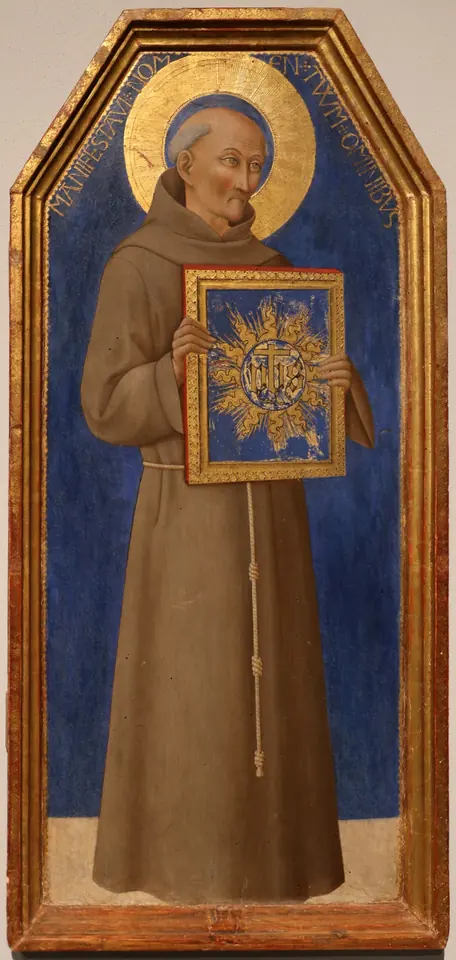
Bernardine's best-known gift to the Church is a picture. While preaching he held up a wooden board painted with the letters IHS, the first letters of Jesus' name in Greek, in gold at the center of a blazing sun, and afterward he let the people venerate it. The Catholic Encyclopedia dates the custom to Volterra in 1424. He urged towns to take down the coats of arms of rival factions from churches and palaces and to put up the Holy Name instead.

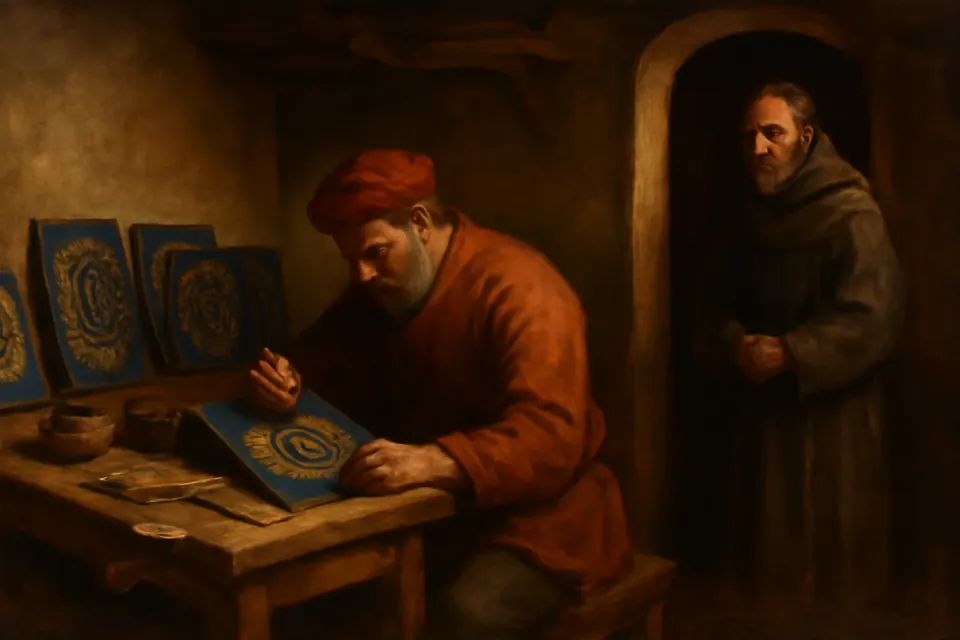
The tablets became so popular that a card painter in Bologna, ruined by Bernardine's sermons against gambling, made a good living by painting them instead. The Catholic Encyclopedia repeats the story; it is traditional.
Not everyone approved. Opponents accused him of a new devotion that risked idolatry, and in 1427 Pope Martin V forbade him to preach until his case was examined. At the trial in St. Peter's, with his disciple St. John of Capistrano defending him, the charges collapsed, and the pope asked him to preach in Rome. The Franciscans later received a feast of the Holy Name, which was extended to the whole Church in 1722 and is kept today on January 3.
Miracles of St. Bernardine
Several lives of Bernardine were written within thirty years of his death, two of them by men who knew him. They record wonders, but none was investigated by modern standards.
- Cures after his death at L'Aquila: reported. The Catholic Encyclopedia says miracles "multiplied," and they were gathered for his canonization in 1450.
- St. Vincent Ferrer's prophecy: traditional. Around 1406 the Dominican is said to have told a crowd at Alessandria that his mantle would pass to someone listening.
- The card painter's fortune: traditional.
Why St. Bernardine is the patron saint of advertisers
According to Time magazine (February 4, 1957), the Vatican's Sacred Congregation of Rites weighed the question for months before naming him patron of advertisers. The IHS tablet is the reason usually given: a single bright image, repeated on every wall, that everyone recognized. He is also a patron of Siena, L'Aquila, Perugia and Massa Marittima. See more on our patron saints page.
Symbols of St. Bernardine in art
Painters began portraying him almost as soon as he died, so his face is unusually consistent.
- The IHS tablet or sun: his main attribute, held in his hands or set on a staff.
- A gaunt, toothless old face: he is almost always shown elderly and thin, a likeness fixed by painters who had seen him, such as Sano di Pietro.
- Three miters on the ground: the three bishoprics he refused, as in El Greco's painting below.
- A Franciscan habit and a pulpit: he is often shown preaching.


Pinturicchio's frescoes in the Bufalini Chapel of Santa Maria in Aracoeli in Rome tell his life, and Agostino di Duccio's carved facade of the Oratory of San Bernardino in Perugia was built by the city in thanks for the peace he preached there.
Feast day and his shrine at L'Aquila
His feast is May 20. Find saints honored nearby on our feast days page. The magistrates of L'Aquila refused to let his body go back to Siena. In 1472 it was moved to a new church built for him, which an earthquake destroyed in 1703. The present basilica, rebuilt afterward, keeps his body in its shrine, and the IHS shines from the center of its dome.


Prayer to St. Bernardine
The collect of his memorial in the Roman Missal reads:
O God, who gave the Priest Saint Bernardine of Siena a great love for the holy Name of Jesus, grant through his merits and prayers, that we may ever be set aflame with the spirit of your love. Through our Lord Jesus Christ, your Son, who lives and reigns with you in the unity of the Holy Spirit, God, for ever and ever.
Catholics who ask his prayers often do so for preachers, for those who work in advertising and communications, and for a deeper love of the name of Jesus.
Frequently asked questions
Why is St. Bernardine the patron saint of advertisers?
In early 1957 the Vatican's Congregation of Rites named him patron of advertising, as Time reported on February 4, 1957. The usual explanation is his IHS tablet, a simple, bright sign he held up while preaching and had copied everywhere, much like a logo.
What does IHS mean?
IHS comes from the first three letters of the name Jesus in Greek (ΙΗΣ). Bernardine painted it in gold within a blazing sun on a blue ground and persuaded cities to put it on their public buildings. In Latin it was later read as Iesus Hominum Salvator, "Jesus, Savior of men."
When is the feast of St. Bernardine of Siena?
May 20, the day he died at L'Aquila in 1444. It is an optional memorial in the General Roman Calendar.
Where is St. Bernardine buried?
In the Basilica of San Bernardino in L'Aquila, in the Abruzzo region of Italy, where his body was moved in 1472.
Sources
- Catholic Encyclopedia (1907): St. Bernardine of Siena
- Time (February 4, 1957): Religion: Saint of the Hard Sell
- Catholic Culture: Optional Memorial of St. Bernardine of Siena, May 20
- Visit Tuscany: San Bernardino, Siena
- Franco Mormando: Bernardino (The Preacher's Demons, University of Chicago Press, 1999)