St. Bede the Venerable
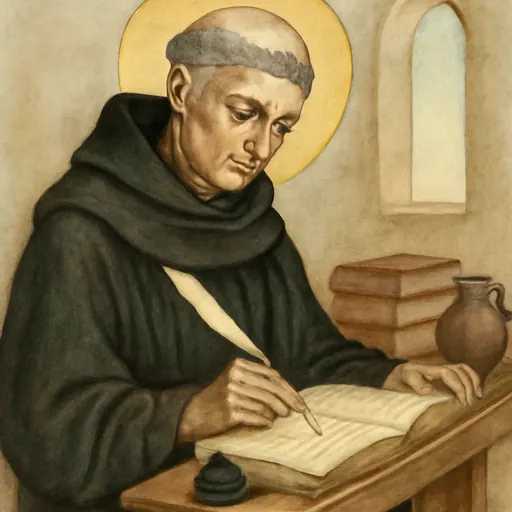
St. Bede the Venerable (about 673–735) was an English monk of the monastery of Wearmouth and Jarrow in Northumbria who wrote the Ecclesiastical History of the English People, the main source for early English history, and made the AD system of dating widely used. He is the only Englishman named a Doctor of the Church. His feast day is May 25, and he is buried in Durham Cathedral.
Who was St. Bede the Venerable?
Bede was an English monk who spent almost his entire life inside one monastery, the twin community of Wearmouth and Jarrow in Northumbria, in the far north of England. From there he wrote about the Bible, grammar, poetry, science and time, and above all the Ecclesiastical History of the English People, finished in 731. Almost everything known about the conversion of the English comes to us through that book.
He also made a habit of dating events "in the year of our Lord," and through his books that system of counting years became the common one in Europe. Pope Leo XIII declared him a Doctor of the Church in 1899, and he is the only English-born Doctor. His feast is May 25.

The sources for his life are unusually good. Bede wrote a short autobiography at the end of the History, and his pupil Cuthbert wrote a detailed letter describing his last days. The quotations below come from A. M. Sellar's translation of the History (1907), which also includes Cuthbert's letter.
The life of St. Bede
A child of the monastery
Bede tells his own story in one long sentence at the end of the History. He was born on the monastery's lands, probably in 672 or 673, and at seven his family handed him over to be raised by the monks:
Having been born in the territory of that same monastery, I was given, by the care of kinsmen, at seven years of age, to be educated by the most reverend Abbot Benedict, and afterwards by Ceolfrid, and spending all the remaining time of my life a dweller in that monastery, I wholly applied myself to the study of Scripture; and amidst the observance of monastic rule, and the daily charge of singing in the church, I always took delight in learning, or teaching, or writing.
Abbot Benedict was Benedict Biscop, the Northumbrian nobleman who founded Wearmouth in 674 and Jarrow a few years later, and who brought back from Rome and Gaul the books that made the library Bede used all his life. Ceolfrid (or Ceolfrith) was the first abbot of Jarrow.
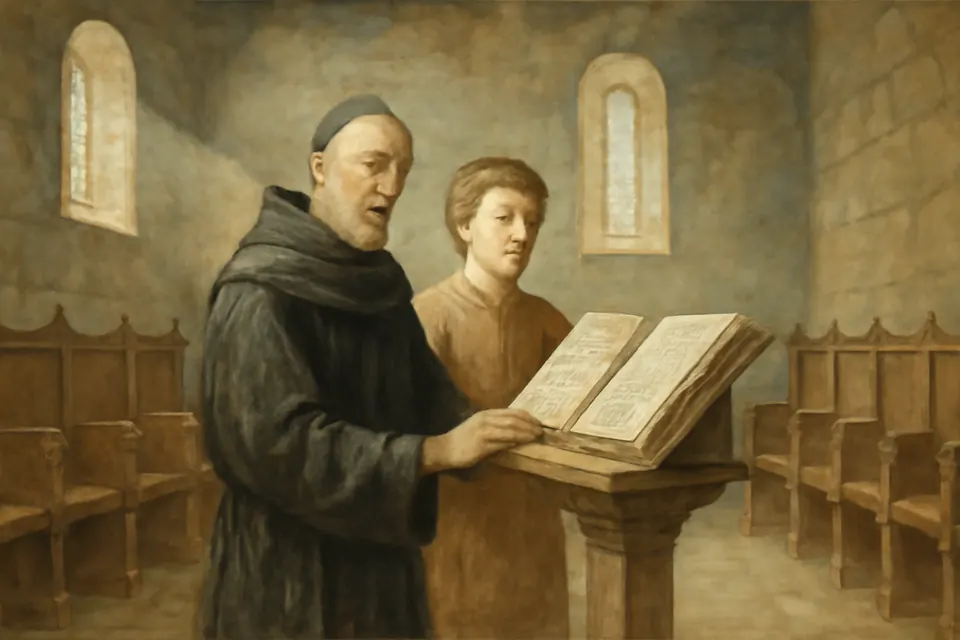
An anonymous history of the abbots tells how plague struck Jarrow in 686 and left Ceolfrid with only one little boy who could sing the office with him. The two of them kept up the full chant until new monks could be trained. The boy is not named, but Sellar notes that he has generally been taken to be Bede.
Deacon, priest and teacher
Bede was ordained deacon "in the nineteenth year of my age" and priest in his thirtieth, both times by Bishop John of Hexham, the saint known as John of Beverley. After that, he wrote, he made it his business "for my own needs and those of my brethren" to compile notes on Scripture "out of the works of the venerable Fathers."
He hardly ever traveled. Sellar finds records of only two short trips, to Lindisfarne and to York. The story that he went to Rome at the pope's request is, in Sellar's words, "highly improbable." The rest of his life was the routine of a monastery: the office sung seven times a day, teaching the young monks, and writing. Alcuin, the great scholar of Charlemagne's court, preserved a saying of his: "I know that angels visit the canonical hours and the congregations of the brethren. What if they do not find me among the brethren? May they not say, 'Where is Bede?'"

The scholar of Jarrow
Bede's list of his own writings at the end of the History runs to some forty works. The Catholic Encyclopedia groups them as commentaries on most of the Bible, about fifty homilies, lives of saints (including two of St. Cuthbert, one in verse and one in prose), textbooks on grammar and poetry, a book on the nature of things, and two books on time, De temporibus and De temporum ratione. He was unusually careful to name his sources and asked copyists to keep his references, something the Catholic Encyclopedia calls a rare sense of "literary property" for his age.
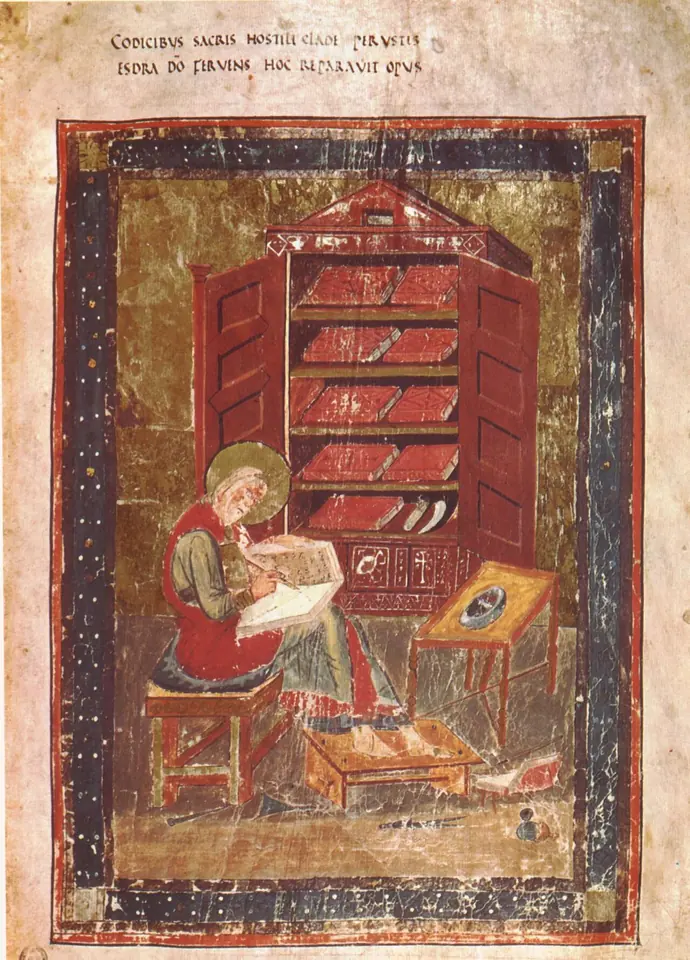
The Wearmouth-Jarrow scriptorium was one of the finest in Europe. In Bede's lifetime it produced three huge one-volume Bibles, one of which, the Codex Amiatinus, Ceolfrid set out to carry to Rome in 716. It survives in Florence and is the oldest complete Latin Bible in existence.

Counting the years
Much of Bede's scholarship was about time: how to calculate the date of Easter, how the sun and moon move, and how to date events. In The Reckoning of Time (725) he explained the calendar and the tides, and in the History he dated events "in the year of our Lord," the system the monk Dionysius Exiguus had devised two centuries earlier. Pope Benedict XVI said in a 2009 audience that Bede's chronology, counted "ab incarnatione Domini," became "the basis of the universal calendar," and that his work on the date of Easter became the reference text for the whole Catholic Church.
The Ecclesiastical History of the English People
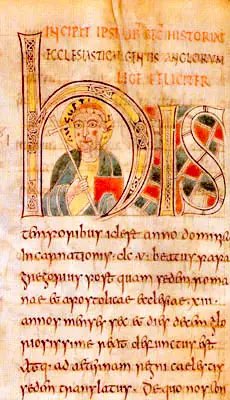
Bede finished the Historia ecclesiastica gentis Anglorum in 731 and dedicated it to Ceolwulf, king of Northumbria. In five books it runs from Julius Caesar's landing in Britain to Bede's own day. It tells of St. Alban, the first martyr of Britain; of Pope Gregory the Great sending Augustine to Kent in 597; of Aidan and the Irish monks of Lindisfarne; of Abbess Hilda of Whitby; and of Cædmon, the cowherd who received the gift of song in a dream (Book IV, chapter 24).
Its best-known passage is the speech of a Northumbrian nobleman to King Edwin, around 627, as the king weighed whether to accept the faith (Book II, chapter 13):
The present life of man upon earth, O king, seems to me, in comparison with that time which is unknown to us, like to the swift flight of a sparrow through the house wherein you sit at supper in winter, with your ealdormen and thegns, while the fire blazes in the midst, and the hall is warmed, but the wintry storms of rain or snow are raging abroad.
The History was translated into Old English in the reign of King Alfred, and the Catholic Encyclopedia calls it the foundation of English history. Sellar points out that Bede took pains over the miracles he reports, seeking first-hand witnesses and naming them.

The death of St. Bede
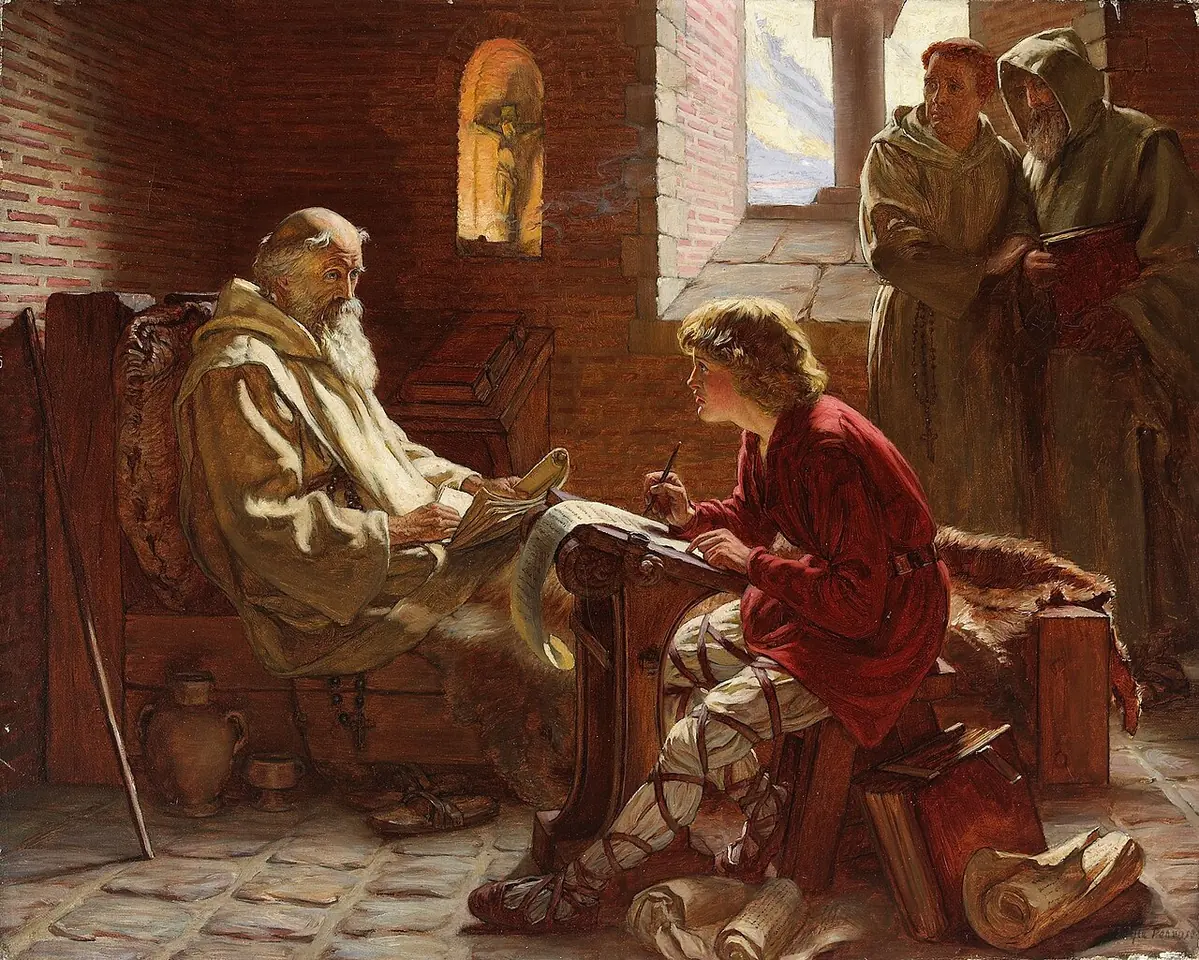
Bede's pupil Cuthbert described his master's last weeks in a letter to a fellow monk, Cuthwin. Bede fell ill with shortness of breath about two weeks before Easter 735 but kept teaching and singing the psalms. He was working on two things: an English translation of the Gospel of John, as far as the words "But what are they among so many?", and extracts from Isidore of Seville, saying, "I would not have my boys read a lie."
On the Wednesday before Ascension Day he dictated all morning, gave his few possessions ("some spices, napkins and incense") to the priests of the monastery, and kept on until evening. Cuthbert's account of the end, in Sellar's translation:
And the aforesaid boy, whose name was Wilbert, still said, 'Dear master, there is yet one sentence not written.' He answered, 'It is well, write it.' Soon after, the boy said, 'Now it is written.' And he said, 'It is well, thou hast said truly, it is finished.'
Bede then asked to be turned toward the place where he used to pray, and on the floor of his cell, singing "Glory be to the Father," he died. Cuthbert dates it to Ascension Day, May 26, 735; by the Church's reckoning the feast began at sunset on the Wednesday, which was May 25.

Miracles and legends of St. Bede
Bede is honored for his learning and holiness, not for wonders. No miracle in his cause was ever formally investigated, since he lived long before the modern process existed.
- The deathbed scene is history, not legend: it rests on the eyewitness letter of Cuthbert.
- The angel and the epitaph (traditional): a later story says that a monk composing Bede's epitaph got as far as "Hac sunt in fossa Bedae ... ossa" and could not find the missing word; next morning an angel had written "venerabilis." The Catholic Encyclopedia says no early writer supports it.
Why St. Bede is a patron of historians and scholars
No decree made Bede a patron of anything. Catholics and Anglicans regard him as a patron of historians, because of the History, and of writers, scholars and students, because he spent his life "learning, or teaching, or writing." English Catholics especially honor him as a father of English letters. See the full list on our patron saints page.
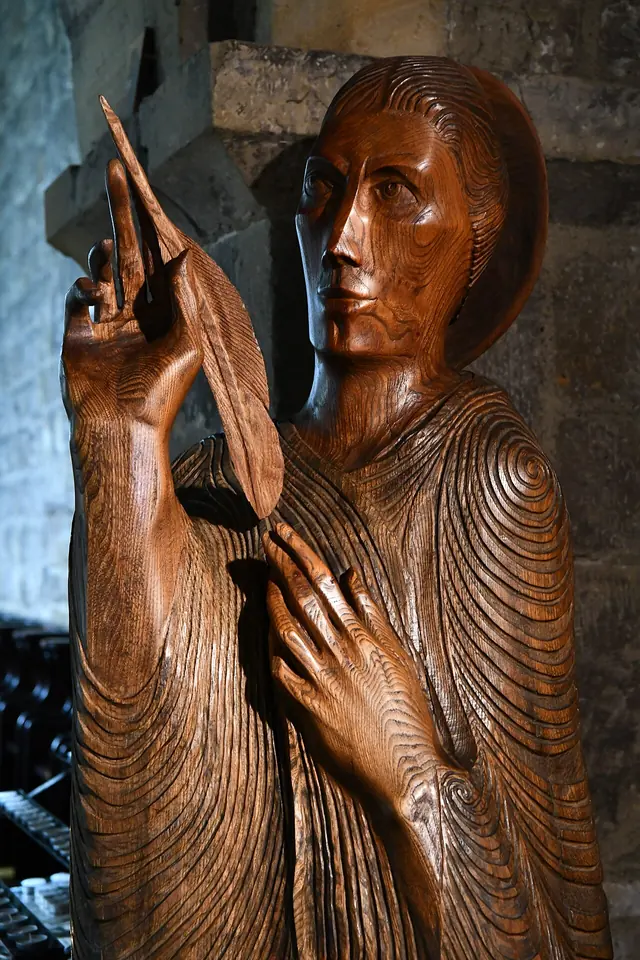

Symbols of St. Bede in art
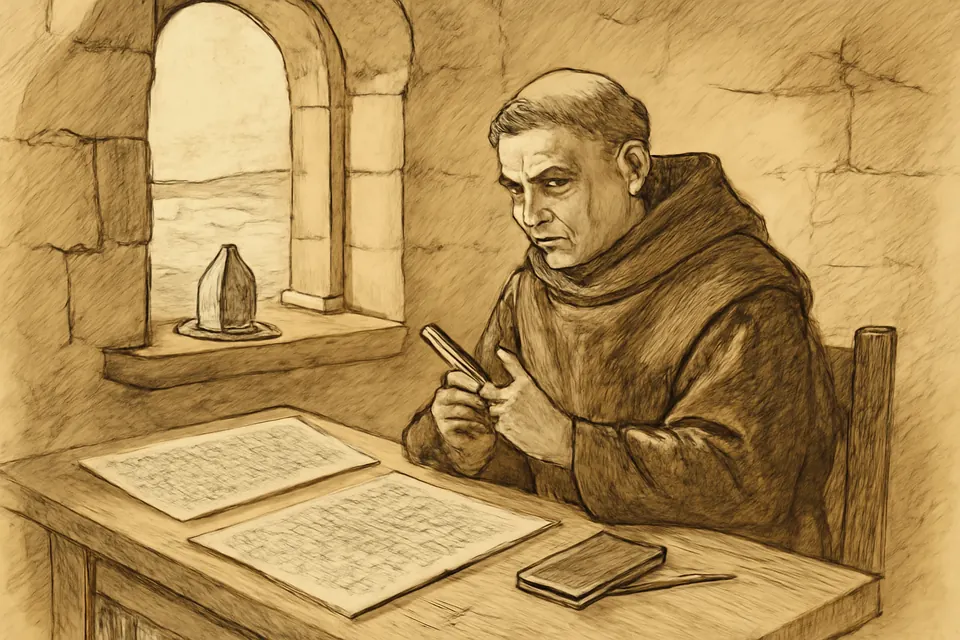
Bede is usually shown as an older monk in a black habit, the dress later artists gave to Benedictine monks. To recognize him, look for:
- A book or open manuscript: the most common attribute, for his writings.
- A pen or quill and a writing desk: often with a young monk taking dictation, after Cuthbert's letter, as in Penrose's The Last Chapter.
- The habit and tonsure of a monk: he was never a bishop or abbot, so he has no miter or crozier.
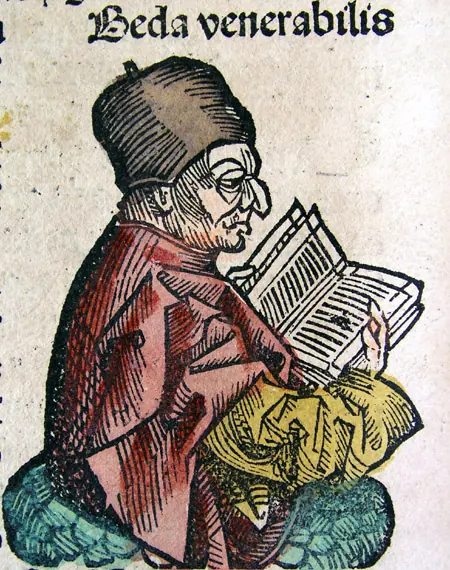
The Nuremberg Chronicle woodcut at the top of this page simply shows a scholar reading. Modern images, like Fenwick Lawson's carving at Jarrow, often give him a quill.
Feast day, tomb and places to visit
Bede's feast is May 25, an optional memorial in the General Roman Calendar since 1969. When Pope Leo XIII made him a Doctor of the Church on November 13, 1899, his feast was set on May 27. See his neighbors on the feast days page.
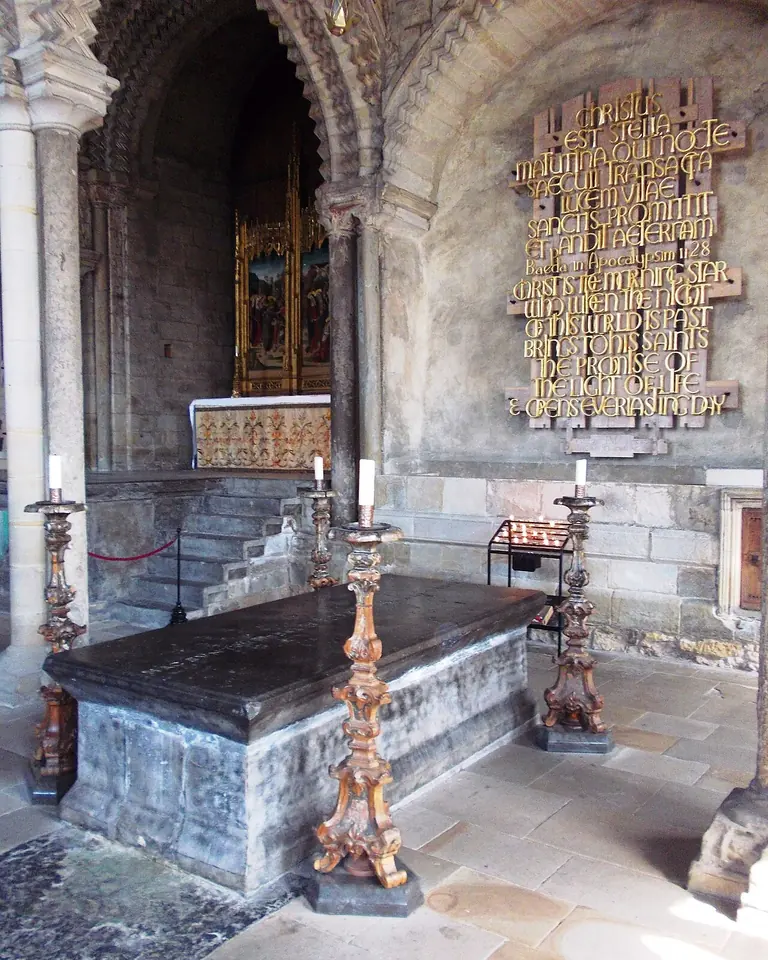
He was buried at Jarrow. In 1022 a monk named Alfred brought his bones to Durham, where they were placed beside the relics of St. Cuthbert. Around 1370 they were moved to the Galilee Chapel, the Romanesque Lady Chapel at the west end of the cathedral. The plain tomb chest is inscribed "Hic sunt in fossa Bedae Venerabilis ossa," and the gilded text on the wall behind it, designed in 1971, quotes Bede's commentary on Revelation about "Christ the morning star."

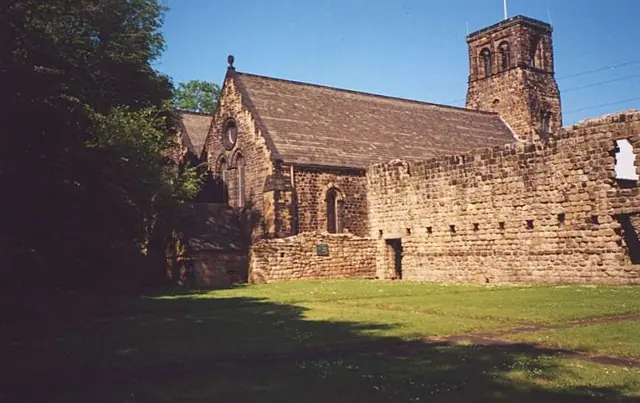
At Jarrow, St. Paul's Church still stands on the site of his monastery, beside the ruins of the medieval buildings, and a museum nearby, Jarrow Hall, tells the story of Anglo-Saxon Northumbria.


Prayer to St. Bede
The Collect of his memorial in the Roman Missal (English translation, 2011, as published by Catholic Culture):
O God, who bring light to your Church through the learning of the Priest Saint Bede, mercifully grant that your servants may always be enlightened by his wisdom and helped by his merits. Through our Lord Jesus Christ, your Son, who lives and reigns with you in the unity of the Holy Spirit, God, for ever and ever.
Bede's own prayer, which closes the Ecclesiastical History, is often used on his feast. In Sellar's translation:
And I beseech Thee, good Jesus, that to whom Thou hast graciously granted sweetly to drink in the words of Thy knowledge, Thou wilt also vouchsafe in Thy loving-kindness that he may one day come to Thee, the Fountain of all wisdom, and appear for ever before Thy face.
Frequently asked questions
Why is Bede called "the Venerable"?
The title was a mark of respect given to him soon after his death. The Catholic Encyclopedia notes that writers such as Alcuin and Paul the Deacon used it, and the Council of Aachen in 835 called him "venerabilis." A later legend says a monk writing his epitaph could not finish the line and an angel filled in the word "venerabilis" overnight, but the Catholic Encyclopedia says there is no early authority for that story.
When is St. Bede's feast day?
May 25, an optional memorial in the General Roman Calendar. From 1899 to 1969 it was kept on May 27. Bede died on the evening of May 25, 735, which his disciple Cuthbert counted as Ascension Day, May 26, since the feast began at sunset.
Did Bede invent AD dating?
No. The system of counting years from the Incarnation was worked out by the monk Dionysius Exiguus in the 6th century. Bede used it throughout his Ecclesiastical History and his books on time, and his influence made it standard. Pope Benedict XVI said that Bede's chronology, dated "ab incarnatione Domini," became the basis of the universal calendar.
What is Bede the patron saint of?
Bede is popularly regarded as a patron of historians, writers and scholars, and of English students, because of his life of study and teaching. No formal decree named these patronages.
Where is St. Bede buried?
In the Galilee Chapel at the west end of Durham Cathedral in northern England. His bones were taken there from Jarrow in 1022 and moved to the Galilee Chapel around 1370. The Latin inscription on the tomb reads "Hic sunt in fossa Bedae Venerabilis ossa," "Here are buried the bones of the Venerable Bede."
Sources
- Catholic Encyclopedia (1907): The Venerable Bede
- Bede, Ecclesiastical History of England, translated by A. M. Sellar (1907), with the letter of Cuthbert on Bede's death (Project Gutenberg)
- Pope Benedict XVI, General Audience of 18 February 2009: Bede, the Venerable
- Durham Cathedral: Buildings and grounds (the Galilee Chapel)
- Durham World Heritage Site: The Venerable Bede
- Catholic Culture: Liturgical calendar for May 25 (Collect of St. Bede)
- Roman Martyrology, May 25