St. Mary Magdalene

St. Mary Magdalene was a woman from Magdala in Galilee whom Jesus freed from seven demons, who followed him and supported his ministry, stood at the foot of the Cross and was the first to see him risen from the dead. Because Jesus sent her to tell the other disciples, she is called the apostle to the apostles. Her feast day is July 22, raised to the rank of a feast by Pope Francis in 2016.
Who was St. Mary Magdalene?
Mary Magdalene is one of the few women the Gospels name again and again, and the only one who appears at every turn of the Easter story. Jesus freed her from seven demons. She followed him through Galilee with other women who paid for the group's needs out of their own money. She stood near the Cross, saw where his body was laid and came back to the tomb on Sunday morning. According to the Gospel of John, she was the first person to see the risen Jesus, and he sent her to tell the others.
Her name means "Mary of Magdala," a town on the western shore of the Sea of Galilee.


For most of Western history she was also remembered as a repentant prostitute, an idea the Gospels never state. Both the woman of the Gospels and the woman of later legend are described below.
Mary Magdalene in the Gospels
A disciple from Galilee
Luke introduces her during Jesus' preaching tour of Galilee. With the Twelve went "some women who had been healed of evil spirits and infirmities: Mary, called Magdalene, from whom seven demons had gone out, and Joanna, the wife of Chuza, Herod's steward, and Susanna, and many others, who provided for them out of their means" (Luke 8:2–3, RSV). The longer ending of Mark repeats the detail of the seven demons (Mark 16:9). Nothing in either passage says what her trouble was, and nothing ties it to sexual sin.
At the Cross and the tomb
All four Gospels place her at the crucifixion (Matthew 27:56, Mark 15:40, Luke 23:49, John 19:25). John puts her beside the Cross with the mother of Jesus and the beloved disciple, St. John. Matthew and Mark say she watched Joseph of Arimathea lay the body in the tomb and roll a stone across the door.


"I have seen the Lord"
On the first day of the week, John says, Mary Magdalene came to the tomb "while it was still dark" and found the stone rolled away. She ran to tell Peter and the beloved disciple, who came, saw the empty grave clothes and went home. She stayed, weeping, and mistook the risen Jesus for the gardener until he spoke her name:
Jesus said to her, "Mary." She turned and said to him in Hebrew, "Rab-bo′ni!" (which means Teacher). Jesus said to her, "Do not hold me, for I have not yet ascended to the Father; but go to my brethren and say to them, I am ascending to my Father and your Father, to my God and your God." Mary Mag′dalene went and said to the disciples, "I have seen the Lord"; and she told them that he had said these things to her. (John 20:16–18, RSV)
The Latin for "Do not hold me," Noli me tangere, became the title of countless paintings.
Apostle to the apostles
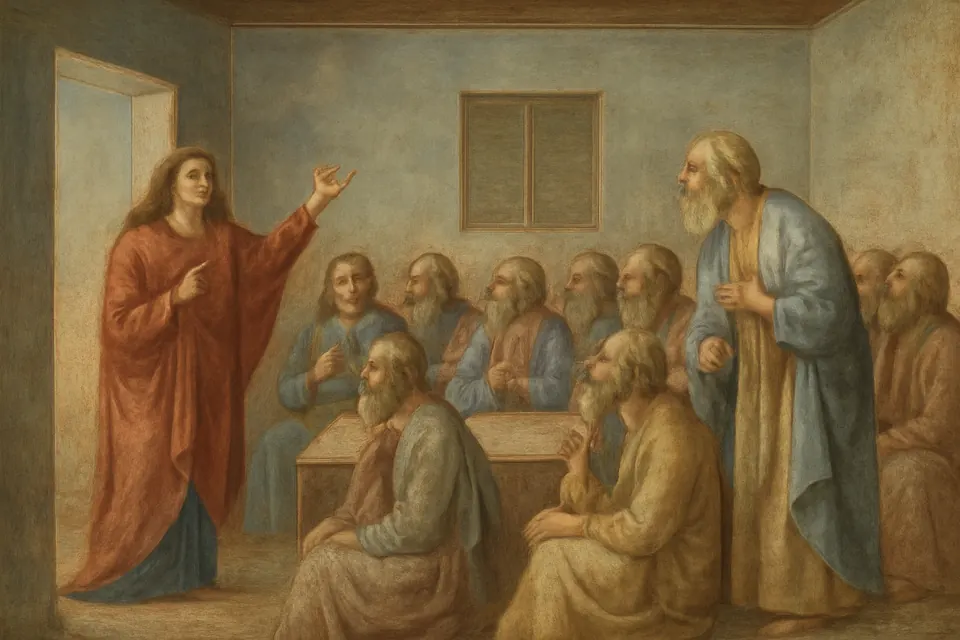
Because Jesus sent her with the Easter message to the men who would carry it to the world, writers called her apostolorum apostola, the apostle to the apostles. Archbishop Arthur Roche of the Vatican's Congregation for Divine Worship traced the title to Rabanus Maurus and to St. Thomas Aquinas, who used it in his commentary on John.
On June 3, 2016, at the express wish of Pope Francis, the Congregation issued a decree raising her celebration on July 22 from a memorial to a feast, the same rank the apostles have in the General Roman Calendar. Roche wrote that it was "right that the liturgical celebration of this woman should have the same rank of Feast as that given to the celebration of the Apostles." The Mass of the day received a new preface titled "Apostle of the Apostles."
The "sinful woman": Gregory the Great and the correction
The Gospels mention three women whose stories later ran together: Mary Magdalene; the unnamed "woman of the city, who was a sinner" who washed Jesus' feet with her tears and dried them with her hair (Luke 7:36–50); and Mary of Bethany, sister of Martha and Lazarus, who anointed Jesus before his Passion (John 12:1–8).
In a sermon preached in Rome, traditionally dated to 591, Pope Gregory the Great taught that the three were one woman. The Vatican's own 2016 commentary on the new preface says plainly that "western tradition following the interpretation of Saint Gregory the Great has generally united in one person Mary of Magdala, the penitent woman forgiven by Jesus and Mary of Bethany." That reading gave the West its weeping, long-haired penitent with a jar of perfume.
The Greek Fathers, the Catholic Encyclopedia admits, kept the three apart, and the Orthodox Church still does. In the West, Bollandist scholars studied the question, and the calendar reform that followed the Second Vatican Council rewrote the Missal, the Liturgy of the Hours and the Martyrology so that July 22 refers only to Mary of Magdala.
The Church never issued a statement that she "was not a prostitute"; it simply stopped saying so. Popular devotion and art kept the penitent image.

After the Resurrection: two traditions
The New Testament says nothing more about her after Easter. Two traditions fill the gap.
Ephesus and the red egg
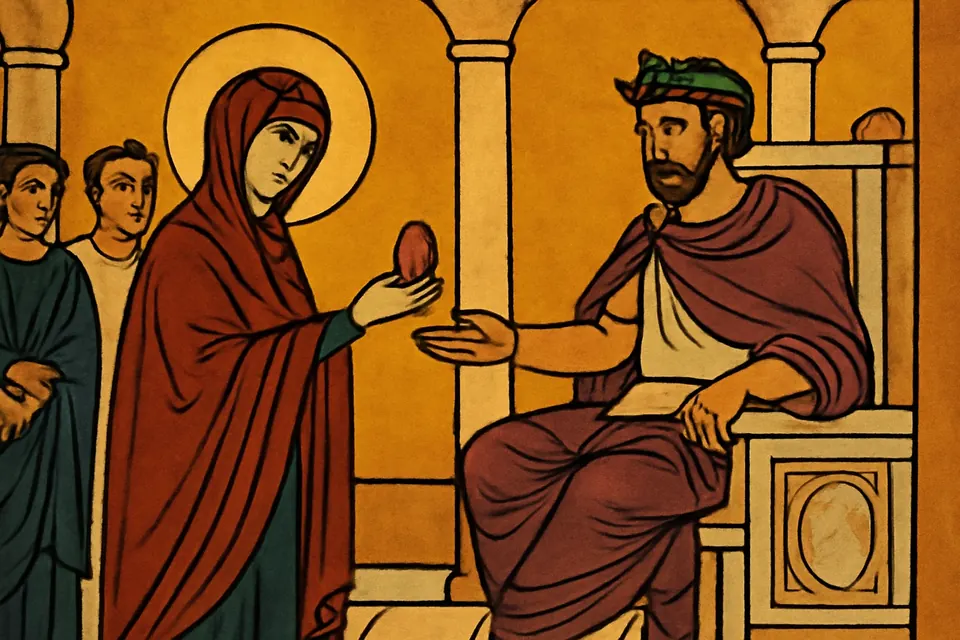
Eastern tradition, which Gregory of Tours also knew, says she went with the Virgin Mary and St. John to Ephesus, died there, and that her relics were moved to Constantinople in the 9th century. The Orthodox Church in America adds that she first preached in Rome and appeared before the Emperor Tiberius. "According to Tradition, she brought him a red egg as a symbol of the Resurrection, a symbol of new life with the words: 'Christ is Risen!'" The OCA connects the Easter custom of red eggs with this story.
Provence, La Sainte-Baume and Saint-Maximin
A French tradition, which the Catholic Encyclopedia reports, says Mary, Lazarus and companions landed at Marseilles and converted Provence. Mary withdrew to a cave in the mountains, La Sainte-Baume, and lived there in penance for thirty years. At her death, the legend says, angels carried her to the oratory of St. Maximinus near Aix, where she received Communion and was buried.


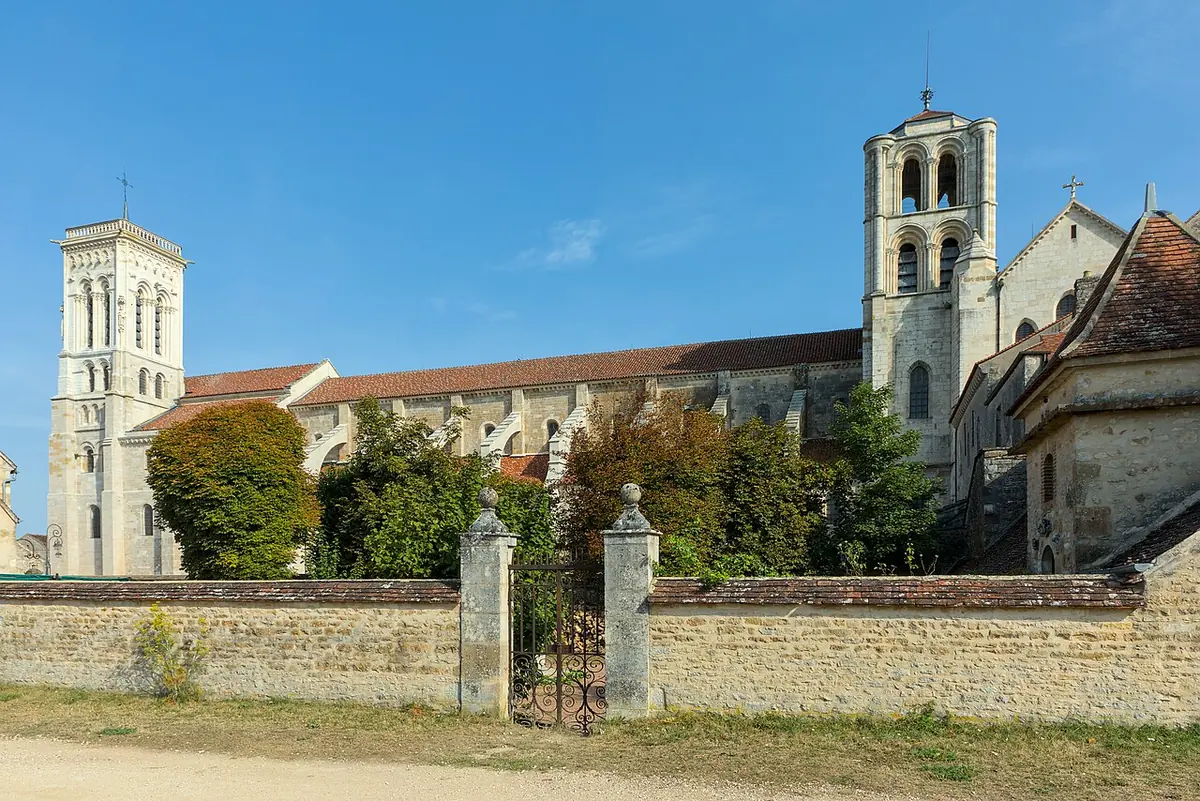
The chronicler Sigebert wrote that in 745 her body was taken north to Vézelay in Burgundy for fear of Saracen raids, and Vézelay's great Romanesque church was built for her cult. Then in 1279 Charles of Salerno, later King Charles II of Naples, had the crypt at Saint-Maximin opened, and the shrine was reported "found intact, with an inscription stating why they were hidden." In 1600 Pope Clement VIII sent a sarcophagus for the relics, and the head was placed in a separate reliquary.
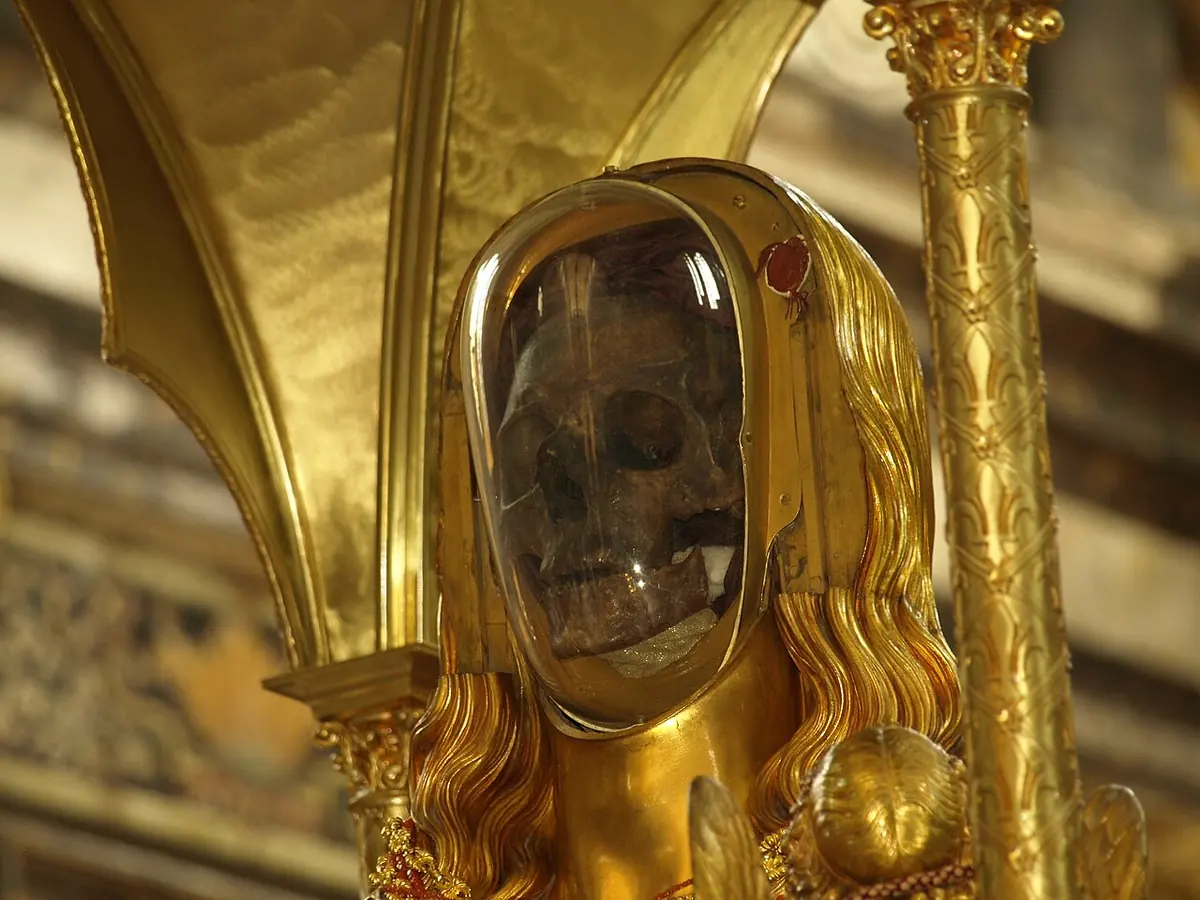

These claims are traditional and cannot be proven, and they contradict the Eastern tradition that she died and was buried at Ephesus. The Catholic Encyclopedia notes that the head at Saint-Maximin has been "the centre of so many pilgrimages."

The miracles of St. Mary Magdalene
No miracle worked through Mary Magdalene has been approved in the modern sense; her cult is far older than formal canonization. The stories are:
- Gospel account: her deliverance from seven demons by Jesus (Luke 8:2). This is a miracle of Christ, not one she worked.
- Traditional: the egg that turned red before Tiberius, in some tellings of the Orthodox story.
- Traditional: her thirty years of penance at La Sainte-Baume and her death, when, the Provençal legend says, angels carried her to the oratory of St. Maximinus.
- Reported: cures claimed by pilgrims at Saint-Maximin, Sainte-Baume and Vézelay, never formally examined.
Why St. Mary Magdalene is the patron saint of penitents
Penitents and converts claim her because the West long read her story as the great example of a sinner forgiven. Perfumers and pharmacists, who once made ointments, claim her because of the alabaster jar of the anointing. Hairdressers take her because the woman of Luke 7 dried Jesus' feet with her hair. These are popular, traditional patronages. See all the patron saints by cause.
Symbols of St. Mary Magdalene in art
She is one of the easiest saints to recognize once you know the clues:
- An alabaster jar of ointment: her most common attribute, from the anointing stories and the spices she brought to the tomb.
- Long loose hair: from the woman who dried Jesus' feet with her hair. Women in art usually cover their hair; she often does not.
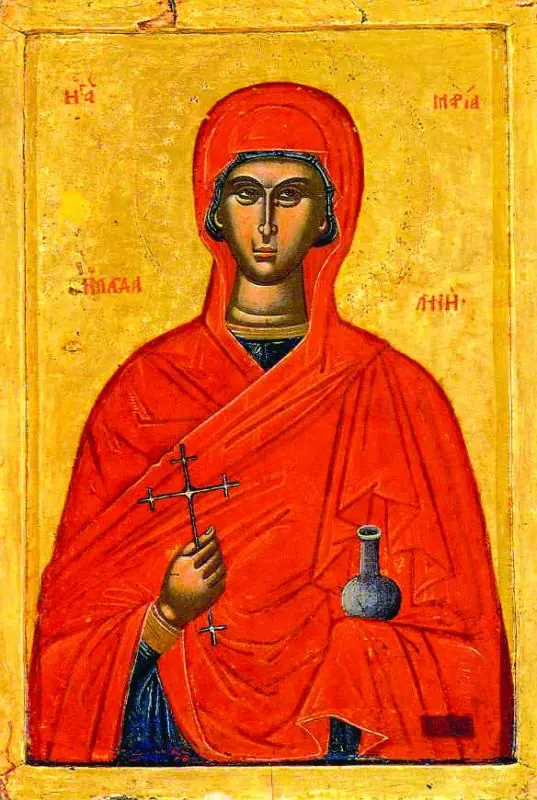
- A red cloak: common in both Western painting and Orthodox icons.
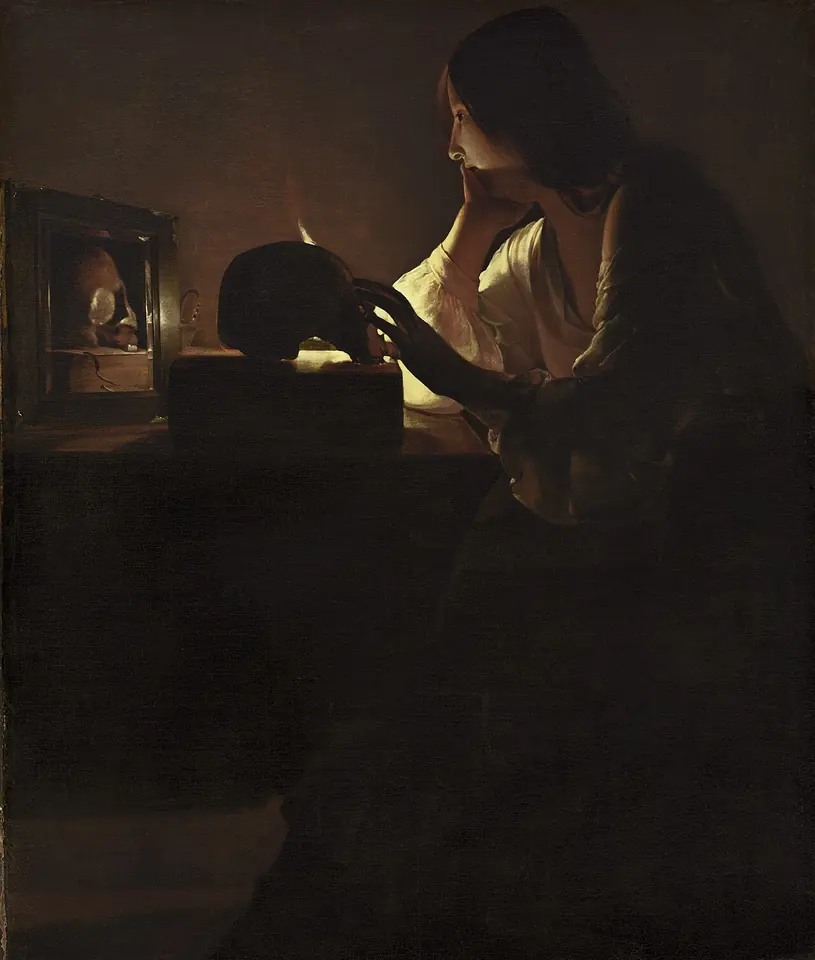
- A skull, a candle or a book: signs of the penitent in her cave, as in Georges de La Tour's candlelit paintings.
- Kneeling at the foot of the Cross: in crucifixion scenes she is usually the woman clinging to the base of the Cross.
- A red egg: in Orthodox icons, from the Tiberius story.

Orthodox icons show her as one of the women carrying spices to the tomb.


Feast day and where she is honored
The Catholic Church keeps her feast on July 22. The Orthodox Church honors her as "Myrrhbearer and Equal of the Apostles" on the same day, and again on the Sunday of the Myrrhbearing Women, two weeks after Pascha, with the Virgin Mary, Martha and Mary of Bethany, Joanna, Salome and Joseph of Arimathea. See the feast day calendar.


The main pilgrim sites are the grotto of La Sainte-Baume and the basilica at Saint-Maximin in Provence, where King Charles II of Naples founded a Dominican convent in 1279, and the hilltop basilica of Vézelay in Burgundy.
Prayer to St. Mary Magdalene
The Church's own prayer for her feast is the preface "Apostle of the Apostles," added to the Roman Missal in 2016. The Congregation for Divine Worship published this unofficial English translation:
It is truly right and just, our duty and our salvation, to glorify you in all things, almighty Father, whose mercy is no less than your power, through Christ our Lord. He appeared in the garden and revealed himself to Mary Magdalene, for she had loved him while he was alive, seen him dying on the Cross, sought him as he lay in the tomb, and was the first to adore him newly risen from the dead. He honoured her with the task of being Apostle to the Apostles, so that the good news of new life might reach the ends of the earth.
Outside the Mass, Catholics ask her prayers in repentance and grief. No other traditional prayer to her has a citable origin.
Frequently asked questions
Why is Mary Magdalene called the apostle to the apostles?
Because the risen Jesus sent her to bring the news of his Resurrection to the disciples (John 20:17–18). Rabanus Maurus and St. Thomas Aquinas called her apostolorum apostola, and in 2016 the Vatican gave her July 22 celebration the same rank as the feasts of the apostles, with a new preface titled "Apostle of the Apostles."
Was Mary Magdalene a prostitute?
The Gospels never say so. They say only that seven demons had gone out of her (Luke 8:2). The idea came from Pope Gregory the Great, who preached that she was the same person as the unnamed sinful woman of Luke 7 and Mary of Bethany. The Catholic calendar reform after the Second Vatican Council stopped treating the three women as one in the liturgy, and the Orthodox Church never joined them.
When is St. Mary Magdalene's feast day?
July 22 in both the Catholic and Orthodox calendars. In the Catholic Church it was a memorial until June 3, 2016, when a decree issued at Pope Francis's wish made it a feast. The Orthodox Church honors her again on the Sunday of the Myrrhbearing Women, the third Sunday of Pascha.
Where are Mary Magdalene's relics?
The Basilica of Saint-Maximin-la-Sainte-Baume in Provence keeps a skull venerated as hers, in a golden reliquary. Vézelay in Burgundy claimed her body in the Middle Ages, and Orthodox tradition says her relics went from Ephesus to Constantinople and later to Rome. None of these claims can be proven.
Why is Mary Magdalene shown with a red egg?
An Orthodox tradition says she went to Rome, appeared before the Emperor Tiberius and gave him a red egg with the words "Christ is risen!" Orthodox icons often show her holding the egg, and Orthodox Christians exchange red eggs at Pascha.
Sources
- Catholic Encyclopedia (1910): St. Mary Magdalen
- Arthur Roche, Apostle of the Apostles (Congregation for Divine Worship, 2016)
- The New Preface of Saint Mary Magdalene (Congregation for Divine Worship, 2016)
- Holy See Press Office: The liturgical memory of Mary Magdalene becomes a feast, like that of the other apostles (June 10, 2016)
- Bible Gateway: John 20:1-18 (RSV Catholic Edition)
- Bible Gateway: Luke 8:1-3 (RSV Catholic Edition)
- Orthodox Church in America: Myrrhbearer and Equal of the Apostles Mary Magdalene
- Orthodox Church in America: Sunday of the Holy Myrrhbearing Women with the Noble Joseph
- Gregory the Great, Homilies on the Gospels, Homily 33
- Roman Martyrology, July 22