St. Veronica and the Veil of the Holy Face
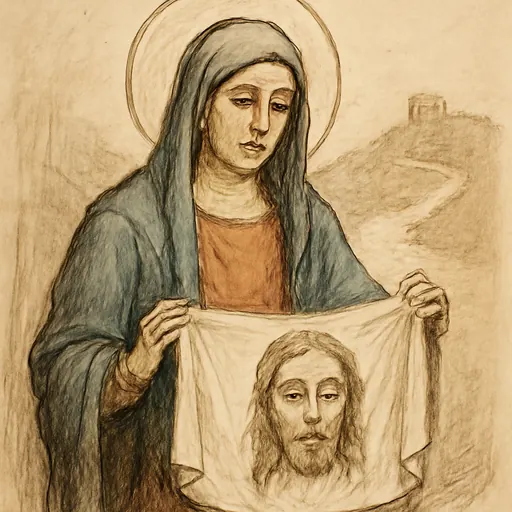
St. Veronica is the woman who, by Christian tradition, wiped the face of Jesus with her veil as he carried his cross, and found his image left on the cloth. She does not appear in the Bible; her story is a legend that grew in the Middle Ages, and her name likely comes from vera icon, "true image." She is remembered at the Sixth Station of the Cross, and popular calendars keep her feast on July 12.
Who was St. Veronica?
Veronica is the woman of the Sixth Station of the Cross. In the familiar story, she pushed through the crowd as Jesus carried his cross toward Calvary, wiped the sweat and blood from his face with her veil, and found his features printed on the cloth.
It is also a story with no basis in the Gospels. The Catholic Encyclopedia, written by Catholic scholars in 1912, says plainly that the traditions about her "cannot be documented." Its explanation of her name is striking: a famous cloth image of Christ in Rome was called the vera icon, the "true image," and over time "popular imagination mistook this word for the name of a person." The cloth came first; the woman, as we know her, grew out of it.
That doesn't make her devotion empty. The same article adds that there is "no reason why the belief that such an act of compassion did occur" should not be honored in the person called Veronica. Luke's Gospel does say that "a great company of people, and of women," followed Jesus to the cross, mourning for him (Luke 23:27, King James Version). Tradition gave one of them a face and a name.

How the legend of Veronica grew
A woman named in the apocrypha
The name first attaches to a different Gospel woman. In one Greek form of the Gospel of Nicodemus, also called the Acts of Pilate, which the Ante-Nicene Fathers edition dates anywhere from about 150 to 400, witnesses defend Jesus before Pilate. "There was found there also a woman named Veronica," it says, "and she said: Twelve years I was in an issue of blood, and I only touched the edge of his garment, and directly I was cured." That is the woman healed in Matthew 9:20–22, who has no name in Scripture. Other versions call her Bernice or Berenice.
The healing of Tiberius
A later Latin legend, The Death of Pilate, tells a fuller story. Its date is unknown, and the translators of the Ante-Nicene Fathers call it late. The emperor Tiberius is ill and sends a messenger to find the healer of Judea. The messenger meets "a certain woman named Veronica, who had been a friend of Jesus." She tells him she once wanted a painted portrait of her Lord, and that Jesus met her on her way to the painter, took her cloth, "and gave it back to me impressed with the image of His venerable face." She goes to Rome, Tiberius looks on the image, and he is healed.
In this early form, the image comes from Jesus' ministry, not from the road to Calvary. The scene on the way of the cross is a later development.

The Veronica of Rome
By the high Middle Ages Rome kept a cloth image of Christ's face at St. Peter's, and the Catholic Encyclopedia cites medieval writers who called it simply "the Veronica," including the English chronicler Matthew of Westminster, who wrote of the image of the Lord's face that is called Veronica. Pilgrims came in crowds to see it shown. Dante, writing in the early 1300s, compared his own wonder in heaven to that of a pilgrim from far-off Croatia, in Longfellow's translation:
As he who peradventure from Croatia
Cometh to gaze at our Veronica,
Who through its ancient fame is never sated,
Copies of the Holy Face, called vernicles, spread across Europe. Local legends multiplied too. The Catholic Encyclopedia notes that in France Veronica was married to Zacchaeus and sailed to Gaul, and that her tomb was venerated at Soulac or at the church of Saint-Seurin in Bordeaux. In Italy she stayed in Rome and left the image to Pope Clement.
Veronica and the Sixth Station of the Cross
The Stations of the Cross took their present form of fourteen stations only in the 1600s and 1700s. In the Catholic Encyclopedia's account, the Veronica scene "does not occur in many of the earlier accounts," and most of the older lists that include it place it just before Calvary rather than in the middle of the journey. Today it is the Sixth Station, "Veronica wipes the face of Jesus," between Simon of Cyrene taking up the cross and Jesus' second fall.


For most Catholics, this station is where they meet Veronica. On the Fridays of Lent and on Good Friday, parishes pray the stations, and at the sixth they stop to remember a stranger's kindness to Jesus in his suffering.
The miracles and legends of St. Veronica
Because her life is known only through legend, no miracle connected with Veronica has been investigated by the Church.
- The image on the cloth: traditional. It is the center of her story, told first in medieval legends and accepted in popular devotion. The Church honors the relic in Rome but has never declared it to be a miraculous image.
- The healing of the emperor Tiberius: traditional, from the apocryphal Death of Pilate.
- Healing of the woman with the issue of blood: this is a Gospel miracle (Matthew 9:20–22), but identifying that woman with Veronica comes from the apocryphal Acts of Pilate and is traditional.
- Graces received before the Holy Face in Rome and Manoppello: reported by pilgrims over the centuries; none has been formally examined.
Why St. Veronica is a patron saint
Her patronages all come from the cloth. Catholic Culture lists laundry workers, linen weavers and seamstresses, who work with fabric as she did, and photographers, because a likeness was fixed on her veil the way an image is fixed on film. It also lists domestic workers and people who suffer from bleeding, the second from her identification with the woman with the issue of blood. See more on our patron saints page.
Symbols of St. Veronica in art
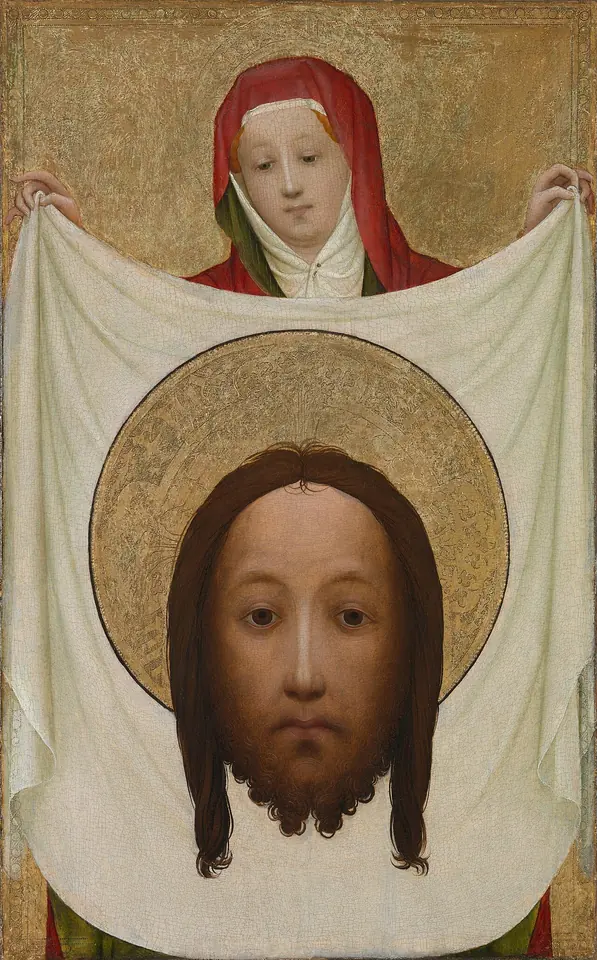
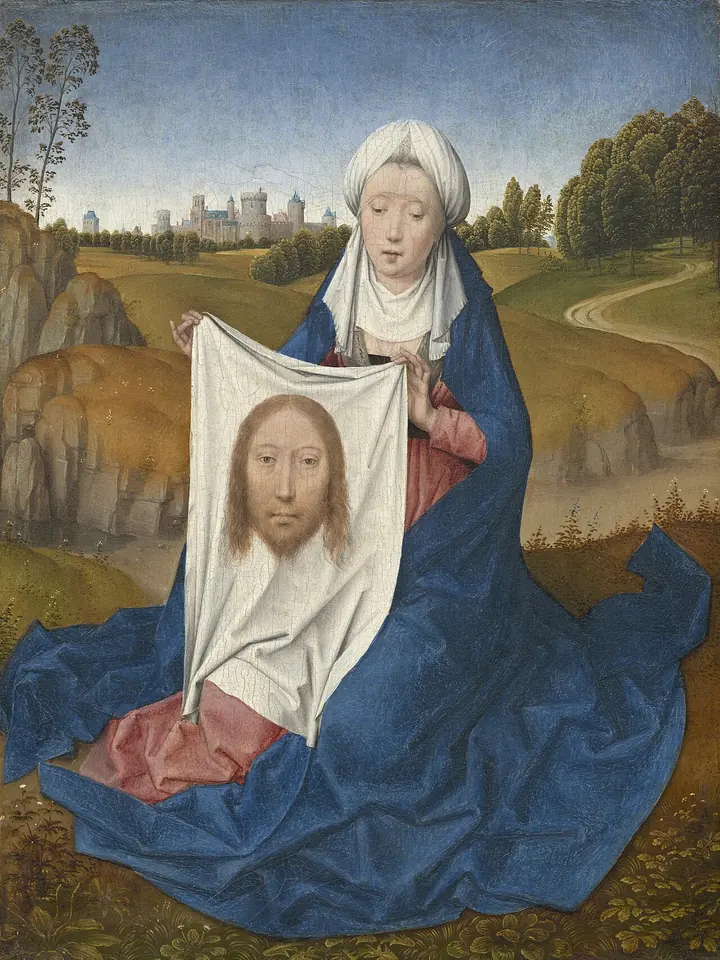
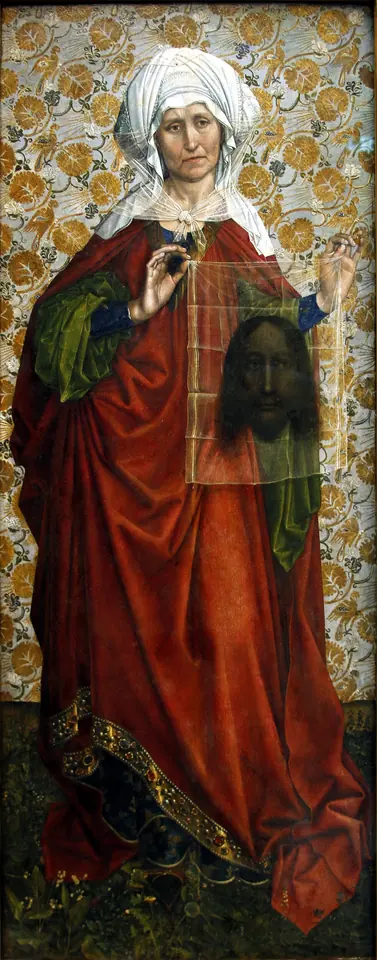
Veronica almost always appears with one attribute: a cloth bearing the face of Christ. She usually holds the veil open toward the viewer, with both hands, so that we see the face rather than her. Look for:
- The cloth, or sudarium: sometimes the face is calm and haloed, as in the gold-ground panels of the 1400s; from the late 1400s on it more often wears the crown of thorns.
- A married woman's head veil: she is usually shown as a mature woman, often in a white wimple or turban.
- A setting on the road to Calvary: in Stations of the Cross and Passion scenes, she kneels near Jesus as he carries the cross.

Some artists dropped Veronica altogether and showed only the cloth. Albrecht Dürer engraved it held by angels; Francisco de Zurbarán painted it alone, pinned against darkness, like a still life.


Zurbarán's version is almost entirely cloth: a white linen pinned at the top, its folds painted with great care, and in the middle only a faint reddish trace of a face.


Eastern Christianity has its own "Image Not Made by Hands," the Mandylion of Edessa, linked to the legend of King Abgar that the Catholic Encyclopedia mentions; Orthodox icons of the Holy Face come from that tradition rather than from Veronica.
The Veronica at St. Peter's Basilica
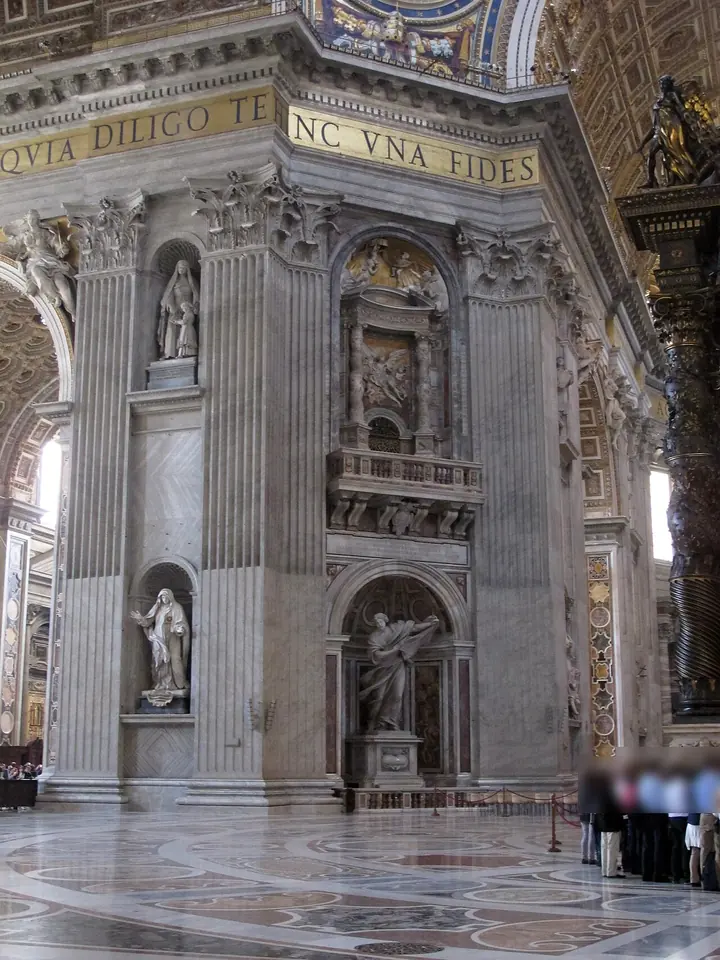
The relic known as the Veronica, or Holy Face, is kept today inside one of the four great piers under the dome of St. Peter's. In front of that pier stands Francesco Mochi's marble statue of Veronica, carved between 1629 and 1632, her veil whipping out as if she had just run forward. Above the statue is the balcony called the Veronica loggia.
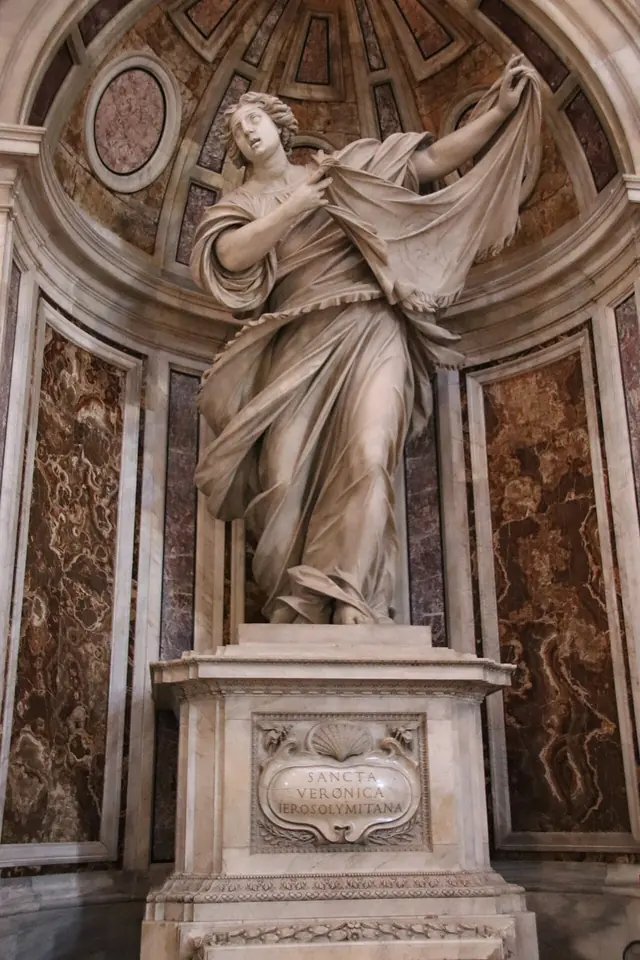

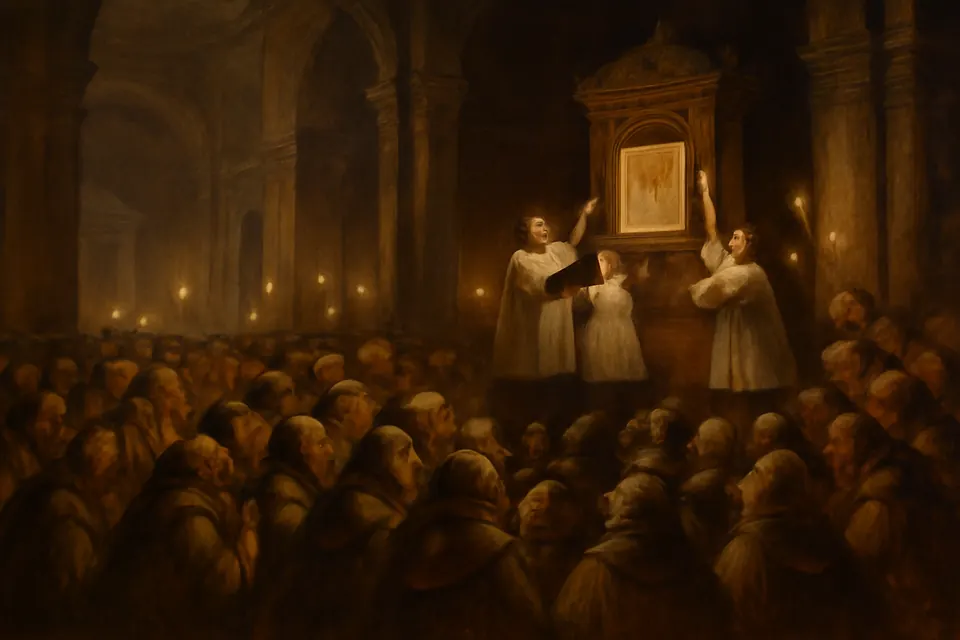
Once a year, on the Fifth Sunday of Lent, the relic is shown to the people. The Holy See Press Office described the 2026 rite: while the litanies are sung, the faithful walk through the aisles of the basilica, and "from the Loggia della Veronica, the relic of the Holy Face (Veil of Veronica) will be displayed," followed by Mass at the Altar of the Chair.

The Holy Face of Manoppello
In the small town of Manoppello, in the Abruzzo region of Italy, Capuchin friars keep a small, nearly transparent cloth with a face on it, the Volto Santo or Holy Face. According to local tradition, recorded by a Capuchin friar in the 1600s, an unknown pilgrim brought it to the town in the early 1500s. Since the late 1990s some writers, notably the Jesuit art historian Heinrich Pfeiffer, have argued that it is the original veil once shown in Rome. Others reject the claim, and the Church has not ruled on it.
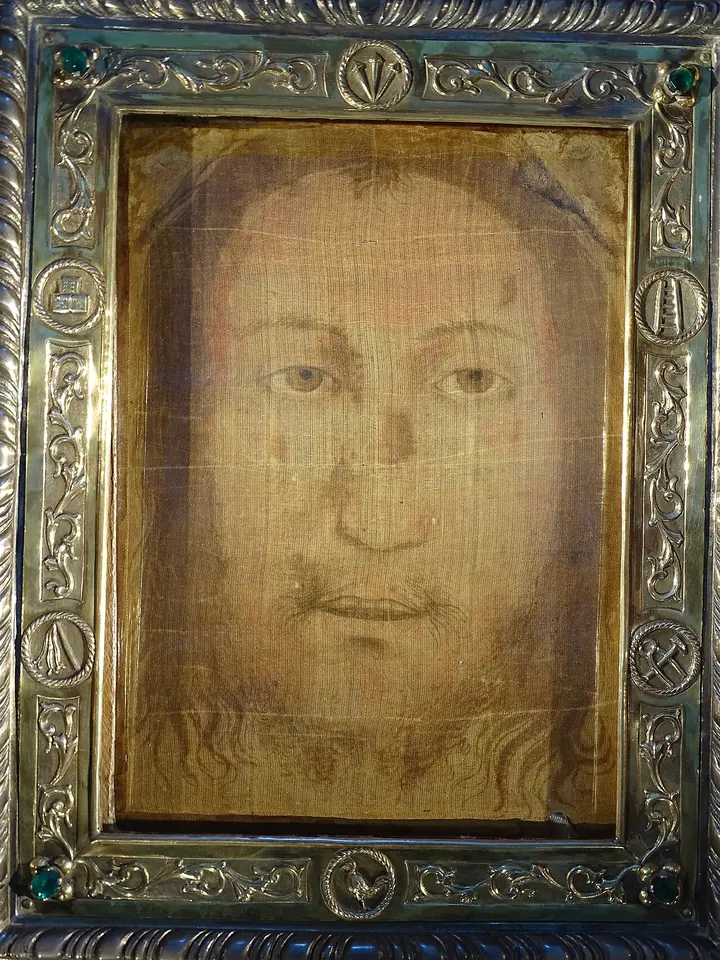

Pope Benedict XVI made a private pilgrimage to the shrine on September 1, 2006. He spoke of contemplating "the image of the Holy Face" and of the human search for the face of God, but he said nothing about the cloth's origin.
Feast day and namesakes
Popular calendars keep St. Veronica's day on July 12. Because she is not on the General Roman Calendar or in the current Roman Martyrology, it is a devotional date, not a liturgical feast. See other July saints on our feast days page.
Two real, historical saints share her name, and they are often confused with her: St. Veronica Giuliani (1660–1727), a Capuchin mystic honored on July 9, and Veronica of Binasco, an Augustinian nun of Milan whom the Roman Martyrology records on January 13. Neither has anything to do with the veil.

Prayer at the Sixth Station
There is no ancient prayer to St. Veronica with a known author. The prayer most Catholics say in her company is the one at the Sixth Station in St. Alphonsus Liguori's 18th-century Way of the Cross, still one of the most widely used versions. In a modern English text it reads:
Consider the compassion of the holy woman, Veronica. Seeing Jesus in such distress, His face bathed in sweat and blood, she presented Him with her veil. Jesus wiped His face, and left upon the cloth the image of his sacred countenance.
My beloved Jesus, Your face was beautiful before You began this journey; but, now, it no longer appears beautiful and is disfigured with wounds and blood. Alas, my soul also was once beautiful when it received Your grace in Baptism; but I have since disfigured it with my sins. You alone, my Redeemer, can restore it to its former beauty. Do this by the merits of Your passion; and then do with me as You will.
The station closes with the Our Father, the Hail Mary and the Glory Be. Many shorter prayers "to St. Veronica" circulate online, but they are modern compositions without a recognized source.


Frequently asked questions
Is St. Veronica in the Bible?
No. None of the four Gospels mentions a woman who wiped Jesus' face on the way to Calvary. Luke 23:27 says a great crowd of women followed him, weeping, and Christian imagination later gave one of them a name and a story. The earliest texts that call a woman "Veronica" are apocryphal, written centuries after the Gospels.
What does the name Veronica mean?
The Catholic Encyclopedia explains that the image of Christ kept in Rome was called vera icon, Latin and Greek for "true image," and that ordinary speech turned this into veronica. Over time people took the word for the name of the woman who owned the cloth. A second derivation, from the Greek name Berenice ("bringer of victory"), appears in some versions of the legend.
When is St. Veronica's feast day?
July 12 in many popular calendars. She is not on the General Roman Calendar and is not listed in the current Roman Martyrology, so no Mass is said in her honor in the universal Church. Her real place in Catholic prayer is the Sixth Station of the Cross, prayed especially on the Fridays of Lent and on Good Friday.
Where is Veronica's veil today?
St. Peter's Basilica in Rome keeps a relic called the Veronica, or Holy Face, in a chapel inside the pier that holds Francesco Mochi's statue of her. It is shown once a year from the balcony above the statue, on the Fifth Sunday of Lent. A cloth in Manoppello, Italy, has also been claimed as the original veil. The Church has made no judgment on either claim.
What is St. Veronica the patron saint of?
Catholic Culture lists photographers, laundry workers, linen weavers, seamstresses, domestic workers and those suffering from bleeding. Most of these come from the cloth in her story; photographers, from the image left on it.
Sources
- Catholic Encyclopedia (1912): St. Veronica
- Catholic Encyclopedia (1912): Way of the Cross
- Gospel of Nicodemus, Part I, Second Greek Form (Ante-Nicene Fathers)
- The Death of Pilate (Ante-Nicene Fathers)
- Holy See Press Office: Saint Peter's Basilica, repetition of the rite of the Holy Face (March 18, 2026)
- Benedict XVI: Pilgrimage to the Shrine of the Holy Face in Manoppello (September 1, 2006)
- Basilica del Volto Santo di Manoppello (official site)
- Catholic Culture: Liturgical calendar for July 12, 2025 (St. Veronica of the Veil, historical commemoration)
- Dante, Paradiso, Canto XXXI (Longfellow translation, Project Gutenberg)
- The Stations of the Cross by Saint Alphonsus Liguori (Catholic Gallery)