St. Ignatius of Antioch
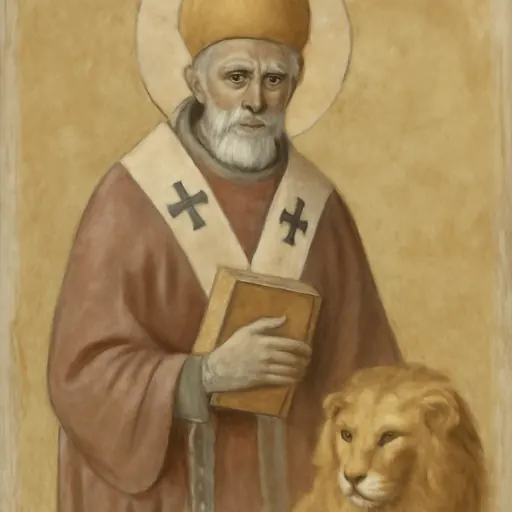
St. Ignatius of Antioch was the bishop of Antioch in Syria who, around 107, was arrested under the emperor Trajan, taken to Rome in chains and thrown to wild beasts. On the way he wrote seven letters that still survive, including the earliest known use of the phrase "the Catholic Church." His feast day is October 17.
Who was St. Ignatius of Antioch?
Ignatius was bishop of Antioch in Syria, the city where, according to the Acts of the Apostles, the followers of Jesus were first called Christians. Around the year 107, in the reign of the emperor Trajan, he was arrested, sentenced to die by wild beasts, and taken under guard to Rome. On the journey he wrote seven short letters to the churches along his route. They survive, and they are some of the oldest Christian writings outside the New Testament.
Almost everything certain about him comes from those letters. He called himself Theophorus, "God-bearer," and the Orthodox Church still calls him Ignatius the God-Bearer. Eusebius of Caesarea, writing his Church History in the early 300s, names him as the second bishop of Antioch after Evodius, counting from St. Peter. Pope Benedict XVI, in a 2007 audience, gave the dates of his time as bishop as 70 to 107.


Some details are much later tradition. The old account of his martyrdom says he and St. Polycarp were both disciples of St. John the Apostle, and the Catholic Encyclopedia (1910) thinks that likely. A more distant legend, which the same encyclopedia says has no good basis, makes Ignatius the little child whom Jesus took in his arms in the Gospels.
The life of St. Ignatius
Bishop in Antioch
Nothing in his own writings describes his years as bishop. The Catholic Encyclopedia reports a statement by the 5th-century writer Theodoret that St. Peter himself appointed him. The church historian Socrates Scholasticus, writing around 440, tells a traditional story that Ignatius saw a vision of angels singing hymns to the Trinity in alternating choirs, and introduced that way of singing at Antioch, from where it spread to every church.
Condemned under Trajan
The Martyrdom of Ignatius, an account that claims to come from his companions on the journey, says Trajan was passing through Antioch and questioned the bishop in person. When Ignatius said he carried Christ within him, the emperor ordered him bound and taken to Rome "to be devoured by the beasts, for the gratification of the people." The Catholic Encyclopedia calls this account "certainly very ancient" but "greatly interpolated," so its dialogues can't be taken as a transcript.
The journey and the seven letters
Eusebius describes the route. Ignatius traveled overland through Asia Minor under heavy guard, and at Smyrna, where Polycarp was bishop, he stayed long enough for delegations to come from nearby churches. From Smyrna he wrote to the Christians of Ephesus, Magnesia, Tralles and Rome. From Troas, farther on, he wrote to Philadelphia, to Smyrna and to Polycarp himself.
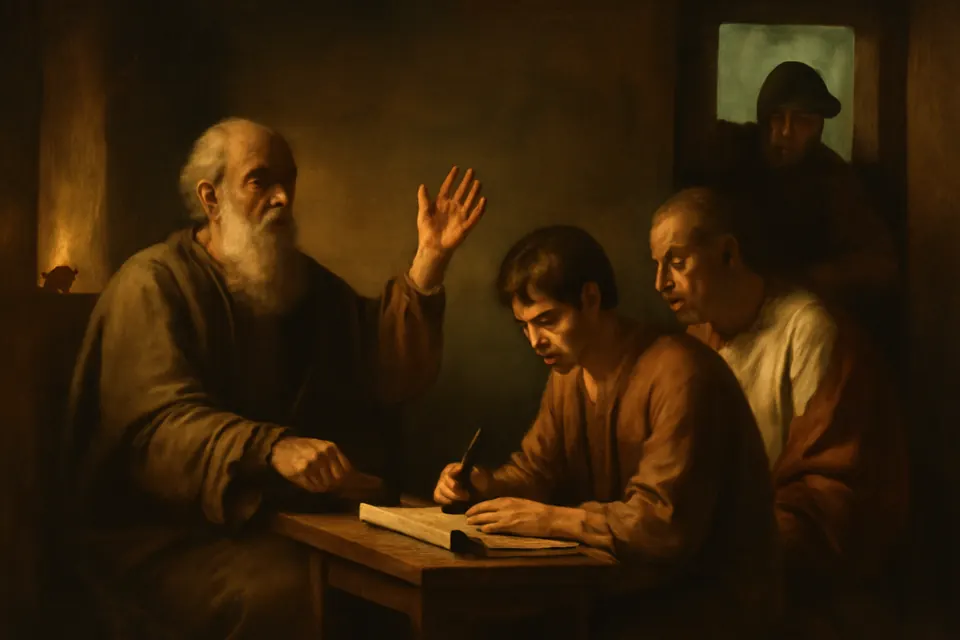
The letters are urgent and personal. Over and over he tells the churches to stay united around their bishop, priests and deacons, and to reject teachers who said Christ only seemed to have a body. To the Ephesians he described the Eucharist as "the medicine of immortality, and the antidote to prevent us from dying."
His guards were not gentle. In the Letter to the Romans he wrote, in the Roberts and Donaldson translation (Ante-Nicene Fathers, 1885):
From Syria even unto Rome I fight with beasts, both by land and sea, both by night and day, being bound to ten leopards, I mean a band of soldiers, who, even when they receive benefits, show themselves all the worse.
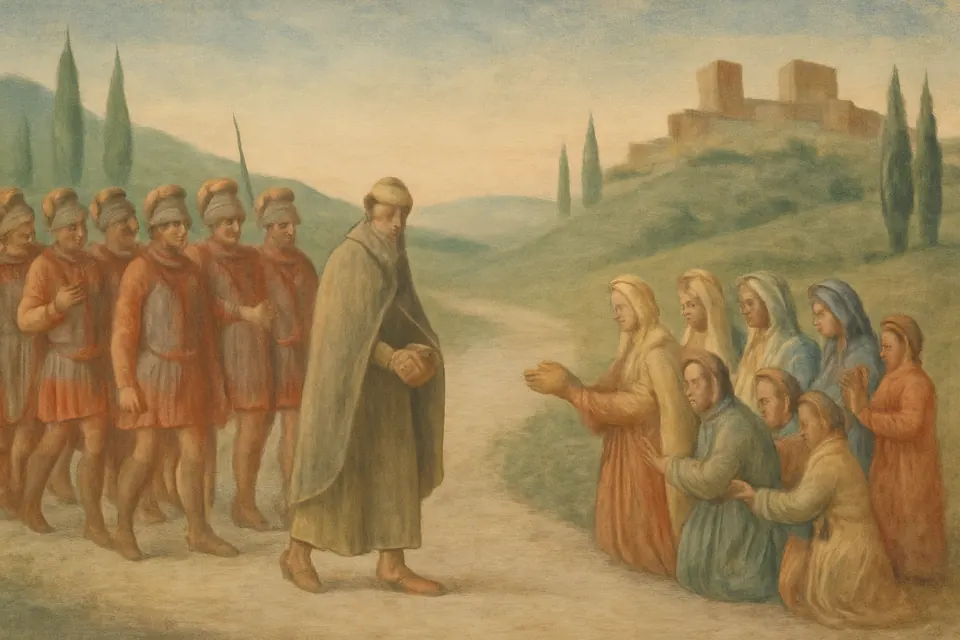
"I am the wheat of God"
The Letter to the Romans is different from the other six. Ignatius had heard that Christians in Rome might try to win his release, and he begged them not to. Chapter 4 holds the line he is best known for, again in the Roberts and Donaldson translation:
I am the wheat of God, and let me be ground by the teeth of the wild beasts, that I may be found the pure bread of Christ.
Irenaeus of Lyons quoted the same sentence around 180, which is one of the reasons historians accept the letter as genuine. In chapter 6 Ignatius added, "It is better for me to die on behalf of Jesus Christ, than to reign over all the ends of the earth."
Death in Rome
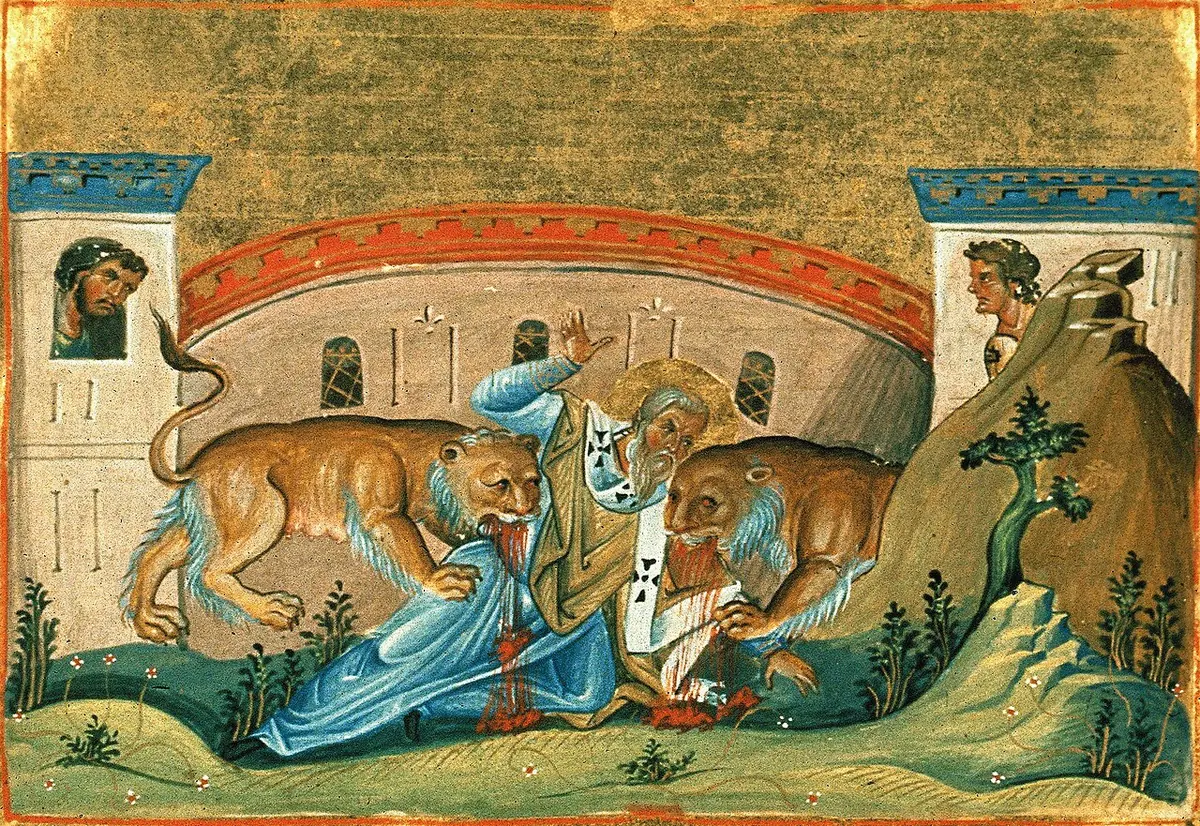
The Martyrdom says he was thrown to the beasts in the amphitheater on December 20, at the close of the public games, and that only "the harder portions of his holy remains" were left. His companions carried these back to Antioch. Eusebius, more cautiously, says only that "report says" he was sent to Rome and became food for wild beasts. The traditional year is 107; the Catholic Encyclopedia allows any date between 98 and 117.

The first "Catholic Church"
In his Letter to the Smyrnaeans, chapter 8, Ignatius wrote:
Wherever the bishop shall appear, there let the multitude [of the people] also be; even as, wherever Jesus Christ is, there is the Catholic Church.
The Catholic Encyclopedia notes that this is the first place the phrase "Catholic Church" appears in any surviving text. Katholikos is Greek for "universal" or "according to the whole." Ignatius uses it for the whole Church as opposed to one local congregation. The same chapter is also an early use of "Eucharist" for the sacrament.
These letters have been argued over for centuries. A longer, padded version circulated from about 400, with six extra letters that are forgeries. John Calvin rejected the letters outright. By 1910, the Catholic Encyclopedia reported, the best critical scholarship, including the non-Catholic scholars Zahn, Lightfoot and Harnack, accepted the seven letters Eusebius listed. A key piece of evidence is a letter of Polycarp, written soon after Ignatius died, that mentions his letters being collected and sent on. Catholic and Orthodox Christians read them as a witness to the shape of the Church a generation after the apostles.
The miracles of St. Ignatius
Ignatius is honored for his martyrdom and his letters, not for wonders, and he left no miracle stories of his own. The accounts that do exist:
- Visions after his death: reported by the Martyrdom, whose authors say that on the night after his death some of them saw him in their sleep, embracing them or praying for them.
- The angel choirs at Antioch: traditional, first told by Socrates Scholasticus three centuries later.
- The name of Jesus in his heart: traditional. A later legend, repeated in the Orthodox life, says the lions left his heart untouched, and when it was cut open the name of Jesus Christ was found written there in gold letters. It explains the heart marked "IHS" in his Western images.
- The child Jesus held: traditional, and the Catholic Encyclopedia calls it unfounded.
Patronage
Ignatius has no single famous patronage. Catholic Culture lists him as a patron of the Church in the eastern Mediterranean and the Church in North Africa, which fits a bishop of Syria, and also of throat ailments, a patronage whose origin we couldn't trace. See the full list on our patron saints page.


Symbols of St. Ignatius of Antioch in art
Ignatius is an older bishop, often with a white or gray beard. To recognize him, look for:
- Lions: the beasts of his martyrdom. Eastern icons often show him standing calm between two lions, which may be biting at his robes.
- Chains: from his journey as a prisoner.
- A heart with the letters IHS: from the legend of the name of Jesus written on his heart, more common in Western prints.
- A book or scroll: his letters.
In Byzantine and Russian art he wears the omophorion, the white bishop's stole with black crosses, like the 10th-century tile near the top of this page.
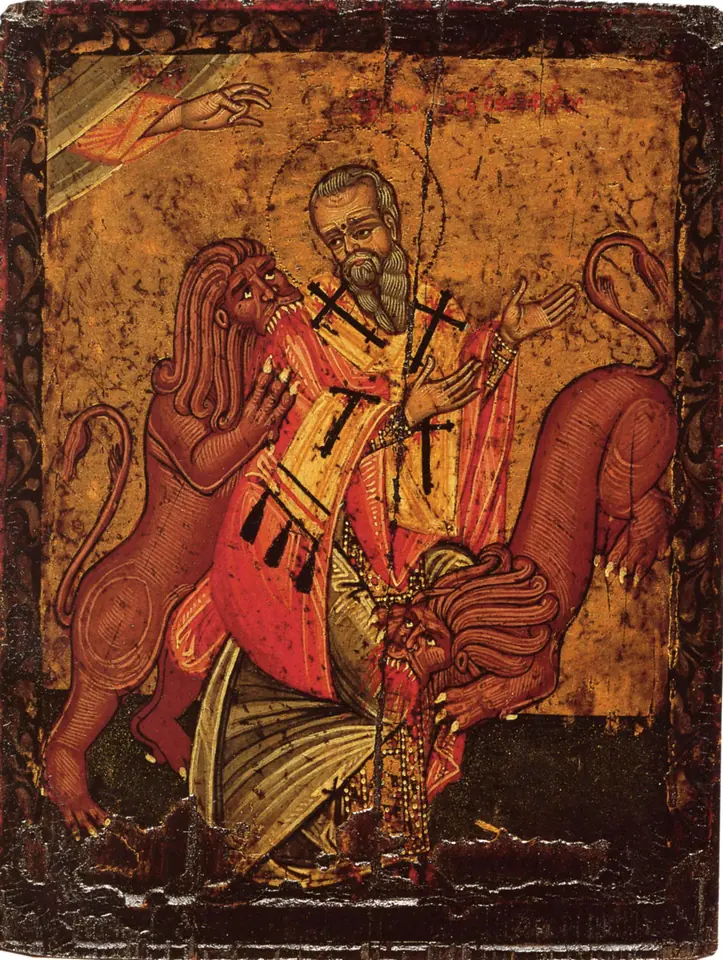

Western images more often give him a miter and crozier. Baroque prints like Jan Luyken's set the scene in a huge Roman amphitheater, with the crowd packed into the stands.


Feast day and relics
The Catholic Church keeps his memorial on October 17, the day the church of Antioch kept his feast in ancient times. From the 12th century until the reform of the calendar in 1969, the Roman calendar had him on February 1, the date the Catholic Encyclopedia still gives. Find his neighbors on our feast days page.
The Orthodox Church celebrates him on December 20, the date of his death in the Martyrdom, and on January 29 remembers the return of his relics to Antioch.
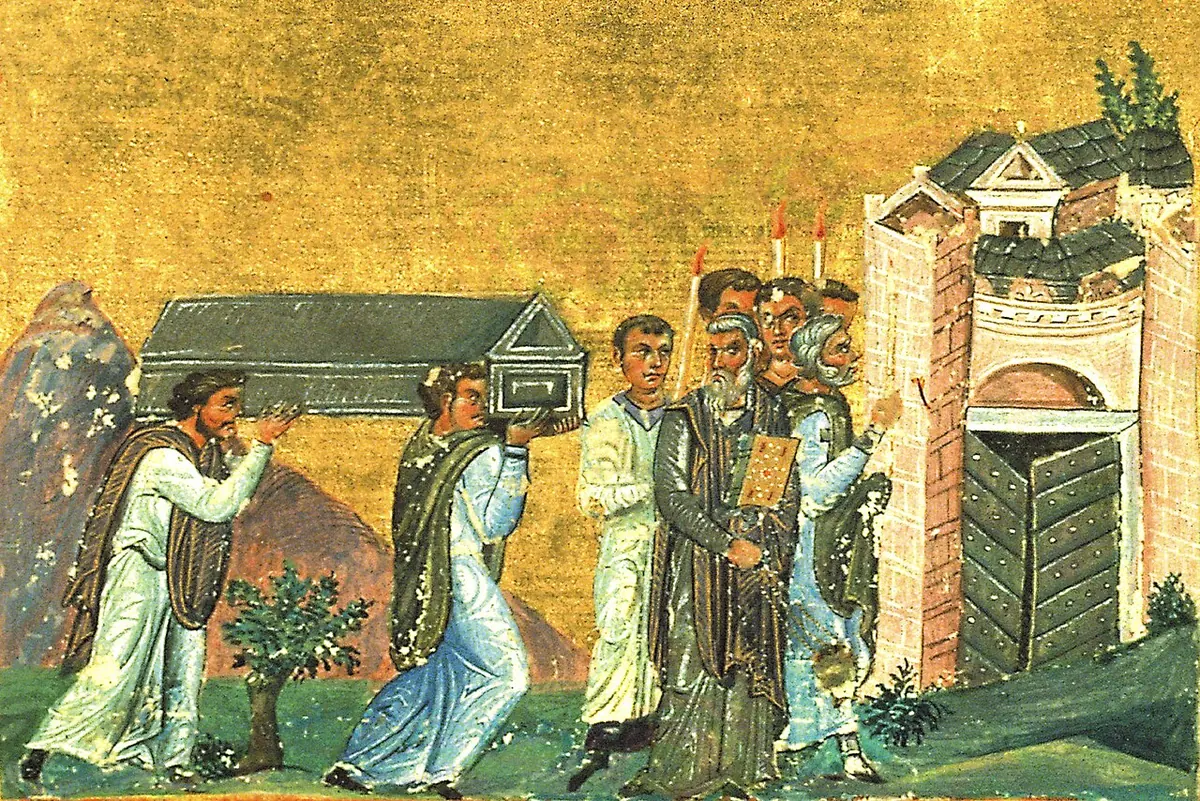

According to the Catholic Encyclopedia, the relics were first buried outside Antioch's gates near Daphne. The emperor Theodosius II moved them into the city, to the former Temple of Fortune, which became a church named for Ignatius. In 637 they were taken to Rome and placed in the Basilica of San Clemente, where they are today.
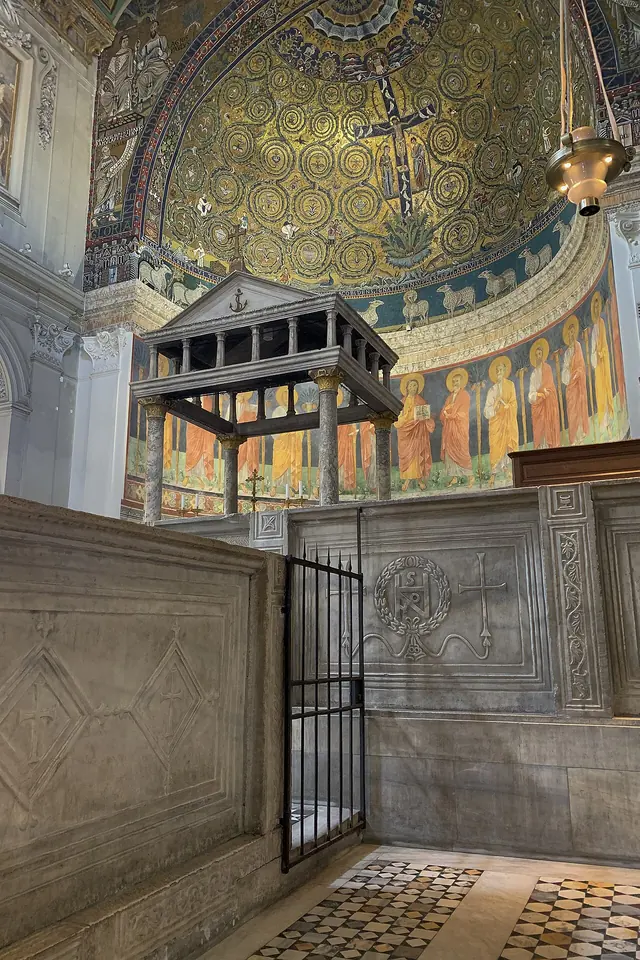

Prayer to St. Ignatius of Antioch
There is no traditional novena to St. Ignatius. The prayers connected with him come from the liturgy.
The Communion antiphon of his Mass adapts his own words; Catholic Culture gives it as "I am the wheat of Christ, ground by the teeth of beasts to become pure bread." The Collect of his memorial in the current English Roman Missal reads:
Almighty ever-living God, who adorn the sacred body of your Church with the confessions of holy Martyrs, grant, we pray, that, just as the glorious passion of Saint Ignatius of Antioch, which we celebrate today, brought him eternal splendor, so it may be for us unending protection. Through our Lord Jesus Christ, your Son, who lives and reigns with you in the unity of the Holy Spirit, God, for ever and ever.
The Orthodox Church sings this troparion on December 20 (translation of the Orthodox Church in America):
By sharing in the ways of the Apostles, / you became a successor to their throne. / Through the practice of virtue, you found the way to divine contemplation, O inspired one of God; / by teaching the word of truth without error, you defended the Faith, even to the shedding of your blood. / Hieromartyr Ignatius, entreat Christ God to save our souls.
Many readers simply pray with his letters, especially the Letter to the Romans, which is short enough to read in one sitting.
Frequently asked questions
What did St. Ignatius of Antioch mean by "I am the wheat of God"?
In his Letter to the Romans (chapter 4) he begged the Christians of Rome not to save him from execution. In the Roberts and Donaldson translation he writes, "I am the wheat of God, and let me be ground by the teeth of the wild beasts, that I may be found the pure bread of Christ." He pictured his death as grain being ground into flour for bread, an image tied to the Eucharist. The Roman Missal uses a version of the line as the Communion antiphon on his feast.
Was Ignatius of Antioch the first to say "Catholic Church"?
His Letter to the Smyrnaeans (chapter 8) is the earliest surviving Christian text that uses the phrase: "Wherever the bishop shall appear, there let the multitude [of the people] also be; even as, wherever Jesus Christ is, there is the Catholic Church." The Greek word katholikos means "universal" or "whole." Nobody can prove he coined it, only that his is the oldest use we still have.
When is the feast of St. Ignatius of Antioch?
October 17 in the Catholic Church, where it is an obligatory memorial. Before 1969 the Roman calendar kept it on February 1. The Orthodox Church remembers him on December 20.
Is St. Ignatius of Antioch the same as St. Ignatius of Loyola?
No. Ignatius of Antioch was a bishop martyred in Rome around 107. St. Ignatius of Loyola, whose feast is July 31, was a 16th-century Spanish soldier who founded the Jesuits. The two simply share a name.
What are the seven letters of St. Ignatius?
Letters to the churches of Ephesus, Magnesia, Tralles and Rome, written from Smyrna, and to the churches of Philadelphia and Smyrna and to Bishop Polycarp, written from Troas. Eusebius listed these seven in the 4th century. Other letters under his name, in a longer collection from about 400, are later forgeries.
Sources
- Catholic Encyclopedia (1910): St. Ignatius of Antioch
- Ignatius, Epistle to the Romans (Ante-Nicene Fathers, Vol. 1, trans. Roberts and Donaldson)
- Ignatius, Epistle to the Smyrnaeans (Ante-Nicene Fathers, Vol. 1)
- Ignatius, Epistle to the Ephesians (Ante-Nicene Fathers, Vol. 1)
- The Martyrdom of Ignatius (Ante-Nicene Fathers, Vol. 1)
- Eusebius, Church History, Book III, chapter 36 (trans. McGiffert)
- Socrates Scholasticus, Church History, Book VI, chapter 8
- Pope Benedict XVI, General Audience of 14 March 2007: Saint Ignatius of Antioch
- Orthodox Church in America: Hieromartyr Ignatius the God-Bearer, Bishop of Antioch
- Orthodox Church in America: Troparion and Kontakion of St. Ignatius
- Catholic Culture: Memorial of Saint Ignatius of Antioch, October 17