Pope St. John XXIII
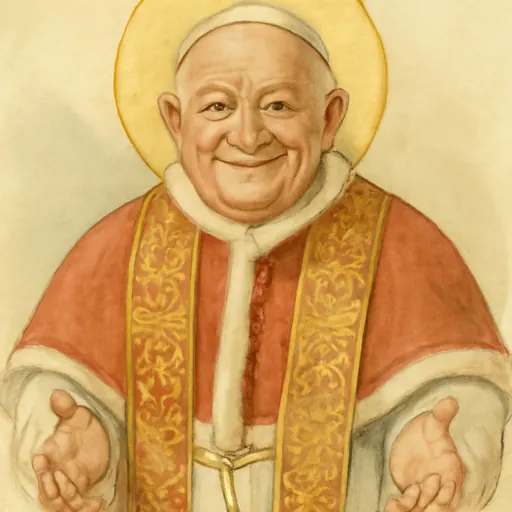
St. John XXIII (1881–1963), born Angelo Giuseppe Roncalli, was a sharecropper's son from near Bergamo who became a Vatican diplomat, Patriarch of Venice and, in 1958, pope. In less than five years he called the Second Vatican Council and wrote the peace encyclical Pacem in terris. Known as Good Pope John, he was canonized in 2014, and his feast day is October 11.
Who was St. John XXIII?
When Angelo Giuseppe Roncalli was elected pope on October 28, 1958, many people, the Vatican's biography notes, regarded him as a "transitional pope." He was 76, a career diplomat with a reputation for good humor rather than great plans. Less than three months later he announced a synod for Rome, a revision of canon law and an ecumenical council for the whole Church. The Second Vatican Council, which he opened in 1962, reshaped Catholic worship and the Church's relations with other Christians and the modern world.
He was also enormously popular. John Paul II said that his style was new, "as was his friendly approach to ordinary people and to the powerful of the world." Italians called him il Papa buono, the good pope. When he died of cancer in June 1963, one newspaper cartoon showed the earth draped in mourning with the caption "A Death in the Family."
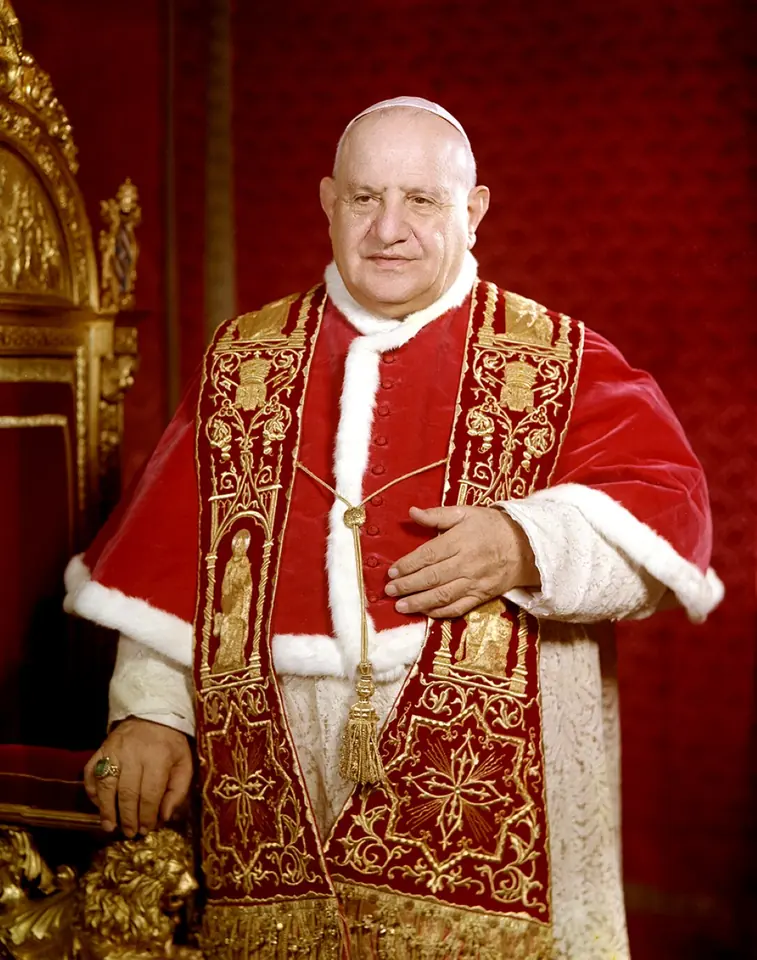

He took the name John, the biography says, in honor of John the Baptist and John the Apostle, and also because many earlier popes named John had short reigns. His was less than five years.
The life of St. John XXIII
A farm family near Bergamo
Angelo Giuseppe Roncalli was born on November 25, 1881, at Sotto il Monte, a village in the hills outside Bergamo, the third of thirteen children in a family of sharecroppers. A local priest tutored him, and he entered the seminary in Bergamo as a boy. A scholarship took him in 1901 to the Apollinare seminary in Rome. He was ordained a priest in 1904.

Secretary, soldier, chaplain
For nine years he was secretary to the new bishop of Bergamo, Giacomo Radini-Tedeschi, a prelate with strong social concerns, from whom he learned much about the problems of working people. He also taught church history. He had already interrupted his studies for military service, and when Italy entered World War I in 1915 he was called up again, serving as a sergeant in the medical corps, a stretcher-bearer and then a military chaplain.
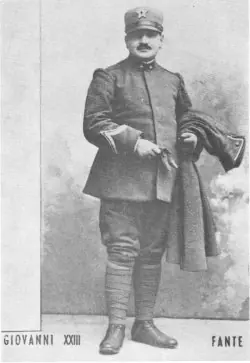

After the war he spent years researching a multi-volume edition of the records of St. Charles Borromeo's 16th-century visitation of Bergamo; the last volume came out after he became pope.
Twenty-eight years as a diplomat
In 1921 he was called to Rome to reorganize the Society for the Propagation of the Faith. In 1925 he was made an archbishop and sent to Bulgaria as apostolic visitor, where he took up the problems of the Eastern Churches. In 1934 he became apostolic delegate to Turkey and Greece, based in Istanbul. During World War II, the biography notes, he set up an office there to trace prisoners of war.

In 1944 he was sent to Paris as nuncio, to help the Church in France after the war, and he became the Holy See's first permanent observer at UNESCO. In 1953 he was made a cardinal and Patriarch of Venice, where he expected to finish his life as a pastor.


Pope John
Elected at 76, he said in his coronation address that he meant to be a pastoral pope, since "learning, practical experience, diplomatic finesse" could enrich pastoral work but never replace it. He enlarged the College of Cardinals to 87, the most international in its history, and in 1960 consecrated fourteen bishops for Asia, Africa and Oceania. He created the Secretariat for Promoting Christian Unity and appointed the first Catholic representative to an assembly of the World Council of Churches, held in New Delhi in 1961.
His encyclical Mater et Magistra (1961) updated Catholic social teaching. Pacem in terris, signed on Holy Thursday, April 11, 1963, was addressed not only to Catholics but "to all Men of Good Will," and argued that peace rests on human rights and dignity. In the nuclear age, it said, "it no longer makes sense to maintain that war is a fit instrument with which to repair the violation of justice."
The Second Vatican Council
He opened the Council in St. Peter's on October 11, 1962, before some 2,500 bishops. In his opening address, the Church, he said, would meet the errors of the age differently than in the past:
But at the present time the Spouse of Christ is pleased to apply the medicine of mercy, rather than take up the weapons of severity.
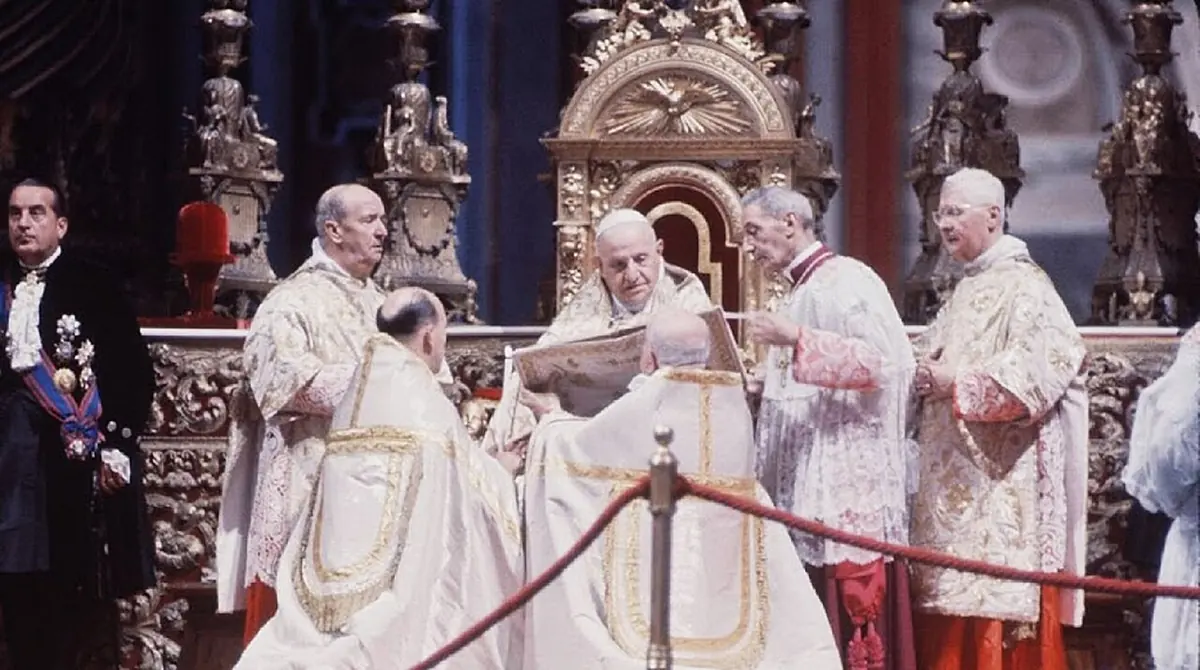

He did not live to see the Council's end. He died of cancer on the evening of June 3, 1963, after the Council's first session; his successor, Paul VI, brought it to a close in 1965. John Paul II quoted his last testament: "What counts the most in life is blessed Jesus Christ, his holy Church, his Gospel, truth and goodness."
The miracle and the canonization of St. John XXIII
The healing of Sister Caterina Capitani (approved). In May 1966 Caterina Capitani, a 22-year-old Italian nun, was dying of a stomach illness that doctors could not cure. On May 22 a fellow sister brought her a piece of cloth from Pope John's deathbed, and she laid it on her wound. On May 25, she said, she felt a hand on the wound, heard her name called and saw the pope, who told her she was healed. Doctors found no scientific explanation, and the Church approved the cure as the miracle for his beatification. Reports differ on the medical details (a perforated stomach in one account, a tumor in another) and on where it happened.
John Paul II beatified him on September 3, 2000, alongside Pius IX. In his homily he remembered "Pope John's smiling face and two outstretched arms embracing the whole world."
Canonization without a second miracle. Normally a second approved miracle is needed for canonization. On July 5, 2013, Pope Francis approved the vote of the cardinals and bishops of the Congregation for the Causes of Saints to canonize him without one. The Vatican spokesman, Fr. Federico Lombardi, said the pope has the power to dispense with it and that "it was [Pope Francis'] will that the sainthood of the great Pope of the Second Vatican Council be recognized." Francis canonized John XXIII and John Paul II together on April 27, 2014, Divine Mercy Sunday, and called Pope John "the pope of openness to the Holy Spirit."
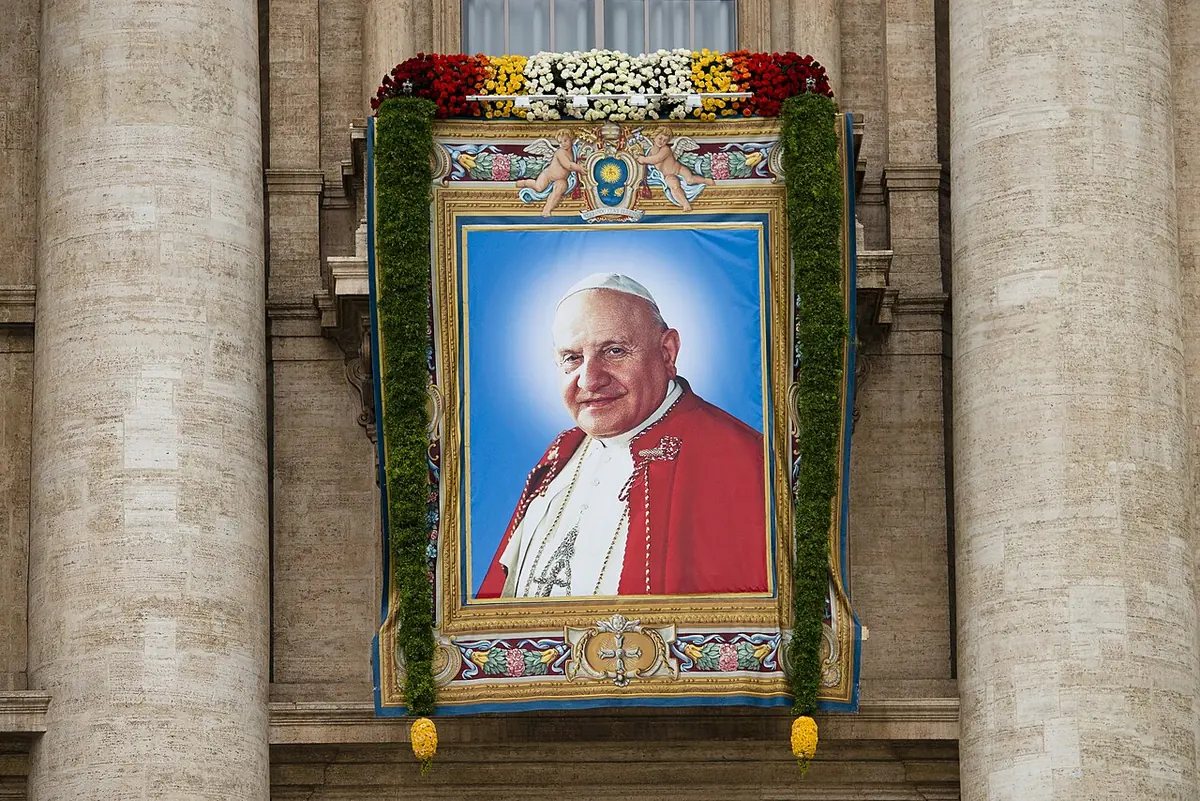

The state of his body (not a miracle). When his coffin was opened in 2001, his body was found nearly intact. Some Italians called it a miracle, but the Vatican did not, and the anatomist who embalmed him in 1963 said a special preserving fluid explained it.
Why St. John XXIII is patron of the Italian Army
In June 2017 the Congregation for Divine Worship issued a bull naming him patron of the Italian Army, and that September Archbishop Santo Marcianò, head of Italy's military ordinariate, presented it to the army's chief of staff. The reason was his years in uniform, especially in World War I, when he served as a sergeant in the medical corps, a stretcher-bearer and a chaplain. The choice surprised many people, since he was remembered as the "Peace Pope" who wrote Pacem in terris. Popular lists also name him a patron of papal diplomats, for his three decades in the Vatican's diplomatic service. See our patron saints page for others.
Symbols of St. John XXIII in art
As a modern saint, John XXIII is shown from photographs, not from old conventions. Look for:
- A heavy, round-faced elderly pope with large ears and a broad smile.
- The red mozzetta, a short velvet cape trimmed with white fur, often with a red stole, as in his best-known portrait. Some photographs show him in the red velvet camauro cap of older papal dress.
- Open arms or a hand raised in greeting, recalling John Paul II's image of "two outstretched arms embracing the whole world."
- A book, for the Council or Pacem in terris.
The bronze statue outside the Church of St. Anthony of Padua in Istanbul, the city where he served as apostolic delegate, shows him with one hand raised in greeting.
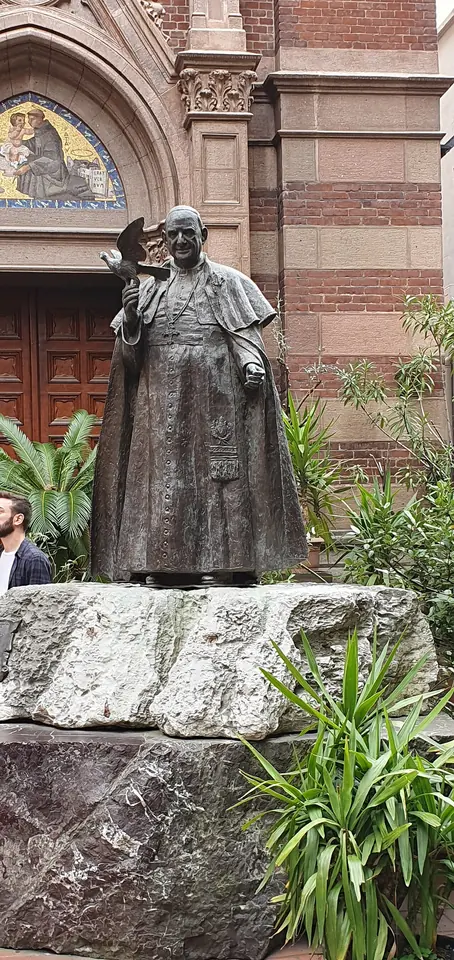

Feast day, tomb and where he is honored
His feast is October 11, an optional memorial in the General Roman Calendar. Pope Francis ordered it added in a decree of May 29, 2014, choosing the day he opened the Council rather than the day he died. Find his neighbors on our feast days page.
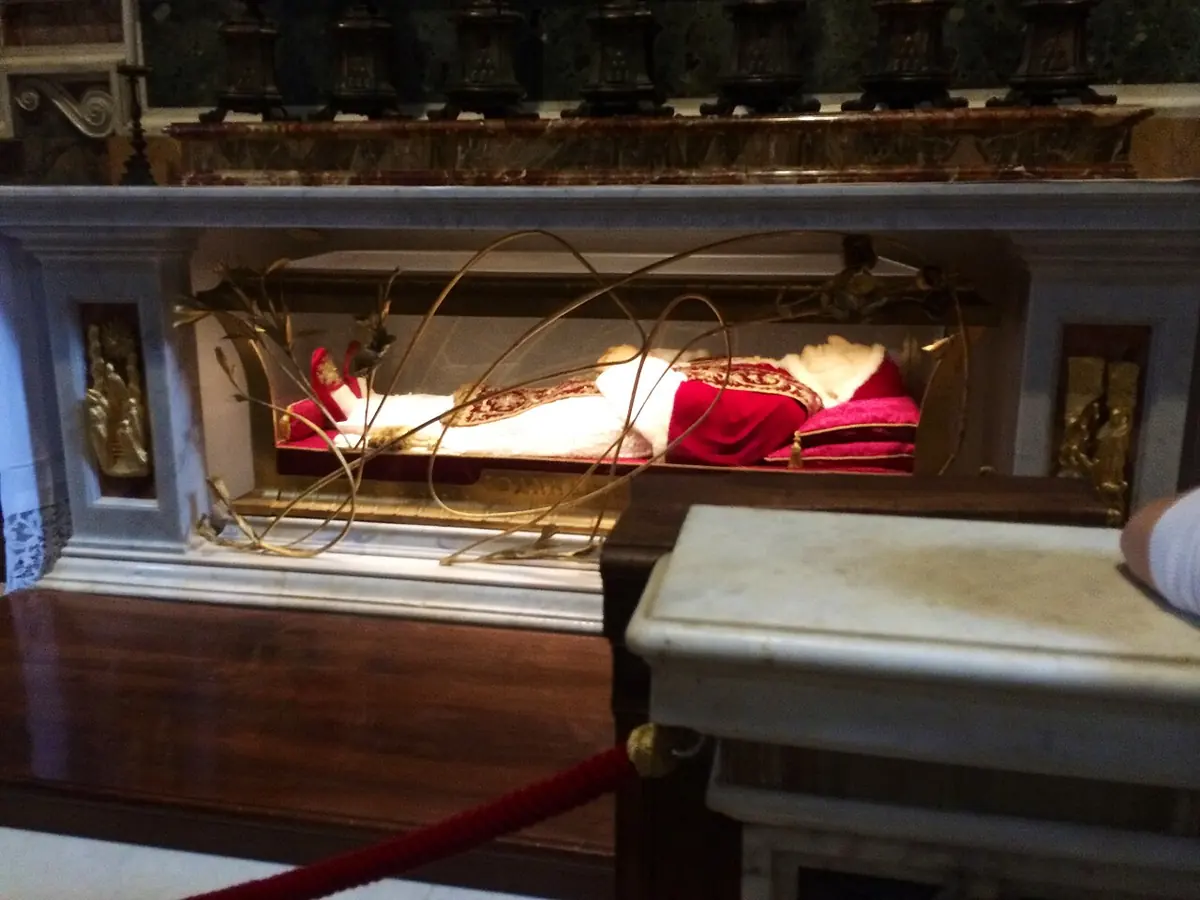
He was first buried in the grottoes beneath St. Peter's. On June 3, 2001, Pentecost Sunday and the 38th anniversary of his death, his body was carried into the basilica and placed in a glass and bronze coffin beneath the Altar of St. Jerome, near the main aisle. Only two other popes, Innocent XI and St. Pius X, had been given that honor.

His birthplace, now called Sotto il Monte Giovanni XXIII, is a place of pilgrimage too.
Prayer of St. John XXIII
The Church's own prayer for his memorial is the Collect of the Mass for October 11. In the English text approved for England and Wales in 2021, it reads:
Almighty ever-living God, who in Pope Saint John the Twenty-Third have given a living example of Christ, the Good Shepherd, to shine throughout the whole world, grant us, we pray, that, through his intercession, we may joyfully pour out an abundance of Christian charity. Through our Lord Jesus Christ, your Son, who lives and reigns with you in the unity of the Holy Spirit, God, for ever and ever.
The Office of Readings for the day uses part of his address opening the Council. His spiritual diary, published as Journal of a Soul, is also widely read; in it, John Paul II noted, he wrote of his hope to be worthy to see Pius IX canonized.
Frequently asked questions
Why is St. John XXIII's feast day October 11?
October 11 is the anniversary of the day he opened the Second Vatican Council in 1962. Pope Francis added the memorial to the General Roman Calendar in 2014 on that date, rather than on June 3, the day he died.
What miracle is attributed to John XXIII?
The healing of Sister Caterina Capitani, a young Italian nun, in May 1966. She was dying of a stomach illness and, she said, saw Pope John at her bedside telling her she was healed. Doctors found no scientific explanation, and the Church approved the cure for his beatification in 2000.
Why was John XXIII canonized with only one miracle?
Pope Francis approved the canonization in July 2013 without a second miracle. The Vatican spokesman, Fr. Federico Lombardi, said the pope has the power to dispense with it and that it was his wish that "the great Pope of the Second Vatican Council" be recognized as a saint.
Where is St. John XXIII buried?
In St. Peter's Basilica in Rome. In 2001 his body was moved from the grottoes beneath the basilica to a glass coffin under the Altar of St. Jerome, near the main aisle, where pilgrims can see it.
What is St. John XXIII the patron saint of?
In 2017 the Vatican named him patron of the Italian Army, recalling his World War I service as a stretcher-bearer and military chaplain, a choice that surprised many who remembered him as the pope of peace. Popular lists also call him a patron of papal diplomats.
Sources
- Vatican: Biography of Pope John XXIII
- John XXIII, Pacem in terris (April 11, 1963)
- John Paul II, Homily for the beatification of Pius IX, John XXIII and others (September 3, 2000)
- Pope Francis, Homily for the canonization of John XXIII and John Paul II (April 27, 2014)
- Congregation for Divine Worship: Decree on the inscription of Saints John XXIII and John Paul II in the General Roman Calendar (May 29, 2014)
- Liturgy Office of England and Wales: Saint John XXIII and Saint John Paul II, texts for the Roman Missal and Liturgy of the Hours
- Catholic World Report: Pope Francis approves the canonization of Popes John Paul II and John XXIII (2013)
- America: A Busy Vatican Friday: Encyclical and Canonization Plans for Popes (2013)
- U.S. Catholic: Meet the women behind the miracles credited to John Paul II and John XXIII (2014)
- Christianity Today: Blessed John XXIII's Remains Are Now On View At St Peter's (2001)
- Crux: Good Pope John fits as patron saint of the Italian army (2017)