St. Edward the Confessor

St. Edward the Confessor (died 1066) was one of the last Anglo-Saxon kings of England, a pious ruler who rebuilt Westminster Abbey and is buried in a shrine at its heart. Pope Alexander III canonized him in 1161. His feast day is October 13, and Catholics count him a patron saint of kings and of difficult marriages.
Who was St. Edward the Confessor?
Edward was King of England from 1042 until his death in January 1066, the year of the Norman Conquest. He was one of the last kings of the old Anglo-Saxon royal line, a son of King Ethelred "the Unready" and his Norman queen, Emma. He rebuilt the abbey church of St. Peter at Westminster, and he lies there still, in a shrine behind the high altar. Pope Alexander III canonized him in 1161, which makes him the only English king ever formally canonized by a pope.
The title "Confessor" was an old name for a saint who witnessed to the faith by a holy life rather than by martyrdom. It also tells him apart from his uncle, St. Edward the Martyr, the king murdered in 978.

Three kinds of sources tell his story. The earliest is the Life of King Edward (Vita Ædwardi Regis), which his widow, Queen Edith, commissioned soon after his death. Then came 12th-century lives written to support his canonization, by Osbert of Clare and Aelred of Rievaulx. The best-known stories, including the ring legend, reached ordinary readers through the Golden Legend in William Caxton's English translation of 1483. The later the source, the more miracles it holds.
The life of St. Edward
Birth and exile
Westminster Abbey gives his birthplace as Islip in Oxfordshire, sometime between 1002 and 1005. When the Danes overran England, the boy was sent to Normandy, to the court of his mother's family. Westminster Abbey counts 28 years of exile. After the Danish king Canute died in 1035, Edward and his brother Alfred tried to return. Alfred was captured and killed, and Edward went back to Normandy. The Golden Legend blames the powerful Earl Godwin for Alfred's death.
King of England
When his half-brother King Harthacnut died suddenly in 1042, Edward was called home and acclaimed king. He was crowned in Winchester Cathedral in 1043, at about forty years old. The Catholic Encyclopedia (1909) describes a reign of almost unbroken peace: Edward abolished the Danegeld, the heavy tax first raised to pay off the Danes, and fought only to repel a Welsh raid and to help Malcolm III of Scotland against Macbeth.


Historians are less admiring of his politics than of his piety. Westminster Abbey's own history says plainly that he "had not been a particularly successful king," but that his character and devotion endeared him to his people. Many remembered his reign later as the time of "the good St. Edward's laws."
Marriage to Edith
In January 1045 he married Edith, the daughter of Earl Godwin. They had no children. A later tradition, found in the Catholic Encyclopedia and the Golden Legend, says the two lived together as brother and sister by mutual agreement. Either way, the marriage left no heir, and the open succession led to the crisis of 1066. Edith herself was well educated and commissioned the first Life of her husband. She died in 1075 and was buried near him.
The vow and Westminster Abbey
In exile Edward had vowed to go on pilgrimage to the tomb of St. Peter in Rome if God brought him home safely. Once king, he felt he could not leave the country. The pope released him from the vow on condition that he should found or restore a monastery dedicated to St. Peter. Edward chose a small Benedictine abbey just west of London and rebuilt it on a large scale in the Norman style. Because it lay west of St. Paul's in the city, it became the "west minster."
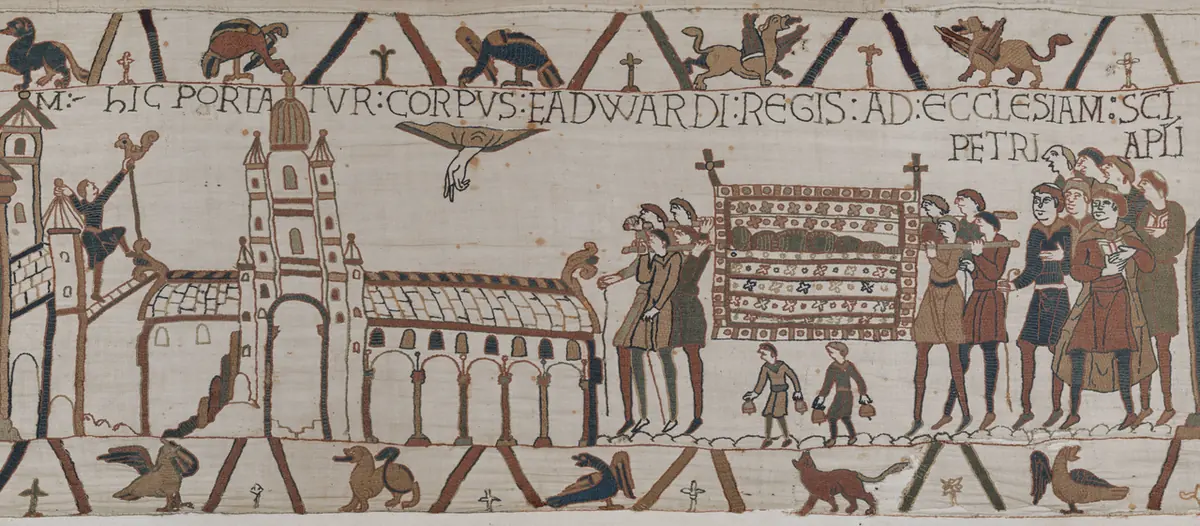
The new church was consecrated on December 28, 1065. Edward was too ill to attend. He died a week later, on the night of January 4 to 5, 1066, and was buried in the abbey on January 6, the feast of the Epiphany.

The miracles and legends of St. Edward
The stories below come mainly from the 12th-century lives and the Golden Legend. None was investigated in the modern way, which did not yet exist.
The ring and St. John
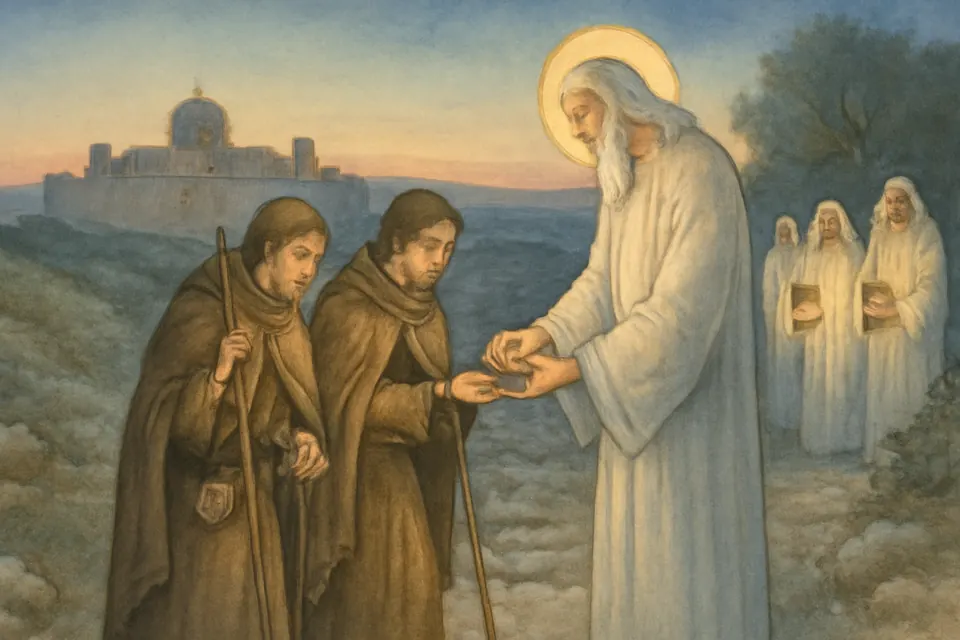
The Golden Legend sets this story at Havering in Essex, where a church was being dedicated to St. John the Evangelist, Edward's favorite saint. During the procession an old man asked the king for alms "in the worship of God and S. John the Evangelist." Edward had no money with him, so he pulled the ring from his finger and gave it away.

Years later, two English pilgrims lost their way in the Holy Land. An old man with white hair led them to shelter and set them on the right road. As they parted, the Golden Legend says, he told them: "I am John the Evangelist," and gave them the ring to take back to their king, with the message that Edward would be with him within six months. The pilgrims did as they were told, and Edward prepared for his death. This is traditional, a legend, but it gave Edward his emblem.
Healing the sick
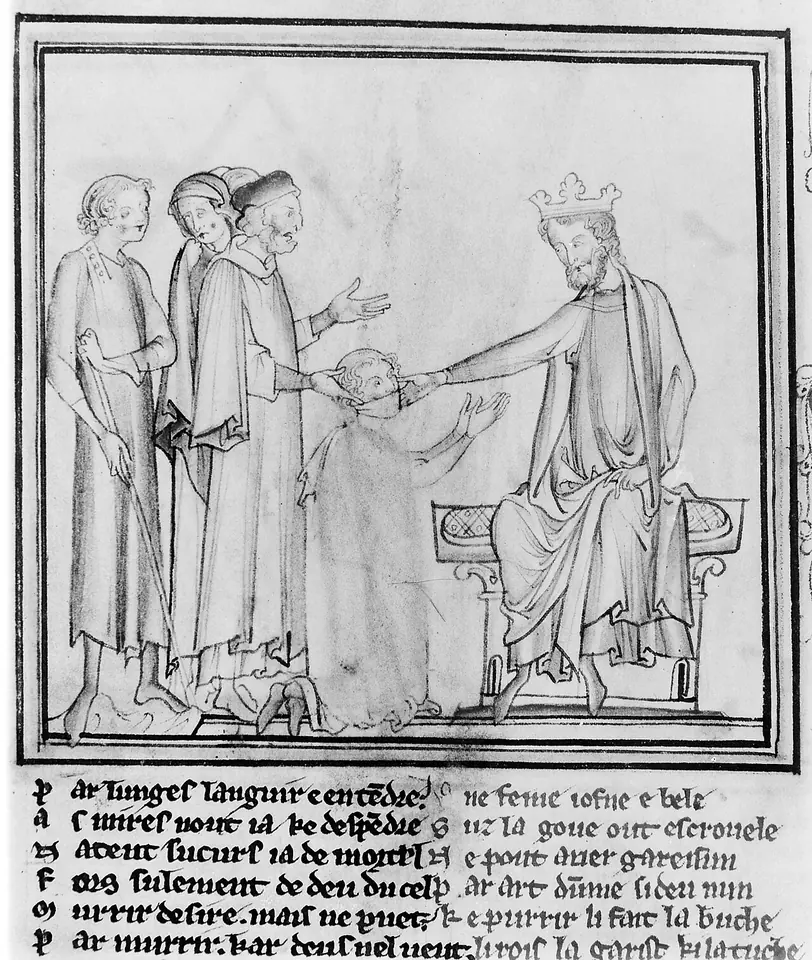
The Catholic Encyclopedia calls Edward "the first King of England to touch for the 'king's evil,'" the name for scrofula, a disease of the lymph glands of the neck. The Golden Legend tells of a young wife covered in sores who was healed after the king washed her neck with his own hands, and of blind men who recovered their sight by bathing their eyes in the water he had washed his hands in. These cures are traditional. Later English and French monarchs kept up the royal touch for centuries.

The vision of the green tree
On his deathbed, the Golden Legend says, Edward told of a vision of God's judgment coming on England for its sins, and of a green tree cut from its trunk that would bear fruit again only when it returned to its root without human hands. The Golden Legend reads it as a prophecy of the Norman Conquest and of Henry I, the Norman king who married Edward's great-great-niece Matilda and so joined the old English line to the new. It is traditional.
Miracles at the tomb
When the tomb was opened in 1102, Osbert of Clare reported, "a wonderful fragrance filled the church," and the body was seen wrapped in a precious pall, the long beard still visible. Westminster Abbey's history adds that miracles were said to take place at the tomb. These are reported claims from the 12th century, gathered as evidence for the canonization of 1161.
Why St. Edward is a patron saint
Catholic Culture lists him as patron of kings and of the English royal family, since he was both. No early source explains his patronage of difficult marriages and separated spouses; it seems to come from the tradition about his own childless marriage to Edith, the daughter of his rival Earl Godwin. For about two centuries, Westminster Abbey notes, many people regarded him as the patron saint of England, until St. George replaced him in the 14th century. See all patronages on our patron saints page.
Symbols of St. Edward the Confessor in art
Edward is almost always a crowned king, usually older, with a long white or gray beard. To tell him from other royal saints, look for:
- A ring: held up between finger and thumb, from the legend of St. John. This is his surest sign.
- A scepter topped with a dove: a symbol of peace, often given to him in English art.
- A purse or coins: his almsgiving.
- A model church: Westminster Abbey, which he rebuilt.
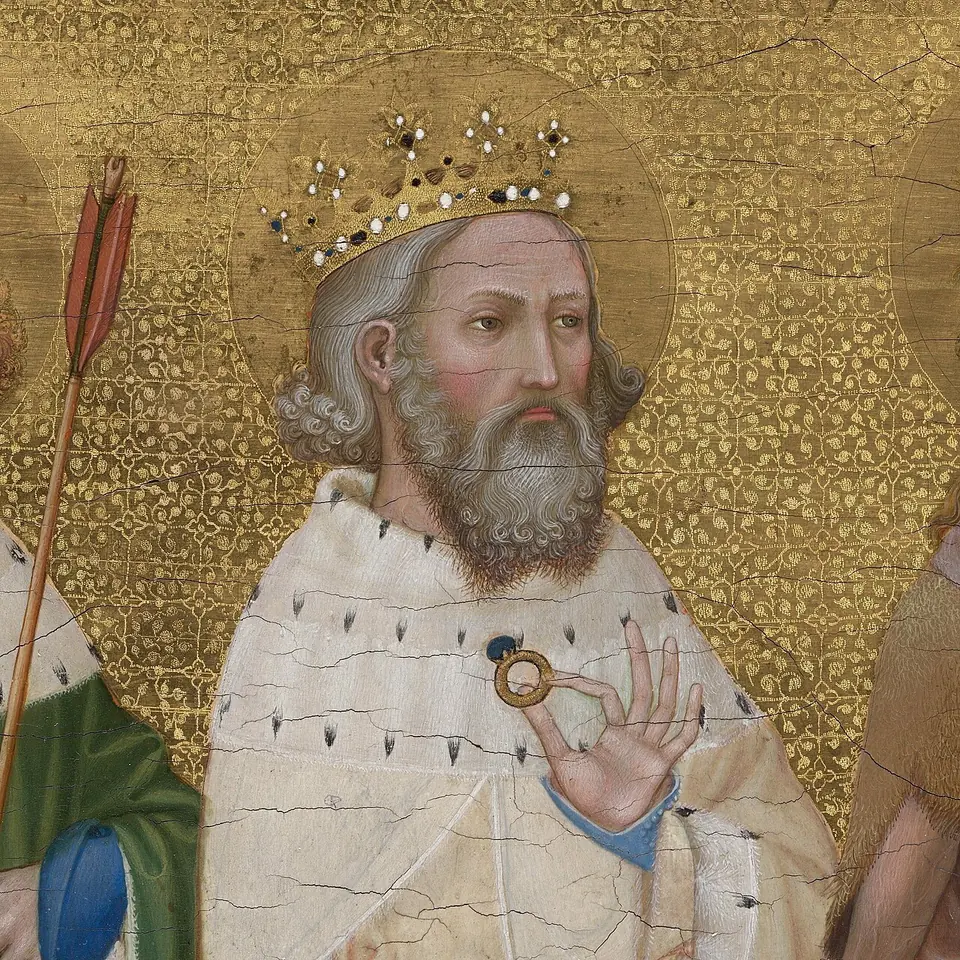
The Wilton Diptych, painted for King Richard II, shows him standing between St. Edmund and St. John the Baptist, holding the ring. So does the window at Canterbury below. A 13th-century illustrated life in Anglo-Norman verse, La Estoire de Seint Aedward le Rei, attributed to Matthew Paris, tells his story in a long series of tinted drawings.


The shrine and feast of St. Edward
On October 13, 1163, two years after his canonization, Edward's body was moved to a new shrine. The Catholic Encyclopedia says St. Thomas of Canterbury, better known as St. Thomas Becket, presided in the presence of King Henry II. October 13 became his main feast. The Roman Martyrology also remembers him on January 5, the day he died.
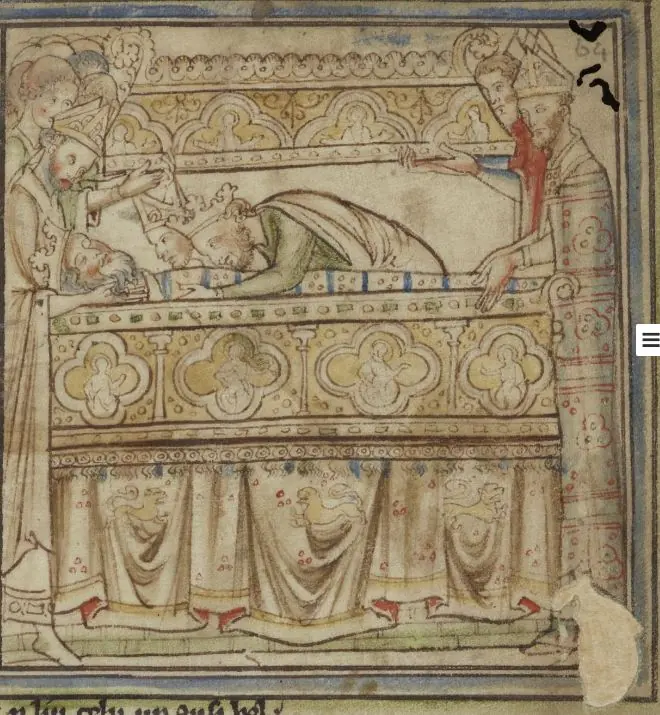

King Henry III, who was devoted to Edward, tore down most of the Norman church from 1245 and built the Gothic abbey that stands today in his honor. On October 13, 1269, Henry, his brother and his two sons carried Edward's coffin on their shoulders to a new shrine decorated with Italian Cosmati mosaic. Sick pilgrims knelt in the recesses of its base to pray for healing.
When Henry VIII dissolved the monastery in 1540, the shrine was stripped of its treasures. Mary I had it reassembled, and by 1557 the coffin was back in place. After a choirman found a hole in the coffin in 1685 and pulled out a gold crucifix and chain, James II had the body enclosed in a new, iron-bound coffin, and it has not been disturbed since.
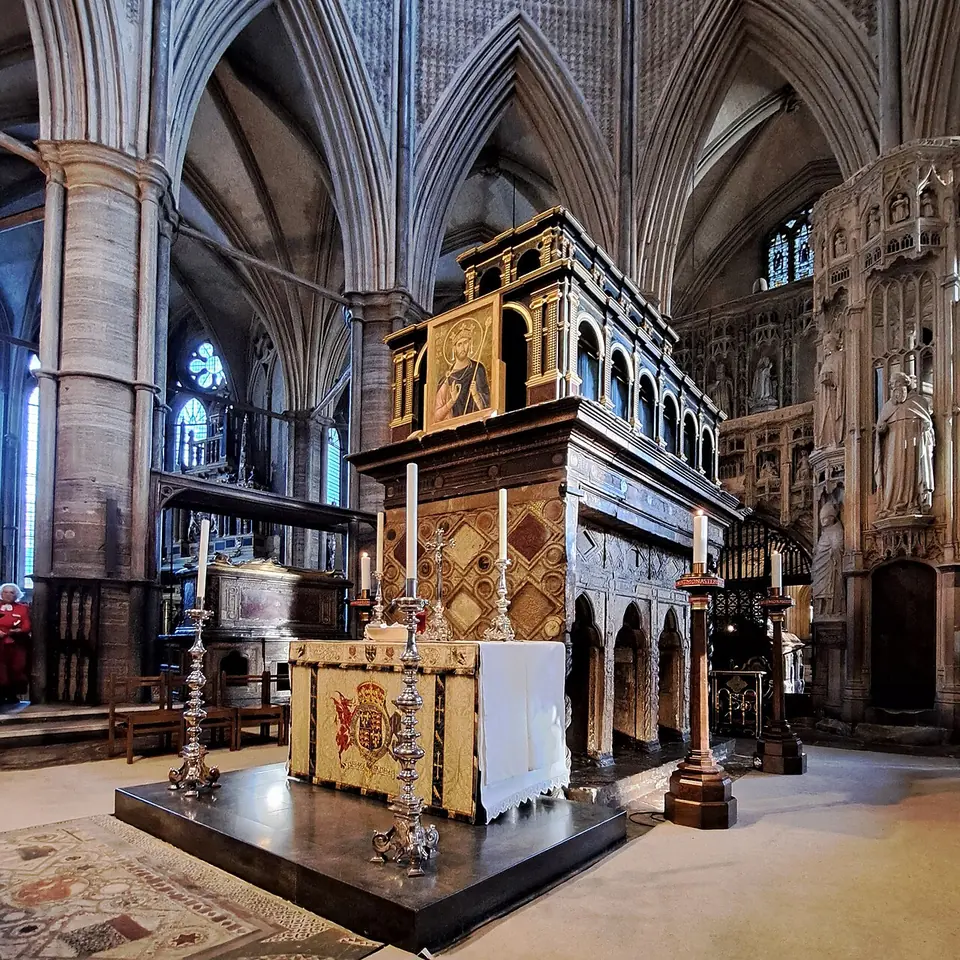

Today October 13 is an optional memorial in the national calendar of England. Westminster Abbey keeps Edwardtide each year from October 13 to 18 with a national pilgrimage to the shrine, and on special occasions pilgrims may still kneel in its recesses to pray. His great-niece, St. Margaret of Scotland, grew up partly at his court. Find nearby feasts on our feast days page.
Prayer to St. Edward the Confessor
There is no novena or prayer to St. Edward that can be traced to an early source, and we haven't found an official English translation of a collect for his memorial to quote here. Catholics, and many Anglicans at Westminster Abbey, ask his intercession in their own words, especially for rulers, for peace in the nation and for troubled marriages. Pilgrims to the shrine during Edwardtide pray in the chapel that holds his coffin.
Frequently asked questions
Why is he called "the Confessor"?
In the Church's old vocabulary, a confessor was a saint who bore witness to the faith by a holy life but did not die as a martyr. The title separates him from his uncle, St. Edward the Martyr, a king of England murdered in 978.
When is St. Edward the Confessor's feast day?
October 13, the anniversary of the day in 1163 when his body was moved to a new shrine at Westminster. It is an optional memorial in the national calendar of England, and Westminster Abbey keeps an octave of celebrations from October 13 to 18. The Roman Martyrology lists him on January 5, the day he died.
What is the legend of St. Edward's ring?
Tradition says the king, having no money with him, gave his ring to an old beggar who asked for alms in the name of St. John the Evangelist. Years later two English pilgrims lost in the Holy Land were helped by an old man who said he was St. John, and he sent the ring back to Edward with word that the king would soon join him in heaven. The story is traditional, and it is carved on a 15th-century screen in Westminster Abbey.
Is St. Edward the Confessor buried in Westminster Abbey?
Yes. His coffin lies inside the stone shrine behind the high altar, in the chapel that bears his name. Henry III built the shrine, and his body was moved into it on October 13, 1269. After the shrine was stripped at the Reformation, Mary I had it put back together, and it is still the center of the abbey.
What is St. Edward the Confessor the patron saint of?
Catholic Culture lists kings, difficult marriages, separated spouses and the English royal family. Before St. George took his place in the 14th century, many English people regarded him as the patron saint of England.
Sources
- Catholic Encyclopedia (1909): St. Edward the Confessor
- Catholic Encyclopedia (1912): Westminster Abbey
- Catholic Encyclopedia (1909): St. Edward the Martyr
- Westminster Abbey: Edward the Confessor and Edith
- Westminster Abbey: Celebrating St Edward
- The Golden Legend, The Life of S. Edward the Confessor (Caxton translation, 1483; Temple Classics edition)
- Liturgy Office of England and Wales: National Calendar for England
- Catholic Culture: St. Edward the Confessor (January 5)
- Roman Martyrology, January 5