St. Denis of Paris
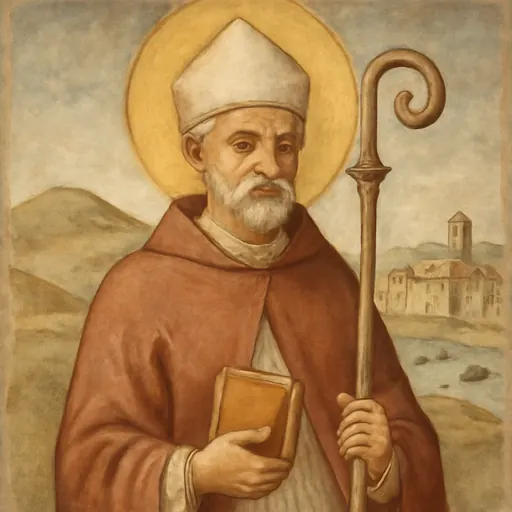
St. Denis was the first bishop of Paris, sent from Rome to Gaul around 250 and beheaded with his companions Rusticus and Eleutherius in the third century. A medieval legend says he picked up his head and walked away carrying it, which is why art shows him holding his head. He is a patron saint of Paris and of France and one of the Fourteen Holy Helpers, invoked against headaches. His feast day is October 9.
Who was St. Denis?
Denis was the first bishop of Paris, a missionary sent from Rome to Gaul in the third century, when Paris was still the small Roman town of Lutetia on the Seine. He was beheaded for his faith together with two companions, the priest Rusticus and the deacon Eleutherius. Over the next thousand years his grave north of the city became the abbey of Saint-Denis, the burial church of the kings of France, and Denis became the patron saint of France.
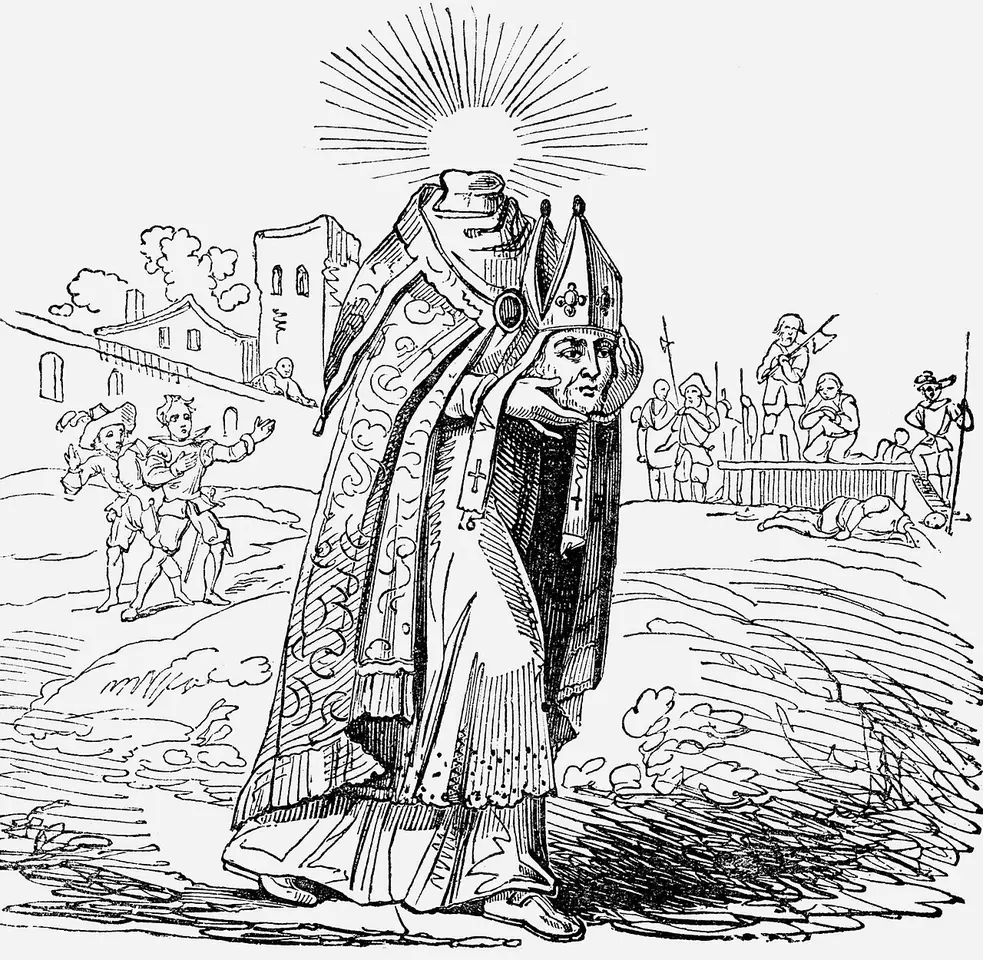
He is best known today for a legend. Medieval writers said that after his execution he picked up his own head and walked away with it, and that is how artists have shown him ever since. That story is legend. The core of his life (a bishop, a mission, a martyrdom and a grave) is history, though thinly documented.


His name is the French form of the Greek Dionysius. English writers have also spelled it Denys.
What the early sources say
The oldest surviving witness is Gregory of Tours, writing his History of the Franks around 590. Under the persecution of the emperor Decius, he says, "seven men were ordained as bishops and sent into the Gauls to preach," and he dates their mission by the consulship of Decius and Gratus, the year 250. "Bishop Dionisius" went to Paris. Gregory's whole account of the martyrdom fits in one sentence: "the blessed Dionisius, bishop of Paris, after suffering divers pains in Christ's name, ended the present life by the threatening sword."
The first full account of his life is the Passion of Sts. Dionysius, Rusticus and Eleutherius, written at the end of the 6th or the start of the 7th century. The Catholic Encyclopedia says it is "interwoven with much legend" but that some facts can be drawn from it:
- Denis came with Rusticus and Eleutherius and settled on the island in the Seine (today's Île de la Cité), where he built a church.
- His preaching led to many conversions, and the pagan priests stirred up the people against him.
- The governor, Fescenninus Sisinnius, had the three men arrested, and when they would not give up their faith they were beheaded.
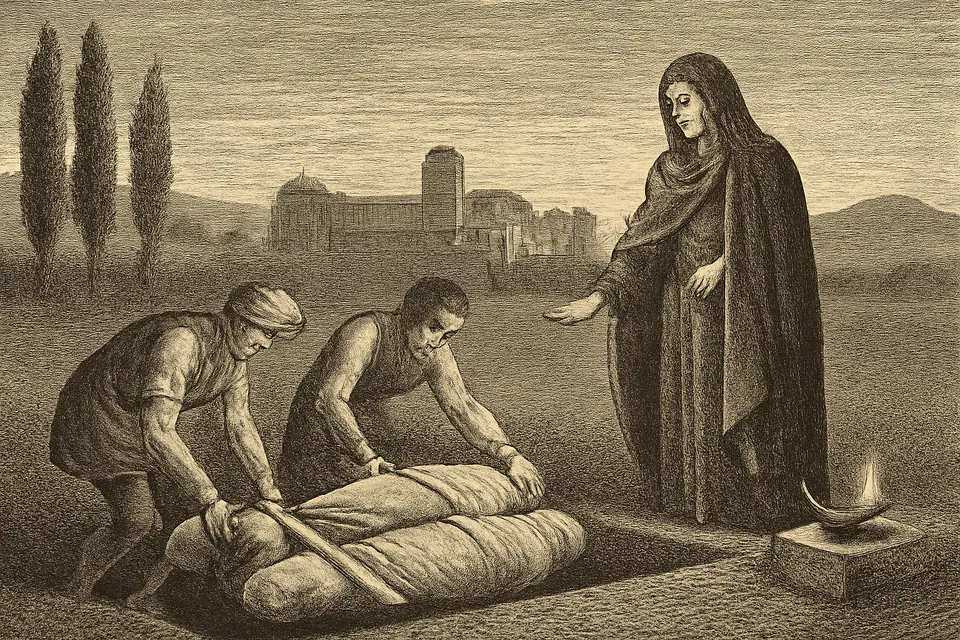
- A Christian woman named Catulla gave them an honorable burial, and a small shrine was built over their grave.
The date of their death is uncertain. The Saint-Denis basilica gives about 250. The Catholic Encyclopedia suggests about 275. Later versions of the story piled on tortures (scourging, the rack, wild beasts, fire) that the earliest sources do not mention.

The legend of the head-carrier
The story that made Denis famous comes from the 9th century. Hilduin, abbot of Saint-Denis, rewrote the saint's life at the request of the emperor Louis the Pious and finished his version in 836. According to the basilica's own history, Hilduin gathered older stories and legends, and the best known of them says that the beheaded bishop picked up his head at Montmartre and walked north, reciting prayers, until he fell at the village of Catulliacus, where the basilica now stands.
This is traditional: a legend, not a historical report, and the basilica calls it "the myth of Saint Denis." Saints shown carrying their heads are called cephalophores, from the Greek for "head-carriers," and Denis is the most famous of them. The legend also tied the hill of Montmartre to the martyrdom, and it is still remembered there.

Three men called Dionysius
Hilduin made a second, larger mistake. He identified Denis of Paris with Dionysius the Areopagite, the Athenian judge who became a Christian after hearing St. Paul preach (Acts 17:34). He also made both men the author of a set of mystical Greek writings that the abbey of Saint-Denis had owned since 827. Those writings are now known to come from an unknown author of about the year 500, called Pseudo-Dionysius.
For about eight centuries this merged figure was believed in France: Denis was a disciple of St. Paul, sent to Gaul in the first century. The Catholic Encyclopedia calls it "a serious error" and notes that scholars from the 17th century on, beginning with Jean de Launoy and the Bollandists, took it apart. Today the three are treated as different people. The Areopagite is honored in the Eastern churches on October 3, Denis of Paris on October 9.
The miracles of St. Denis
None of Denis's miracles has been formally investigated; his cult is far older than the modern process. Sorted by this encyclopedia's labels:
- Carrying his head after his beheading: traditional, from Hilduin's 9th-century life.
- Conversions and wonders during his preaching in Lutetia: traditional, from the Passion and later lives.
- Healings and favors at his tomb: reported. Pilgrims came to his grave for centuries; Abbot Suger wrote in the 12th century that the crowds coming to honor the relics were so large that people were crushed in the press. None of these claims was examined in the modern way.
Why St. Denis is the patron saint of Paris and France
Denis is a patron of Paris because he was its first bishop and died there. He shares that title with St. Genevieve, who had a church built over his grave in the 5th century, according to her early Life.
He became the patron saint of France in the Middle Ages because the kings made his abbey their own. Dagobert I, who died in 639, was the first king buried at Saint-Denis, and his successors enriched the abbey and placed themselves under the saint's protection.
He is also one of the Fourteen Holy Helpers, the saints whom Christians in medieval Germany called on together during the Black Death. Catholic Culture's list says Denis is "Invoked against diabolical possession and headaches." The headache patronage follows from his legend. Other Holy Helpers include St. Blaise, St. Vitus, St. Christopher and St. Giles. See our patron saints page for the full list.


Symbols of St. Denis in art
Denis is one of the easiest saints to recognize in a French church. Look for:
- His head in his hands: a bishop holding his own head, usually still wearing its miter, in front of his chest. This is the sign of his martyrdom and of the legend told above.
- Bishop's vestments, miter and crozier: he is always dressed as a bishop.
- Two companions: a priest (Rusticus) and a deacon (Eleutherius), shown beside him in scenes of his preaching or martyrdom.
- Angels: on the Portal of the Virgin at Notre-Dame, two angels escort him.
- Fleurs-de-lis: in late medieval French art, his robe may carry the royal lilies, a sign that he was the kingdom's saint.
Other head-carrying saints exist, but in France a bishop holding his head is almost always Denis. When he is shown before his death he looks like any early bishop, so the companions and the setting in Paris are the clues.


The Basilica of Saint-Denis
Christians gathered at Denis's grave from the beginning. Catulla's small shrine was replaced in the 5th century by a church; the basilica says a first church was probably built then. Merovingian nobles chose to be buried near the saint, among them Queen Aregund, a daughter-in-law of Clovis, around 580.


A larger church was consecrated in 775 in the presence of Charlemagne. Then, in the 12th century, Abbot Suger, elected in 1122, rebuilt it. He gave it a new west front between 1130 and 1140 and a new choir between 1140 and 1144, with ribbed vaults and walls opened up for great stained glass windows. Suger said he enlarged the church because the crowds coming to honor the saints' relics had grown too large. His choir is counted as the first great building of Gothic architecture.


The abbey became the burial place of the kings of France: 40 kings, 26 queens and about a dozen servants of the crown, from Dagobert in 639 to Louis XVIII in 1824. St. Louis IX had sixteen tomb effigies carved for his royal ancestors. In October 1793, during the Revolution, the royal bodies were exhumed and thrown into two mass graves; Louis XVIII had the remains gathered into an ossuary in the crypt in 1817. The church became the cathedral of the new Diocese of Saint-Denis in 1966.
Feast day of St. Denis
His feast is October 9, an optional memorial on the General Roman Calendar, shared with his companions Rusticus and Eleutherius. See our feast days page for the saints around it.


Many French churches are named for him, as is the city of Saint-Denis, which grew up around his tomb.
Prayer to St. Denis
The Church's own prayer for his feast is the collect of the Mass of October 9 in the Roman Missal, as printed by Our Sunday Visitor:
O God, who sent Saint Denis and his companions to preach your glory to the nations and strengthened them for their mission with the virtue of constancy in suffering, grant, we pray, that we may imitate them in disdaining prosperity in this world and in being undaunted by any trial. Through our Lord Jesus Christ, your Son, who lives and reigns with you in the unity of the Holy Spirit, God, for ever and ever.
Outside the liturgy, Catholics ask St. Denis to pray for them in headaches and other pains of the head, as one of the Fourteen Holy Helpers, and for the Church in Paris and France.
Frequently asked questions
Why is St. Denis holding his head?
Because of a legend first written down in full in the 9th century by Hilduin, abbot of Saint-Denis. It says that after Denis was beheaded he picked up his head and walked north from Montmartre, praying, to the place where he wished to be buried, now the town of Saint-Denis. The story is traditional, a legend, not history; saints shown this way are called cephalophores, "head-carriers."
When is St. Denis's feast day?
October 9. In the General Roman Calendar it is an optional memorial of St. Denis, bishop, and his companions, martyrs. The companions are the priest Rusticus and the deacon Eleutherius, who died with him.
What is St. Denis the patron saint of?
He is a patron of Paris, where he was the first bishop, and was honored as the patron saint of France in the Middle Ages. As one of the Fourteen Holy Helpers he is invoked against headaches and against diabolical possession.
Is St. Denis the same as Dionysius the Areopagite?
No. Dionysius the Areopagite was an Athenian converted by St. Paul (Acts 17:34). Medieval writers, above all Abbot Hilduin in 836, merged him with Denis of Paris and with the unknown author of the mystical writings now called Pseudo-Dionysius. The Catholic Encyclopedia calls this "a serious error," and historians today treat them as three different people.
Who is buried in the Basilica of Saint-Denis?
Besides the saint himself, 40 kings, 26 queens and about a dozen servants of the crown were buried there, from King Dagobert in 639 to Louis XVIII in 1824. The basilica has more than 70 royal tomb effigies.
Sources
- Catholic Encyclopedia (1908): St. Denis
- Gregory of Tours, History of the Franks, Book I, 30 (Brehaut translation, Medieval Sourcebook)
- Centre des monuments nationaux: History of the monument, Saint-Denis Basilica Cathedral
- Centre des monuments nationaux: The cradle of Gothic art, Saint-Denis Basilica Cathedral
- Centre des monuments nationaux: The recumbents of the Basilique cathédrale Saint-Denis
- Catholic Culture: Fourteen Holy Helpers
- Our Sunday Visitor: St. Denis and Companions (with the collect of the day)
- Passio SS. Dionysii, Rustici et Eleutherii (late 6th or early 7th century)
- Roman Martyrology, October 9