St. Isaac Jogues, St. John de Brébeuf and the North American Martyrs
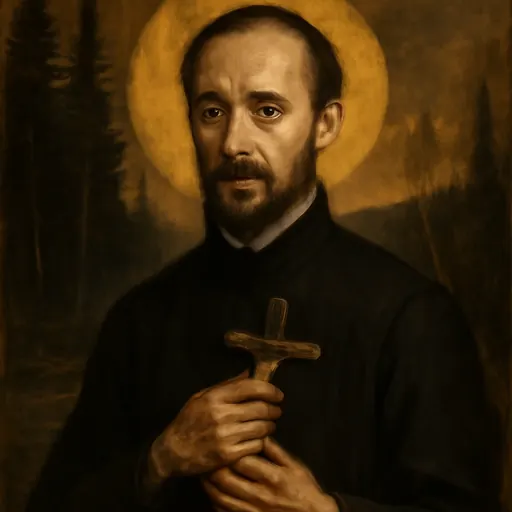
St. Isaac Jogues (1607 to 1646) was a French Jesuit priest who worked among the Wendat (Huron) people in Canada, survived a year as a captive of the Mohawk, and was killed at the Mohawk village of Ossernenon, in present-day New York, in 1646. He, St. John de Brébeuf and six companions are the North American Martyrs, canonized in 1930. Their feast day is October 19 (September 26 in Canada), and they are patrons of Canada.
Who was St. Isaac Jogues?
Isaac Jogues was a French Jesuit who came to New France in 1636, worked six years among the Wendat (Huron) people around Georgian Bay, was captured by Mohawk warriors in 1642 and lived thirteen months as their captive. He escaped with Dutch help, went back to France, and then, against all advice, returned to the Mohawk country as a peace envoy and missionary. He was killed at the Mohawk village of Ossernenon on October 18, 1646.
The Church honors him together with seven others who died between 1642 and 1649: the Jesuit priests John de Brébeuf, Gabriel Lalemant, Anthony Daniel, Charles Garnier and Noël Chabanel, and two lay helpers, René Goupil and John de Lalande. Pope Pius XI canonized all eight on June 29, 1930. In Canada they are usually called the Canadian Martyrs. In the United States they are the North American Martyrs, and Jogues, Goupil and Lalande, who died in what is now New York State, are honored at the shrine of Auriesville.


Their stories come mainly from the Jesuit Relations, the yearly reports the missionaries sent to France, and from Jogues's own letters. These are firsthand sources, written by men who believed in their mission and saw the Wendat and Haudenosaunee through 17th-century French eyes. The National Shrine at Auriesville describes the setting plainly: the Wendat and Algonquin were allied with the French, the Haudenosaunee (Iroquois) with the Dutch, and the fur trade, epidemics and war drew the missionaries into conflicts much larger than themselves.
The life of Isaac Jogues
Orléans to Huronia
Jogues was born in Orléans on January 10, 1607, and entered the Society of Jesus at 17. The Jesuits' own biography says he celebrated his first Mass on February 10, 1636, and was on his way to New France two months later. Within weeks of landing at Quebec he set out on the long canoe journey to Ihonatiria in the Huron country, where he met John de Brébeuf and began learning the language. The Wendat called him Ondessonk.
The Catholic Encyclopedia says he and Charles Raymbault reached Sault Ste. Marie in 1641, among the first Europeans to do so, and that Jogues hoped to carry the Gospel west to the Sioux.
Captivity among the Mohawk, 1642 to 1643
On August 3, 1642, a Mohawk war party ambushed his canoes on the St. Lawrence. Jogues, the lay surgeon René Goupil, another Frenchman named Guillaume Couture and about twenty Wendat were taken to Ossernenon on the Mohawk River. The sources describe beatings and the loss of several of Jogues's fingers. On the way, Goupil asked to be received into the Society, and Jogues accepted his vows.
At Ossernenon, Goupil made the sign of the cross over a child. Some in the village took it for a curse, and he was killed with a hatchet blow. The Catholic Encyclopedia gives the date as September 23, 1642; the Jesuits and the Auriesville shrine give September 29. Jogues buried him in a ravine.
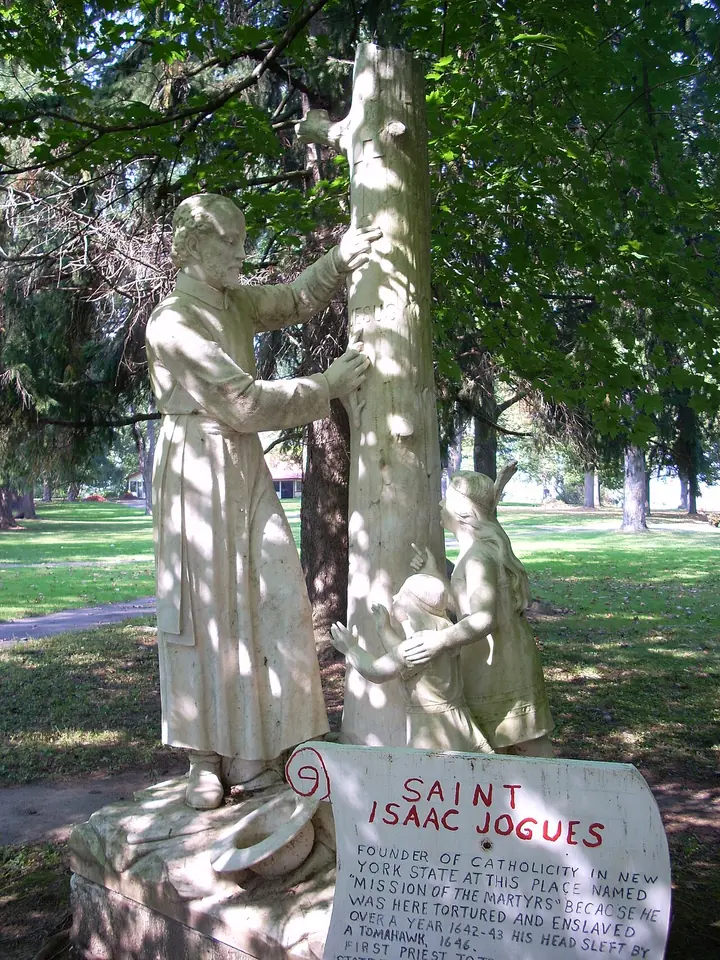
Jogues lived on as a slave. The shrine records that a Mohawk woman he called his "aunt" protected him more than once. When he could slip away, he stripped bark from a tree in the shape of a cross and prayed there. He also baptized and heard the confessions of other prisoners.

Escape and return
In 1643, Dutch settlers at Fort Orange (Albany), among them the Reformed minister Johannes Megapolensis, helped him escape and hid him until a ship carried him to New Amsterdam, which made him the first Catholic priest known to have visited Manhattan. He landed in Brittany on Christmas morning, 1643. Because of his hands he could no longer celebrate Mass under the rules of the time, and Pope Urban VIII gave him a dispensation. The 1910 Catholic Encyclopedia reports that the pope called him a martyr of Christ.
He returned to New France in 1644. In 1646 the French sent him to the Mohawk to confirm a peace treaty. On the way he named the long lake the Mohawk called Horicon the Lake of the Blessed Sacrament. It is Lake George today. The talks went well, and he left a box of belongings at Ossernenon, meaning to come back.

Death at Ossernenon, 1646
He set out again in late September 1646 with John de Lalande, a young layman from Dieppe. By then sickness and crop failure had struck the village, and the box he had left was blamed. Jogues knew the danger and went on. He and Lalande were seized near Lake George and taken to Ossernenon. The Jesuits note that some clans wanted peace with the French, but on the evening of October 18 Jogues was struck down with a tomahawk as he entered a lodge. Lalande was killed early the next morning. Their bodies were thrown into the Mohawk River, and no relics were recovered.

John de Brébeuf and the Huron mission
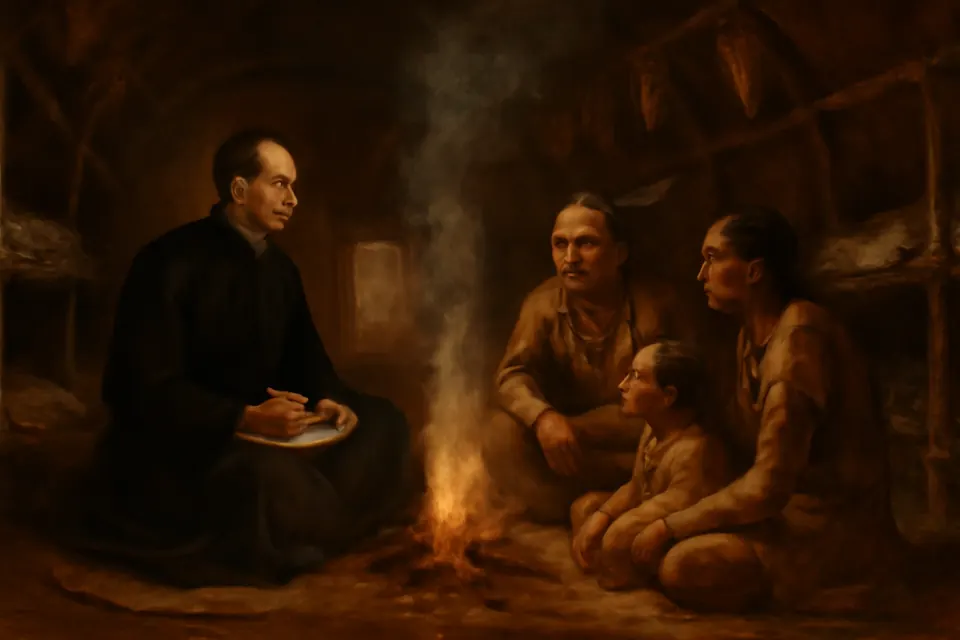
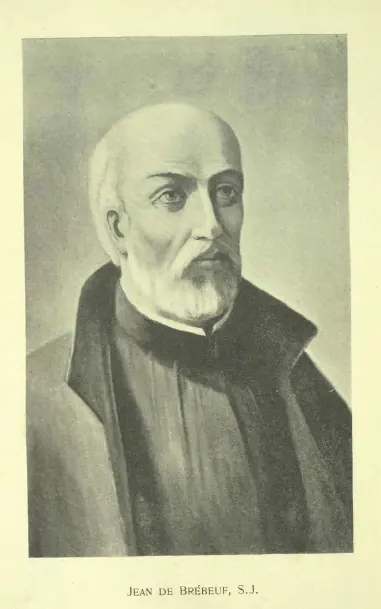
John (Jean) de Brébeuf, born in Normandy in 1593, was the first Jesuit to reach Huronia, in 1626. He was a very big man, and the Wendat named him Echon, "the one who carries the load." He spent years learning their language, wrote a Huron grammar and catechism, and taught the language to the missionaries who followed, including Jogues.
Tradition credits him with the Huron Carol, Jesous Ahatonhia. When Pope John Paul II prayed at the Martyrs' Shrine in 1984, he said Brébeuf "dreamed of a Church fully Catholic and fully Huron as well."

The work was hard. A smallpox epidemic struck the Wendat in 1636 and lasted all winter. The Jesuits baptized more than a thousand people at the point of death, and some Wendat accused them of causing the disease. The mission headquarters, Sainte-Marie, became what the Jesuits describe as a thriving settlement where the missionaries farmed and raised cattle, pigs and fowl.


The Haudenosaunee war against the Wendat reached Huronia in 1648. The other five martyrs died in the next eighteen months:
- Anthony Daniel: killed on July 4, 1648, at Teanaostaye, after he gathered his people in the chapel, baptized the catechumens and walked out to meet the attackers.
- John de Brébeuf and Gabriel Lalemant: captured on March 16, 1649, at the mission of St. Louis, where they chose to stay with the Wendat Christians, and killed at St. Ignace. Brébeuf died that day and Lalemant the next. The Jesuits say Lalemant had been in Huronia only a few months.
- Charles Garnier: killed on December 7, 1649, among the Petun people, while helping the wounded.
- Noël Chabanel: killed on December 8, 1649. He had found the language and life almost unbearable but took a vow never to leave the mission.
The sources record the torments of these deaths in detail. This entry leaves them there. The Catholic Encyclopedia notes that Brébeuf never cried out, and the Jesuits say he kept encouraging the Wendat Christians around him.
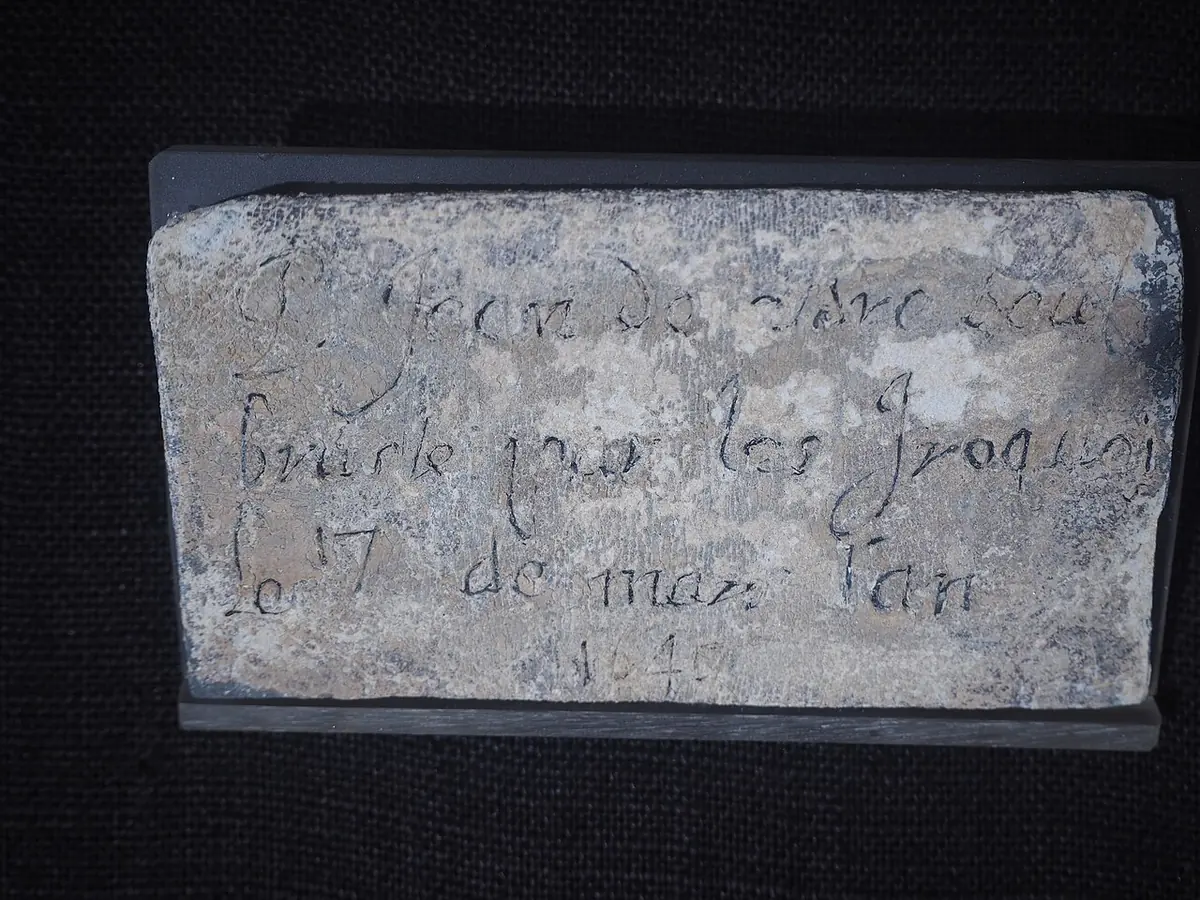

The plate's catalog record says it was found in 1954 during excavations of the Wendat chapel at Sainte-Marie. It gives the date as March 17, a day later than the date in the Catholic Encyclopedia and the Jesuits' own biography.
Miracles and canonization
The eight were canonized as martyrs, killed, in the Church's judgment, in hatred of the faith. No individual miracle of theirs is described in the sources used here. The Catholic Encyclopedia records that a church court sat in Quebec to take testimony about Jogues and that a court for Brébeuf sat for a full year in 1904. Pope Pius XI canonized them in 1930.
- Traditional: wonders told in devotional writing come from the missionaries' circle and later devotion, not from formal investigation. The Auriesville novena, for example, says of Charles Garnier: "Many were those who saw you walking with holy beings not of this world."
- Reported: favors attributed to the martyrs by pilgrims at Auriesville and Midland are personal testimonies the Church has not examined.
Why they are the patron saints of Canada
The martyrs died founding the first Catholic mission in what became Ontario, and the Church in Canada has honored them since. Catholic Culture lists them as patrons of Canada and of the Americas. Their feast in Canada is September 26. See all the patron saints.
Symbols of the North American Martyrs in art
- Black Jesuit cassock and crucifix: every one of the eight is shown this way, often with the IHS monogram of the Society of Jesus.
- The martyr's palm and red roses: signs of martyrdom, common on holy cards.
- A cross cut into a tree: the sign of Isaac Jogues, from his prayer in the woods at Ossernenon. The Auriesville statue on this page uses it.
- Damaged hands: some portraits of Jogues show the missing fingers, the mark of his captivity.
- A very tall priest: Brébeuf is usually the largest figure in group scenes, sometimes in a broad-brimmed hat, as in the Midland window.
- Wendat or Mohawk figures: children being taught, or converts such as Joseph Chiwatenwa, often appear with them.


To tell them apart in a group, look for names under the figures. Brébeuf and Jogues, the two named in the feast's title, are usually given the central places.


Feast day and shrines
The Church celebrates the eight on October 19 in the General Roman Calendar and the United States, and on September 26 in Canada. See the feast day calendar.
Auriesville, New York
In 1884 Fr. Joseph Loyzance, S.J., bought land on a hill at Auriesville that he and other researchers identified as Ossernenon and built a small shrine there called Our Lady of Martyrs. The first Mass on August 15, 1885, drew 4,000 pilgrims. The round Coliseum church was finished in 1931 and seats 6,500. In 2017 the Jesuits transferred the shrine to a lay nonprofit, the Friends of Our Lady of Martyrs Shrine. The shrine also honors St. Kateri Tekakwitha, who was born at Ossernenon in 1656.
The location is debated. In a 2025 book, Richard Upsher Smith Jr. argued that the martyrdoms happened about seven miles upriver at an archaeological site in Root, New York. The shrine has published a reply defending the traditional site.


Midland, Ontario
The Martyrs' Shrine stands on a hill across the road from Sainte-Marie among the Hurons, the reconstructed Jesuit mission. Pope John Paul II prayed there on September 15, 1984, and recalled that Pope Urban VIII had named the chapel of Sainte-Marie a place of pilgrimage in 1644.


Relics
The martyrs' remains were mostly lost. The 1907 Catholic Encyclopedia reports that Brébeuf's head was kept as a relic at the Hôtel-Dieu in Quebec. Goupil's body lies somewhere in the ravine at Auriesville, which the shrine calls a natural reliquary. Jogues and Lalande were thrown into the Mohawk River.
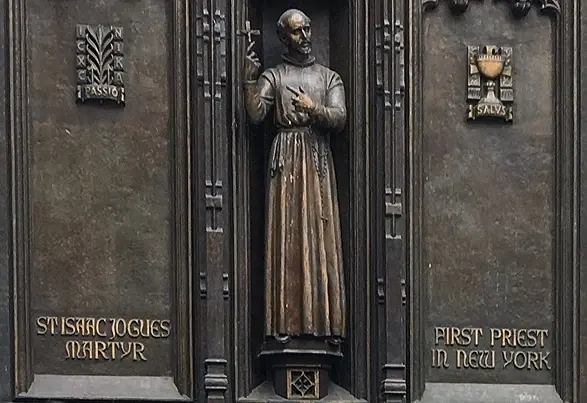
In New York City, Jogues appears on the bronze doors of St. Patrick's Cathedral as the "First Priest in New York."

Prayer to the North American Martyrs
The Collect of the Mass for October 19, from the Roman Missal as used in the United States, is the Church's official prayer for the day:
O God, who chose to manifest the blessed hope of your eternal Kingdom by the toil of Saints John de Brébeuf, Isaac Jogues and their companions and by the shedding of their blood, graciously grant that through their intercession the faith of Christians may be strengthened day by day. Through our Lord Jesus Christ, your Son, who lives and reigns with you in the unity of the Holy Spirit, God, for ever and ever.
The National Shrine at Auriesville prays a novena from October 11 to 19, one day for each martyr, and ends with this closing prayer:
Heavenly Father, You consecrated the beginnings of the faith in North America by the blood of St. John de Brébeuf, St. Isaac Jogues, and their companions who were preaching the faith to the Indigenous peoples. Through their intercession may people throughout North America and the world respond to the Gospel of Salvation. Grant that our way of life may give witness to our faith in You. We ask this through our Lord Jesus Christ, your Son, who lives and reigns with you and the Holy Spirit, one God, for ever and ever. Amen
The shrine's novena also quotes Jogues's own words from captivity: "in all probability I could escape, yet on this cross to which our Lord has nailed me beside Himself, am I resolved by His grace to live and die."
Frequently asked questions
Who are the eight North American Martyrs?
Six Jesuit priests and two lay assistants: St. Isaac Jogues, St. John de Brébeuf, St. Gabriel Lalemant, St. Anthony Daniel, St. Charles Garnier and St. Noël Chabanel, with René Goupil and John de Lalande. Goupil, Jogues and Lalande died in what is now New York (1642 and 1646); the other five died in Huronia, in present-day Ontario (1648 and 1649).
When is the feast of St. Isaac Jogues?
October 19 in the General Roman Calendar and in the United States, where it is a memorial of Sts. John de Brébeuf and Isaac Jogues and Companions. In Canada the feast is September 26. Jogues himself died on October 18, 1646.
What is St. Isaac Jogues the patron saint of?
Catholic Culture lists the North American Martyrs as patrons of Canada and of the Americas. Jogues, Goupil and Lalande, who died in what is now New York State, are especially honored at the shrine in Auriesville.
Why did Isaac Jogues need the pope's permission to say Mass?
During his captivity in 1642 his captors cut or crushed several of his fingers, including the thumb and forefinger a priest uses to hold the Host. Church law then barred a priest with such injuries from celebrating Mass. Pope Urban VIII granted him a dispensation after his return to France.
Where are the North American Martyrs honored?
At the National Shrine of Our Lady of Martyrs in Auriesville, New York, which the Jesuits founded in 1884 on the site they identified as Ossernenon, and at the Martyrs' Shrine in Midland, Ontario, beside the reconstructed mission of Sainte-Marie among the Hurons.
Sources
- Catholic Encyclopedia (1910): St. Isaac Jogues
- Catholic Encyclopedia (1907): Jean de Brébeuf
- Catholic Encyclopedia (1909): René Goupil
- Catholic Encyclopedia (1908): Anthony Daniel
- Society of Jesus: Saint Isaac Jogues
- Society of Jesus: Saint John de Brébeuf
- Society of Jesus: Saint Gabriel Lalemant
- Society of Jesus: Saint Charles Garnier
- Society of Jesus: Saint Noél Chabanel
- Society of Jesus: Saint John de la Lande
- John Paul II, Liturgy of the Word at the Martyrs' Shrine (Huronia), 15 September 1984
- National Shrine of Our Lady of Martyrs: Story of the Martyrs
- National Shrine of Our Lady of Martyrs: Shrine History
- National Shrine of Our Lady of Martyrs: Auriesville is Ossernenon
- National Shrine of Our Lady of Martyrs: Novena to the North American Martyrs (2017)
- Catholic Culture: Memorial of Sts. John de Brébeuf and Isaac Jogues, Priests, and Companions, Martyrs (October 19)