St. Boniface, Apostle of Germany
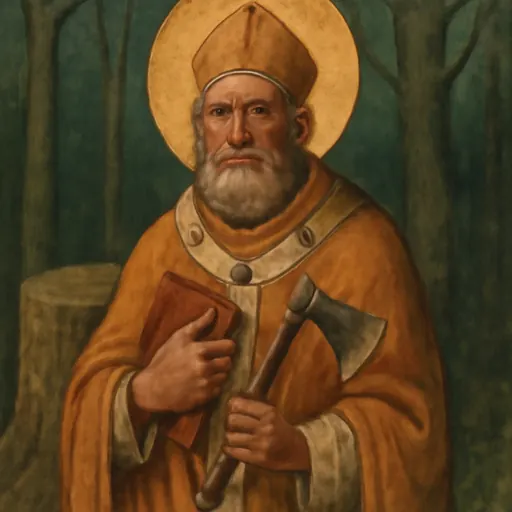
St. Boniface (about 675–754) was an English Benedictine monk, born Winfrid in Wessex, who became the Apostle of Germany. He felled the sacred oak at Geismar, founded monasteries such as Fulda, organized the Church in Germany as archbishop of Mainz and was killed by a band of pagans near Dokkum in Frisia. His feast day is June 5.
Who was St. Boniface?
Boniface was an Anglo-Saxon monk from Wessex, baptized Winfrid, who left a promising career as a teacher in England to preach the Gospel to the pagan and half-Christian peoples of Germany. Over nearly forty years he became their bishop, then archbishop of Mainz, the founder of monasteries such as Fulda, and the man who tied the young German Church closely to Rome. He was killed in 754, at almost eighty, while waiting to confirm new converts on a riverbank in Frisia. Germany honors him as its apostle.
We know him unusually well for an 8th-century saint. More than a hundred of his letters survive, and a priest named Willibald wrote his Life within about thirteen years of his death, drawing on the memories of Boniface's own disciples. Willibald's book is the source of most of the stories below. Later lives added more, and those additions are marked as such.


The life of St. Boniface
Winfrid of Wessex
The Catholic Encyclopedia puts his birth around 675, probably in southwestern Wessex; a later tradition names Crediton in Devon. Willibald says that as a small boy he listened to traveling monks who stayed in his father's house and wanted to join them. His father resisted at first, then let him go to the monastery at Exeter, and later to Nursling, near Southampton, where he ran the school and wrote a Latin grammar and poems. He was ordained a priest at about thirty.
First failure, then Rome
In 716 he sailed to Frisia, on the coast of the present-day Netherlands, to help the missionary St. Willibrord, but war and the pagan King Radbod made preaching impossible and he went home. Elected abbot of Nursling the next year, he declined. In the fall of 718 he went to Rome instead. Pope Gregory II met with him day after day and on May 15, 719, gave him written authority to preach to the peoples of Germany. Benedict XVI noted that it was the Pope who gave Winfrid his new name, Boniface, though the Catholic Encyclopedia reports other views on when he took it.
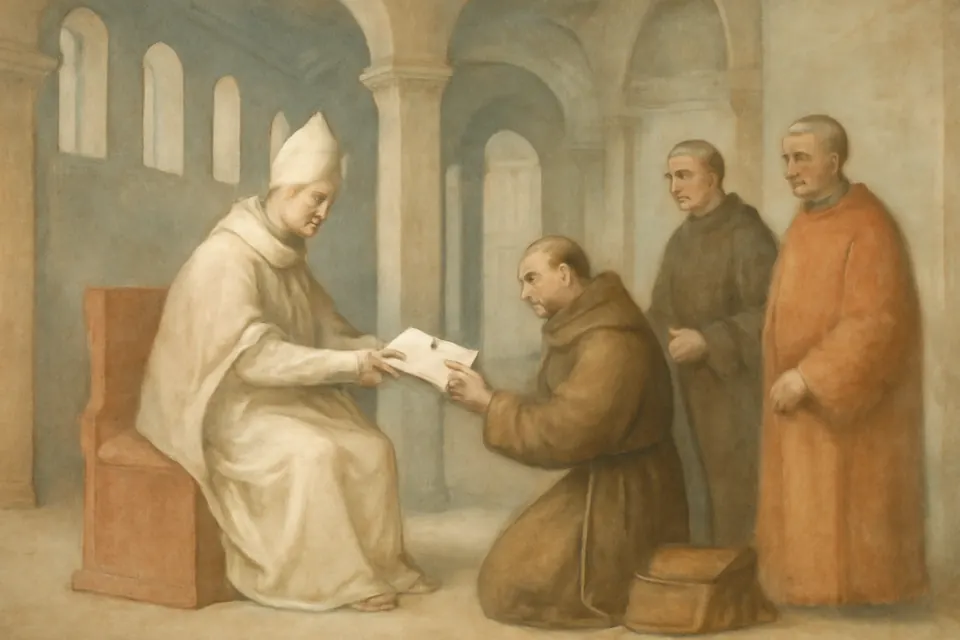
He spent three years in Frisia under Willibrord, who wanted him as his successor at Utrecht. Boniface refused and moved on to Hesse. On November 30, 722, Gregory II consecrated him a bishop in Rome, with no fixed see, and gave him letters asking the Frankish ruler Charles Martel to protect him.
The oak at Geismar
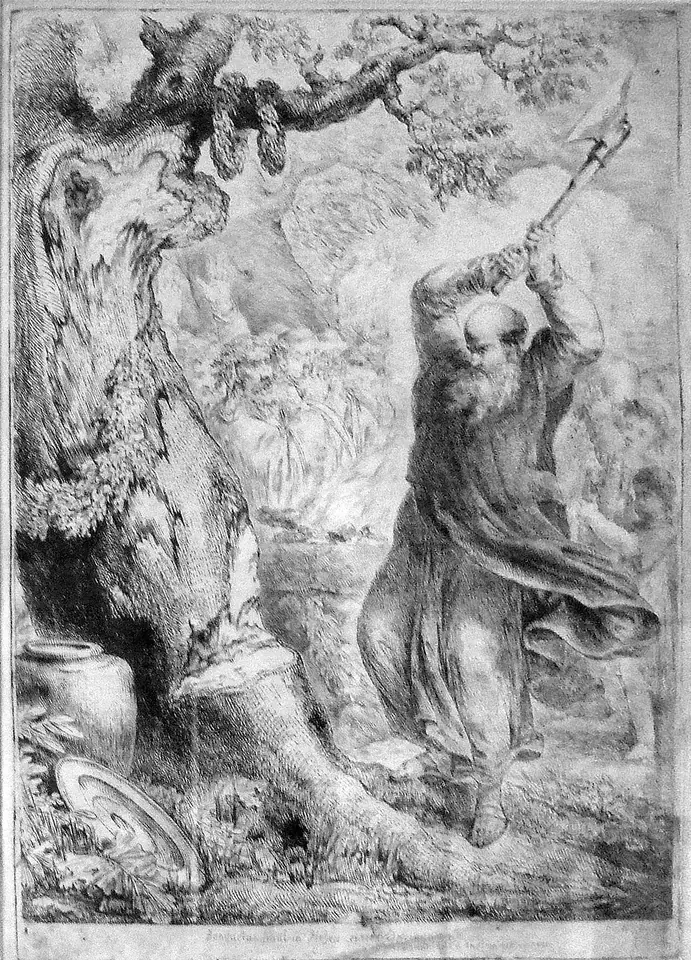
The most famous scene of his life comes from Willibald. At Geismar, near Fritzlar in Hesse, stood an oak of enormous size, called in the old pagan tongue the Oak of Jupiter, the Latin name for the thunder god the Germans called Donar or Thor. Some of the Hessians were baptized Christians who still made offerings at trees and springs. With their advice, Boniface set out to cut the tree down while a crowd of pagans stood by, "bitterly cursing in their hearts the enemy of the gods."
Willibald writes that Boniface had made only a first, shallow cut when a great wind struck the oak from above. It crashed down and burst into four parts of equal length. The watching pagans stopped cursing and began to praise God. Boniface built an oratory from the timber and dedicated it to St. Peter. Willibald presents the gust of wind as an act of God; we label that detail traditional, while the felling of the oak itself is accepted as historical. The Catholic Encyclopedia dates the event to about 723.


Builder of the German Church
From then on Boniface worked less as a lone preacher than as an organizer. He asked England for help, and monks and nuns came: Lull, Burchard, Willibald (the later bishop of Eichstätt, not the biographer), Wunibald, and women such as Lioba, Thecla and Walburga, whom he made abbesses. Gregory III sent him the pallium of an archbishop in 732. Boniface founded monasteries at Amöneburg, Fritzlar and Ohrdruf, set up dioceses in Bavaria, and created new sees at Würzburg, Eichstätt, Buraburg and Erfurt.
With the Frankish rulers Carloman and Pepin he held a series of reform councils from 742 on, the first German synods, which put the clergy under their bishops, forbade priests to carry arms or hunt, and made the Rule of St. Benedict the norm for monks. Pope Zachary made him archbishop of Mainz in 747 or 748. His favorite foundation was Fulda, begun in the 740s under his disciple St. Sturm, where he went every year to pray and teach.

Martyrdom at Dokkum
In his last years Boniface handed Mainz to his disciple Lull and went back to Frisia, the mission field where he had first failed. Willibald records his instructions to Lull: finish the church at Fulda and bury him there, and pack a linen shroud in the chest with his books. In 754 he baptized many thousands east of the Zuiderzee, then camped on the river Borne near Dokkum to confirm the new Christians on an appointed day.
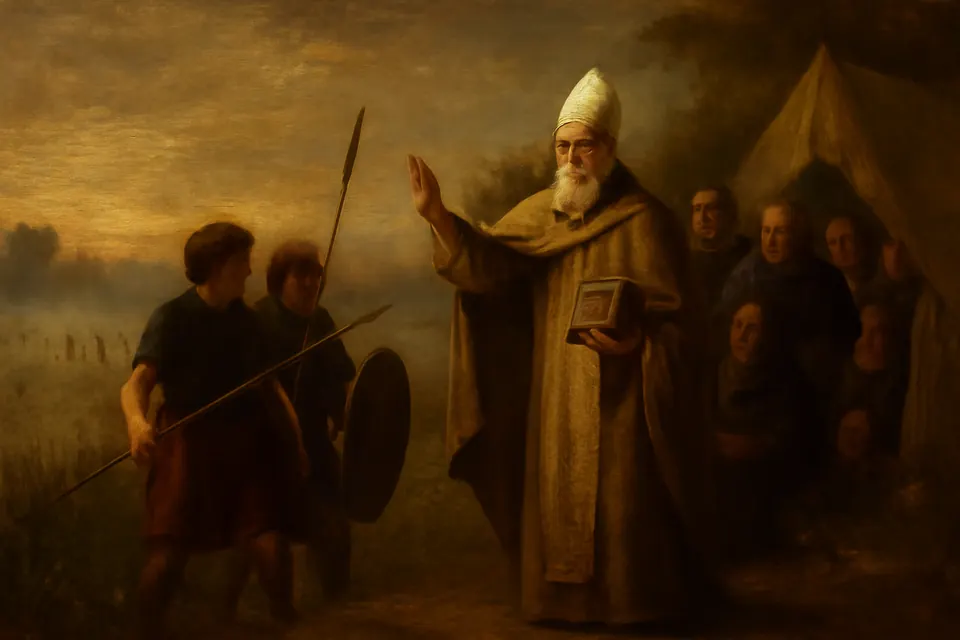
At dawn on June 5, an armed band attacked the camp instead. Willibald says Boniface's attendants grabbed weapons, but he came out of his tent with the relics he always carried and stopped them: "Sons, cease fighting. Lay down your arms, for we are told in Scripture not to render evil for good but to overcome evil by good." He and his companions, about fifty in all, were killed. The attackers broke open his chests hoping for gold, found only books, and scattered them in the fields and marshes. Willibald dates the martyrdom to 755; most historians now give 754.
His body went first to Utrecht, then to Mainz, and finally, as he had asked, to Fulda.
The miracles of St. Boniface
Boniface is remembered far more for his work than for wonders, and Willibald tells only a few. None was investigated in the modern sense, since his cult began centuries before canonization procedures existed.
- The fall of the oak at Geismar: the felling is historical; the sudden wind that split it into four parts is traditional, from Willibald.
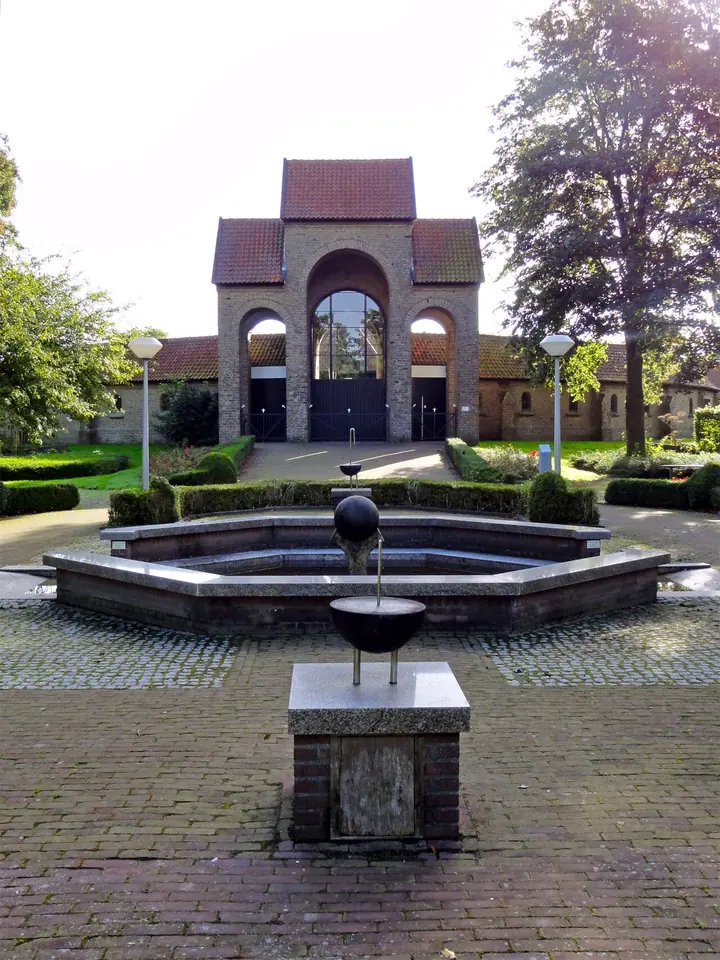
- The spring at Dokkum: Willibald says Bishop Lull heard from King Pepin, who heard from eyewitnesses, that when the Frisians raised a mound for a church at the place of the martyrdom, a spring of fresh water broke out there. It is traditional. A fountain beside the Bonifatiuskapel in Dokkum recalls it.
- The book raised over his head: a later life written at Utrecht reports an eyewitness's memory that Boniface held a Gospel book over his head as the blow fell. Fulda keeps a damaged manuscript, the Ragyndrudis Codex, as that book. This is traditional and cannot be proved.
- Healings at his tomb in Fulda: reported in medieval sources over many centuries; none has been formally examined.
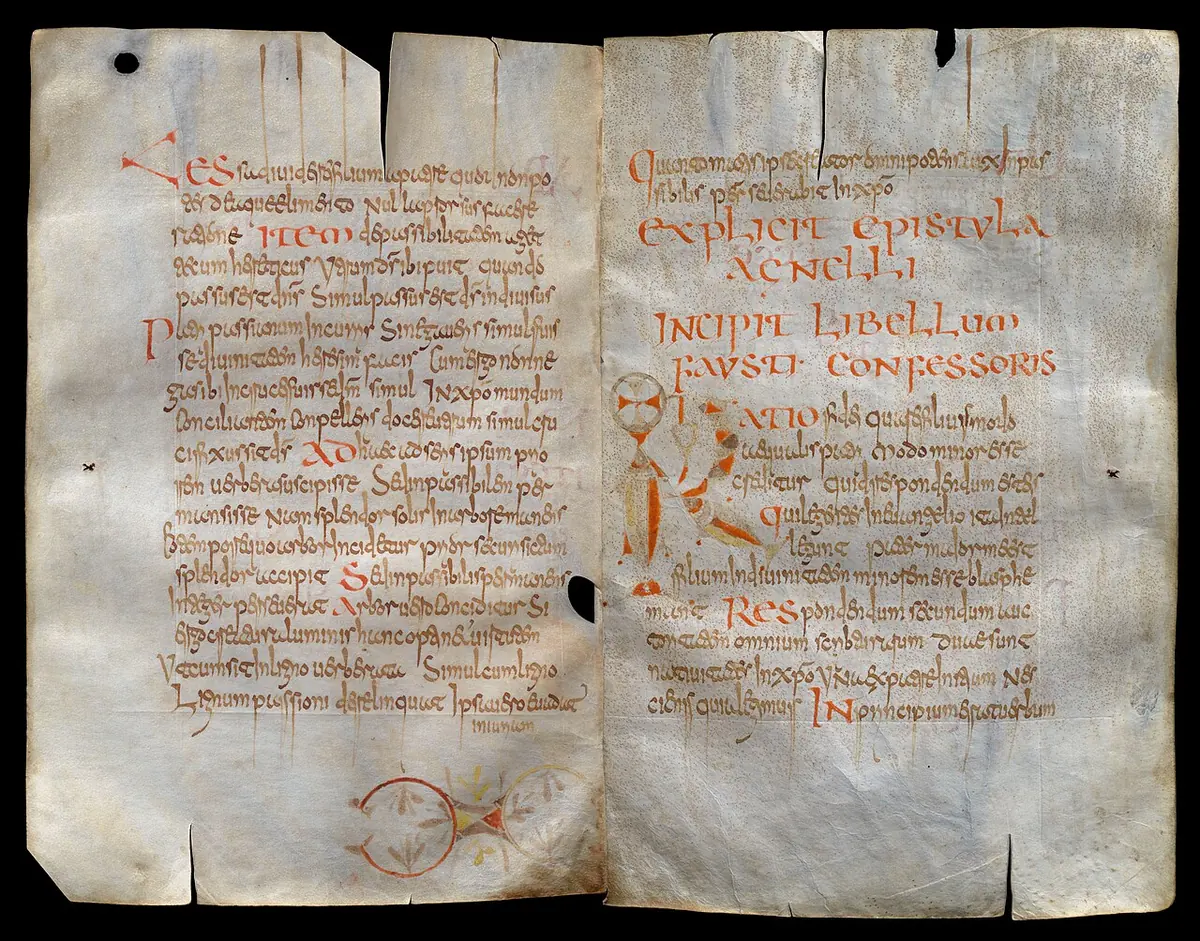

Why St. Boniface is the patron saint of Germany
His patronage of Germany rests on what he did there, not on a legend: he preached to its tribes, founded its first dioceses and monasteries, and gave its Church a structure that lasted. Benedict XVI, himself a German, called him "the Apostle of the Germans" and quoted an early biographer who said Boniface could call himself "father of all the inhabitants of Germany."
The Catholic Encyclopedia also lists brewers, tailors and file cutters among the trades that chose him as patron, without explaining why. See all patronages on our patron saints page.
Symbols of St. Boniface in art
Boniface usually appears as a bishop, in miter and pallium, often older and bearded. To pick him out from other bishops, look for:
- An axe and a felled oak: the Geismar story. Sometimes he stands with one foot on the stump.
- A book pierced by a sword: the Gospel book he is said to have raised over his head at Dokkum. It is his most distinctive emblem in older art, as in Cornelis Bloemaert's engraving below.
- A fountain: the spring that rose where he died.
- A crozier and Gospel book: marks of the bishop and preacher.


The Catholic Encyclopedia lists still more emblems: a fox, a raven, a scourge. Medieval Fulda manuscripts, like the sacramentary near the top of this page, tell his story in scenes. Nineteenth-century painters and glassmakers preferred the oak, and the window in Maysville, Kentucky, shows him preaching beside its fallen trunk.


Feast day, Fulda and Dokkum
Boniface's feast is June 5, a memorial in the General Roman Calendar. England kept the day first, and Pope Pius IX extended it to the whole Latin Church on June 11, 1874. See the rest of June on our feast days page.
His tomb is in the crypt of Fulda Cathedral, the Baroque church that replaced the abbey church where he asked to be buried. Pilgrims have come to the grave since the 8th century; the Catholic Encyclopedia notes crowds especially on his feast and during its octave.


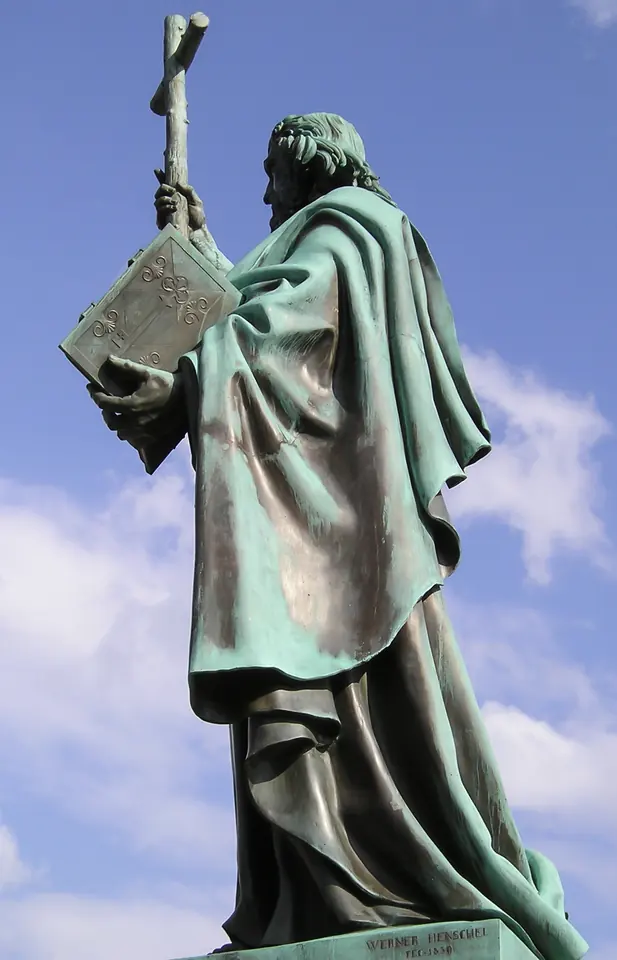
Out in the city, a bronze statue of the saint by Werner Henschel, raised in 1830, shows him as a missionary rather than a prince of the Church.

In Dokkum, the place of his death is marked by the Bonifatiuskapel, a Catholic pilgrimage chapel, a park with an open-air Way of the Cross, and the fountain that recalls the spring in Willibald's story.

Prayer to St. Boniface
The Catholic Church prays this collect on his memorial, from the Roman Missal (English translation, 2011):
May the Martyr Saint Boniface be our advocate, O Lord, that we may firmly hold the faith he taught with his lips and sealed in his blood and confidently profess it by our deeds. Through our Lord Jesus Christ, your Son, who lives and reigns with you in the unity of the Holy Spirit, God, for ever and ever.
Boniface's own words are another way people pray with him. In a letter quoted by Benedict XVI, he wrote of the Church's pastors: "We are not mute dogs or taciturn observers or mercenaries fleeing from wolves!" Catholics ask his intercession for missionaries, for the Church in Germany and for courage in hard work begun late in life.
Frequently asked questions
Why is St. Boniface called the Apostle of Germany?
He spent nearly forty years as a missionary among the Germanic peoples east of the Rhine: Hessians, Thuringians, Bavarians and Frisians. He preached, founded monasteries, named bishops for new dioceses such as Würzburg and Eichstätt, and held the first German church councils. An early biographer, Otloh of St. Emmeram, called him the father of all the inhabitants of Germany.
What was Donar's Oak?
A huge oak at Geismar, near Fritzlar in Hesse, sacred to the thunder god. Boniface's earliest biographer, Willibald, calls it the Oak of Jupiter, the Latin name for the god the Germans called Donar (Thor). Willibald says Boniface cut it down while pagans watched, the tree split into four parts, many were converted, and Boniface built a chapel to St. Peter from its timber.
Did St. Boniface invent the Christmas tree?
No early source says so. Willibald's Life tells of the oak at Geismar but mentions no fir tree. The story that Boniface pointed people to a young fir as a Christian sign is a modern legend, spread by 19th-century tales such as Henry van Dyke's "The First Christmas Tree." It is traditional in the loosest sense, a story rather than history.
When is St. Boniface's feast day?
June 5, the day of his martyrdom in 754. It is a memorial in the General Roman Calendar. Pope Pius IX extended it to the whole Latin Church in 1874. Fulda, where he is buried, holds its main celebrations on and around the feast.
What is St. Boniface the patron saint of?
Germany above all. The Catholic Encyclopedia adds that brewers, tailors and file cutters chose him as their patron, as did several German cities.
Sources
- Catholic Encyclopedia (1907): St. Boniface
- Willibald: The Life of St. Boniface (Internet Medieval Sourcebook, Talbot translation)
- Benedict XVI, General Audience of 11 March 2009: Saint Boniface, the Apostle of the Germans
- Catholic Culture: Memorial of St. Boniface, Bishop and Martyr (June 5)
- Roman Missal, Collect for the Memorial of St. Boniface