St. Paul the Apostle

St. Paul was Saul of Tarsus, a Jewish Pharisee and Roman citizen who persecuted the first Christians until the risen Jesus appeared to him on the road to Damascus. He became the Apostle to the Gentiles, founded churches across Asia Minor and Greece and wrote the letters that make up much of the New Testament. Tradition says he was beheaded in Rome under Nero. His feast day is June 29, shared with St. Peter, and Catholics also keep the Conversion of St. Paul on January 25. He is the patron saint of missionaries, converts and writers.
Who was St. Paul?
Paul is the apostle who never walked with Jesus in Galilee. Born Saul in Tarsus, a Greek-speaking city in what is now southern Turkey, he was a strict Pharisee who hunted down the first Christians. Then, on the road to Damascus, he met the risen Christ in a blinding light, and the persecutor became the Church's most tireless missionary. In about thirty years he crossed the eastern Mediterranean on foot and by ship, founded churches from Asia Minor to Greece, and wrote letters that Christians have read aloud in church ever since.
Thirteen of the twenty-seven books of the New Testament carry his name, and the Acts of the Apostles gives more than half its pages to him. St. Jerome called him "an apostle outside the number of the twelve apostles." Paul called himself "the least of the apostles, unfit to be called an apostle, because I persecuted the church of God" (1 Corinthians 15:9).
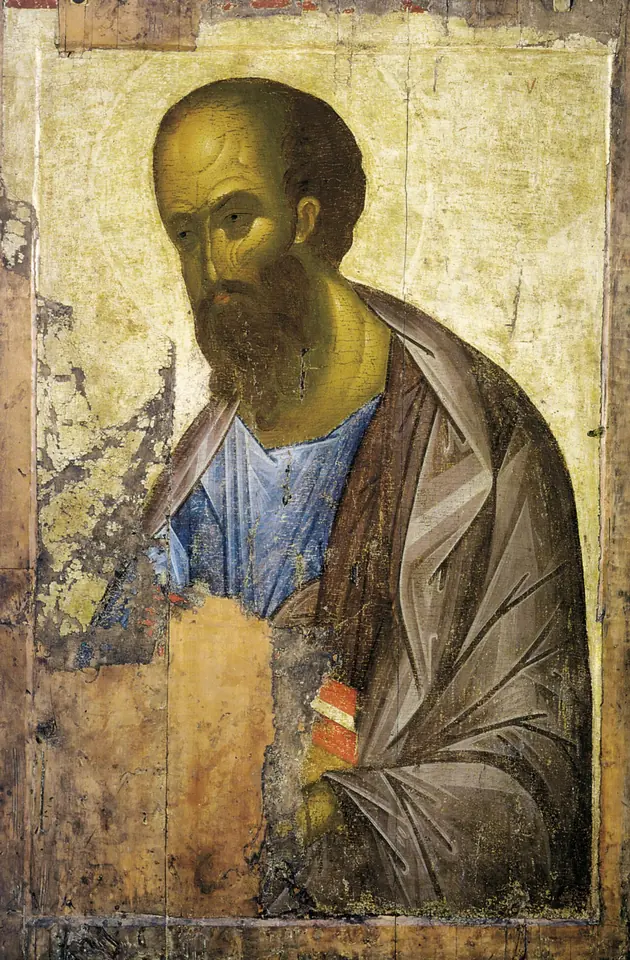

Ancient tradition holds that he died a martyr in Rome under Nero, beheaded with a sword. Catholics, Orthodox and Protestants all honor him. The Catholic and Orthodox Churches keep his feast with St. Peter's on June 29, and Catholics celebrate his conversion on January 25.
The life of St. Paul
Saul of Tarsus
Paul described himself to the Philippians as "circumcised on the eighth day, of the people of Israel, of the tribe of Benjamin, a Hebrew born of Hebrews; as to the law a Pharisee, as to zeal a persecutor of the church" (Philippians 3:5–6). In Acts he tells a Jerusalem crowd, "I am a Jew, born at Tarsus in Cilicia, but brought up in this city at the feet of Gamaliel" (Acts 22:3). He was also a Roman citizen by birth, a rare privilege for a provincial Jew. When a tribune told him he had bought his own citizenship "for a large sum," Paul answered, "But I was born a citizen" (Acts 22:28).
Benedict XVI, who opened a Pauline Year in 2008 to mark roughly two thousand years since Paul's birth, placed it around the year 8. Paul had a Hebrew name, Saul, after the first king of Israel, who was also of the tribe of Benjamin, and a Latin one, Paulus, which Benedict noted echoed it in sound. He learned a trade, tentmaking (Acts 18:3), and at twelve or thirteen went to Jerusalem to study the Law under Gamaliel the Elder.
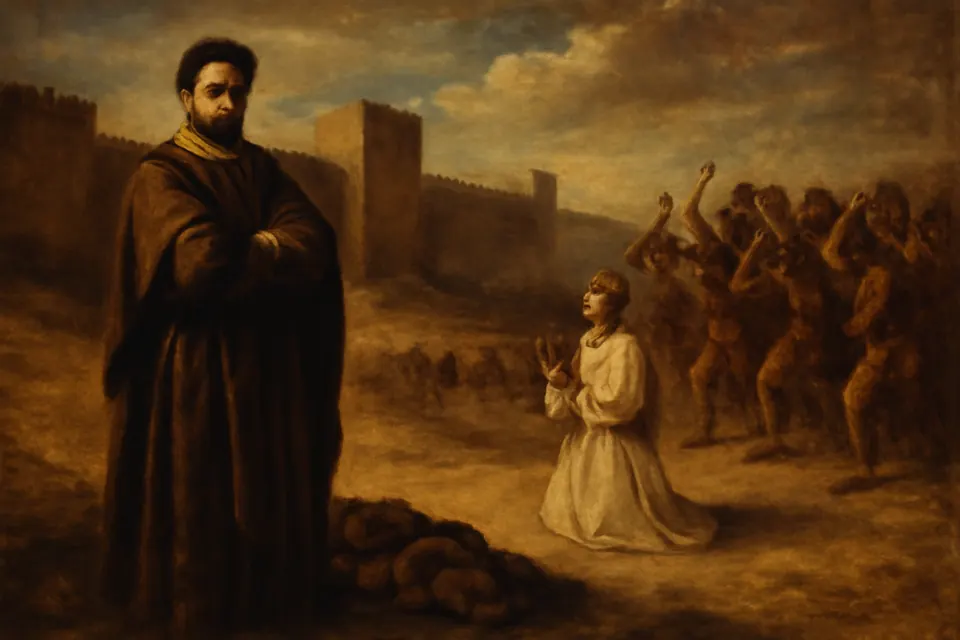
At the stoning of Stephen
Saul first appears in the Bible at the death of St. Stephen, the first Christian martyr. The men who stoned Stephen "laid down their garments at the feet of a young man named Saul" (Acts 7:58), and "Saul was consenting to his death" (Acts 8:1). He then went from house to house in Jerusalem, dragging Christians off to prison, and asked the high priest for letters authorizing him to arrest followers of "the Way" in the synagogues of Damascus.
The road to Damascus
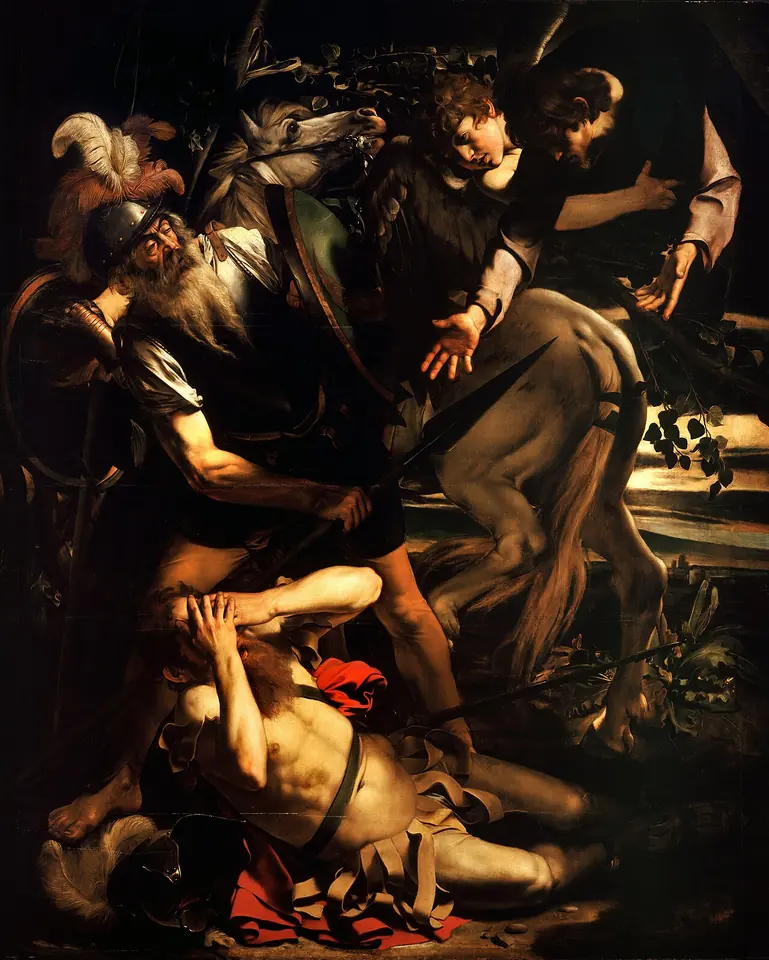
Acts tells the story three times (chapters 9, 22 and 26). The first account, in the Revised Standard Version:
Now as he journeyed he approached Damascus, and suddenly a light from heaven flashed about him. And he fell to the ground and heard a voice saying to him, "Saul, Saul, why do you persecute me?" And he said, "Who are you, Lord?" And he said, "I am Jesus, whom you are persecuting; but rise and enter the city, and you will be told what you are to do." (Acts 9:3–6)
Blind, he was led by the hand into Damascus and fasted for three days. Jesus sent a disciple there named Ananias, who was afraid to go to such a man. The Lord answered, "Go, for he is a chosen instrument of mine to carry my name before the Gentiles and kings and the sons of Israel" (Acts 9:15). When Ananias laid his hands on him, "something like scales fell from his eyes and he regained his sight. Then he rose and was baptized" (Acts 9:18).


Benedict XVI called the event "an encounter with the Risen One," not the result of reflection: "St Paul was not transformed by a thought but by an event." Paul himself rarely told the story. He wrote only that God "was pleased to reveal his Son to me, in order that I might preach him among the Gentiles" (Galatians 1:15–16), and listed himself last among the witnesses of the Resurrection. Acts doesn't mention a horse; painters added one in the late Middle Ages, and the fall from the horse became the standard image.

Damascus, Arabia and Jerusalem
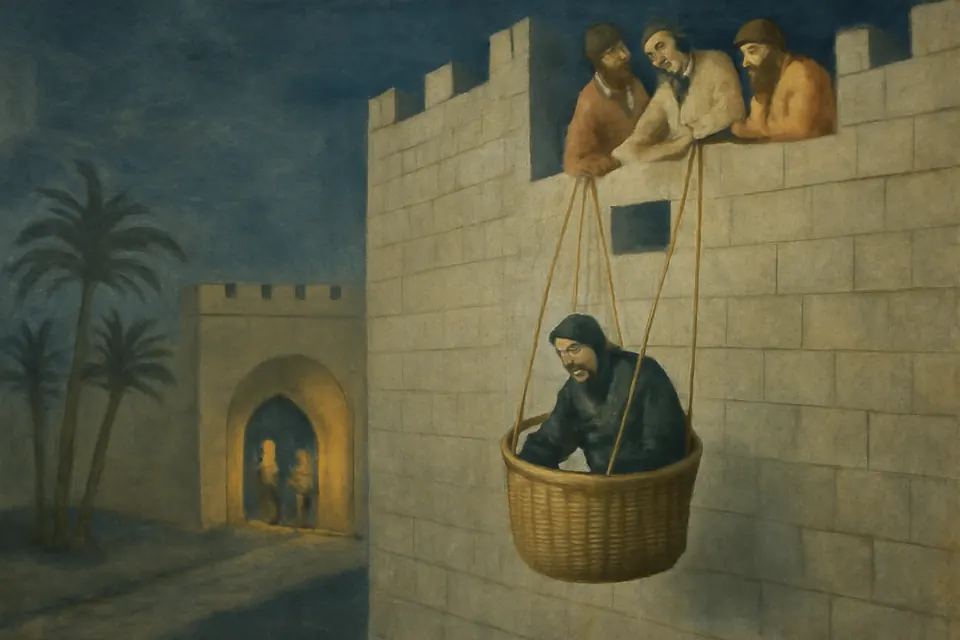
After his baptism Paul went into Arabia, then returned to Damascus and began preaching that Jesus was the Son of God. When his opponents watched the city gates day and night to kill him, "his disciples took him by night and let him down over the wall, lowering him in a basket" (Acts 9:25). In Jerusalem the disciples were afraid of him until St. Barnabas vouched for him. Paul later wrote that he went up "to visit Cephas" and stayed with him fifteen days, seeing no other apostle except James, the Lord's brother (Galatians 1:18–19).
He spent some years back in Tarsus until Barnabas brought him to Antioch in Syria, where, Acts notes, "the disciples were for the first time called Christians" (Acts 11:26).
The missionary journeys
Acts describes three journeys, all starting from Antioch.
The first, led by Barnabas, crossed Cyprus, where the proconsul Sergius Paulus believed, and went into the highlands of Asia Minor. At this point Acts begins to call him Paul: "Saul, who is also called Paul" (Acts 13:9). At Lystra Paul healed a man lame from birth, and the crowd took him and Barnabas for the gods Hermes and Zeus and tried to offer them sacrifice. Soon afterward the same city stoned Paul and left him for dead.
The Council of Jerusalem, around 49 or 50, settled the great question of those years: whether Gentile converts had to be circumcised and keep the Law of Moses. With Peter and James, the apostles decided they did not (Acts 15). Benedict XVI said the "effective birth of a universal Church depended" on that decision.
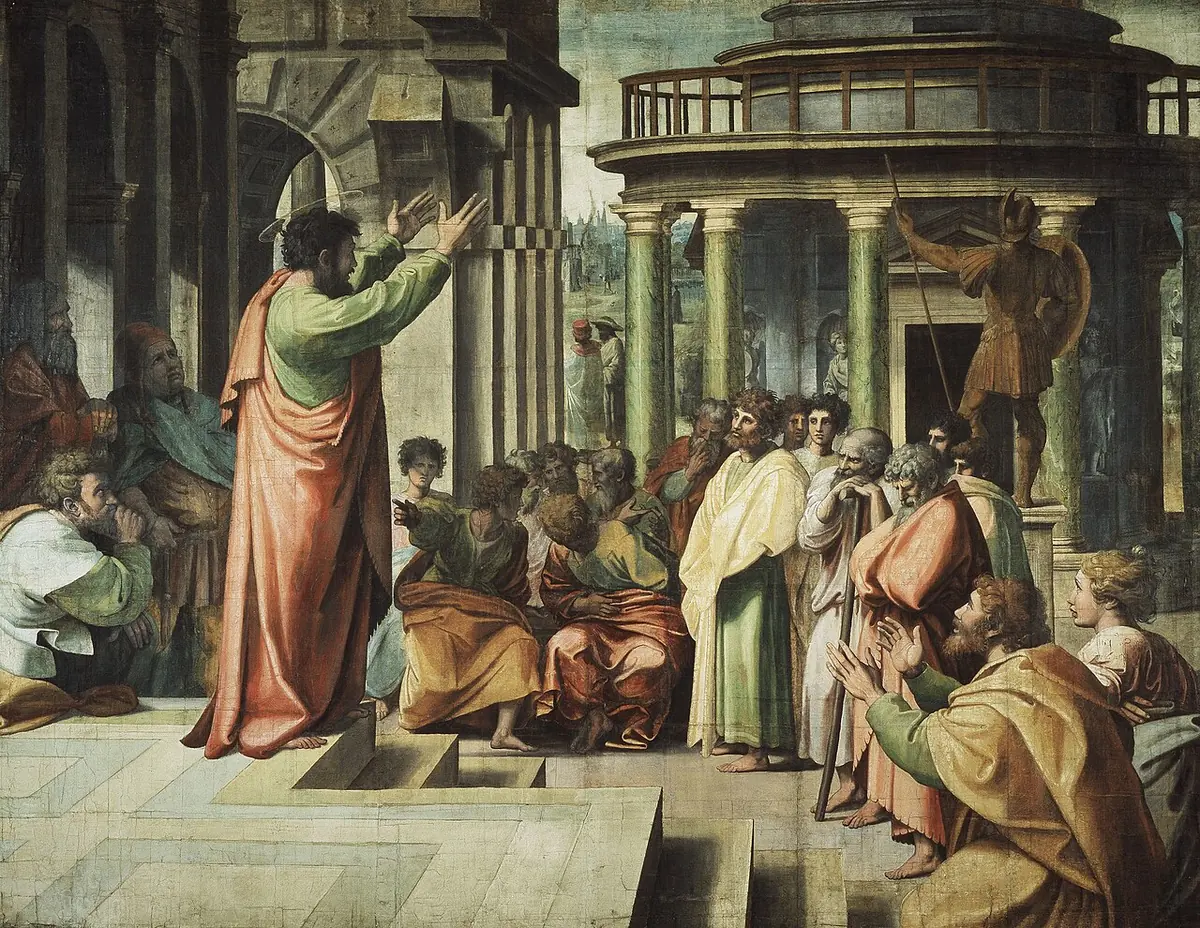
The second journey, with Silas and later Timothy, crossed into Europe. At Philippi Paul and Silas were beaten and jailed; at midnight they were "praying and singing hymns to God" when an earthquake opened the prison doors (Acts 16:25–26). In Athens Paul spoke to the philosophers on the Areopagus about an altar he had seen inscribed "To an unknown god" (Acts 17:23). He stayed a year and a half in Corinth, working at his trade with Aquila and Priscilla.

The third journey centered on Ephesus, where he stayed more than two years. Acts says that "handkerchiefs or aprons were carried away from his body to the sick, and diseases left them" (Acts 19:12). New converts burned their books of magic, and the silversmiths who sold images of the goddess Artemis started a riot against him.
Paul summed up those years for the Corinthians: "Three times I have been beaten with rods; once I was stoned. Three times I have been shipwrecked; a night and a day I have been adrift at sea" (2 Corinthians 11:25).
Arrest and appeal to Caesar
Back in Jerusalem around 57, Paul was mobbed in the Temple by men who believed he had brought a Gentile inside. A Roman tribune rescued him. He spent two years in custody at Caesarea under the governors Felix and Festus, and finally, as a citizen, appealed to the emperor. Festus answered, "You have appealed to Caesar; to Caesar you shall go" (Acts 25:12).
Shipwreck on Malta
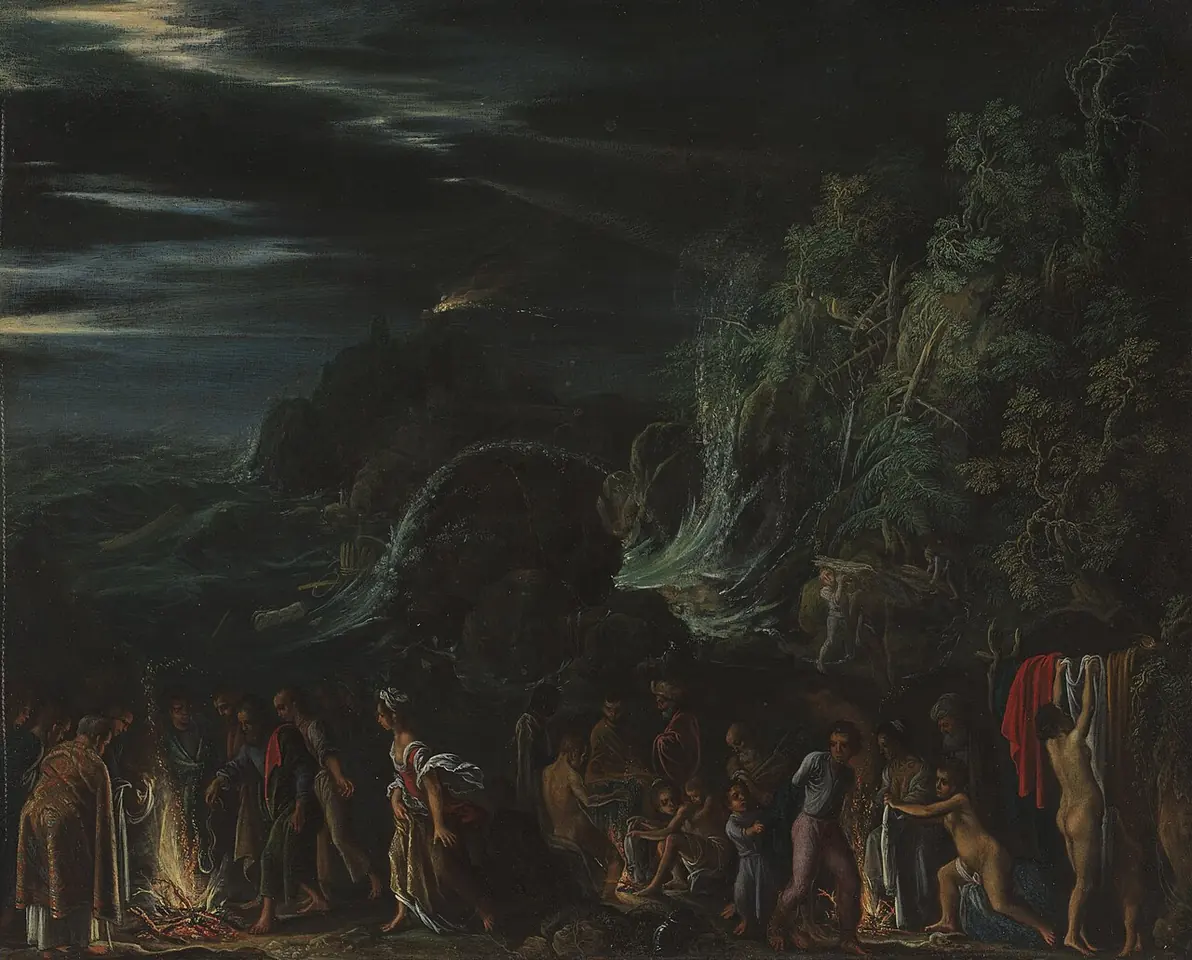
The voyage to Rome, told by an eyewitness in Acts 27, is one of the great sea stories of antiquity. Paul's ship, an Alexandrian grain carrier, was caught by a winter storm off Crete and driven for fourteen days before it ran aground. All 276 people aboard reached shore. "After we had escaped, we then learned that the island was called Malta" (Acts 28:1).
As Paul gathered sticks for a fire, a viper fastened on his hand. The islanders expected him to die, but "he shook off the creature into the fire and suffered no harm" (Acts 28:5), and they decided he was a god. Paul then healed the father of Publius, the island's chief man, and many other sick people. The castaways spent three months on Malta before sailing on.

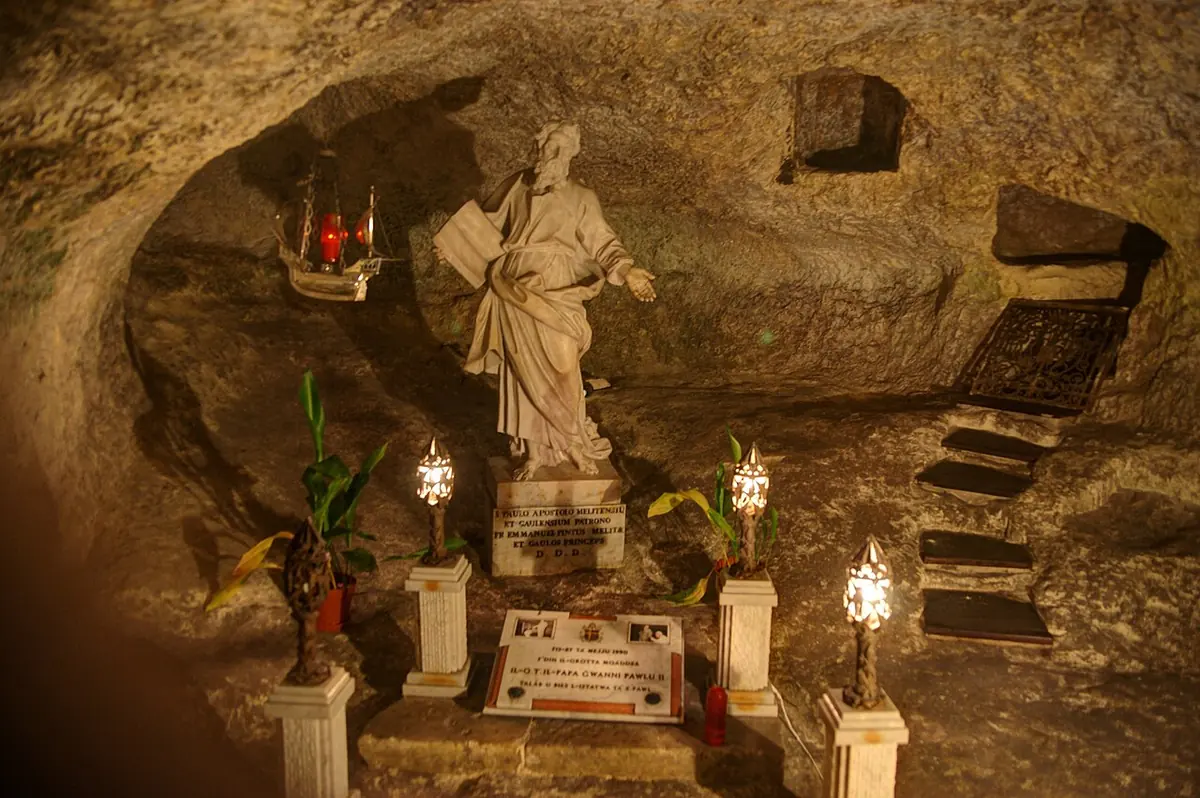
Maltese tradition dates the shipwreck to the year 60. Benedict XVI came for its 1,950th anniversary in 2010 and prayed at St. Paul's Grotto in Rabat, the cave where Paul is said to have lived during those three months. He called Paul the one "who first brought the faith to these islands."

Prisoner in Rome
Christians from Rome walked out along the Appian Way to meet him. Acts ends with Paul under house arrest, guarded by a soldier: "he lived there two whole years at his own expense, and welcomed all who came to him, preaching the kingdom of God and teaching about the Lord Jesus Christ quite openly and unhindered" (Acts 28:30–31).
What happened next isn't in the Bible. The Catholic Encyclopedia and St. Jerome both hold that Paul was released and traveled again, perhaps to Spain, which he had told the Romans he hoped to visit (Romans 15:24), before a second arrest. Benedict XVI noted that "a series of reasons induce many scholars of St Paul to end his biography with Luke's narrative in the Acts."

The letters of St. Paul
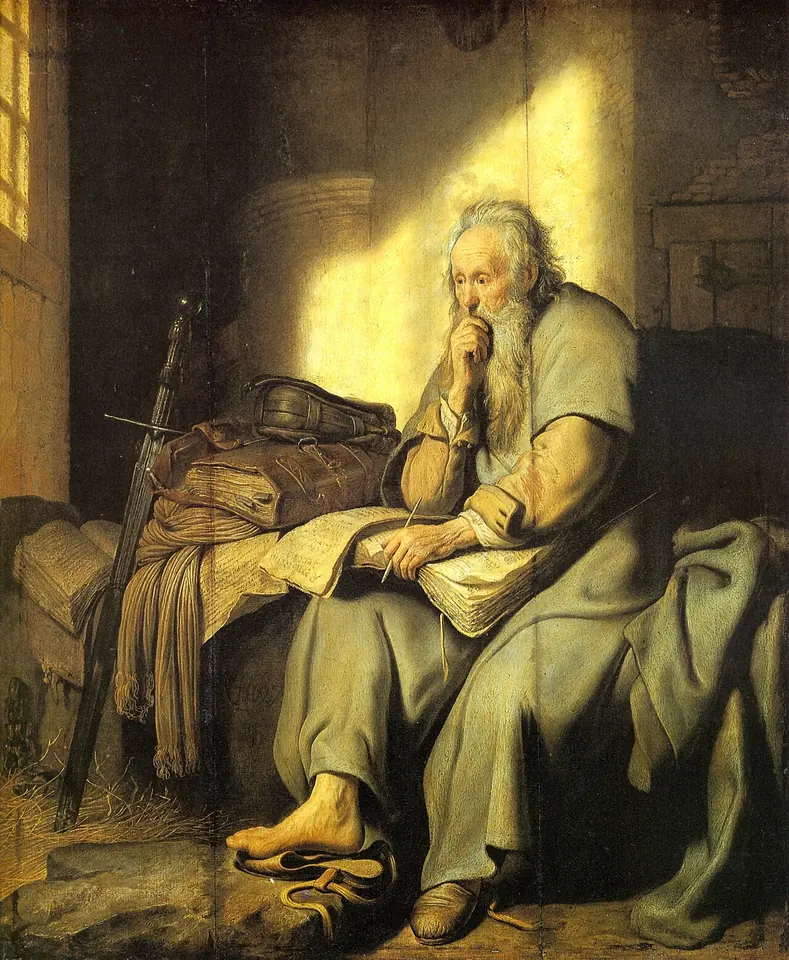
Paul's letters are the oldest Christian writings that survive. First Thessalonians, probably written from Corinth around 50, is likely the earliest book of the New Testament. He wrote to answer questions, settle quarrels and encourage young churches, usually dictating to a secretary and adding a greeting in his own hand. They contain some of the most quoted passages in the Bible, from the hymn to love in 1 Corinthians 13 to these lines:
"I have been crucified with Christ; it is no longer I who live, but Christ who lives in me." (Galatians 2:20, RSV)
"For I am sure that neither death, nor life, nor angels, nor principalities, nor things present, nor things to come, nor powers, nor height, nor depth, nor anything else in all creation, will be able to separate us from the love of God in Christ Jesus our Lord." (Romans 8:38–39, RSV)
Thirteen letters carry his name: Romans, 1 and 2 Corinthians, Galatians, Ephesians, Philippians, Colossians, 1 and 2 Thessalonians, 1 and 2 Timothy, Titus and Philemon. Catholic and Orthodox tradition has always received them as his. Modern scholars often divide them into seven undisputed letters (Romans, 1 and 2 Corinthians, Galatians, Philippians, 1 Thessalonians and Philemon) and six disputed ones that may come from his disciples. Benedict XVI acknowledged the debate over the Pastoral Letters: "Most exegetes today are of the opinion that these Letters would not have been written by Paul himself, but would have come from the 'Pauline School,'" though he added that parts of 2 Timothy "appear so authentic that they could have come only from the heart and mouth of the Apostle." The Letter to the Hebrews was long counted as Paul's fourteenth; it names no author, and few now think he wrote it.
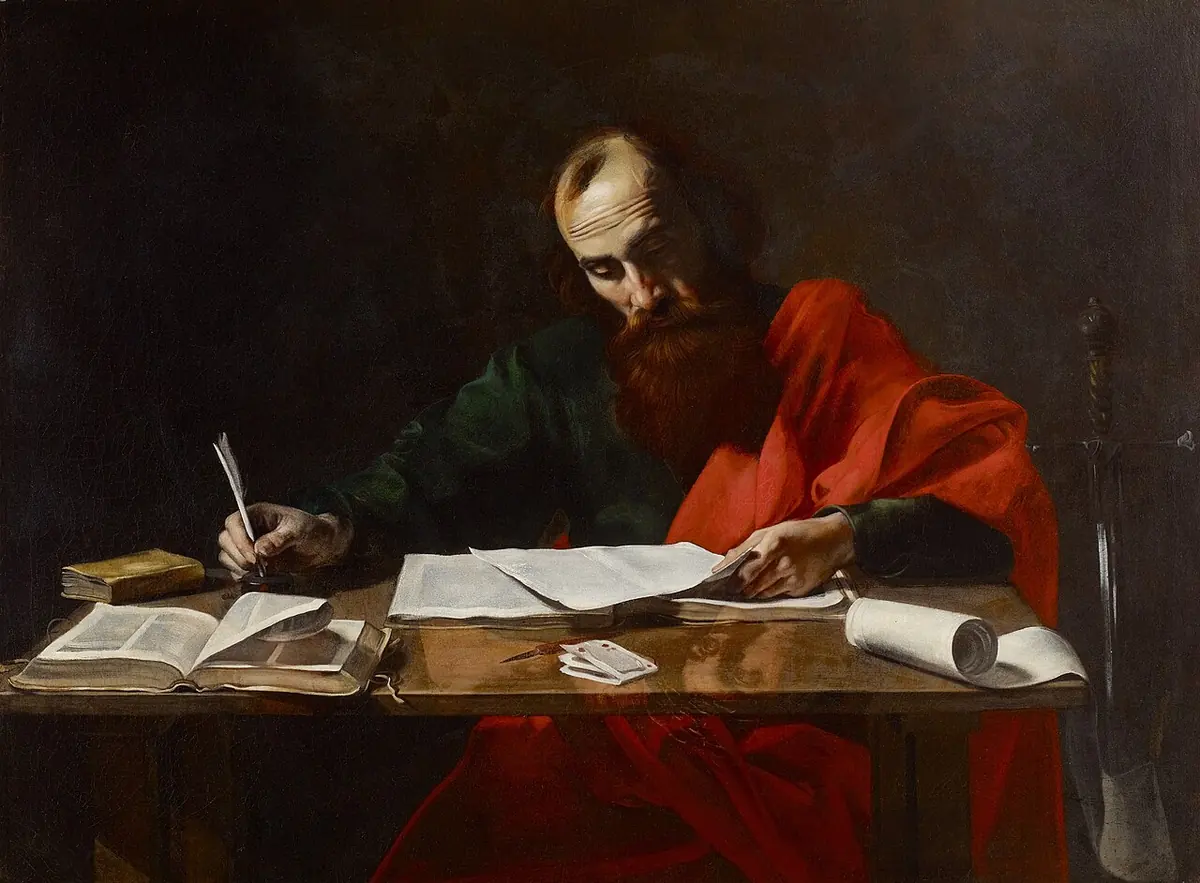

Benedict XVI traced St. Augustine's conversion, the commentaries of St. Thomas Aquinas and Martin Luther's new reading of justification back to Paul's letters, and noted the growing agreement between Catholic and Protestant interpreters "precisely on the point that was the origin of the greatest historical dissent."
The death of St. Paul
The New Testament doesn't describe Paul's death. In 2 Timothy he writes, "For I am already on the point of being sacrificed; the time of my departure has come. I have fought the good fight, I have finished the race, I have kept the faith" (2 Timothy 4:6–7).
The oldest witness is the letter of the Roman church to Corinth around 95, known as First Clement. It says that Paul, "after being seven times thrown into captivity, compelled to flee, and stoned," and "having taught righteousness to the whole world, and come to the extreme limit of the west, and suffered martyrdom under the prefects," was "removed from the world." Tertullian, around 200, wrote that in Rome "Paul was crowned with the death of John," meaning that he was beheaded like John the Baptist. Eusebius records that "Paul was beheaded in Rome itself." Jerome dates it to the fourteenth year of Nero, "on the same day with Peter."
The Acts of Paul, a late-2nd-century apocryphal book, adds that when the executioner "struck off his head, milk spurted upon the cloak of the soldier." A later legend from the 5th century places the execution at Aquae Salviae on the Via Laurentina and says that his head bounced three times, and a spring rose wherever it touched the ground. The place has been called Tre Fontane, "Three Fountains," ever since, and Trappist monks still keep an abbey there. Both stories are traditional.
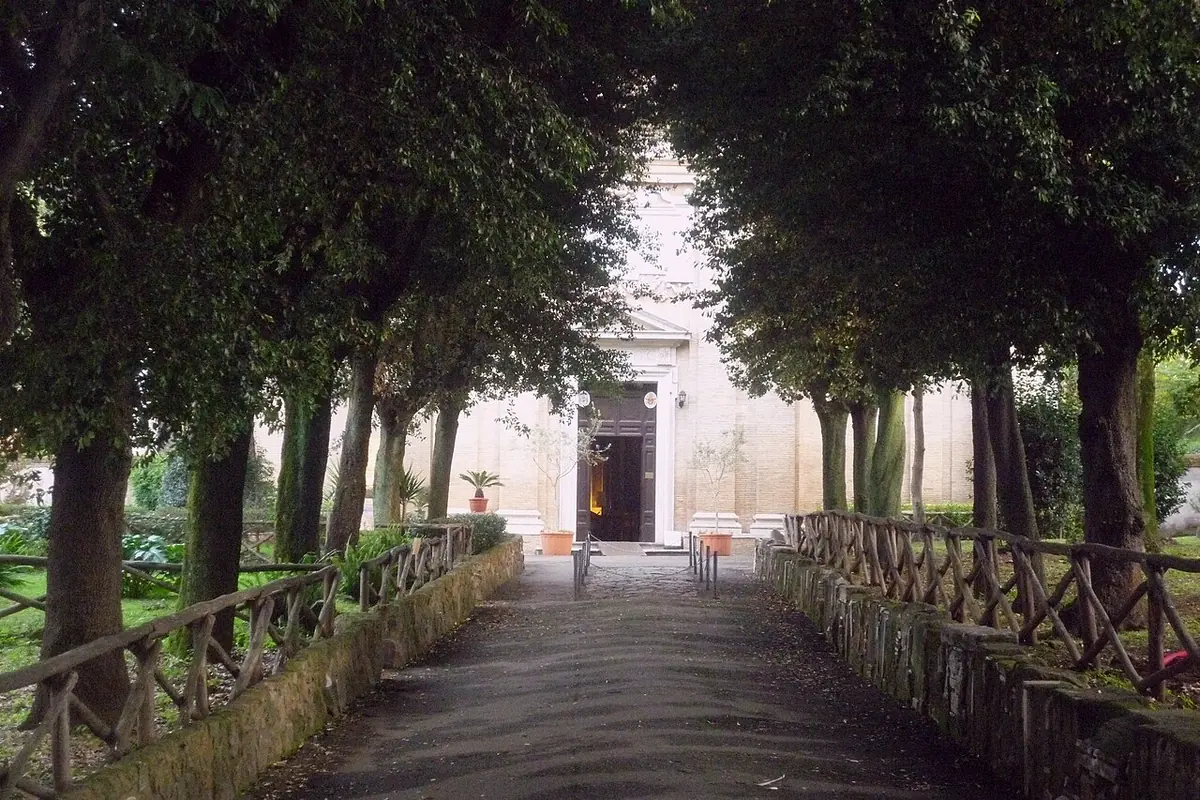

The tomb of St. Paul
Around 200, the Roman priest Gaius told an opponent he could show "the trophies of the apostles," one on the Vatican and one "on the Ostian way." Benedict XVI explained that "trophies" meant their tombs. A 4th-century passion says Paul was buried on the estate of a Christian matron named Lucina, two miles outside the city. Constantine built a first church over the grave, and emperors enlarged it into a great basilica late in the 4th century. Fire destroyed most of it in the 19th century, and the present Basilica of St. Paul Outside the Walls was rebuilt on the same plan.
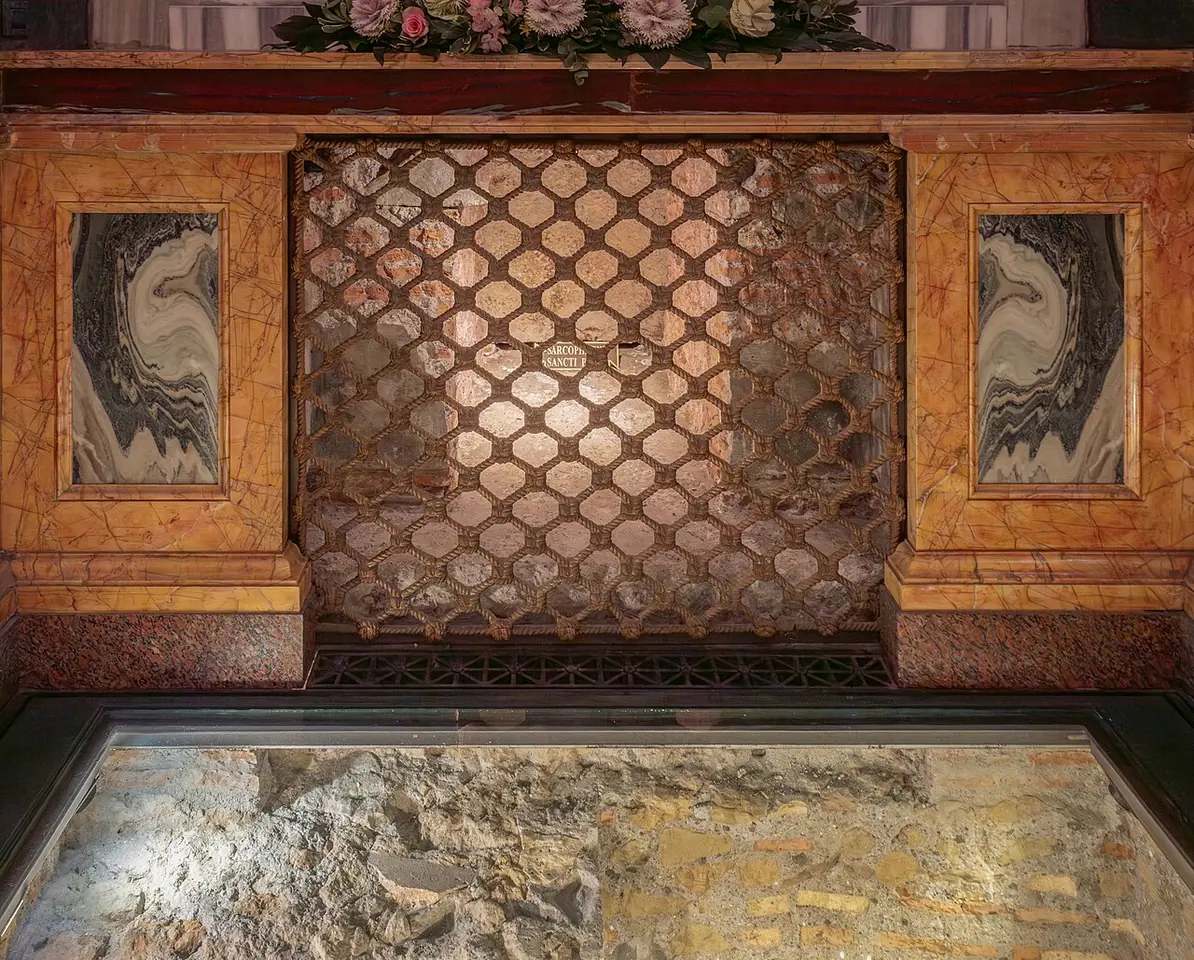

On June 28, 2009, closing the Pauline Year, Benedict XVI announced what a scientific probe had found inside the sarcophagus beneath the papal altar. His words, in the Vatican's English translation, are reported findings:
A tiny hole was drilled in the sarcophagus, which in so many centuries had never been opened, in order to insert a special probe which revealed traces of a precious purple-coloured linen fabric, with a design in gold leaf, and a blue fabric with linen threads. Grains of red incense and protein and chalk substances were also found. In addition, minute fragments of bone were sent for carbon-14 testing by experts unaware of their provenance. The fragments proved to belong to someone who had lived between the first and second centuries.
The pope said this "would seem to confirm the unanimous and undisputed tradition" that the sarcophagus holds Paul's remains. The sarcophagus itself has not been opened. Through a window below the altar, pilgrims can see the ancient marble slab over the tomb, inscribed PAULO APOSTOLO MART, "to Paul, apostle and martyr."
The miracles of St. Paul
The miracles in Acts are part of Scripture, and Christians receive them as Scripture, not as later reports. None of Paul's is approved in the modern sense, since he lived long before the Church began investigating miracles. In Acts, Paul struck the magician Elymas blind on Cyprus (13:11), healed the lame man at Lystra (14:10), drove a spirit of divination out of a slave girl at Philippi (16:18), was freed with Silas by an earthquake (16:26), healed the sick at Ephesus through cloths that had touched him (19:12), raised the young man Eutychus, who had fallen from a third-story window at Troas (20:9–12), survived the viper on Malta (28:5) and healed the father of Publius (28:8).
Later stories are sorted by this encyclopedia's labels:
- Traditional: the milk that flowed at his beheading (the Acts of Paul) and the three springs at Tre Fontane (5th-century legend).
- Reported: favors attributed to his intercession by pilgrims to his tomb, to Tre Fontane and to Malta. These are personal testimonies.
Why St. Paul is the patron saint of missionaries, converts and writers
- Missionaries: he was the Apostle to the Gentiles, sent, in the words of Acts 9:15, to carry Christ's name "before the Gentiles and kings and the sons of Israel." Missionary orders such as the Paulist Fathers in the United States bear his name.
- Converts: his conversion is the most famous in history, and the only one the Church celebrates with its own feast.
- Writers, theologians and the Catholic press: because of his letters. The Raccolta includes a prayer to St. Paul "for the printing of good books," recalling the books burned at Ephesus, and the "Pauline Family" founded by Blessed Giacomo Alberione in the 20th century works in publishing and media under his patronage.
- Malta: the islanders honor him as their apostle. Benedict XVI called him "the great Apostle of Malta."
- Rome: he shares the city's patronage with St. Peter.
See all the patron saints by cause.
Symbols of St. Paul in art
Paul is one of the easiest saints to recognize, because artists gave him the same face for fifteen centuries. The Acts of Paul describes him as "a man little of stature, thin-haired upon the head, crooked in the legs, of good state of body, with eyebrows joining, and nose somewhat hooked, full of grace." In art that becomes a high, balding forehead and a long, dark, pointed beard, a strong contrast with Peter's curly hair and short square beard.
His attributes:
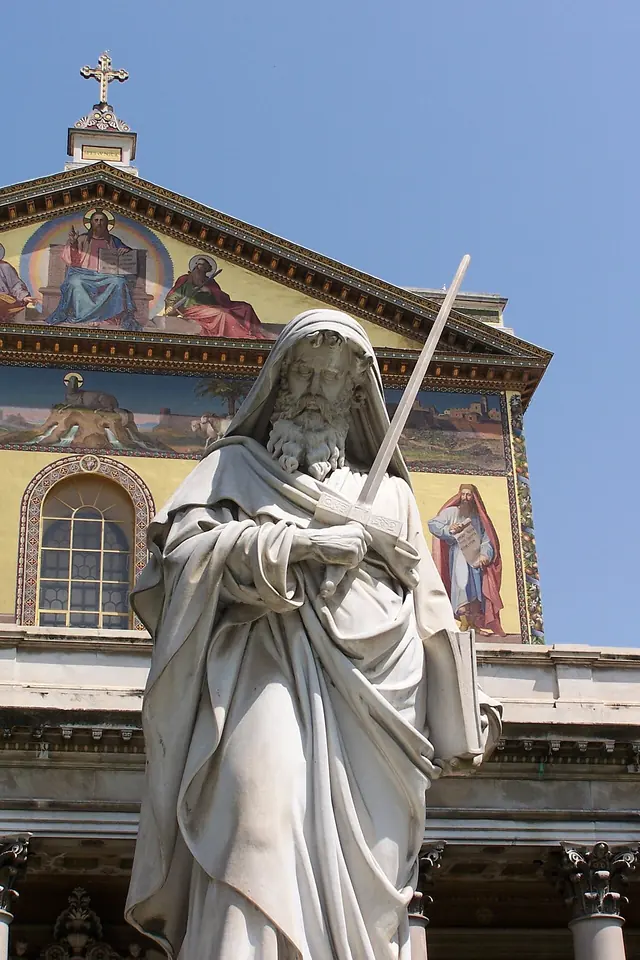
- A sword: the instrument of his beheading, and "the sword of the Spirit, which is the word of God" (Ephesians 6:17). Medieval portraits almost always give him one.
- A book or scroll: his letters. Icons, like Rublev's above, usually give him a closed book.
- A horse: in scenes of his conversion, from about the 15th century on, though Acts never mentions one.
- A viper and a fire: the shipwreck on Malta.
- Next to St. Peter: the two stand on either side of Christ in countless mosaics and sculptures, Peter with the keys and Paul with the sword or book.
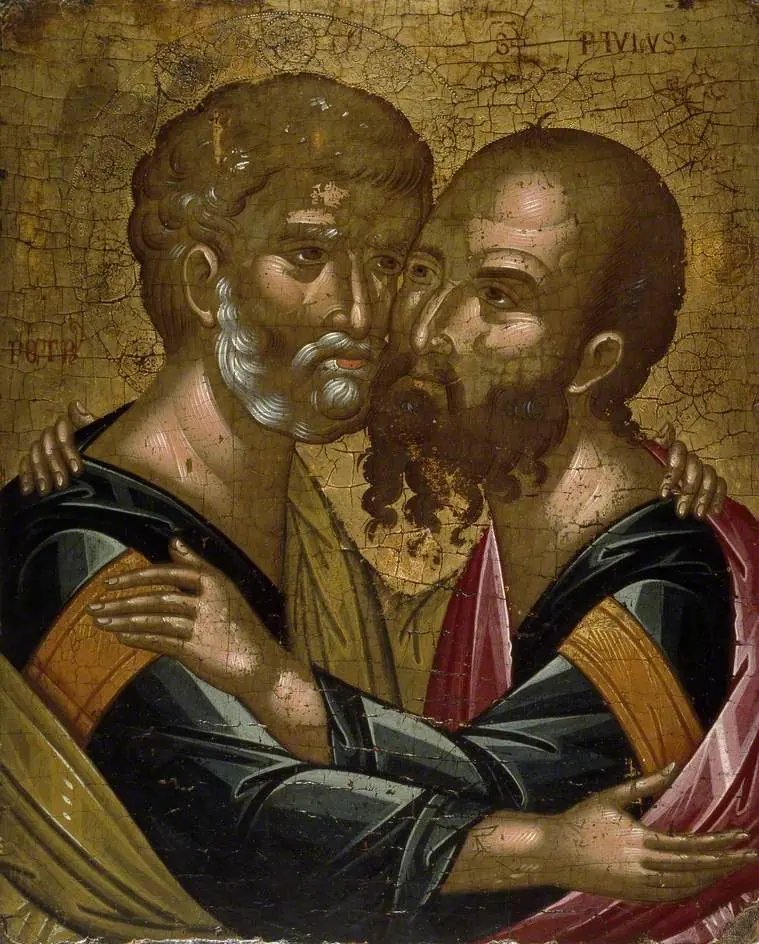

In Byzantine art the embrace of Peter and Paul stands for the unity of the Church. In Western churches, look for him in a red cloak over a green or blue tunic. Tall statues of Paul with a sword stand in front of both St. Peter's Basilica and St. Paul Outside the Walls.

Feast days and where St. Paul is honored
- June 29, the Solemnity of Sts. Peter and Paul, kept in Rome on this date since 258, the feast of the city's two founders. Orthodox Christians prepare for it with the Apostles' Fast. See the feast day calendar.
- January 25, the Conversion of St. Paul. It closes the Week of Prayer for Christian Unity, and the pope traditionally celebrates Vespers that day at St. Paul Outside the Walls.
- November 18, the dedication of the basilicas of Sts. Peter and Paul, an optional memorial in the Roman calendar.
- February 10, the feast of St. Paul's Shipwreck, a public holiday in Malta, with a procession of his statue through the streets of Valletta.
Places to visit include the basilica and tomb on the Via Ostiense, the abbey at Tre Fontane, the Mamertine Prison in the Roman Forum (where a legend says he was held with Peter), and in Malta, St. Paul's Bay, St. Paul's Islands with their large statue of the apostle, and the grotto at Rabat. Christians also follow his footsteps through Turkey and Greece, from Tarsus and Ephesus to Philippi, Athens and Corinth.
Prayer to St. Paul
These prayers come from the liturgy and from the Raccolta, the Catholic manual of indulgenced prayers (English edition 1957).
The Collect of the Conversion of St. Paul
From the Roman Missal, for January 25:
O God, who taught the whole world through the preaching of the blessed Apostle Paul, draw us, we pray, nearer to you through the example of him whose conversion we celebrate today, and so make us witnesses to your truth in the world. Through our Lord Jesus Christ, your Son, who lives and reigns with you in the unity of the Holy Spirit, God, for ever and ever.
Prayer to St. Paul from the Raccolta
O glorious St. Paul, who from a persecutor of Christianity, didst become a most ardent Apostle of zeal; and who to make known the Savior Jesus Christ unto the ends of the world didst suffer with joy imprisonment, scourgings, stonings, shipwrecks and persecutions of every kind, and in the end didst shed thy blood to the last drop, obtain for us the grace to receive, as favors of the Divine mercy, infirmities, tribulations, and misfortunes of the present life, so that the vicissitudes of this our exile will not render us cold in the service of God, but will render us always more faithful and more fervent.
Prayer to the holy apostles Peter and Paul
Also from the Raccolta:
O holy apostles, Peter and Paul, I choose you this day and for ever to be my special patrons and advocates; thee, St. Peter, Prince of the Apostles, because thou art the Rock, upon which Almighty God hath built His Church; thee, St. Paul, because thou wast forechosen by God as the Vessel of election and the Preacher of truth in the whole world. Obtain for me, I pray you, lively faith, firm hope and burning love; complete detachment from myself, contempt of the world, patience in adversity, humility in prosperity, attention in prayer, purity of heart, a right intention in all my works, diligence in fulfilling the duties of my state of life, constancy in my resolutions, resignation to the will of God and perseverance in the grace of God even unto death; that so, by means of your intercession and your glorious merits, I may be able to overcome the temptations of the world, the flesh and the devil, and may be made worthy to appear before the chief and eternal Shepherd of souls, Jesus Christ, who with the Father and the Holy Ghost liveth and reigneth for endless ages, to enjoy His presence and love Him forever. Amen.
The Orthodox troparion of June 29
O foremost of the Apostles and teachers of the inhabited earth, / intercede with the Master of all / to grant peace to the world and great mercy to our souls.
Frequently asked questions
When is St. Paul's feast day?
June 29, the Solemnity of Sts. Peter and Paul, in the Catholic and Orthodox Churches. Catholics also celebrate the Conversion of St. Paul on January 25, the last day of the Week of Prayer for Christian Unity. In Malta, the feast of St. Paul's Shipwreck on February 10 is a public holiday.
What is St. Paul the patron saint of?
Missionaries, as the Apostle to the Gentiles; converts, because of his own conversion; writers, the Catholic press and theologians, because of his letters; and Malta, where he was shipwrecked. He shares the patronage of Rome with St. Peter.
Why did Saul change his name to Paul?
The Bible never says Jesus renamed him. Acts simply switches names at Cyprus, "Saul, who is also called Paul" (Acts 13:9). As a Jew of the Diaspora and a Roman citizen he likely had both names from birth; Benedict XVI noted that the Latin name Paulus echoed the Hebrew Saul. St. Jerome thought he took it from Sergius Paulus, the proconsul of Cyprus and his first noted convert.
How many letters did St. Paul write?
Thirteen New Testament letters carry Paul's name. Catholic and Orthodox tradition receives all of them as his. Many modern scholars, including the exegetes Benedict XVI mentioned, think some were written by Paul's disciples in his name; the Pastoral Letters (1 and 2 Timothy and Titus) are the most often questioned. The Letter to the Hebrews does not name its author, and few today attribute it to Paul.
How did St. Paul die?
Ancient writers agree that he was put to death in Rome under Nero. As a Roman citizen he was beheaded with a sword rather than crucified. A later legend says his head bounced three times and a spring rose at each spot, which is why the place is called Tre Fontane, "Three Fountains."
Why is St. Paul shown with a sword?
Because he was beheaded with one. The sword also recalls his phrase "the sword of the Spirit, which is the word of God" (Ephesians 6:17). Medieval artists almost always gave him a sword and often a book for his letters.
Where is St. Paul buried?
In the Basilica of St. Paul Outside the Walls, on the road from Rome to Ostia. In 2009 Benedict XVI announced that a probe inserted into the sarcophagus beneath the altar had found purple linen, incense and bone fragments carbon-dated to the 1st or 2nd century.
Was St. Paul one of the twelve apostles?
No. He never met Jesus before the crucifixion and was not one of the Twelve. He called himself an apostle because the risen Christ appeared to him, writing, "Last of all, as to one untimely born, he appeared also to me" (1 Corinthians 15:8). St. Jerome calls him "an apostle outside the number of the twelve apostles."
Sources
- Catholic Encyclopedia (1911): St. Paul
- Catholic Encyclopedia (1911): St. Peter, Prince of the Apostles (with Tertullian on the deaths of Peter and Paul)
- Catholic Encyclopedia (1910): Saint John Lateran
- Benedict XVI, General Audience of 27 August 2008: Life of Saint Paul before and after Damascus
- Benedict XVI, General Audience of 3 September 2008: St Paul's "Conversion"
- Benedict XVI, General Audience of 28 January 2009: Theological vision of the Pastoral Letters
- Benedict XVI, General Audience of 4 February 2009: St Paul's martyrdom and heritage
- Benedict XVI, First Vespers of Sts. Peter and Paul closing the Pauline Year, 28 June 2009
- Benedict XVI, Visit to the Grotto of St. Paul, Rabat, Malta (17 April 2010)
- Clement of Rome, Letter to the Corinthians
- Eusebius, Church History, Book II (chapter 25)
- Jerome, De Viris Illustribus (chapter 5: Paul)
- The Acts of Paul, translated by M. R. James (The Apocryphal New Testament, 1924)
- Orthodox Church in America: The Holy Glorious and All-Praised Leader of the Apostles, Paul
- Orthodox Church in America: Troparia and kontakia for June 29
- Catholic Culture: Solemnity of Saints Peter and Paul, Apostles (June 29)
- Catholic Culture: Feast of the Conversion of St. Paul, Apostle (January 25)
- Catholic Culture: Prayer to Saint Paul the Apostle (from the Raccolta)
- Catholic Culture: The Holy Apostles Peter and Paul (prayer from the Raccolta)
- Catholic Culture: A Prayer to Saint Paul for the Printing of Good Books (from the Raccolta)
- St. Paul in Art (Christian Iconography)
- Roman Martyrology, January 25 and June 29