St. Simon the Apostle (Simon the Zealot)
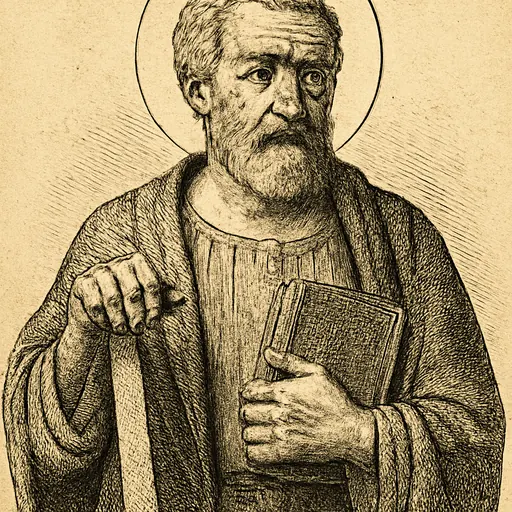
St. Simon the Apostle, also called Simon the Zealot or Simon the Cananaean, was one of the twelve apostles chosen by Jesus. The New Testament gives his name and nickname and little else; later traditions say he preached in Egypt, Persia or around the Black Sea and died a martyr. His feast day is October 28, shared with St. Jude, and his emblem is a saw.
Who was St. Simon the Apostle?
Simon was one of the twelve men Jesus chose as apostles. His name appears in every list of the Twelve in the New Testament (Matthew 10:4, Mark 3:18, Luke 6:15 and Acts 1:13), always near the end and always next to Jude. To tell him apart from Simon Peter, the Gospels give him a second name. Matthew and Mark call him "the Cananaean," and Luke calls him "the Zealot."
That is nearly all the Bible says about him. He never speaks in the Gospels, and no story centers on him. Everything else, including where he preached and how he died, comes from traditions written down centuries later, and those traditions disagree with each other. This entry sorts them out.

What "Zealot" means
Both of Simon's nicknames mean the same thing. The Catholic Encyclopedia explains that "Cananaean" is not a place name but comes from the Hebrew qana, "the zealous," which Luke translated into Greek as Zelotes. Saint Jerome and others took it to mean that Simon came from Cana, and the Golden Legend repeats that idea, but the encyclopedia calls it a mistake.
Was Simon a member of the Zealots, the party that later led the revolt against Rome? Pope Benedict XVI, in his 2006 catechesis on Simon and Jude, thought it "highly likely" that even if he was not, he was "at least marked by passionate attachment to his Jewish identity, hence, for God, his People and divine Law." Benedict pointed out that Jesus put Simon in the same small group as Matthew, a tax collector who had worked for the Roman system. In his words, "It was people who interested him, not social classes or labels!"

Traditions about his life
The bridegroom of Cana
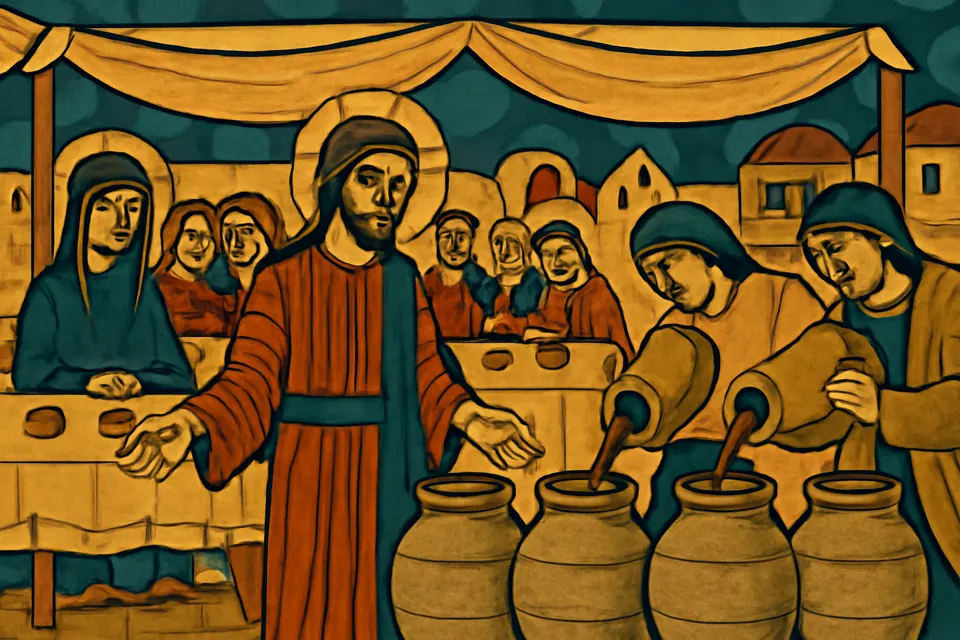
Eastern Christians tell a story the West does not. The Orthodox Church in America says that Simon came from Cana in Galilee and that "Tradition says that he was the bridegroom at the wedding where the Savior performed His first miracle." After seeing the water turned into wine, he followed Jesus. The Catholic Encyclopedia notes that the Greeks, Copts and Ethiopians identify him with Nathanael of Cana as well. These identifications are traditional.
Where he preached
The Catholic Encyclopedia says plainly that "where he actually preached the Gospel is uncertain." Greek tradition sends him around the Black Sea, to Egypt, North Africa and even Britain. The Latin Passion of Simon and Jude, the source of the Western story, has him preach in Egypt and then join Jude in Persia. Georgian tradition places him in Colchis, on the eastern shore of the Black Sea, and the Armenian historian Moses of Chorene says he died in Iberia, in what is now Georgia.

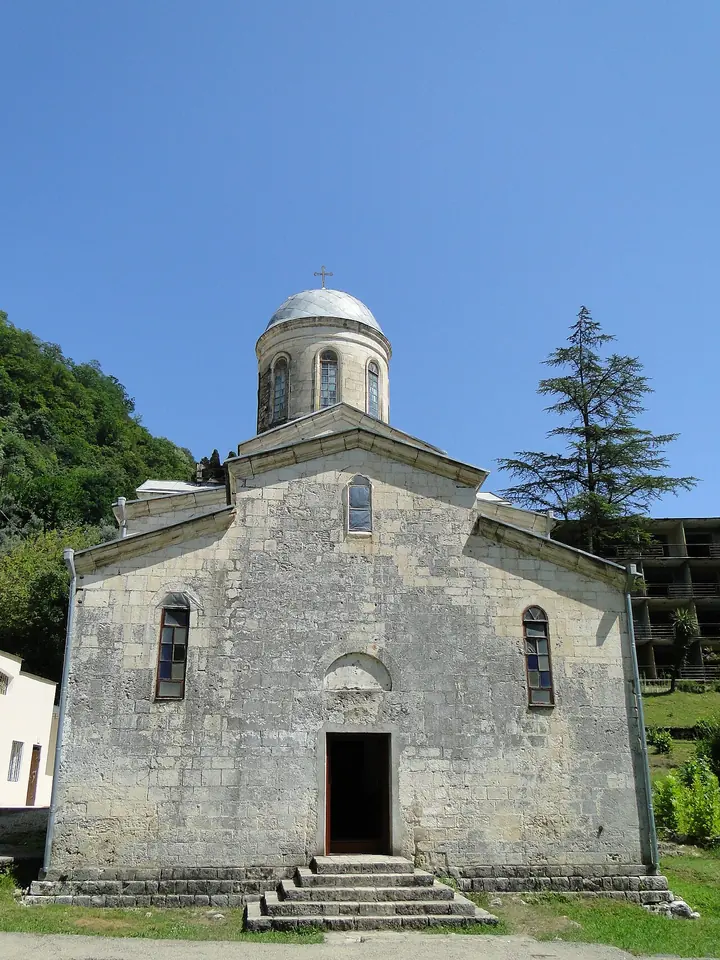
A medieval church near New Athos in Abkhazia, on that eastern Black Sea coast, is dedicated to him.

How he died
There are at least three accounts, and all of them are traditional:
- In Persia, with Jude. The Golden Legend, retelling the Passion, says the two apostles refused to sacrifice to the sun and moon, and pagan priests "ran upon the apostles and hewed them to death." This is why the West honors them on the same day. For the full story, see our entry on St. Jude.
- By crucifixion. The Orthodox Church in America says Simon "suffered martyrdom by crucifixion" after preaching from Britain to the Black Sea.
- In Jerusalem. Some writers confused him with Simon, son of Clopas, the second bishop of Jerusalem, who was crucified under Trajan. The Golden Legend already doubted this, and the Orthodox, following St. Demetrius of Rostov, keep the two men distinct.
The Catholic Encyclopedia concludes: "His place of burial is unknown."
Why St. Simon is the patron saint of tanners and sawyers
The Catholic Encyclopedia says he "is regarded as the patron of tanners," without giving a reason. Woodworkers and sawyers adopted him because of his saw. These patronages come from custom, not from any decree. You can find them on our patron saints page.
Symbols of St. Simon in art
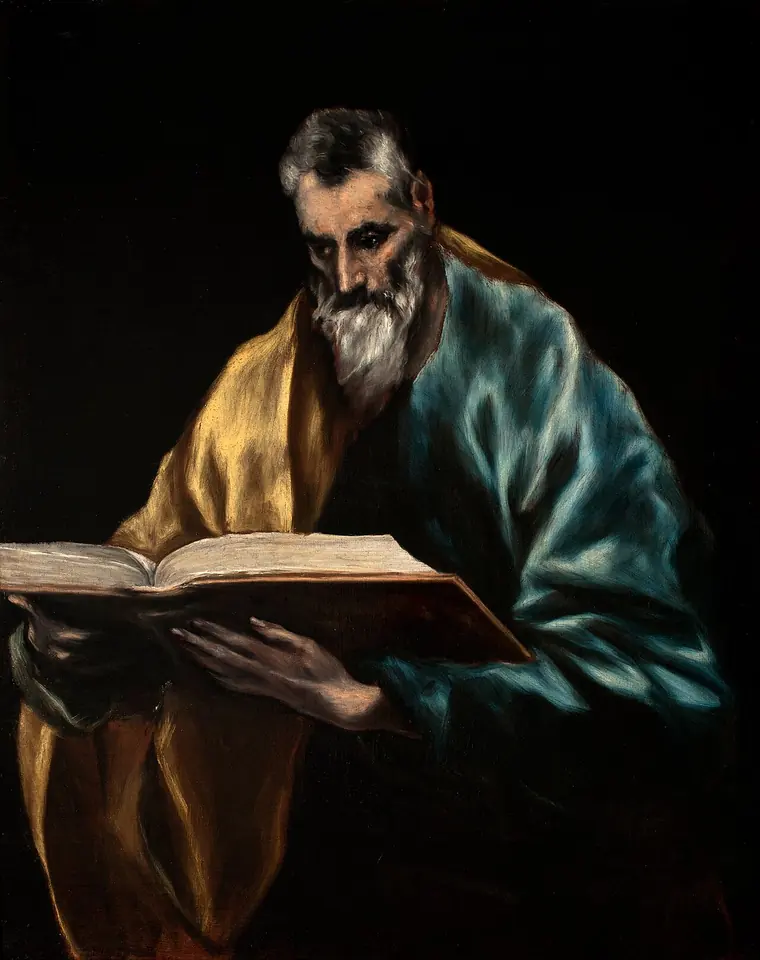
Simon looks like most apostles: a bearded man in a long robe and cloak, often holding a book for the Gospel he preached. What sets him apart is a saw, usually a large two-handled saw or a bucksaw. Richard Stracke's Christian Iconography notes that the saw became his usual attribute after the 13th century, drawn from the legend that he was cut to pieces. Rarer attributes are a lance or a boat; the boat appears in East Anglia, where it may recall the story that he sailed to Britain.


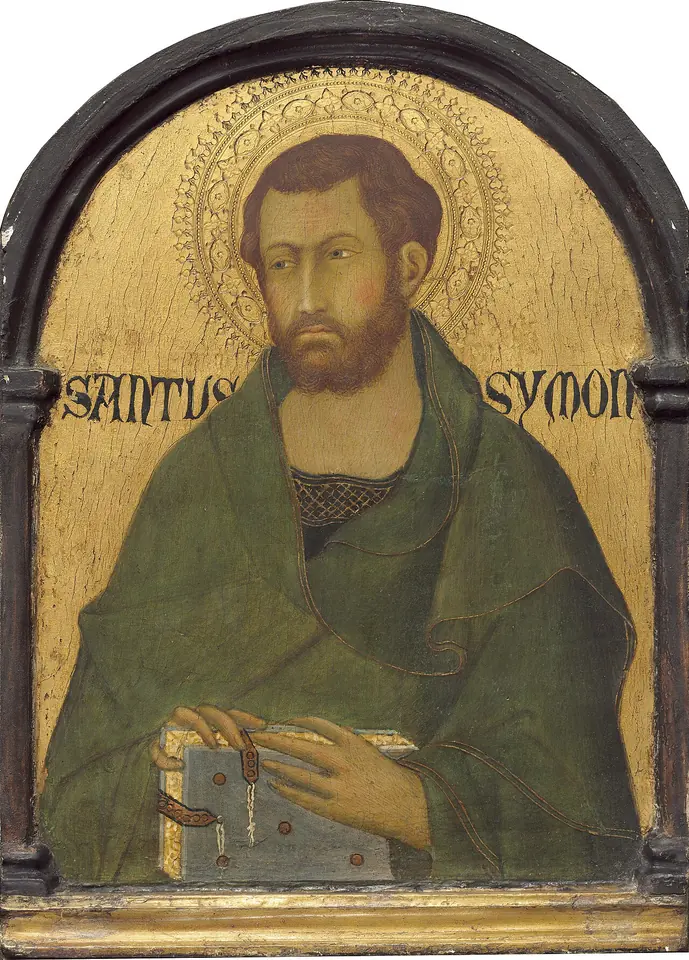
Older images may give him only a book, like the Master of Saint Francis panel in New York, where he stands behind St. Bartholomew. When two apostles appear together with a saw and a club or halberd, they are almost certainly Simon and Jude.


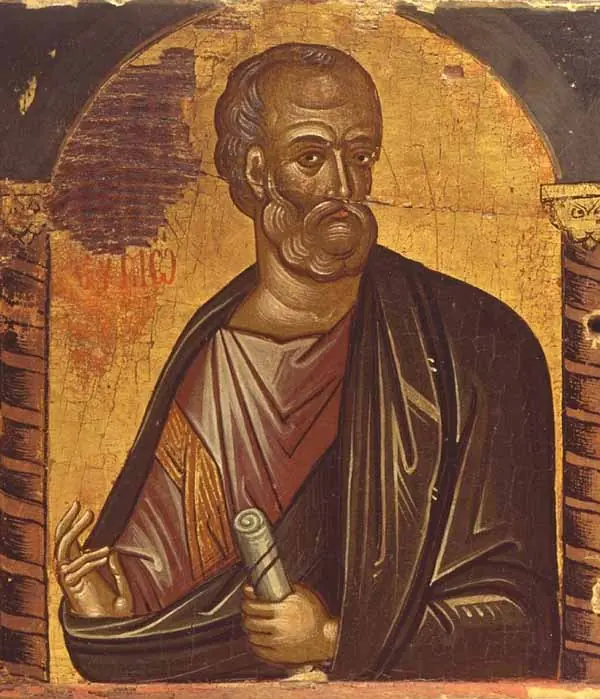
In Eastern icons Simon is usually an older man with a gray beard and a scroll, without the saw.

The Neoclassical apostles in Copenhagen Cathedral, designed by Bertel Thorvaldsen, give Simon a saw blade held quietly at his side.


Feast day and relics
The Catholic Church keeps the feast of Sts. Simon and Jude on October 28, a feast in the General Roman Calendar. The Orthodox Church commemorates Simon on May 10 and with all the apostles on June 30. See more saints of the season on our feast days page.
Claims to his relics are, in the Catholic Encyclopedia's words, "as uncertain as concerning his preaching," with traces "from Babylon to Rome and Toulouse." The encyclopedia adds that in Rome they were venerated in the Vatican, where relics honored as those of Simon and Jude are still kept together in St. Peter's Basilica.
Prayer to St. Simon
No prayer to Simon alone with a documented origin is in wide use in the Western Church. Catholics usually pray to him together with Jude in the Mass and Liturgy of the Hours of October 28. The Orthodox Church sings this troparion on his feast, in the translation of the Orthodox Church in America:
Holy Apostle Simon / entreat the merciful God / to grant our souls forgiveness of transgressions.
Frequently asked questions
Why is St. Simon called the Zealot?
Luke and Acts call him "Simon the Zealot," while Matthew and Mark call him "the Cananaean." Both names come from the Hebrew word for zeal. Pope Benedict XVI said that even if Simon did not belong to the nationalist Zealot party, he was at least marked by passionate attachment to God, his people and the divine Law.
Why is St. Simon shown with a saw?
Medieval tradition said his body was sawn to pieces at his martyrdom, so from about the 13th century Western artists gave him a large saw. The story is traditional; the New Testament says nothing about how or where he died.
Why do St. Simon and St. Jude share a feast day?
They stand next to each other in the lists of the Twelve, and the Latin Passion of Simon and Jude says they preached together in Persia and were martyred together there. The Western Church has honored them together on October 28 for many centuries. The Orthodox Church honors Simon separately on May 10.
What is St. Simon the patron saint of?
The Catholic Encyclopedia names him patron of tanners. Because of the saw, he is also popularly called the patron of sawyers and woodcutters, and older lists add curriers (leather dressers).
Sources
- Catholic Encyclopedia (1912): St. Simon the Apostle
- Benedict XVI, General Audience of 11 October 2006: Simon and Jude
- Orthodox Church in America: Apostle Simon the Zealot
- Orthodox Church in America: Apostle Simon the Zealot, Troparion and Kontakion
- Jacobus de Voragine, The Golden Legend (Caxton translation): Life of SS. Simon and Jude
- Christian Iconography: St. Simon in Art
- Roman Martyrology, October 28