St. Winifred (Winefride) of Holywell
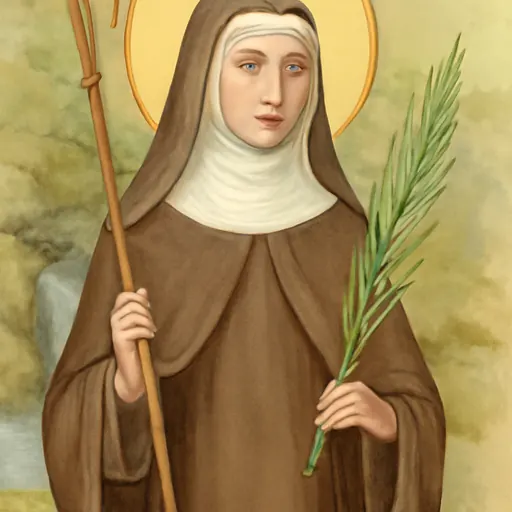
St. Winifred (Winefride, in Welsh Gwenfrewi) was a 7th-century Welsh noblewoman and abbess. Her legend says a chieftain named Caradoc cut off her head, a spring burst from the ground where it fell, and her uncle St. Beuno restored her to life. St. Winefride's Well at Holywell has drawn pilgrims seeking healing ever since. Her feast day is November 3.
Who was St. Winifred?
Winifred, more often spelled Winefride in Wales and in Catholic use (Gwenfrewi in Welsh), was a young noblewoman of north Wales in the 7th century. She became a nun and later abbess, first at Holywell and then at Gwytherin, in the hills near the source of the River Elwy. She is remembered for one extraordinary story, her beheading and restoration to life, and for the spring that the story explains: St. Winefride's Well at Holywell, which has drawn pilgrims for at least nine hundred years.
How much of her life is history is uncertain. The Catholic Encyclopedia draws on a Life said to be by Elerius, a monk who knew her, and on a Life compiled in the 12th century by Robert, prior of Shrewsbury. Both survive only in medieval manuscripts written long after her time. Cadw, the Welsh government's heritage service, adds that the story of the well "may actually have much older, pagan origins." This entry calls the main events traditional.


The life and legend of St. Winifred
Beuno's niece
Her father, Thevit (Tyfid), held land in what is now Flintshire, and her mother, Wenlo, was the sister of St. Beuno, a monk and founder of monasteries. The Catholic Encyclopedia says Beuno came to his sister's husband looking for a place to build, settled in the hollow below their house, and built a chapel where he said Mass and preached. Winefride, at fifteen, was one of his most attentive listeners and resolved to give her life to God.
Caradoc and the spring
Caradoc, the son of a neighboring prince, wanted to marry her. One morning he found her alone at home while her parents were at Mass. When she refused him, she ran toward the church; he caught her on the slope above the present well and cut off her head with one blow of his sword. The Catholic Encyclopedia tells the rest: "The head rolled down the incline and, where it rested, there gushed forth a spring."
Beuno left the altar, carried the head to the body, covered both with his cloak and went back to finish Mass. Then he knelt and prayed, and Winefride rose "as if awakening from a deep slumber," with nothing to show but "a thin white circle round her neck." Caradoc, still leaning on his sword, fell dead; popular belief said the ground swallowed him.

Abbess at Holywell and Gwytherin
Winefride took vows and became abbess of a small community of women on her father's land at Holywell. Before Beuno left for his monastery at Clynnog Fawr, tradition says he sat on a stone that still stands in the outer pool and promised that whoever asked three times for a favor from God in her name at that spot would receive it, "if it was for the good of his soul." After his death she moved inland to Gwytherin, where, the Catholic Encyclopedia says, she lived under the abbess there and later became abbess herself. She died there, by tradition on November 3, around 660.
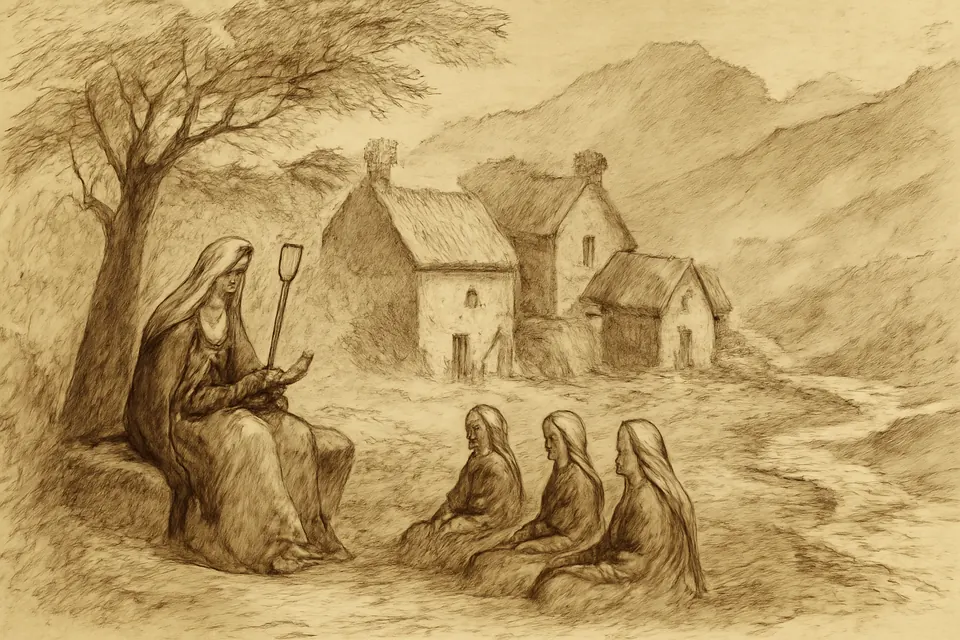
Miracles and healings at Holywell
- Her beheading, the spring and her restoration: traditional. The Catholic Encyclopedia tells it as the old Lives do, and the shrine itself introduces it with "Accounts vary in detail."
- Beuno's promise and the stone in the pool: traditional.
- Healings at the well: reported. The shrine says records going back hundreds of years tell of "many cures from sickness and infirmity," and pilgrims still bathe in the water. None has been formally approved by the Church as a miracle.

St. Winefride's Well
The well is in the town of Holywell (Treffynnon in Welsh) in Flintshire, near the Dee estuary. Cadw says it has been a place of pilgrimage "since at least 1115" and calls it "reputedly the oldest continually visited pilgrim site in Britain." The shrine notes that the crypt survived the Reformation and that pilgrims kept coming despite the penalties on Catholic worship.
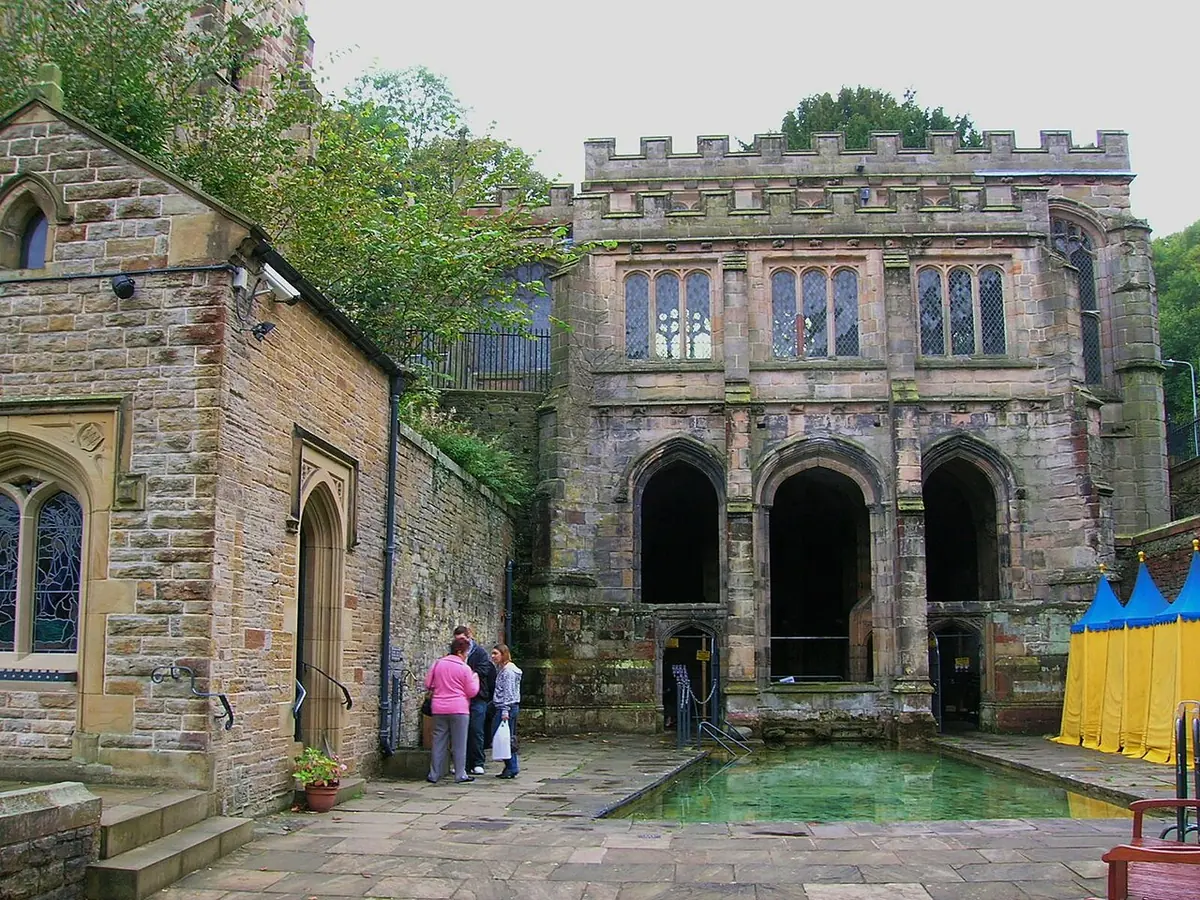

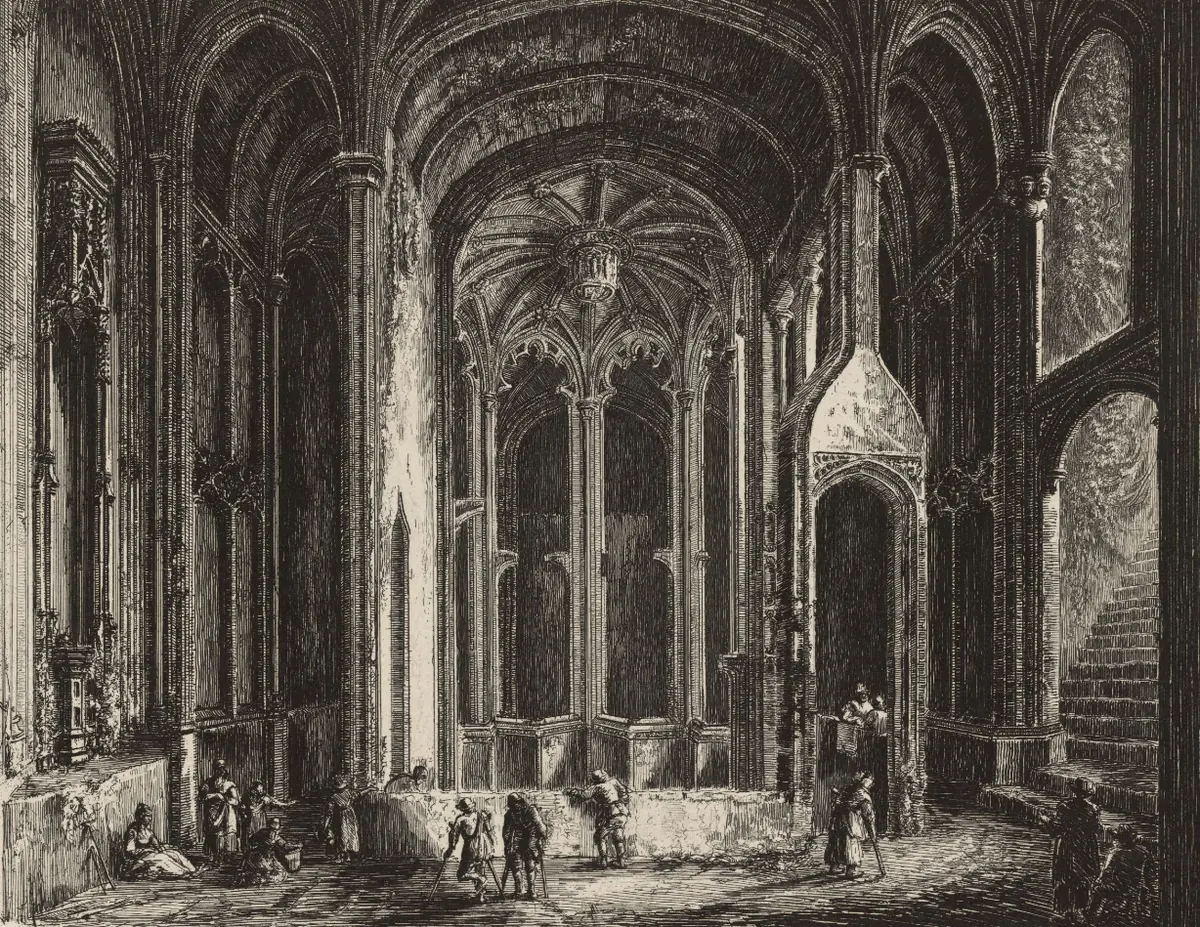
The present two-story building dates from around 1500; Cadw calls it "richly decorated and exceptionally well-built." The shrine attributes it to Lady Margaret Beaufort, mother of King Henry VII. Below, the spring rises into a star-shaped basin under an elaborately vaulted ceiling and flows out into a large open-air pool; above is St. Winefride's Chapel. Cadw looks after the medieval building, and the Diocese of Wrexham runs the shrine.

In 2023 the Bishop of Wrexham designated the shrine a place of prayer and healing for victims of abuse, recalling the violence Winefride suffered.
Shrewsbury Abbey says her remains were brought there from Gwytherin in 1137, and a pilgrim trail still links Shrewsbury to Holywell. A relic is now kept in Shrewsbury's Catholic cathedral, and another is venerated at the well.
Symbols of St. Winifred in art
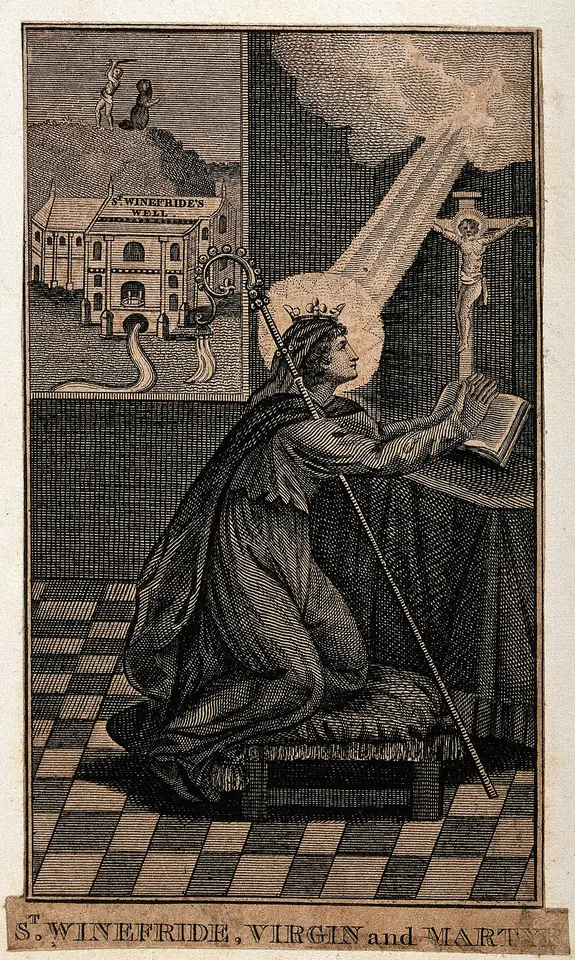
Winifred appears as a young woman, sometimes crowned as a princess, sometimes veiled as an abbess. Look for:
- A thin red or white line around her neck, the mark of her restoration.
- A sword, the weapon of her martyrdom, and a martyr's palm.
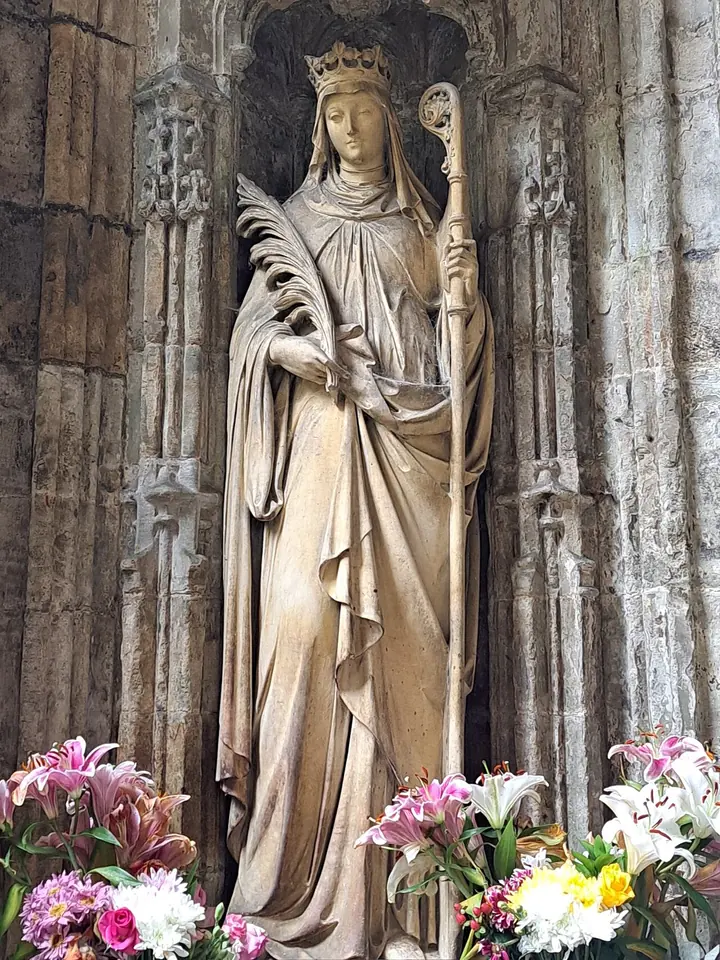
- An abbess's crozier, as in the 1886 statue at the well.
- A spring or well at her feet, or a picture of the well chapel, as in the engraving above.

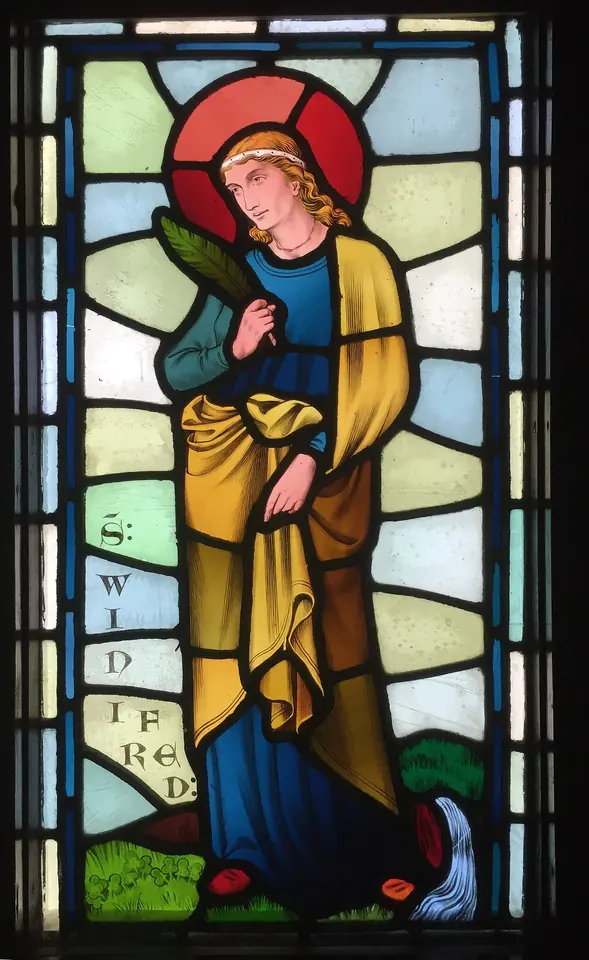
William Burges's stained glass at Castell Coch gives her a palm and puts a little stream of water at her feet, for the spring of Holywell.

Feast day and prayer
Her feast is November 3, which the Catholic Encyclopedia calls her chief feast. It is kept especially in Wales, but it is not on the General Roman Calendar (see our feast days page). Pilgrimages to Holywell run through the summer, with the main season from Pentecost to the end of September.
No traditional prayer to St. Winifred with a documented origin is in wide use. Pilgrims follow the custom tied to Beuno's promise: they ask God three times, in her name, for the favor they seek, and many bathe in the outer pool.
Frequently asked questions
What is the legend of St. Winifred?
As the 12th-century Lives tell it, the young Winefride refused the advances of Caradoc, a prince's son, and fled toward her uncle Beuno's church. He overtook her and struck off her head with his sword. Where it came to rest a spring gushed out. Beuno set the head back on her body and prayed, and she rose alive with only a thin white circle around her neck. The story is traditional.
What is St. Winefride's Well?
A holy well in Holywell, Flintshire, in north Wales, believed to have sprung up at the place of Winefride's martyrdom. Cadw, which cares for the building, says it has been a place of pilgrimage since at least 1115. The spring rises in a star-shaped basin under a late Gothic well house and flows into an outdoor bathing pool.
Can you bathe in St. Winefride's Well?
Yes. The shrine allows bathing at set times each day in the outer pool, in modest clothing, and holds a daily service with veneration of the saint's relic from Pentecost to the end of September.
When is St. Winifred's feast day?
November 3, which the Catholic Encyclopedia calls her chief feast. It is kept especially in Wales and at Holywell. A midsummer feast traditionally marked her martyrdom.
Sources
- Catholic Encyclopedia (1912): St. Winefride
- Cadw: St Winefride's Chapel and Well
- St Winefride's Shrine: The Legend of St Winefride
- St Winefride's Shrine: Sanctuary, Crypt and Outer Pool
- St Winefride's Shrine: Bathing and Veneration of the Relic
- St Winefride's Shrine: A Place of Healing
- Shrewsbury Abbey: St Winefride Pilgrim Trail