Our Lady of Charity of El Cobre (La Caridad del Cobre)
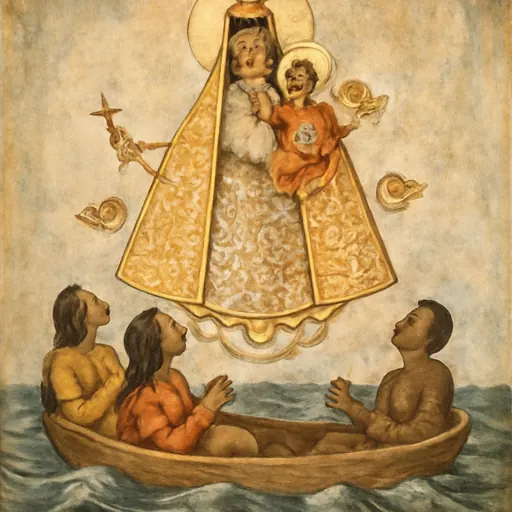
Our Lady of Charity of El Cobre (La Caridad del Cobre) is the title Catholics give the Virgin Mary in the small statue found floating in Cuba's Bay of Nipe in the early 1600s by two Indigenous brothers and an enslaved African boy. Pope Benedict XV declared her the patroness of Cuba in 1916. Her feast day is September 8, and the original statue is kept in the basilica at El Cobre, near Santiago de Cuba.
Who is Our Lady of Charity of El Cobre?
Our Lady of Charity of El Cobre is the Virgin Mary as Cubans know her in a small statue that, by tradition, three young men found floating in the Bay of Nipe in the early 1600s. She is the patroness of Cuba. Cubans call her La Caridad del Cobre, or simply "La Cachita," and the statue lives in a basilica on a hill above the old copper-mining town of El Cobre, about 12 miles (20 km) west of Santiago de Cuba.
The statue is small: a little over a foot tall. The Catholic Culture account describes a head of baked clay with a white powder finish; the Virgin holds the Child Jesus on her left arm and a gold cross in her right hand, and stands on a crescent moon. For centuries she has worn rich embroidered robes, so what pilgrims see is mostly a golden triangle of cloth with two small faces at the top.


She belongs to the same family of Marian images as Our Lady of Guadalupe: a title of the Blessed Virgin Mary tied to one image, one place and one people. Unlike Guadalupe, the story at El Cobre is not an apparition. Mary is not said to have appeared or spoken. Catholics honor her through an image that, as they understand it, came to Cuba in a remarkable way.
The finding in the Bay of Nipe
Juan Moreno's testimony
The story rests on an unusually old document. On April 1, 1687, the parish priest of El Cobre, Juan Ortiz Montejo de la Cámara, took the sworn testimony of Captain Juan Moreno, an enslaved Black man then 85 years old. The record survives in the Archive of the Indies in Seville (Santo Domingo 363), and the University of California, Santa Cruz has published a transcription and English translation.
Moreno said that when he was about ten he went with two Indigenous brothers, Rodrigo and Juan de Hoyos, to gather salt in the Bay of Nipe, on Cuba's northeast coast. They camped on a key, and one calm morning before sunrise they set out in a canoe. In the translation's words, "they saw a white thing [floating] over the foam in the water." At first they took it for a bird, then for a girl. It was a small image of the Virgin with the Child in her arms, standing on a little plank, and "in the said plank there were big letters which Rodrigo de Hoyos read and they said I am the Virgin of Charity." He added: "they were astonished that although her garments were made of cloth they were not wet."

The date
Moreno's testimony gives no year. If he was 85 in 1687 and about ten at the finding, it took place in the early 1610s, and the date usually given is 1612. When Pope Benedict XVI came to Santiago de Cuba in 2012, he came for the 400th anniversary of the discovery of the image. The year is a reasonable reckoning, not a recorded fact.
What is history and what is tradition
The 1687 deposition is a real historical source: a sworn eyewitness account, taken down by a priest, about 75 years after the event. That the image was found floating in the bay and carried to El Cobre is history in that sense. The dry garments, the calm that followed the storm in later retellings, and the details that grew around the story are traditional. Popular devotion calls the finders "the three Juans," although the testimony names only two Juans. Where the statue came from before it reached the water is unknown.
From Barajagua to El Cobre
Moreno said the men took the image to the cattle ranch at Barajagua, where the overseer reported it to Captain Francisco Sánchez de Moya, the administrator of the royal copper mines. An altar was set up and a lamp kept burning before her. Sánchez de Moya then sent a Franciscan friar with soldiers and townspeople to bring the image in procession to the parish church of El Cobre, where a sung Mass was celebrated.
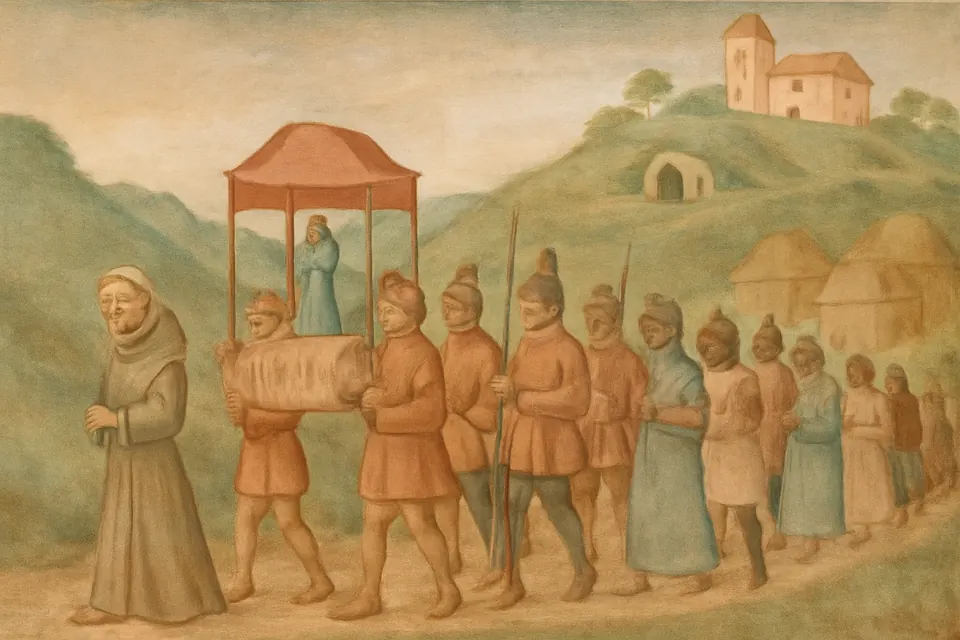
The testimony goes on to tell of three lights seen on three nights over the hill of the mine, which settled the place for her hermitage. It also describes pilgrims coming from Santiago de Cuba and from Bayamo, more than thirty leagues away. These lights are a traditional element of the story, recorded in the 1687 document but never examined by the Church.
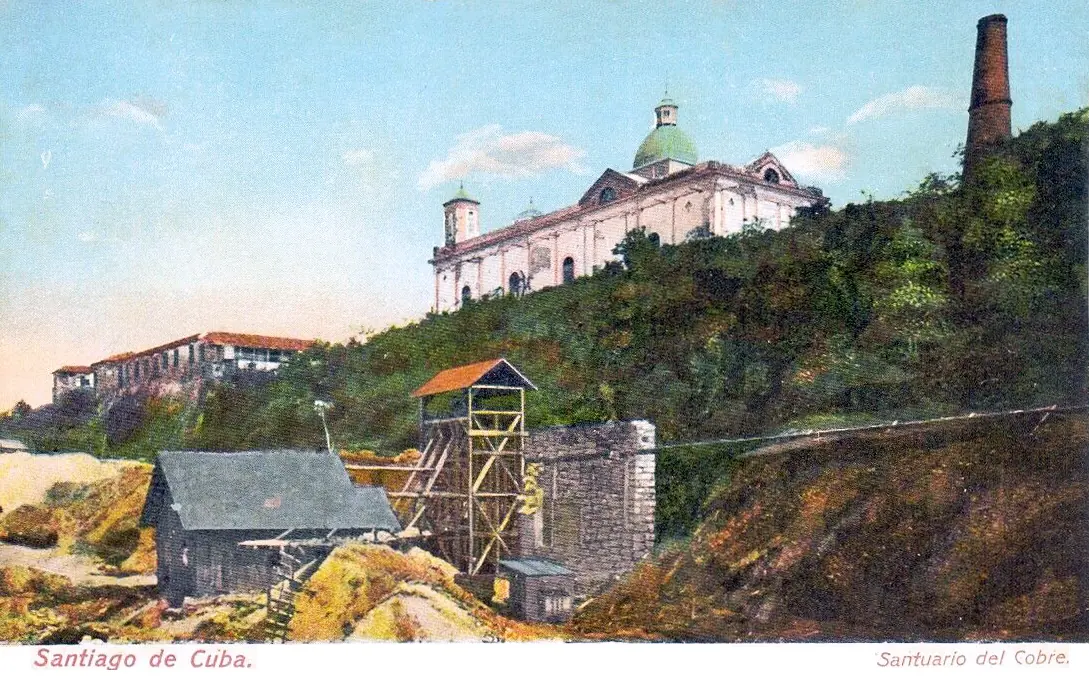
The town matters to the devotion. El Cobre's copper mine was worked by enslaved Africans, and Moreno himself was one of them. Pope John Paul II recalled the town's later history in 1998: "El Cobre, where the shrine is located, was the first place in Cuba where freedom was won for slaves."

Patroness of Cuba
Devotion to La Caridad grew with Cuba itself. Veterans of the wars of independence asked Rome to make her the nation's patroness, and Pope Benedict XV did so in 1916. The present basilica was finished in 1926 on the hill above the mine, replacing the older church. In 1936 the statue was solemnly crowned during the Eucharistic Congress in Santiago de Cuba, and in 1977 Pope Paul VI gave the shrine the rank of a minor basilica.
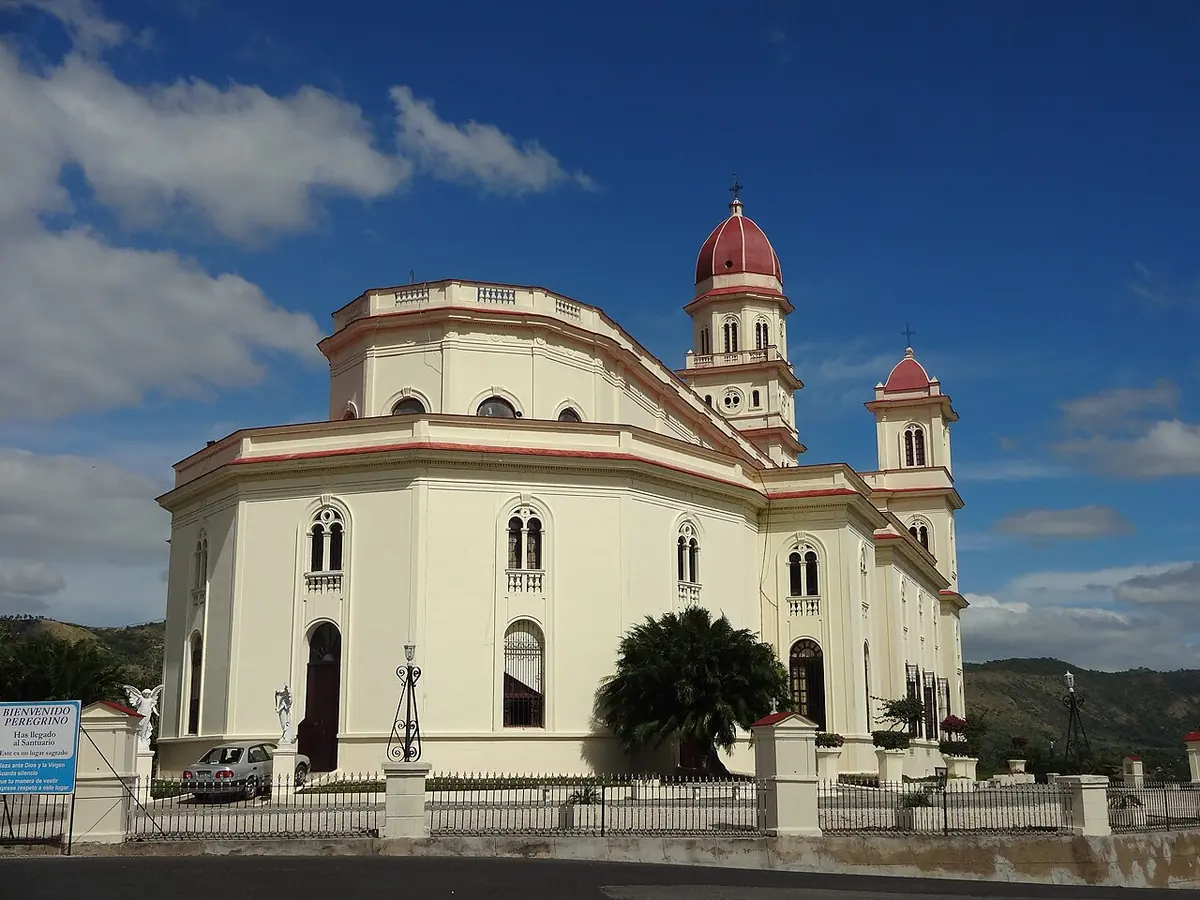

Pilgrims leave gifts at the shrine: crutches, letters, photographs, sports jerseys and medals. The Associated Press, in 2024, described baseball players and Olympic champions leaving their uniforms and medals there. Ernest Hemingway asked that his 1954 Nobel Prize be placed at the statue's feet, and a replica of the medal hangs on a wall of the church.
Popes at El Cobre
Three popes have prayed before the statue:
- John Paul II crowned the image again on January 24, 1998, during an outdoor Mass in Santiago de Cuba, and offered a long prayer to her.
- Benedict XVI celebrated Mass in Santiago on March 26, 2012, for the 400th anniversary of the finding, and the next morning prayed at the shrine in El Cobre.
- Francis prayed at the shrine on September 21, 2015, and celebrated Mass in the basilica the next day. He played on the town's name in his homily: Mary's presence, he said, "is our most valuable treasure (cobre)."
Symbols of Our Lady of Charity in art
The image is easy to recognize once you know it:
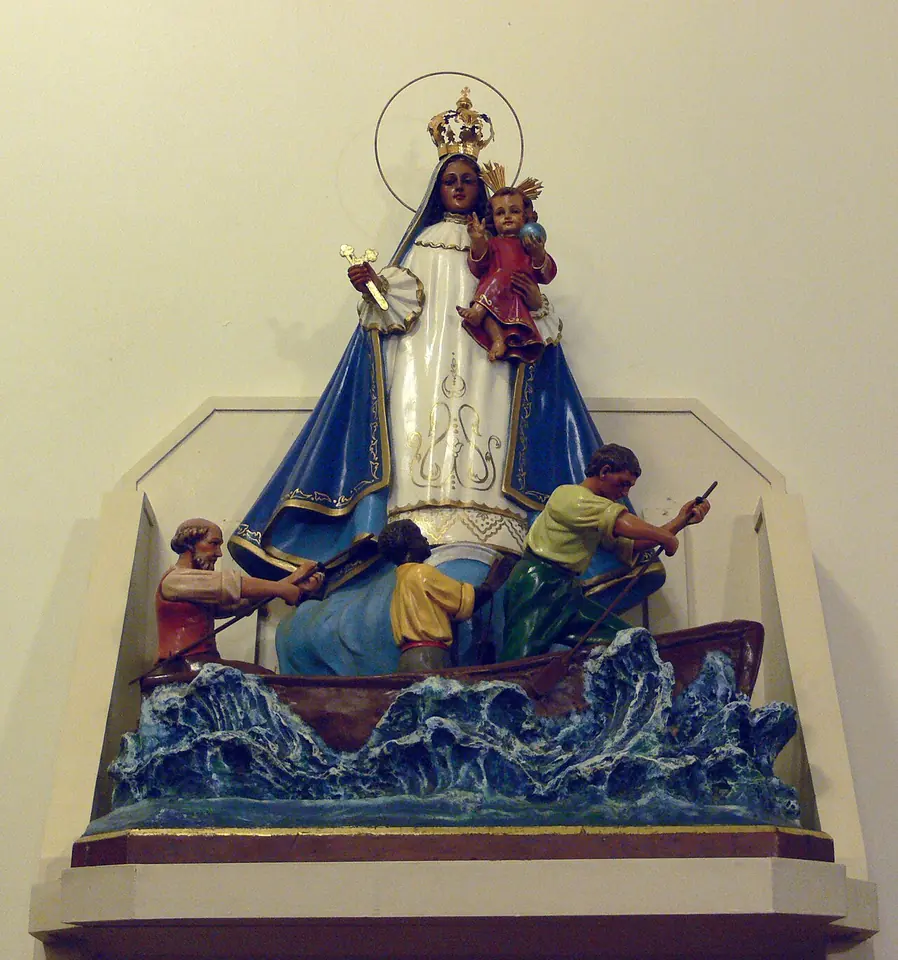
- A small crowned Virgin in a wide golden mantle, shaped like a triangle, with the Child on her left arm. The Child usually holds a small globe and raises a hand in blessing.
- A gold cross in Mary's right hand.
- A crescent moon under her feet and small angel heads on a silver cloud.
- Three men in a little boat on rough water below her, looking up. Holy cards and statues almost always include them. John Paul II described them as "two Indians and a Black," figures who "symbolize the rich plurality of this people."
- A banner or board with the words "I am the Virgin of Charity," from the plank in the story.
Popular paintings often show her above a storm, with the waves high and the men rowing hard. That storm comes from later tellings; Moreno's testimony speaks of a calm morning.

The Miami shrine and the Cuban diaspora
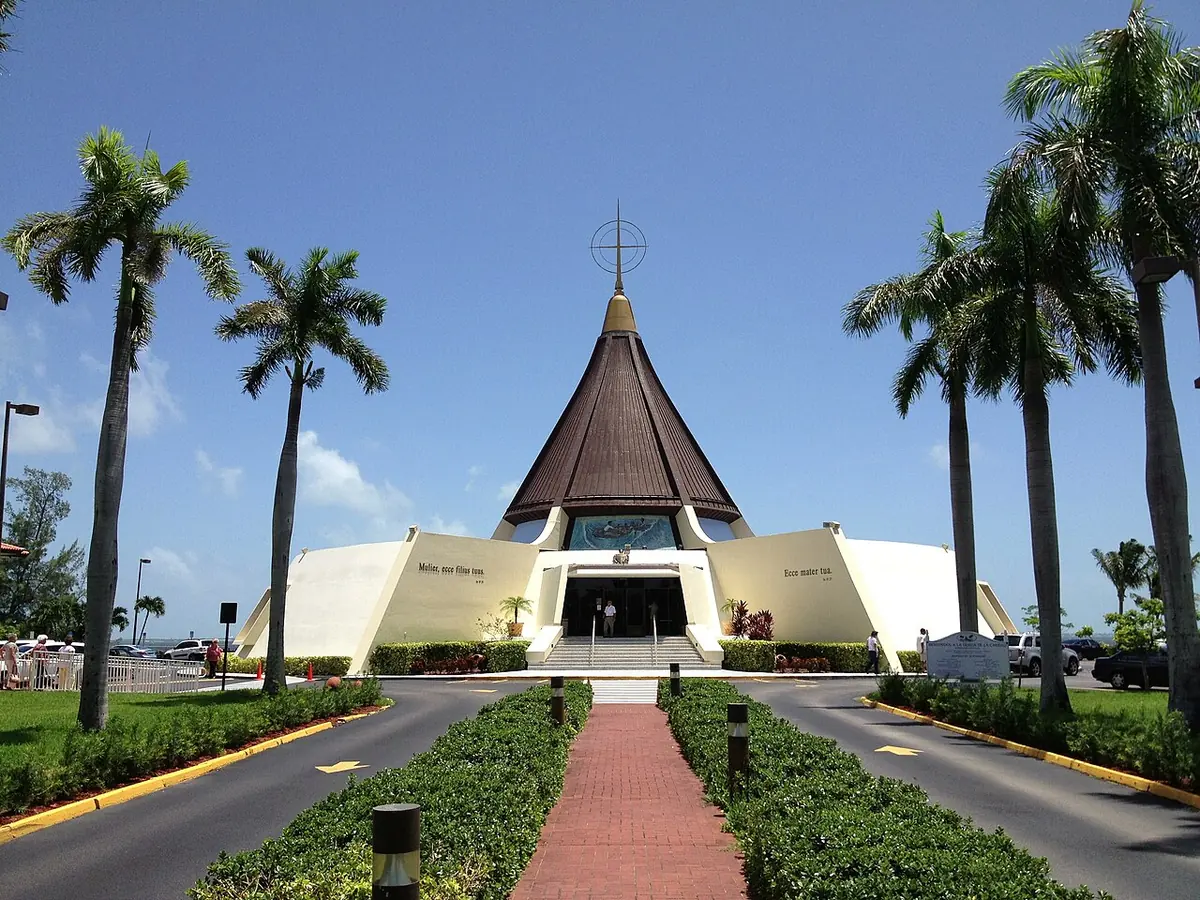
After the revolution of 1959, hundreds of thousands of Cubans left the island, and La Caridad went with them. In September 1961 a replica of the statue, smuggled out of Cuba, reached Miami for her feast day (one older account gives 1960). Thousands of exiles gathered at Miami Stadium to receive it.
Agustín Román, a priest expelled from Cuba in 1961 with more than a hundred other priests, came to Miami in 1966 and, as EWTN News reported at his death in 2012, founded the shrine and oversaw its construction for seven years, with exiles paying for it. La Ermita de la Caridad opened on the shore of Biscayne Bay in 1973. The U.S. bishops named it a national shrine in 2000.

Santería and Ochún
In Cuba the image is also honored by followers of Santería, an Afro-Cuban religion of Yoruba origin. They associate her with Ochún, an orisha connected with rivers, love and motherhood, and use the same image. The Catholic Church honors her only as the Virgin Mary, and this encyclopedia describes her in those terms.
Feast day and the shrine today
Her feast is September 8, the Nativity of Mary. At El Cobre the statue is carried in procession, and in Miami thousands come to the Ermita and to a Mass in her honor. You can find other Marian feasts on our feast days page and other national patrons on our patron saints page.
Prayer to Our Lady of Charity
The best-known modern prayer to her is the one Pope John Paul II prayed in Santiago de Cuba on January 24, 1998, before crowning the statue. Pope Francis opened his own prayer at El Cobre in 2015 with the same words. It begins:
Our Lady of Charity of El Cobre,
Patroness of Cuba!
Hail Mary, full of grace!
You are the beloved Daughter of the Father,
the Mother of Christ, our God,
the living Temple of the Holy Spirit.
The full text is on the Vatican website. Cubans also sing to her and pray the Rosary at her shrines, asking her to pray for their families and for their country.
Frequently asked questions
What is the story of Our Lady of Charity of El Cobre?
The oldest account is the sworn testimony of Juan Moreno, given in 1687 when he was 85. He said that as a boy of ten he went to gather salt in the Bay of Nipe with two Indigenous brothers, Rodrigo and Juan de Hoyos. One calm morning they saw a white object floating on the water. It was a statue of the Virgin holding the Child on a small board, with letters that said she was the Virgin of Charity, and her clothes were dry. The image was taken to the copper-mining town of El Cobre, where her shrine still stands.
When is the feast of Our Lady of Charity?
September 8, the feast of the Nativity of Mary. Cubans on the island and in exile celebrate it with Masses and processions; in Miami the National Shrine holds its largest celebration of the year.
Why is Our Lady of Charity the patroness of Cuba?
Veterans of Cuba's wars of independence asked Rome to name her the country's patroness, and Pope Benedict XV did so in 1916. The statue was crowned in 1936, and Pope John Paul II crowned it again in Santiago de Cuba in 1998.
What are the three men in the boat?
They are the "three Juans" of popular tradition, the finders of the statue. Juan Moreno's testimony names his companions as Rodrigo and Juan de Hoyos, so only two were named Juan; the nickname came later. John Paul II said the figures, "two Indians and a Black," stand for the many peoples of Cuba.
Is Our Lady of Charity the same as Ochún?
No. In the Catholic Church she is the Virgin Mary. Followers of Santería, the Afro-Cuban religion, associate her image with Ochún, an orisha (spirit) of their own tradition. The two are often mentioned together in Cuba, but they belong to different religions.
Sources
- Deposition of Juan Moreno on the Apparition, 1687 (El Cobre, Cuba: Images, Voices, Histories, UC Santa Cruz)
- Catholic Culture: Our Lady of Charity (María Ruiz Scaperlanda, Knights of Columbus, 2007)
- John Paul II: Prayer to Our Lady of Charity of El Cobre, homily at Santiago de Cuba, January 24, 1998
- Benedict XVI: Holy Mass for the 400th anniversary of the discovery of the image, Santiago de Cuba, March 26, 2012
- Benedict XVI: Visit to the Shrine of the Virgen de la Caridad del Cobre, March 27, 2012
- Francis: Holy Mass at the Minor Basilica of the Shrine of the Virgen de la Caridad del Cobre, September 22, 2015
- Associated Press: Revered by Hemingway and visited by popes, why Cuba's small patron saint is such a huge symbol (2024)
- EWTN News: Church grieves death of Bishop Agustin Román, leader of Cuban exiles (2012)