St. Giles, Hermit and Abbot
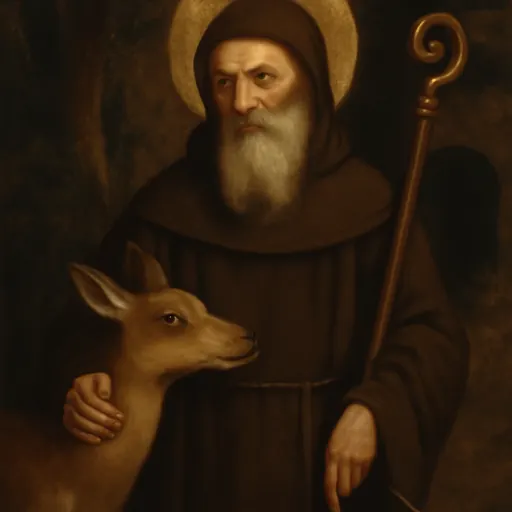
St. Giles was a hermit and abbot who lived in Provence, in southern France, around the year 700. Legend says a hind fed him with her milk, and that he was wounded by an arrow when the king's hunters chased her to his cave. He is one of the Fourteen Holy Helpers and the patron of people with disabilities, beggars and nursing mothers. His feast day is September 1.
Who was St. Giles?
Giles (Aegidius in Latin, Gilles in French) was a hermit who lived in Provence, in the south of France, in the late seventh and early eighth centuries, and founded a monastery there. The town that grew around it still carries his name: Saint-Gilles, in the department of the Gard.
Almost everything else comes from his Life, the Vita Sancti Aegidii, written long after his death; the Bollandists edited it in 1889. The Catholic Encyclopedia retells it with care and points out a problem at once. The king in the story is called Flavius or Wamba, king of the Visigoths, but the Franks had driven the Visigoths from the region near Nîmes well before Giles's time, so the king "must have been a Frank." The legend is old, and much of it is traditional rather than history.
What is certain is how widely he was loved. By the Middle Ages his shrine was one of the great pilgrim churches of Europe, and churches of St. Giles stood from Poland to Scotland.

The life and legend of St. Giles
A noble son of Athens
The legend says Giles was born in Athens to a distinguished family. Finding that his birth and his reputation for holiness got in the way of a humble life, he sailed for Gaul. He lived first as a hermit near the mouth of the Rhône and then by the River Gard. When crowds found him there too, he went deep into a forest near Nîmes.
The hind and the arrow
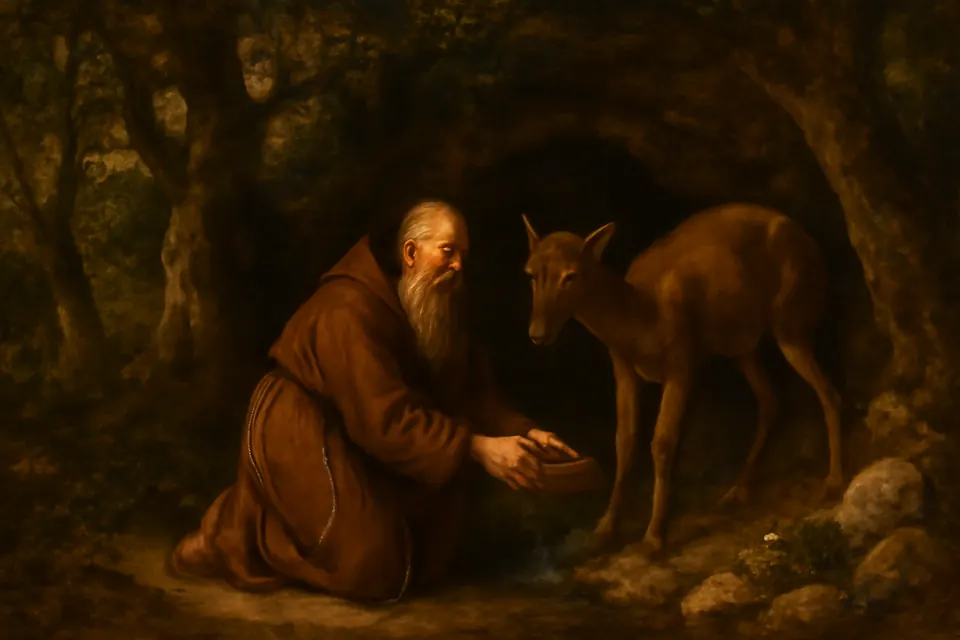
In the forest his only companion was a hind, a female deer. Christian Iconography's summary of the legend says Christ sent her to feed him with her milk.
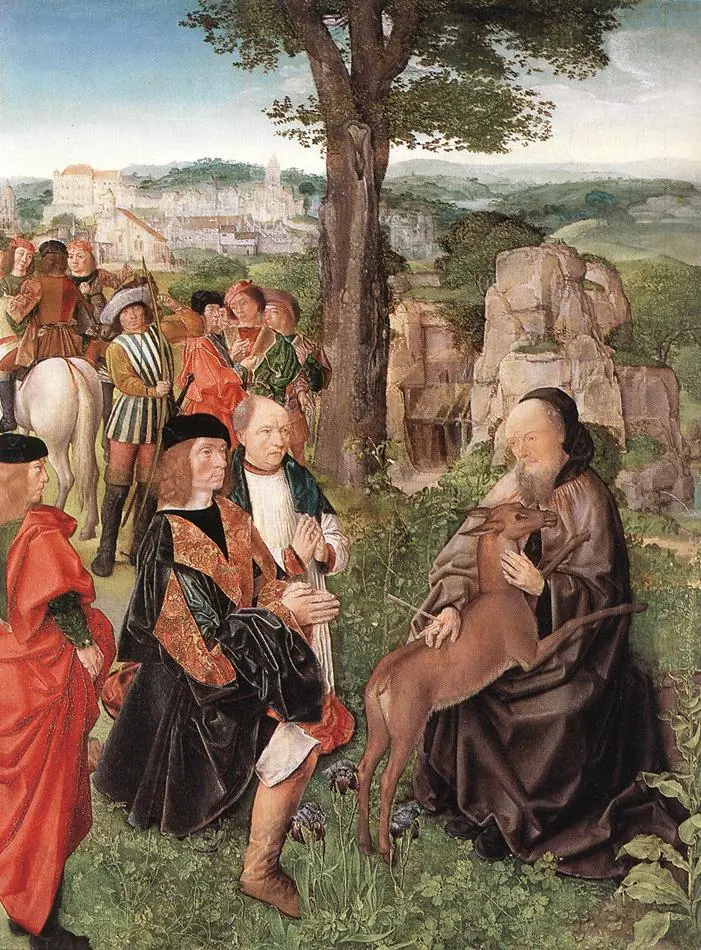
One day the king went hunting. His hounds chased the hind, and she fled to the hermit's cave. A hunter shot into the thicket and struck Giles instead. When the king came and found the old man wounded, holding the deer, he offered his physicians. Giles refused and prayed that the wound would never heal, quoting St. Paul: "power is made perfect in infirmity" (2 Corinthians 12:9). The king was so moved that he gave land for a monastery. Giles agreed to take disciples, built the monastery in his valley and placed it under the Rule of St. Benedict. He died there in the early eighth century.


The Mass of St. Giles
A second famous story involves a "King Charles," who had committed a sin so terrible that he could not bring himself to confess it. While Giles was saying Mass for him, an angel laid on the altar a scroll on which the sin was written. Giles then brought the king to repent and be forgiven. Christian Iconography notes that if the king is historical at all, he could be Charles Martel, who ruled the Franks in Giles's lifetime. This story is why Giles is invoked for a good confession.


The miracles of St. Giles
None of his miracles was examined in the modern way, since his cult is older than the canonization process.
- The hind that fed him: traditional.
- The arrow and the wound he refused to have healed: traditional.
- The scroll at the Mass for King Charles: traditional.
- Healings at his shrine: reported. Medieval pilgrims told of many, and the Catholic Encyclopedia says he died "with the highest repute for sanctity and miracles."
Why St. Giles is the patron of people with disabilities
Because Giles chose to stay lame, people with physical disabilities took him as their own. Catholic Culture lists him as patron of "cripples, beggars, and breastfeeding mothers," the old wording for people with disabilities. The beggars follow from the same idea, since people unable to work often had to beg. Nursing mothers came from the hind and her milk.
He is also one of the Fourteen Holy Helpers, the saints that German Catholics invoked together during the Black Death, along with St. Blaise, St. Christopher, St. Vitus, St. Erasmus and St. Barbara. Catholic Culture notes that he is the only one of the fourteen who was not a martyr. See more on our patron saints page.
Symbols of St. Giles in art
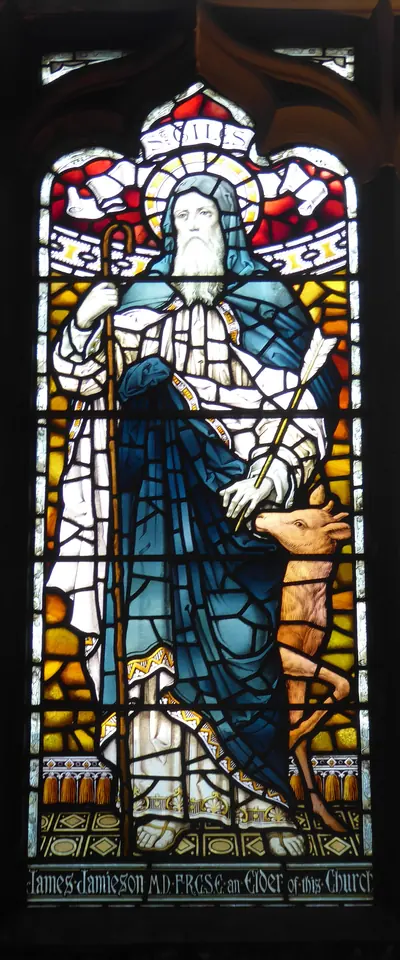
Giles is an old man in a monk's habit, often with an abbot's crozier and a book. The one attribute that marks him is the hind: a deer with no antlers, pressed against him, lying in his lap or looking up at him. Often there is an arrow, in his hand, his leg or the deer.
Christian Iconography gives a useful warning: don't confuse Giles's hind with the stag of St. Eustace or St. Hubert, which has antlers and a crucifix between them. Modern icons, like the one painted by an Orthodox monk at Walsingham in 2009, show him shielding his deer.


Saint-Gilles, Toulouse and the pilgrim road
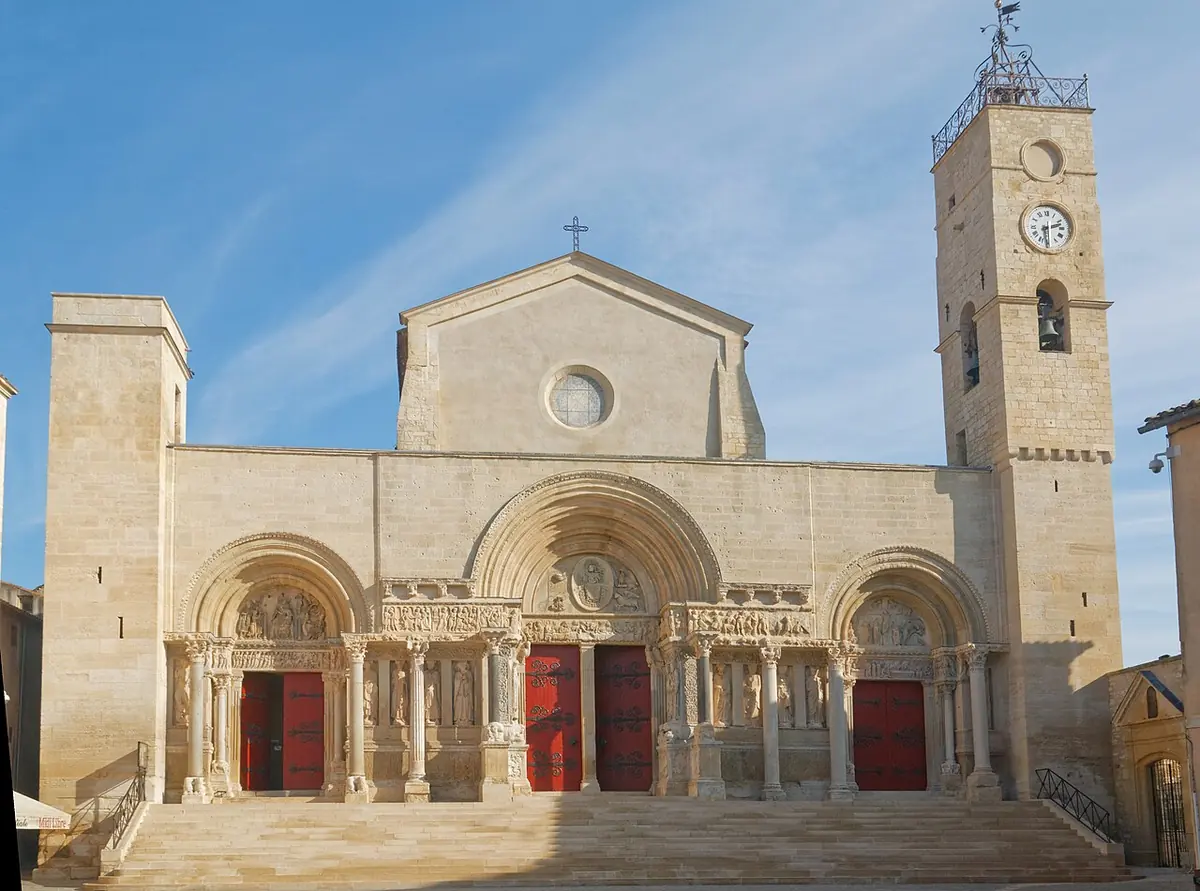
The abbey at Saint-Gilles was a great pilgrim church in its own right and a stop on the road to Santiago de Compostela that started at Arles, one of the four routes through France named by UNESCO. The abbey church is among the monuments of the World Heritage listing of the Routes of Santiago de Compostela in France. Its Romanesque facade, with three carved portals, dates from the twelfth century.

The Catholic Encyclopedia tells what happened to the relics. In 1562, during the Wars of Religion, they were secretly carried to Toulouse to save them from the Huguenots, and the pilgrimage declined. A large part was returned to Saint-Gilles in 1862, his old tomb in the crypt was found in 1865, and pilgrims returned. Other relics are claimed by churches in Belgium, Germany, Italy and elsewhere.
His name is everywhere in Britain. St. Giles' Cathedral in Edinburgh, now a Church of Scotland church, still bears it, as do many English parish churches.

Feast day and prayer
The feast of St. Giles is September 1, the day given in the Roman Martyrology (see our feast days page). He is not on the General Roman Calendar, so the day is kept in places dedicated to him.
No prayer by Giles survives. In the devotion to the Fourteen Holy Helpers, Catholics name him in litanies with the others and ask his prayers in sickness, in fear and before confession.
Frequently asked questions
Why is St. Giles the patron saint of people with disabilities?
In his legend a hunter's arrow struck him while he protected his hind, and he refused treatment and stayed lame for the rest of his life, praying, according to the Christian Iconography summary of the legend, that the wound would never heal. Medieval people with physical disabilities, many of whom lived by begging, took him as their patron.
Is St. Giles one of the Fourteen Holy Helpers?
Yes. He is the only one of the fourteen who was not a martyr, as Catholic Culture notes. The helpers were invoked together during the Black Death; Giles was called on against plague, panic, epilepsy, madness and nightmares, and for a good confession.
When is the feast of St. Giles?
September 1. He is listed on that day in the Roman Martyrology, though he is not on the General Roman Calendar. Local churches and towns named for him keep the feast.
What is the symbol of St. Giles?
A hind, a female deer without antlers, usually pressed against him or lying in his lap, often with an arrow. Don't confuse it with the stag of St. Hubert or St. Eustace, which has antlers and a crucifix between them.
Sources
- Catholic Encyclopedia (1909): St. Giles
- Christian Iconography: St. Giles: Art, Iconography, Legend
- Catholic Culture: Fourteen Holy Helpers
- UNESCO World Heritage Centre: Routes of Santiago de Compostela in France
- Vita Sancti Aegidii, ed. Charles de Smedt et al., Analecta Bollandiana 8 (1889), 103–120
- Roman Martyrology, September 1