St. Raymond Nonnatus

St. Raymond Nonnatus (about 1204–1240) was a Catalan friar of the Mercedarian Order, which ransomed Christians held captive in North Africa. His surname means "not born": he was taken alive from his mother's womb after she died. Catholics ask his prayers in pregnancy and childbirth and for the falsely accused, and his feast day is August 31.
Who was St. Raymond Nonnatus?
Raymond (Ramon in Catalan) was a friar of the Order of Our Lady of Mercy, the Mercedarians, founded in Barcelona in the early 13th century to buy back Christians taken captive by Muslim raiders and held in North Africa. He lived from about 1204 to 1240, worked as a ransomer in Algiers, and died young in Catalonia.
Most of his story survives only through the Mercedarians' own tradition. Richard Stracke's Christian Iconography notes that the sources were "written some centuries later by the Mercedarians," and historians treat several details with caution. This entry follows the Catholic Encyclopedia for the outline and labels the legends as legends.

The life of St. Raymond Nonnatus
"Not born"
Raymond was born at Portell, in the Diocese of Urgell in Catalonia, in 1200 or 1204. His mother died before he was born, and he was taken from her womb. The Latin non natus, "not born," became his surname. Later accounts disagree about who performed the delivery, and the details are traditional.
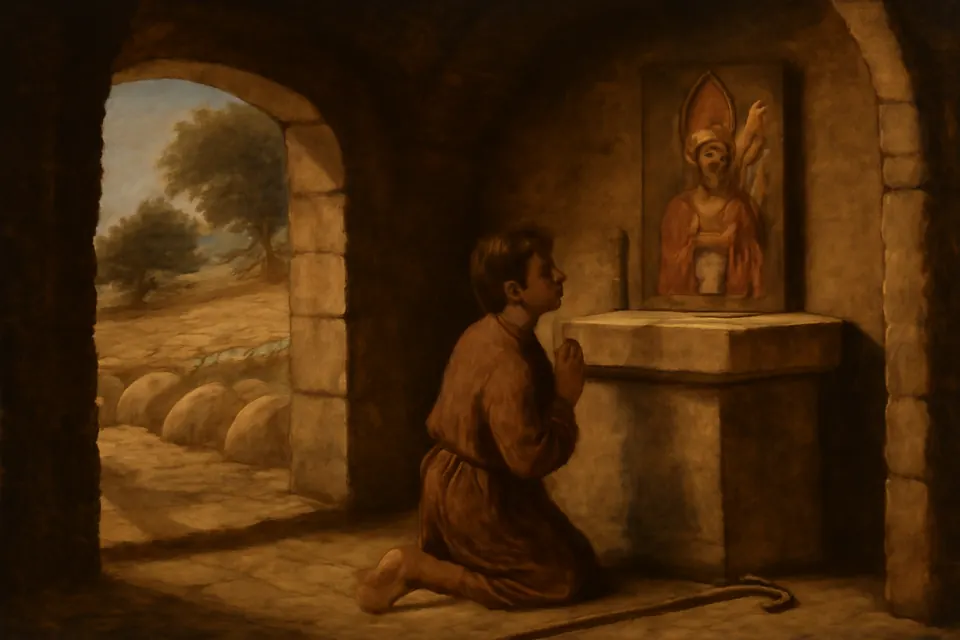
His family was noble but poor. His father set him to work on a farm, and the Catholic Encyclopedia says he showed "early traits of piety and great talent." Tradition says he often prayed as a boy at a small country chapel of St. Nicholas near the farm.
The Mercedarian
His father finally let him enter the Mercedarians in Barcelona, where he received the habit from the founder, St. Peter Nolasco. The friars took a special vow to give themselves as hostages, if necessary, to free captives. Raymond soon became a ransomer himself.
Hostage in Algiers
He was sent to Algiers, where, the Catholic Encyclopedia says, he "liberated many captives. When money failed he gave himself as a hostage." He kept teaching the Christian faith and made converts, which angered the authorities. According to the tradition, he was beaten, made to run the gauntlet and sentenced to impalement, until the governor decided he was worth more alive as a ransom. To stop his preaching, his lips were pierced with a red-hot iron and closed with a padlock. The Mercedarians eventually paid his ransom, and he came back to Spain in 1239.

Cardinal and death
The old accounts say Pope Gregory IX named him a cardinal and called him to Rome, but that he got only as far as Cardona, in Catalonia, where he died on August 31, 1240, at about 36. Modern scholarship doubts the cardinal's hat. The Italian historian Agostino Paravicini Bagliani, studying the cardinals of those years, concluded that the story grew out of a confusion with an Englishman, Robert Somercote, who was cardinal deacon of Sant'Eustachio at the time.
His body was taken to the chapel of St. Nicholas near his old farm, where the Sanctuary of Sant Ramon now stands.
Miracles and legends of St. Raymond Nonnatus
None of these was formally investigated in the modern way. His name was placed in the Roman Martyrology by Pope Alexander VII in 1657, a recognition of a cult already centuries old.
- His survival at birth: the basic fact of his name, though the details told about it are traditional.
- The padlock: traditional, from Mercedarian sources written long after his death.
- The Eucharist from heaven: Spanish painters show angels, or Christ, bringing him Holy Communion before he died. This is traditional.
- The mule: a later story says the people of Cardona, the friars and the local lord all wanted his body, so it was placed on a blind mule, which carried it unguided to the chapel of St. Nicholas. This is traditional.
- Help in childbirth: favors granted to mothers who call on him are reported, not approved.


Why St. Raymond Nonnatus is the patron saint of childbirth
A man who survived his own mother's death in labor became, naturally, the saint mothers turned to before giving birth. The Catholic Encyclopedia already noted in 1911 that he "is invoked by women in labour and by persons falsely accused." The Roman Ritual once included a blessing of water and of candles in his honor for the sick. Midwives, obstetricians and expectant mothers have long claimed him too. See other saints of mothers and children, such as St. Gerard Majella and St. Anne, on our patron saints page.
The patronage of the falsely accused may come from his long captivity. In Latin America some Catholics also leave padlocks at his altar and ask him to stop gossip and slander.
Symbols of St. Raymond Nonnatus in art
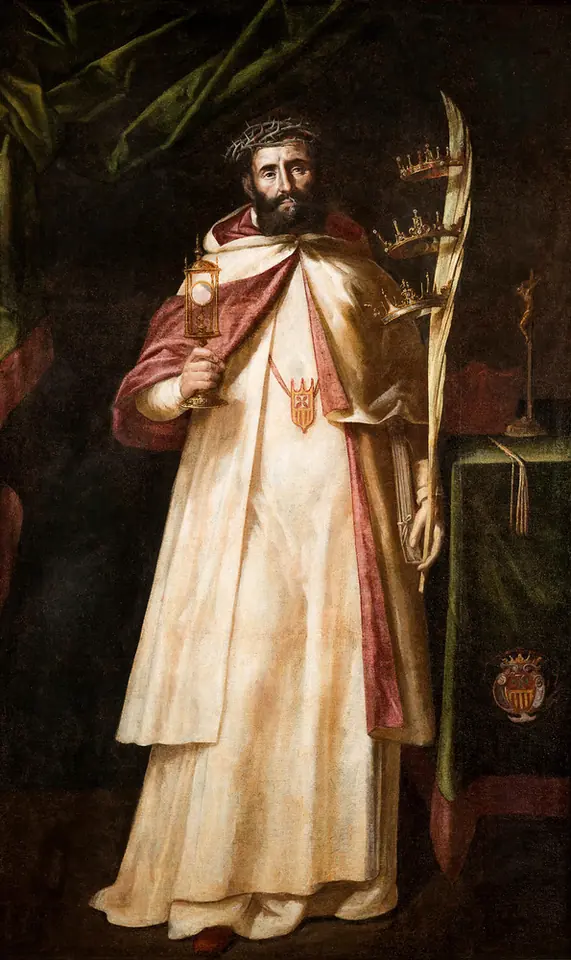
Raymond almost always wears the white habit of the Mercedarians, with the order's shield on his chest: a white cross on red above the red and gold stripes of the Crown of Aragon. Look for:
- A padlock on or at his lips, recalling his imprisonment.
- A monstrance, for his devotion to the Eucharist and the legend of his last Communion.
- A palm branch, sometimes hung with three crowns. The palm marks him as a martyr in suffering, though he did not die for the faith.
- A cardinal's red hat or short red cape, from the cardinal tradition.
Castillo's painting near the top of this page shows the monstrance, palm and crowns together. Jerónimo Jacinto de Espinosa, in the Prado, gave him the cardinal's red cape and showed child angels bringing him the Host.


Feast day and shrine
His feast is August 31. It was removed from the General Roman Calendar in the 1969 reform, but he remains in the Roman Martyrology, and the Mercedarians and many parishes in Spain and Latin America still celebrate it. See the full feast days calendar.
His tomb is in the Sanctuary of Sant Ramon, a large monastery in the village of the same name in the Segarra region of Catalonia, which includes his birthplace of Portell.


Prayer to St. Raymond Nonnatus
Many prayers to St. Raymond for a safe delivery circulate on holy cards, but this encyclopedia has not found one with a documented origin to reproduce. Catholic mothers ask his intercession in their own words during pregnancy and labor, often lighting a candle at his image, and the Mercedarian Order celebrates the Mass of his feast on August 31.
Frequently asked questions
Why is he called Raymond "Nonnatus"?
Nonnatus is Latin for "not born." The Catholic Encyclopedia says he "was taken from the womb of his mother after her death, hence his name." In other words, he was delivered by what we now call a Caesarean section.
Why is St. Raymond Nonnatus the patron of childbirth and midwives?
Because of his own dangerous birth. The Catholic Encyclopedia says he "is invoked by women in labour," and devotion to him spread among expectant mothers, midwives and, today, obstetricians. The midwives' patronage comes from custom rather than any formal decree.
Was St. Raymond Nonnatus really a cardinal?
Probably not. From the 16th century his biographers said Pope Gregory IX made him a cardinal in 1239, which is why he is painted with a red hat or cape. The Italian historian Agostino Paravicini Bagliani concluded that this came from a confusion with an English cardinal of the same years, Robert Somercote.
Why does St. Raymond have a padlock on his mouth?
Mercedarian tradition says that in Algiers his captors pierced his lips with a hot iron and closed them with a padlock to stop him preaching. The story is traditional. Some Catholics leave small padlocks at his altars and ask him to guard them from gossip and false accusations.
Sources
- Catholic Encyclopedia (1911): St. Raymond Nonnatus
- Christian Iconography: St. Raymond Nonnatus in Art
- Order of Mercy: Mercedarian Friars USA
- Butler's Lives of the Saints, August 31
- Roman Martyrology, August 31