St. Moses the Black
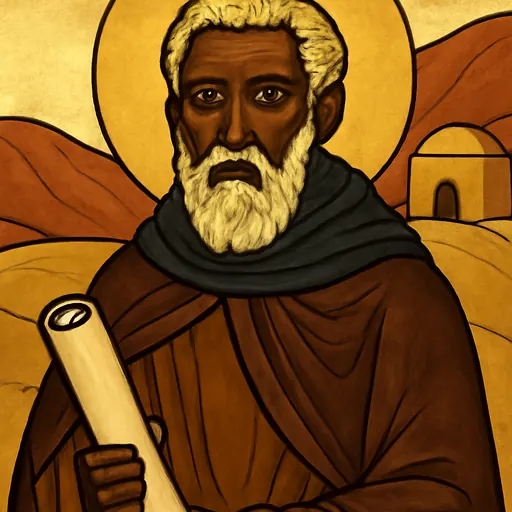
St. Moses the Black (about 330 to about 405) was an Ethiopian slave and robber chief in Egypt who repented, became a monk in the desert of Scetis and was ordained a priest. He is one of the best-loved Desert Fathers, and tradition says he was killed by raiders after refusing to defend himself. His feast day is August 28, and many today call him a patron of nonviolence.
Who was St. Moses the Black?
Moses was an African slave who became a robber, then a monk, then one of the most quoted elders of the Egyptian desert. He lived at Scetis, the monastic settlement in what is now Wadi El Natrun, northwest of Cairo, in the second half of the 4th century, and died there about 405.
His story is unusually well attested for a desert monk. Palladius, who knew the Egyptian monks firsthand, wrote it up in his Lausiac History around 420. The church historian Sozomen told it again a few decades later. The Sayings of the Desert Fathers (the Apophthegmata Patrum), collected in the 5th and 6th centuries, preserve a group of his sayings and short stories. All three call him an Ethiopian, which in Greek meant a Black African from south of Egypt; Palladius says he was "an Ethiopian by race and black."


The life of St. Moses
Slave and robber
Palladius says Moses was a house servant of a government official, who drove him out "because of his immorality and brigandage," adding that "he was said to go even the length of murder." He became the leader of a robber band. Palladius tells one exploit in detail: a shepherd's dogs once spoiled a raid, so Moses swam the flooded Nile at night with his sword in his teeth to take revenge. The shepherd hid in the sand. Moses killed four rams, swam back with them, and traded the skins for wine.
Conversion
How he changed, Palladius doesn't say, only that he was "conscience-stricken as a result of one of his adventures" and "gave himself up to a monastery." Sozomen calls it "so sudden a conversion from vice to virtue" that it had never been seen before. The Orthodox life adds that the monks doubted him at first and that he wept at the gate until they let him in.
Later, four robbers broke into his cell without knowing who lived there. Moses tied them up, carried them on his back "like a truss of straw" to the church, and asked the brothers, "Since I am not allowed to hurt anyone, what do you bid me do with these?" When the robbers learned who he was, they became monks themselves.

Years of struggle
Both early sources say his old habits did not leave quickly. His teacher, Abba Isidore, told him to persevere. Moses ate only a little dry bread, prayed through whole nights standing, and at night carried water in secret to the cells of older monks, some of whom lived miles from the well. Palladius says that one night he was struck down at the well and lay ill for a year. Only after that, at Isidore's word, did the struggle ease.
Priest and elder
He was ordained a priest for the monks of Scetis. The Orthodox life keeps a story from his ordination: the bishop, seeing him in white vestments, said, "Now Abba Moses is entirely white!" and Moses answered, "Only outwardly, for God knows that I am still dark within." Palladius says he left seventy disciples.
John Cassian, who lived among the Egyptian monks in the 380s and 390s, opens his Conferences with two discourses by an "Abbot Moses," eminent "not only in practical but also in contemplative excellence." Tradition identifies this teacher with Moses the Black. Through Cassian his teaching on the goal of monastic life reached Western monks, among them St. Benedict, who told his monks to read the Conferences.


The leaking jug
The best-known story about Moses comes from the Sayings of the Desert Fathers. A brother at Scetis had sinned, and the monks called a council to judge him. Moses refused to come. When the priest sent for him again, he went, but on the way he "took a leaking jug, filled it with water and carried it with him." The monks asked what it meant. In Benedicta Ward's translation (1975) he said:
My sins run out behind me, and I do not see them, and today I am coming to judge the errors of another.
The council said no more and forgave the brother. Other translations of the same saying, such as John Wortley's, have him carry a basket with many holes, filled with sand.

His death
Palladius and Sozomen say only that Moses died at Scetis at the age of seventy-five. The tradition of his martyrdom comes from the Sayings: he warned that raiders were coming and told the monks to flee, but stayed himself, quoting Christ's words from Matthew 26:52. The Orthodox life gives his reply to the disciples who begged him to leave: "For many years now, I have awaited the time when the words spoken by my Master, the Lord Jesus Christ, should be fulfilled: 'All who take up the sword, shall perish by the sword.'" Seven brothers stayed with him, and the raiders, usually identified as Mazices, Berber nomads who attacked Scetis in the early 5th century, killed all but one, who hid. The year is usually given as about 405.
The miracles of St. Moses
The early sources tell few wonders about him. Sozomen says Moses was "celebrated for his meekness, his love, and his power of healing of sufferings by prayer," and both he and Palladius say God gave him power over demons. These are traditional, recorded by writers who lived within a generation or two of him. No miracle of his has been formally investigated, since his cult is older than that process.
Why St. Moses is the patron of nonviolence
The patronage is modern and popular, not an official title. It comes from the story of his death: a strong man and former killer who, when attackers came, would not let his monks take up weapons. He is also often listed as a patron of Africa. See our patron saints page for more.
Symbols of St. Moses the Black in art
Moses appears almost only in Eastern art: Byzantine, Serbian and Russian frescoes and icons, and modern Coptic icons. Look for:
- Dark skin with white hair and beard: Russian icons call him Moses Murin, "the Ethiopian," and many old ones paint him with dark skin, as at Gračanica. Some, like the Novgorod icon above, do not.
- A monk's habit and cowl: the plain dress of a desert father, never a bishop's vestments.
- A scroll: as in the Novgorod icon, often lettered with one of his sayings.
- A jug or a leaking basket: in modern icons, from the story of the council.
- Companions: other desert elders, such as Poimen or St. Anthony the Great.
Feast day and relics
The Roman Martyrology remembers him on August 28, the same day as St. Augustine, and the Eastern Orthodox churches keep the same date. The Coptic Orthodox Church honors him on 24 Paoni (July 1). See our feast days page.
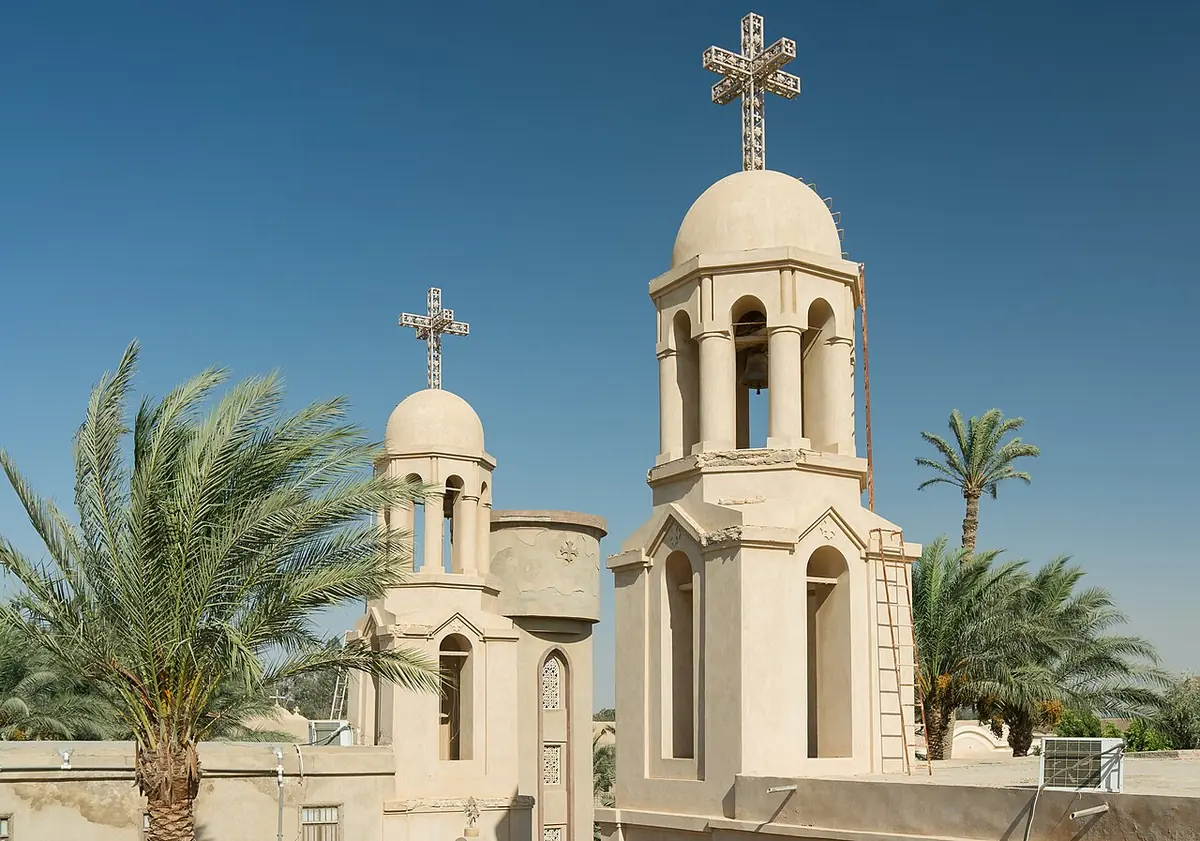
His relics are kept in the Church of the Virgin Mary at the Paromeos (Baramus) Monastery in Wadi El Natrun, one of the four ancient monasteries still active in the old desert of Scetis.

Prayer to St. Moses the Black
There is no traditional Western prayer to St. Moses that we can trace to an approved source. The Orthodox Church sings a troparion and kontakion on his feast, which the Orthodox Church in America publishes alongside his life. Catholics and Orthodox Christians ask him to pray for them in their own words, especially for people caught in violence, addiction or crime, and for anyone tempted to judge others.
Frequently asked questions
Who was St. Moses the Black?
A 4th-century African who was driven out by his master, led a band of robbers along the Nile, and then gave himself up to a monastery in the Egyptian desert. Palladius, Sozomen and the Sayings of the Desert Fathers all tell his story. He became a priest at Scetis and died there at seventy-five.
What is the story of St. Moses and the leaking jug?
When a monk at Scetis sinned and a council met to judge him, Moses came carrying a leaking jug of water. Asked why, he said, in Benedicta Ward's translation, "My sins run out behind me, and I do not see them, and today I am coming to judge the errors of another." The monks forgave the brother.
When is the feast of St. Moses the Black?
August 28 for Catholics and Eastern Orthodox Christians. The Coptic Orthodox Church remembers him on 24 Paoni, which falls on July 1.
Why is St. Moses the Black the patron of nonviolence?
Because of the tradition about his death. When raiders came to Scetis, he would not let the monks fight, quoted the words of Jesus, "All who take up the sword, shall perish by the sword," and stayed behind to be killed. The patronage is a modern, popular one, not an official title.
Sources
- Palladius, The Lausiac History, chapter 19, Moses the Robber (tr. W. K. Lowther Clarke, 1918)
- Sozomen, Ecclesiastical History, Book VI, chapter 29 (New Advent)
- Orthodox Church in America: Venerable Moses the Ethiopian of Scete
- John Cassian, Conference 1, First Conference of Abbot Moses (New Advent)
- Benedicta Ward, The Sayings of the Desert Fathers: The Alphabetical Collection (Cistercian Publications, 1975), Moses
- Wikipedia: Moses the Black (for the relics and calendar dates)
- Roman Martyrology, August 28