The Infant Jesus of Prague

The Infant Jesus of Prague is a small Spanish statue of the Child Jesus, about 18 inches tall, kept in the Carmelite Church of Our Lady Victorious in Prague since Princess Polyxena of Lobkowicz gave it to the friars in 1628. It is not a saint but a devotion to Jesus himself, shown as a crowned child who holds the world in one hand and blesses with the other. Catholics around the world pray before copies of it, especially for children and families, and its robes are changed with the seasons of the Church year.
What is the Infant Jesus of Prague?
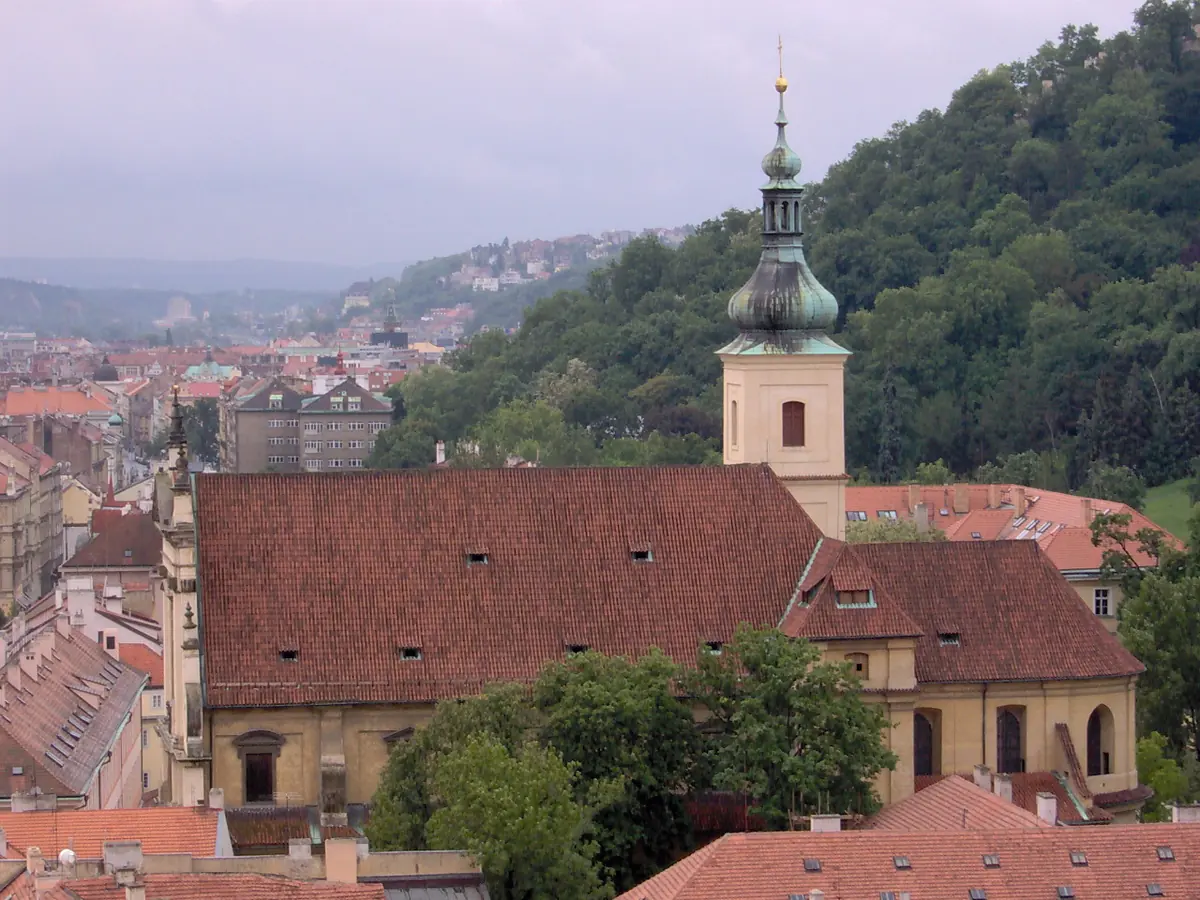
The Infant Jesus of Prague is a statue of Jesus as a small child, and the devotion that grew up around it. The original stands in a side altar of the Church of Our Lady Victorious in Prague's Lesser Town (Malá Strana), cared for by Discalced Carmelite friars. It is small: 47 centimeters, about 18.5 inches, with a wooden core modeled in colored wax. It came from Spain, and no one knows who made it.
The Infant of Prague is not a saint. Catholics who pray before the statue are praying to Jesus Christ, honored in his childhood, and the statue is a way of fixing the mind on him. Pope Benedict XVI put it simply when he visited in 2009: "The figure of the Child Jesus, the tender infant, brings home to us God's closeness and his love."


Copies of the statue are found in Catholic churches and homes on every continent. In Spanish it is the Niño Jesús de Praga, in Czech the Pražské Jezulátko, in Ireland simply the Child of Prague.
The history of the statue
The Carmelites of Prague publish the statue's history on their shrine's website. What follows keeps their established facts apart from the legends they also record.
From Spain to Prague
The statue was probably made in Spain in the second half of the 16th century, or earlier. Two legends explain where it came from. One says a monk modeled it after the Child Jesus appeared to him in a vision. The other says it belonged to St. Teresa of Ávila, who loved to honor the childhood of Jesus, and that she gave it to a friend whose daughter was marrying in Prague. Neither story can be traced to a source from the time, and the shrine itself calls them legends.
The established history begins in 1556, when a Spanish noblewoman, Maria Manrique de Lara, married Vratislav of Pernštejn and brought the statue with her to Bohemia. She later gave it to her daughter, Polyxena, as a wedding gift.
Polyxena's gift, 1628
Polyxena of Lobkowicz (1566–1642) was by then a widow and one of the great Catholic noblewomen of Bohemia. In 1628 she gave the statue to the Discalced Carmelite friars at the Church of Our Lady Victorious. Ann Ball, in her Handbook of Catholic Sacramentals, reports her words as: "I am giving you what I most esteem of my possessions." The friars put it in the chapel of their novitiate, where the young friars prayed before it every day.

Plunder, and Fr. Cyril's discovery
The Thirty Years' War soon reached Prague. When Saxon troops took the city in 1631, the Carmelites fled, the monastery was plundered, and the statue was damaged and thrown aside as junk. It lay forgotten behind the altar for years.
In 1637 the friars came back. Among them was Fr. Cyril of the Mother of God (1590–1675), a Carmelite from Luxembourg who remembered praying before the little statue as a novice. He found it among the rubbish with both hands broken off. Eventually he had it repaired, and new hands were made. Carmelite tradition, retold by Ann Ball and others, adds that as Cyril prayed before the broken statue he heard the words: "Have pity on me, and I will have pity on you." Popular books give a longer version that ends, "The more you honor Me, the more I will bless you." These words are traditional; they rest on Cyril's own account as later retold, not on any formal judgment by the Church.

Coronation and growth
People in Prague began to credit the statue with healings, and also with protecting the city during the Swedish siege of 1639. In 1641 it was moved to a chapel near the church entrance so the public could pray before it. Ann Ball writes that the Archbishop of Prague gave the devotion its first church approval in 1648. In 1655 the Bishop of Prague solemnly crowned the statue, with a crown commissioned by Bernard of Martinic, the chief royal official of Bohemia. Crowds grew so large that in 1741 the statue was moved to its present altar on the right side of the nave, and in 1754 Empress Maria Theresa sent it an embroidered robe.


Decline and revival
Emperor Joseph II closed the Prague Carmelite monastery in 1784, and the altar fell into decay. It was restored in 1879, and the devotion spread again through the Austro-Hungarian Empire and then around the world, carried by Spanish and Portuguese Catholics to Latin America and by missionaries and emigrants to Asia and North America. Pope Leo XIII confirmed a sodality (a lay association) of the Infant of Prague in 1896, according to Ann Ball. Under Nazi occupation and then communist rule, from 1939 to 1989, public devotion in Prague was suppressed, though pilgrims still came. The Discalced Carmelites returned to the church in 1993. On September 26, 2009, Benedict XVI visited the statue, brought it a new crown, and prayed there for children and families.

Miracles attributed to the Infant of Prague
None of the miracles connected with the statue has been formally investigated in the way the Church examines a miracle for a canonization; there is no canonization to investigate. Sorted by the labels this encyclopedia uses:
- The words heard by Fr. Cyril, and the help he received to repair the hands: traditional.
- The protection of Prague in the Swedish siege of 1639: traditional.
- Healings and answered prayers since the 1630s: reported. The shrine says the statue was credited with healings from 1639 on, and both walls of the altar's alcove are covered with plaques of thanks.
Why Catholics turn to the Infant of Prague
Catholics bring every kind of need to the Infant of Prague, but two stand out. Children come first, because the image shows Jesus as a child. Families come next, because the devotion has always been kept in homes; Benedict XVI, at the statue in 2009, entrusted all families of the world to "the Holy Infant of Prague." Many people also come with money troubles or illness, remembering that Fr. Cyril prayed for the means to restore the statue and received them. See our patron saints page for saints connected with the same intentions.


Symbols of the Infant Jesus of Prague in art
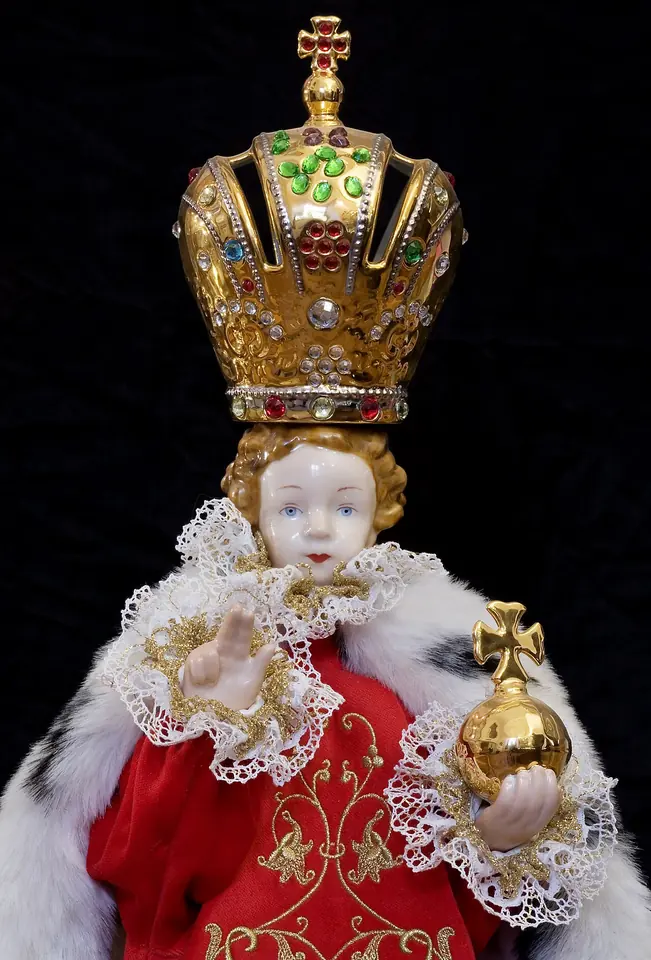
The Infant of Prague is one of the easiest images in Catholic art to recognize. A small, stiff, bell-shaped figure of a child stands on a pedestal, nearly hidden in robes, wearing a crown far too big for a real child. Each detail has a meaning:
- The crown: Christ as king. On the original, the crown is not placed on the head but fixed just above it. The crown worn today on the feast dates from 1767; the 2009 crown from Benedict XVI is in the shrine's museum.
- The orb with a cross, in the left hand: the world under Christ's rule. It is the same orb that European kings held at their coronations.
- The raised right hand: a blessing, with two fingers extended. Where a king would hold a scepter, the Child blesses.
- The vestments: a white gown, a colored gown and a short cope, with lace at the neck and wrists. The shrine explains that dressing the statue shows his humanity, the way parents dress a child, while the royal robes point to his divinity.
- The face and hair: the Prague shrine notes Moorish features in the face and the originally dark curly hair, signs of the statue's Spanish origin.
Without its robes, the statue is a plain child in a long tunic with bare feet, as some replicas show.

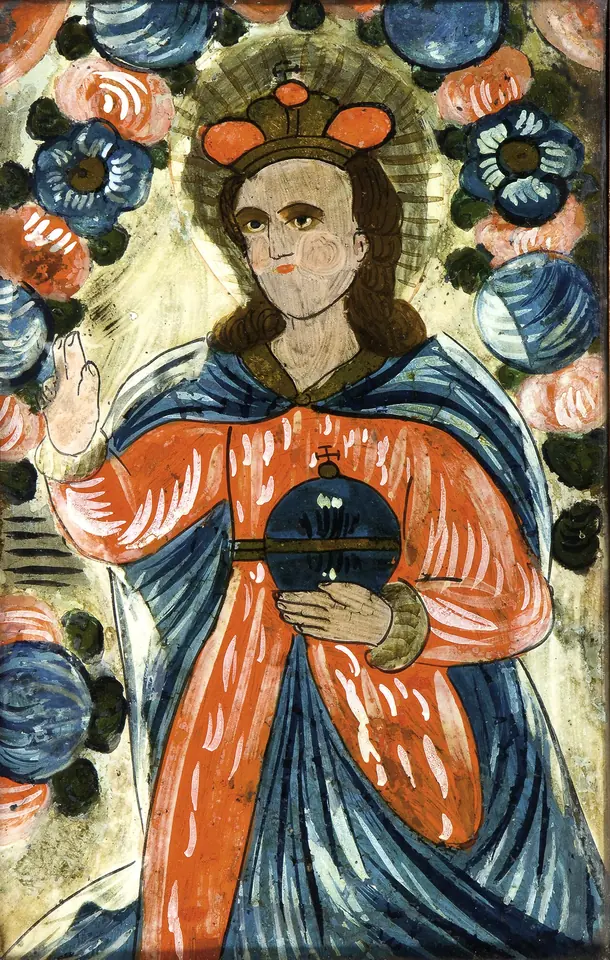
Folk artists in Central Europe copied the statue on painted glass, in paper collages and on house walls, often in colors no real vestment ever had.

The vestment colors
The Infant's wardrobe holds about 300 garments, most of them gifts from the faithful, and some are shown in the shrine's museum. The Carmelite Sisters of the Infant Jesus dress the statue in the colors of the liturgical season, as a priest is vested at Mass:
- Green for Ordinary Time, the color seen most often
- Purple for Advent and Lent
- White for Christmas, Easter and other celebrations
- Red for Holy Week and Pentecost
- Pink (rose) for the third Sunday of Advent and the fourth Sunday of Lent
- Blue for feasts of the Virgin Mary, especially Our Lady of Mount Carmel on July 16
- Gold on festive days, in place of another color
- Royal red with an ermine mantle for the Feast of the Coronation

Feast day and customs
There is no universal feast of the Infant of Prague. In Prague the shrine keeps the Feast of the Coronation on the first Sunday of May, remembering the crowning of 1655. The statue is dressed in its royal robes and set in the sanctuary for the weekend, and at the English Mass people bring roses. This encyclopedia lists the Infant under January 3, the memorial of the Most Holy Name of Jesus, in the Christmas season, when the devotion to the Child Jesus is most often kept. See our feast days page for the calendar.


In Ireland the statue took on a life of its own. Plaster copies were in many Irish homes from the late 19th century, and, as folklorist Marion McGarry writes for RTÉ, families would leave the Child of Prague outside under a bush the night before a wedding to ask for good weather. Some believed it worked better if the head had broken off by accident, which happened often, because the neck was the weak point. This is folk custom, not church practice.
Outside Europe, the best-known American shrine is the National Shrine of the Infant Jesus of Prague at St. Wenceslaus Church in Prague, Oklahoma. A statue arrived there in 1947, and the shrine was dedicated in 1949. Across Latin America, where Spanish and Portuguese Catholics first carried it, many churches are named for the Niño Jesús de Praga; Medellín, Colombia, has a parish shrine dedicated to the Niño Jesús de Praga.


Prayer to the Infant Jesus of Prague
The prayer most closely tied to the statue is attributed to Venerable Fr. Cyril of the Mother of God, the Carmelite who rescued it. The Prague shrine publishes it in this English form:
Jesus, you decided to become a child, and I come to you full of trust. I believe that your attentive love pre-empts all my needs. Even for the intercession of your holy Mother, You can meet my needs, spiritual as well as material, if I pray according to your holy will.
I love you with all my heart, all my strength, I beg your forgiveness if my weakness makes me sin. I repeat with the Gospel "Lord, if you want, you can heal me." I leave you to decide how and when. I am ready to accept suffering, if this is your will, but help me not to become hardened to it, rather to bear fruit.
Help me to be a faithful servant and for your sake, holy Child, to love my neighbour as myself. Almighty Child, unceasingly I pray for you to support me in my necessities of the present moment (you can mention them here).
Grant me the grace to remain in you, to be possessed and to possess you entirely,with your parents, Mary and Joseph, in the eternal praise of your heavenly servants.
Amen.
An older English version, beginning "O Infant Jesus, I have recourse to You and ask you through the intercession of Your Holy Mother to help me in my need," appears in American prayer books; the Carmelites of Boston present it as a prayer given by Our Lady to Fr. Cyril.
The shrine also publishes the prayer Pope Benedict XVI said at the statue in 2009, and offers a nine-day novena, each day devoted to one trait of childhood (smallness, frailty, poverty, trust and others), and a chaplet of twelve Hail Marys in honor of twelve mysteries of Jesus' childhood, from the Annunciation to the finding in the Temple.
Frequently asked questions
Is the Infant of Prague a saint?
No. The Infant of Prague is Jesus Christ himself, honored as a child through a particular statue. Catholics do not pray to the statue; they use it, as they use a crucifix, to turn their attention to Christ. That is why it has no canonization date and no feast on the universal calendar of its own.
What does the Infant of Prague hold in his hands?
In his left hand he holds an orb topped with a cross, a royal sign meaning the world under Christ's rule. His right hand, where a king would hold a scepter, is raised in blessing with two fingers extended. The Prague shrine describes both gestures this way.
Why are the Infant of Prague's clothes changed?
Like a priest at the altar, the statue is dressed in the color of the liturgical season, according to the shrine in Prague. Green is worn in Ordinary Time, purple in Advent and Lent, white at Christmas and Easter, and red in Holy Week and at Pentecost. The Carmelite Sisters of the Infant Jesus do the dressing, from a wardrobe of about 300 garments.
What is the prayer to the Infant Jesus of Prague?
The best-known is the prayer attributed to Venerable Fr. Cyril of the Mother of God, the Carmelite who found and repaired the damaged statue in 1637. The Prague shrine publishes it, along with a prayer Pope Benedict XVI said before the statue in 2009, a nine-day novena and a chaplet of the twelve mysteries of Jesus' childhood.
Why do Irish families put the Child of Prague outside before a wedding?
It is a folk custom, not a church practice. In Ireland, where the statue was common in homes from the late 19th century, families left it outside under a bush the night before a wedding to ask for good weather, RTÉ reports. Some even said the statue worked better if its head had broken off by accident.
Sources
- Infant Jesus of Prague (official shrine): The Story of the Statue
- Infant Jesus of Prague (official shrine): Statue Appearance
- Infant Jesus of Prague (official shrine): Coronation Celebration
- Infant Jesus of Prague (official shrine): Prayers
- Benedict XVI, Visit to the Holy Infant of Prague at the Church of Our Lady Victorious (September 26, 2009)
- Ann Ball, The Infant Jesus of Prague, from A Handbook of Catholic Sacramentals (EWTN)
- Carmelites of Boston: Miraculous Infant of Prague
- National Shrine of the Infant Jesus of Prague (Prague, Oklahoma): History
- RTÉ Brainstorm: Why is the Child of Prague statue associated with Irish weddings and weather?