Biblically accurate angels
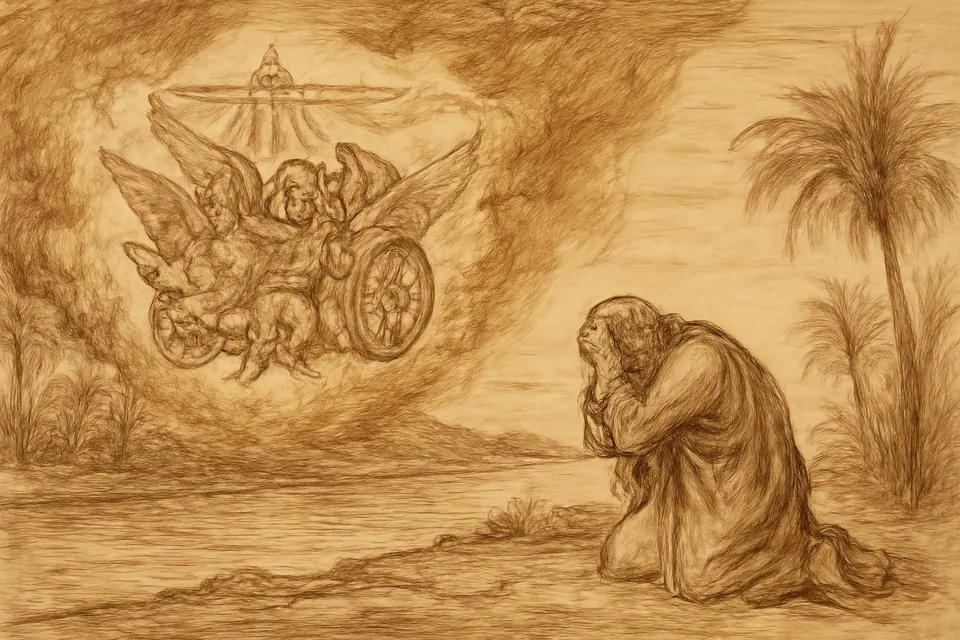
"Biblically accurate angels" is an internet name for pictures of angels as rings of eyes, wheels of fire and faces wrapped in wings, drawn from the visions of Ezekiel and Isaiah. Those visions are real Scripture, but they describe only a few kinds of angels, in symbolic language. Many angels in the Bible look like ordinary men, and the Church teaches that angels are pure spirits who take visible forms so that we can see them.
You may have seen them on social media: a tangle of golden rings covered in eyes, a face buried in a blaze of wings, a creature with four heads, all captioned "biblically accurate angel," usually with the joke "BE NOT AFRAID." The pictures spread widely in the early 2020s, and they made a lot of people curious about what the Bible really says about angels.
That curiosity is a good thing. The meme gets something right: Scripture's angels are not greeting-card figures. But it also leaves a lot out. Let us look at what the Bible actually describes and what the Church teaches about how angels appear.
What the meme gets right
The images behind the meme come from real passages of Scripture, and they are as strange and wonderful as the pictures suggest.
The prophet Ezekiel, an exile in Babylon around 593 BC, saw a storm cloud of fire come out of the north. In it were four living creatures: "there was the likeness of a man in them. Every one had four faces, and every one four wings" (Ezekiel 1:5-6, Douay-Rheims). They had the faces of a man, a lion, an ox and an eagle, human hands under their wings and feet like a calf's that "sparkled like the appearance of glowing brass." Beside each creature was a wheel, "as it were a wheel in the midst of a wheel," and "the whole body was full of eyes round about all the four" (1:16-18). In chapter 10 Ezekiel tells us these creatures were cherubim.
Isaiah saw seraphim above the throne of God: "the one had six wings, and the other had six wings: with two they covered his face, and with two they covered his feet, and with two they flew" (Isaiah 6:2). St. John saw four living creatures in heaven with "each of them six wings; and round about and within they are full of eyes" (Apocalypse 4:8).

Daniel's vision by the Tigris is just as overwhelming. He saw "a man clothed in linen," and "his body was like the chrysolite, and his face as the appearance of lightning, and his eyes as a burning lamp: and his arms, and all downward even to the feet, like in appearance to glittering brass: and the voice of his word like the voice of a multitude" (Daniel 10:5-6). The men with Daniel saw nothing, but terror fell on them and they ran; Daniel himself fainted.
So yes, some angels in Scripture are truly awe-inspiring and unlike anything on earth.
What the meme leaves out
The trouble with the meme is that it takes a few visions and treats them as the one true picture of every angel. Scripture is much more varied than that.
Many angels look like ordinary men
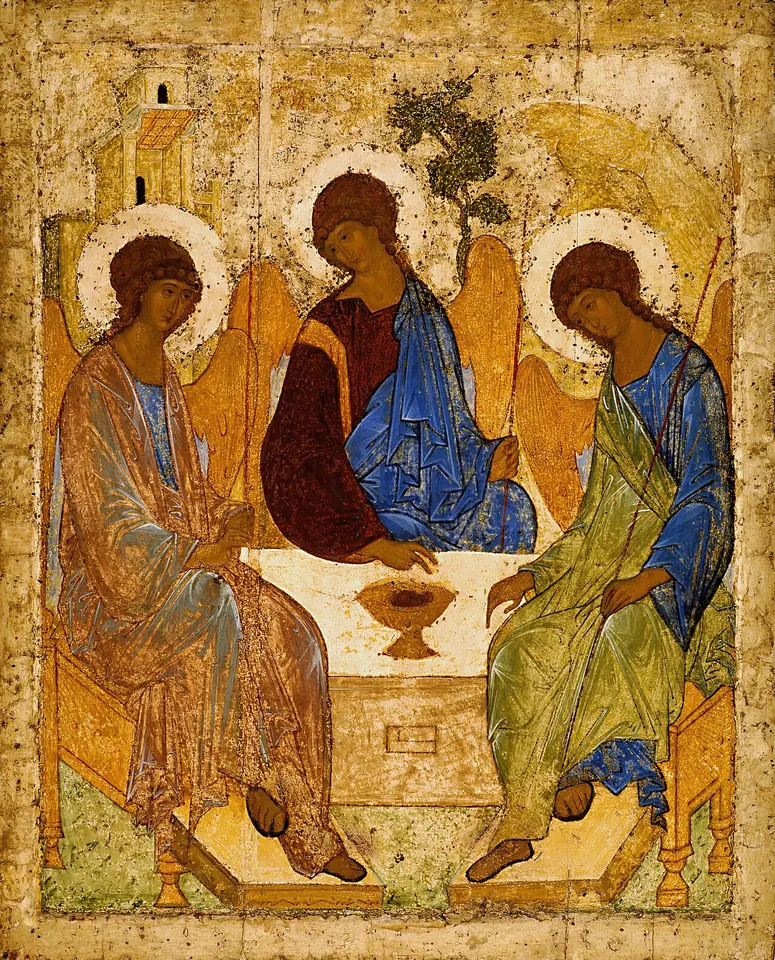
The first angels Abraham met came to lunch. "There appeared to him three men standing near him," says Genesis 18:2, and he washed their feet and fed them under a tree. Two of them went on to Sodom, where Lot took them in for the night (Genesis 19). The Letter to the Hebrews remembers these stories: "hospitality do not forget; for by this some, being not aware of it, have entertained angels" (Hebrews 13:2).
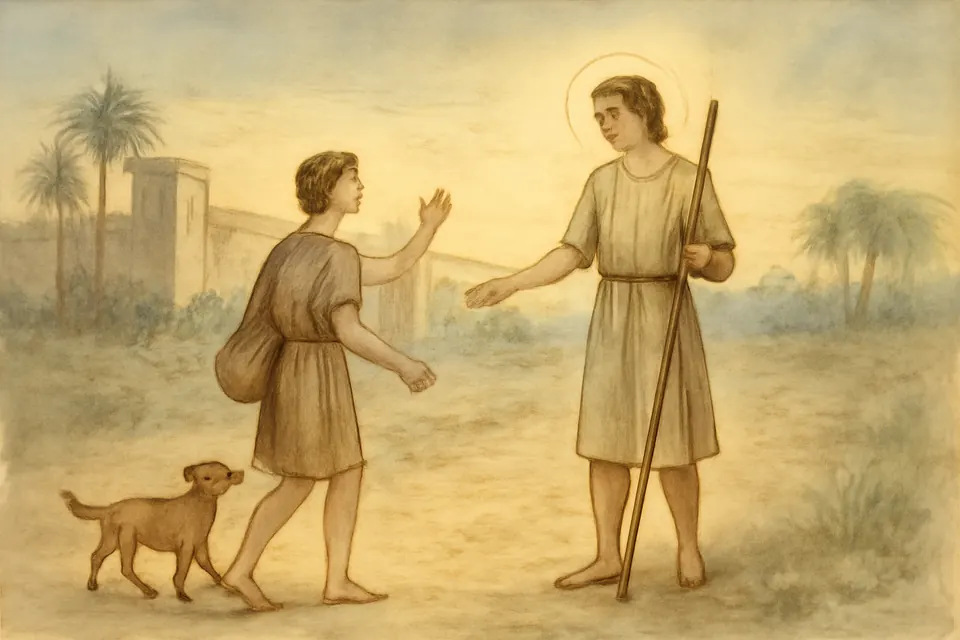
Jacob wrestled all night with "a man" whom tradition understands as an angel (Genesis 32:24). When young Tobias set out on his journey, he "found a beautiful young man, standing girded, and as it were ready to walk," and did not know "that he was an angel of God" (Tobias 5:5-6). Only at the end did the archangel Raphael reveal who he was.

The angels of the New Testament often appear the same way. At the empty tomb, the women saw "a young man sitting on the right side, clothed with a white robe" (Mark 16:5). St. Luke speaks of "two men... in shining apparel" (Luke 24:4), and at the Ascension "two men stood by them in white garments" (Acts 1:10). Even Gabriel, in Daniel, is called "the man Gabriel" (Daniel 9:21). These angels have no eyes on their wings, and often no wings at all. Their clothes shine, their faces may blaze like lightning (Matthew 28:3), but their form is human.

Different visions, different angels
The meme also mixes up different beings. Isaiah's six-winged seraphim are not Ezekiel's four-faced cherubim, and the wheels full of eyes, called ophanim in Hebrew, are a separate part of Ezekiel's vision that later tradition linked with the choir of thrones (see the ophanim). In the Church's tradition these belong to the highest of the nine choirs of angels, who stand nearest to God's throne. The angels Scripture describes visiting people are usually messengers from the lower choirs, and they come looking like men.
"Be not afraid"
The meme's punchline is half true. Angels in the Gospels do keep saying "Fear not." Gabriel says it to Zachary and to Mary (Luke 1:13, 30). The angel at Bethlehem says it to the shepherds when "the brightness of God shone round about them; and they feared with a great fear" (Luke 2:9-10). The angel at the tomb says it to the women (Matthew 28:5). But in none of these scenes does the fear come from a monstrous shape. It comes from meeting a messenger who carries the glory of God. The angel's first word is always a word of peace.
What the Church teaches about how angels appear
Behind all of this is a simple truth of faith. Angels have no bodies. The Catechism teaches that "as purely spiritual creatures angels have intelligence and will: they are personal and immortal creatures, surpassing in perfection all visible creatures" (330). In themselves, they look like nothing, because there is nothing material to see.
So how did Abraham feed them? St. Thomas Aquinas answers that the angels who appeared in Scripture were really seen, not just imagined, because "the angels who appeared to Abraham were seen by him and by his whole family, by Lot, and by the citizens of Sodom." Since only a body can be seen with the eyes, and angels have no bodies of their own, "it follows that they sometimes assume bodies." Raphael said as much to Tobias: "I seemed indeed to eat and to drink with you: but I use an invisible meat and drink, which cannot be seen by men" (Tobias 12:19).
The visions of the prophets are a different case. They are signs God gave to teach us, and their strangeness is deliberate. Pseudo-Dionysius, writing around 500 AD, warned against reading them literally, so that we do not "irreverently think that the heavenly and Godlike minds are certain many-footed and many-faced creatures, or moulded to the brutishness of oxen, or the savage form of lions." He argued that the odd, even shocking images are actually the safer kind, because no one could mistake them for the real thing: "the sacred descriptions of the Oracles honour, and do not expose to shame, the Heavenly Orders, when they make them known by dissimilar pictorial forms."
He also read the symbols one by one. Fire shows the angels' likeness to God. The wheels, "winged, and advancing without turning and without deviation," show their straight path toward the good. The eyes, he says, "denote the most transparent elevation towards the Divine lights," and the wings "the elevating quickness and the heavenly progress towards higher things." And when Scripture shows angels as men, it is "on account of the intellectual faculty," because of all bodily creatures we are the ones with minds.

How Christian art pictured angels
Christian artists have tried both ways of showing angels. The oldest Christian picture of an angel, an Annunciation in the Roman catacomb of Priscilla, shows Gabriel as a man in a tunic and cloak, with no wings. The Catholic Encyclopedia explains that winged angels appear only from the time of Constantine in the 4th century, borrowing the wings of the Roman figures of Victory, and that the strange visions of the prophets were painted much less often.
Medieval and Byzantine artists kept both traditions. They painted Michael and Gabriel as tall young men in court robes or armor, and they painted the seraphim as faces wrapped in six wings and the thrones as fiery wheels with eyes. Artists from Raphael to Gustave Doré tried their hand at Ezekiel's vision. None of these pictures is "accurate" in the sense of a photograph, and none was meant to be.

The angel beside you
The meme can leave the impression that angels are frightening monsters kept far away in heaven. The Church's teaching is the opposite. The same God who showed Ezekiel the cherubim around his throne gives each of us a guardian angel who stays beside us all our lives, as quietly as Raphael walked beside Tobias. For everything else about the holy angels, see our angels hub.
Holy angels, whether you come in glory or in the plain clothes of a traveler, keep us in all our ways.
Frequently asked questions
What does a biblically accurate angel look like?
There is no single biblical look. Ezekiel saw cherubim with four faces and four wings beside wheels full of eyes; Isaiah saw seraphim with six wings; Daniel saw a man in linen with a face like lightning. But Abraham, Lot, Tobias and the women at the tomb saw angels who looked like men, sometimes so ordinary that they were not recognized.
Are biblically accurate angels real?
The visions in Ezekiel, Isaiah, Daniel and the Apocalypse are inspired Scripture, and the angels they reveal are real. But angels are pure spirits with no bodies, so the wheels, eyes and wings are visible signs given to the prophets, not photographs of the angels' natures.
Why do angels say "Be not afraid"?
Because the people who saw them were afraid. Gabriel tells Zachary and Mary "Fear not," and the angel at Bethlehem says it to the shepherds when "the brightness of God shone round about them" (Luke 2:9-10). The fear came from meeting a messenger of God's glory, not from a monstrous shape.
Do angels have wings?
Not in themselves, since they have no bodies. Scripture gives wings to the seraphim, the cherubim and some visions, and Gabriel comes "flying swiftly" to Daniel, but many angels in the Bible appear without any mention of wings. Christian art added wings from the 4th century on as a sign of their speed and heavenly origin.
What does the Catholic Church teach about what angels look like?
The Catechism teaches that angels are "purely spiritual creatures" with intelligence and will (330). St. Thomas Aquinas taught that they sometimes take on bodies so that people can see them, and that the strange images of the prophets are symbols of spiritual realities.
Sources
- Ezechiel 1, Douay-Rheims Bible (drbo.org)
- Daniel 10, Douay-Rheims Bible (drbo.org)
- Dionysius the Areopagite, The Celestial Hierarchy, tr. John Parker (1899), chapters 2 and 15
- St. Thomas Aquinas, Summa Theologiae I, q. 51 (The angels in comparison with bodies)
- Catholic Encyclopedia (1907): Early Christian Representations of Angels
- Catechism of the Catholic Church, nos. 325-354