St. Pius X
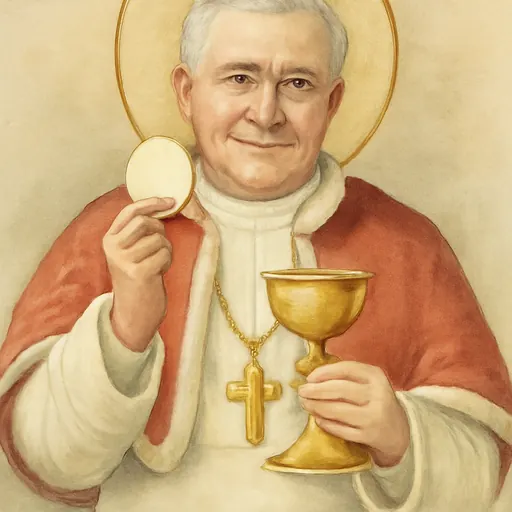
St. Pius X (1835–1914), born Giuseppe Sarto, was the son of a village postman who became pope in 1903. He took as his motto "to restore all things in Christ," opened First Communion to children of about seven, urged frequent Communion, restored Gregorian chant and condemned Modernism. Catholics honor him as the patron of first communicants, and his feast day is August 21.
Who was St. Pius X?
Giuseppe Melchiorre Sarto was born on June 2, 1835, in Riese, a village in the Venetian countryside near Treviso. His father, Giovanni Battista, was the village postman; his mother, Margarita Sanson, lived long enough to see her son a cardinal. Pope Benedict XVI, speaking about him in 2010, called it "a peasant family."
He was pope from 1903 to 1914 under the name Pius X. His reign is remembered for children's First Communion, for the catechism that bore his name, for the reform of church music and canon law, and for his condemnation of Modernism. His life is well documented, and nothing in this entry depends on legend.
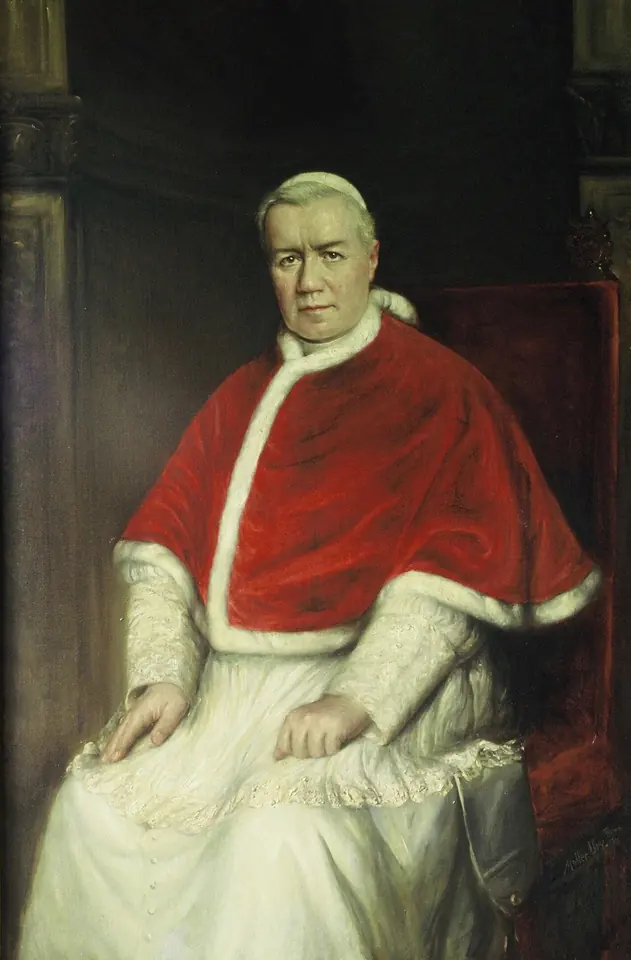

The life of St. Pius X
Village priest
As a boy he walked every day to the school at Castelfranco Veneto and back. A diocesan scholarship took him to the seminary in Padua, and he was ordained in 1858. For nine years he was chaplain at Tombolo, where the elderly pastor was an invalid, so the young priest did most of the parish work and started a night school for adults. In 1867 he became archpriest of Salzano, where the Catholic Encyclopedia notes his care for the sick during an outbreak of cholera.


Bishop and patriarch
He served the Diocese of Treviso as canon, seminary spiritual director and vicar-general. In 1884 he was named Bishop of Mantua, where he taught theology in the seminary himself and sang Gregorian chant with the seminarians. In 1893 Leo XIII made him a cardinal and Patriarch of Venice, though the Italian government delayed his installation for eighteen months in a quarrel over the right of appointment.
Pope
Leo XIII died in July 1903, and the cardinals elected Sarto on August 4. In his first encyclical, E supremi, he wrote of the "tears and warm instance" with which he had tried to refuse. He took his program from Ephesians 1:10, instaurare omnia in Christo: "to restore all things in Christ and to lead men back to submission to God is one and the same aim."
He began the codification of canon law in 1904 (the Code was finished under Benedict XV in 1917), reorganized the Roman Curia, founded the Pontifical Biblical Institute in 1909 and published a catechism for Rome that spread across Italy and beyond. He died on August 20, 1914, less than three weeks after the First World War began. On August 2 he had issued an appeal to Catholics that Benedict XVI called "the anguished plea of a father who sees his children taking sides against each other."

The Pope of the Eucharist
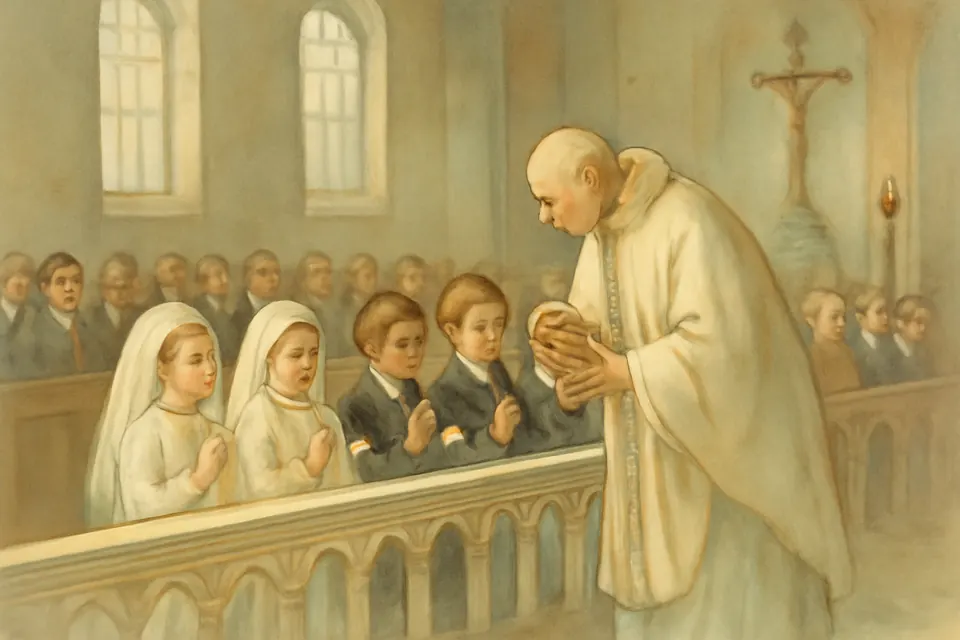
In 1905 he urged Catholics to receive Communion often, even daily. Five years later the decree Quam singulari (August 15, 1910) ended the custom of making children wait until ten, twelve or fourteen. The decree states:
The age of discretion, both for Confession and for Holy Communion, is the time when a child begins to reason, that is about the seventh year, more or less.
At his canonization Pius XII described him leading children to the altar, "quasi sollevandoli sulle sue braccia" (as if lifting them in his arms), and called him the "Pontefice della Eucaristia e del catechismo," the pope of the Eucharist and of the catechism.
Church music and Gregorian chant
As priest, bishop and patriarch he had promoted sacred music. Three months into his reign, on November 22, 1903, he issued the motu proprio Tra le sollecitudini, which ordered the restoration of Gregorian chant and set rules for music in churches. Benedict XVI pointed to its teaching that the Christian spirit has its "first and indispensable source" in "active participation" in the liturgy.
The campaign against Modernism
In 1907 the decree Lamentabili condemned sixty-five propositions, and on September 8 the encyclical Pascendi Dominici gregis described "Modernism" as a system that, in its words, could be called "the synthesis of all heresies." The encyclical set up diocesan councils of vigilance and censors of books, and from 1910 clergy and teachers had to take an oath against Modernism.
Supporters saw this as a defense of the faith against theories that would empty doctrine of objective truth. Critics, then and since, judged the campaign harsh. Pius XII, at the canonization, acknowledged that for some people Pius X's firmness against error "può forse rimanere ancora quasi una pietra di scandalo" (may perhaps still remain almost a stumbling block), while calling it a final service of charity.


The miracles of St. Pius X
- Healings for his beatification and canonization are approved. Pius XII approved two miracles in 1951 before beatifying him on June 3 of that year, and two more before the canonization of May 29, 1954. According to published accounts of the cause, all four were cures of serious illness.
- Cures during his lifetime are reported. Witnesses told the investigators of his cause about healings they credited to his blessing or prayer. These stories were not themselves the miracles the Church approved.
Symbols of St. Pius X in art
Pius X lived in the age of photography, so most images follow his photographs: a broad-faced, white-haired pope in a white cassock and zucchetto, often with a red mozzetta. To recognize him look for:
- The Eucharist: a chalice and host, or a monstrance, for his decrees on frequent and early Communion. Prayer cards often show him with the instruments of Communion.
- Children receiving First Communion, sometimes from his own hand.
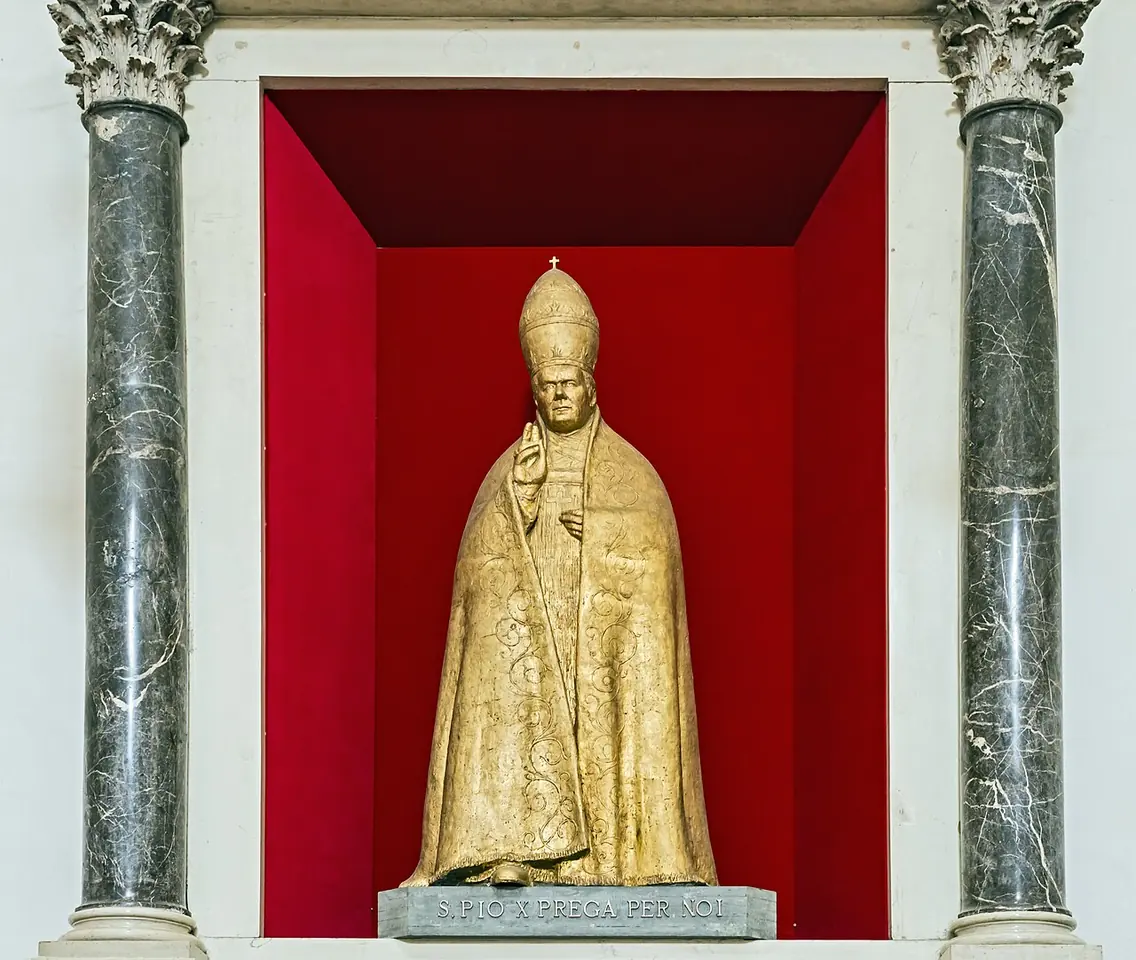
- The papal tiara, as on the Treviso statue.
- A catechism, for the Catechism of Pius X.
Feast day and where he is honored
His feast is August 21, an obligatory memorial. See our feast days calendar and patron saints list. His birthplace was renamed Riese Pio X in his honor, and its museum keeps his family home.
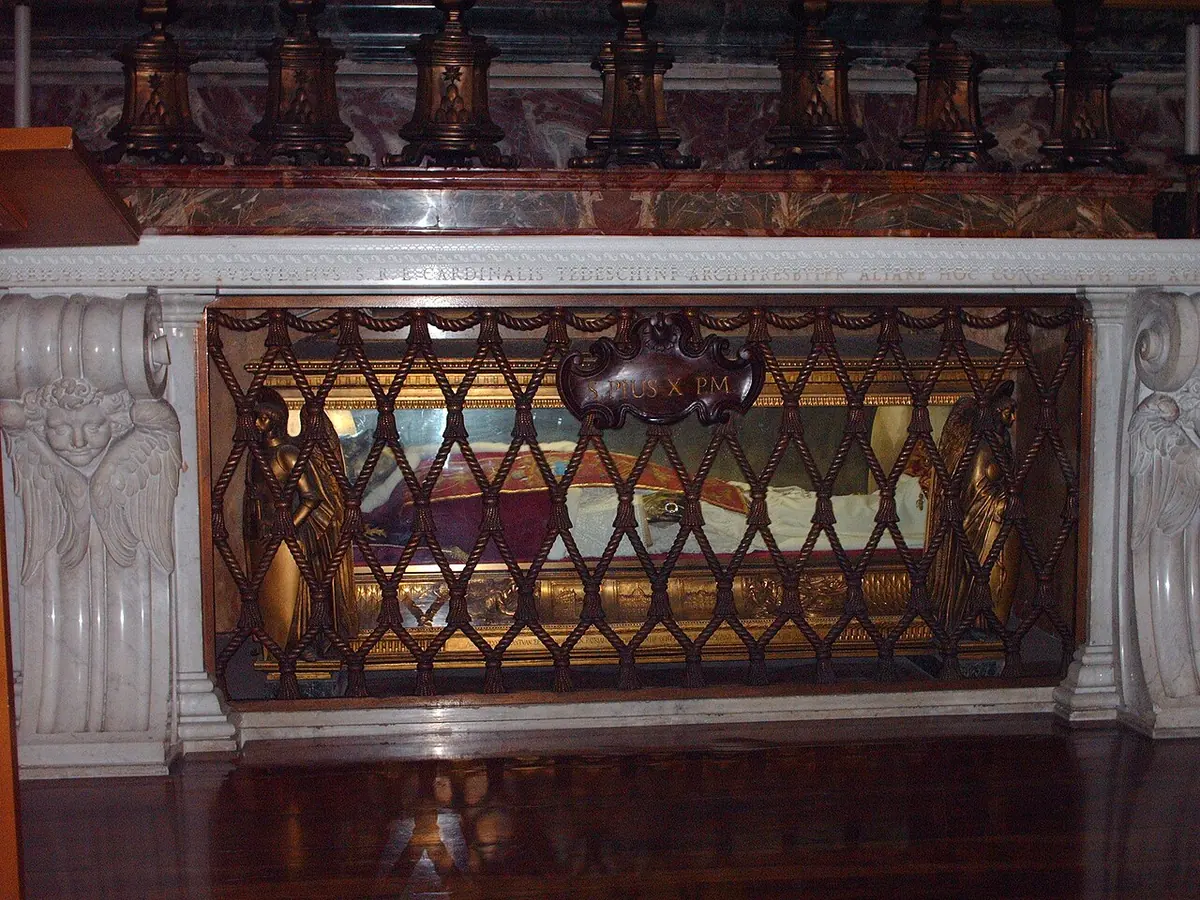
He was first buried in the crypt of St. Peter's. In 1952 his body was moved into the basilica and placed under the altar of the Chapel of the Presentation, where it lies in a crystal casket, dressed in pontifical robes, with the face and hands covered with silver. In 1959 Pope John XXIII, another Patriarch of Venice, allowed the body to be taken to Venice for a time.

Prayer to St. Pius X
The Church's own prayer for his feast is the collect of the Roman Missal for August 21:
O God, who to safeguard the Catholic faith and to restore all things in Christ, filled Pope Saint Pius the Tenth with heavenly wisdom and apostolic fortitude, graciously grant that, following his teaching and example, we may gain an eternal prize. Through our Lord Jesus Christ, your Son, who lives and reigns with you in the unity of the Holy Spirit, God, for ever and ever.
Pius XII also closed his canonization address with a prayer to the new saint, which begins "Sì, o Santo Pio X, gloria del sacerdozio" ("Yes, O Saint Pius X, glory of the priesthood," our translation) and asks him to obtain peace among the nations.
Frequently asked questions
When is the feast day of St. Pius X?
August 21, an obligatory memorial in the General Roman Calendar. He died on August 20, 1914. Between his canonization and the calendar reform of 1969, his feast was kept on September 3.
Why is St. Pius X the patron of first communicants?
In the decree Quam singulari of August 15, 1910, he ruled that children may make their first Confession and First Communion once they reach "the age of discretion," which the decree puts at "about the seventh year, more or less." Before that, many places made children wait until ten, twelve or even fourteen.
What was the motto of Pope Pius X?
His motto was the Latin "Instaurare omnia in Christo," from Ephesians 1:10. He announced it in his first encyclical, E supremi (October 4, 1903). The Vatican's English translation renders it "to restore all things in Christ."
Is the body of St. Pius X incorrupt?
His body lies in a crystal casket under the altar of the Chapel of the Presentation in St. Peter's Basilica. The basilica's guide notes that the face and hands are covered with silver. The Church has made no formal declaration that the body is incorrupt.
Sources
- Catholic Encyclopedia (1911): Pope Pius X
- Pius X, E Supremi (October 4, 1903), Vatican
- Pius X, Pascendi Dominici Gregis (September 8, 1907), Vatican
- Sacred Congregation of the Discipline of the Sacraments, Quam Singulari (1910), Papal Encyclicals Online
- Benedict XVI, General Audience of 18 August 2010: Saint Pius the Tenth
- Pius XII, Nella canonizzazione di San Pio X (29 maggio 1954)
- St. Peter's Basilica: Presentation Chapel
- Catholic Culture: Memorial of St. Pius X, Pope (August 21), with the collect