St. Columba of Iona
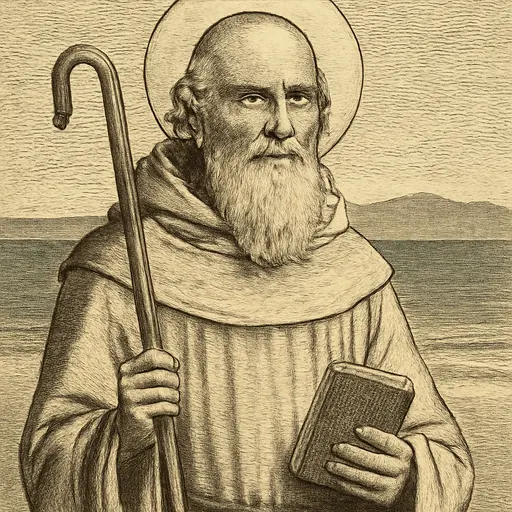
St. Columba (521–597), in Irish Colum Cille, was an Irish monk of royal blood who sailed to Scotland in 563, founded the monastery of Iona and spent his last thirty-four years there and among the Picts of the north. Much of what we know comes from Adomnán's Life of St. Columba, written about a century after his death. His feast day is June 9, and he is a patron saint of Ireland and Scotland, as well as of poets and bookbinders.
Who was St. Columba?
Columba was an Irish monk, priest and abbot who left Ireland in 563, founded a monastery on the small Hebridean island of Iona and from there carried the Gospel to the Picts of northern Scotland. He died on Iona on June 9, 597. Iona became the mother house of a family of monasteries in Ireland and Britain, and its monks later brought Christianity to the north of England.
His baptismal name was Colum, Irish for "dove," which became Columba in Latin. Irish speakers call him Colum Cille, "dove of the church," and the name appears in English as Columcille or Columbkille. He is not the same person as St. Columbanus, a younger Irish monk who founded monasteries in France and Italy.


The sources for his life
We know Columba better than almost any saint of his time because of one book. Adomnán, the ninth abbot of Iona, wrote a Life of St. Columba in Latin about a hundred years after his death. His book is arranged by theme, not by date: Book I tells of Columba's prophecies, Book II of his miracles and Book III of visions of angels. The English quotations here come from William Reeves's translation, published in Edinburgh in 1874.
The Venerable Bede, writing in Northumbria a generation later, adds a few lines. Later Irish lives and poems add much more, but much of it is legend.
The life of St. Columba
Prince, student and founder
The Catholic Encyclopedia gives his birth as December 7, 521, at Gartan in County Donegal. He belonged to the Uí Néill, the most powerful family in the north of Ireland, and was a great-great-grandson of the high king Niall of the Nine Hostages. He studied under St. Finnian of Movilla, where he became a deacon, under an old poet named Gemman, and under St. Finnian of Clonard. He was ordained a priest and in the following years founded monasteries in Ireland, among them Derry and Durrow.
The battle and the psalter
Later Irish tradition explains his departure from Ireland with a dramatic story. Columba secretly copied a psalter belonging to Finnian, the king ruled that the copy belonged to Finnian, and the quarrel helped bring on the battle of Cooldrevny in 561, in which three thousand men died. His confessor, St. Molaise, is said to have sent him into exile to win for Christ as many souls as had been lost. The Catholic Encyclopedia points out that the earliest authorities say nothing of this and that some scholars think the bards invented it. Adomnán gives a simpler reason: Columba sailed from Ireland "wishing to be a pilgrim for Christ." The battle story is traditional.
Iona, 563
He left Ireland in 563, in his forty-fourth year, with twelve companions in a currach, a boat of wicker covered with hides. The Catholic Encyclopedia says they landed on Iona on the eve of Pentecost, May 12, 563. Irish sources say the island was a gift from his kinsman Conall, king of the Irish settlers of Dalriada in western Scotland; Bede says the Picts gave it. The monks built a church, a refectory and huts of wattle and timber.
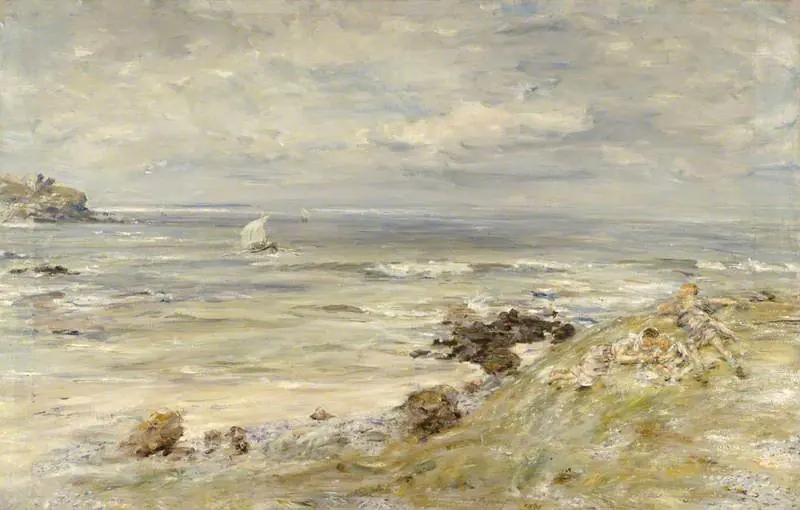

Mission to the Picts
From Iona Columba traveled up the Great Glen to the fortress of Brude, king of the northern Picts, near Inverness. Adomnán says the proud king kept his gates shut, so Columba made the sign of the cross on them and knocked, and "the bolts having been driven back with great force," the gates swung open. After that, "so long as he lived, the king held this holy and reverend man in very great honour." The Catholic Encyclopedia says Brude was baptized, though Adomnán doesn't say so outright. This miracle, like the others in the Life, is traditional.
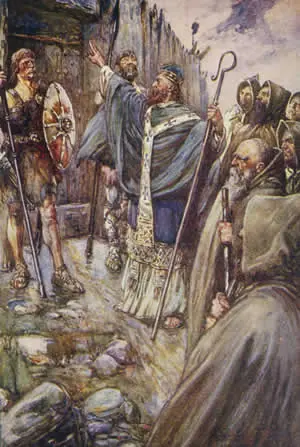

Columba spent his remaining thirty-four years preaching, founding churches and governing his monasteries in Scotland and Ireland. He went back to Ireland more than once, and he took part in the assembly of Drumceatt with Aidan, the king of Dalriada, whom he had inaugurated shortly before.
A scribe and a poet
Columba loved books. The Catholic Encyclopedia reports that he was copying a book on the eve of his death and that, according to tradition, he wrote three hundred books with his own hand. The Cathach, a psalter of the late 500s now kept in the Royal Irish Academy in Dublin, is traditionally his own work. Several Latin and Irish poems are attributed to him, best known among them the Latin hymn Altus Prosator. This is the reason poets and bookbinders claim him as their patron.


The last days
Book III of Adomnán's Life describes Columba's death in loving detail. On Saturday, June 8, 597, the old abbot rested on the way back from the barn, and the white horse that carried the monastery's milk came and laid its head on his chest, weeping. When his attendant tried to drive it away, Columba said, "Let it alone, as it is so fond of me, let it pour out its bitter grief into my bosom."

He climbed the little hill above the monastery and blessed it, then sat copying the Psalter until he reached the verse "They that seek the Lord shall want no manner of thing that is good," and stopped, leaving the rest for his successor Baithene. At midnight he went into the church ahead of the others, knelt at the altar and died there. His attendant, Diormit, lifted the dying man's right hand so that he could bless the monks who came running with lights.
The miracles of St. Columba
Adomnán filled a whole book with miracles, and none has been examined by modern standards. Sorted by this encyclopedia's labels, all are traditional:
- Water into wine: as a young deacon in Ireland, he changed water into wine for Mass.
- The gates of Brude's fortress: opened at the sign of the cross.
- The beast of the River Ness: described below.
- A floating white stone: he blessed a pebble from the river for healing, and it floated "like an apple" before King Brude's household.
- Winds and storms calmed: Adomnán tells of contrary winds turned fair at his prayer.
- Healings and raising a child: he is said to have restored to life the dead child of a Pictish family.
- Light around his body: monks reported seeing a heavenly light around him at prayer, and at his death.
St. Columba and the Loch Ness Monster
The most famous story in the Life today is Book II, chapter 28 in Reeves's translation, "How an Aquatic Monster was driven off by virtue of the blessed man's prayer." While traveling among the Picts, Columba came to the River Ness and found people burying a man who had been "bitten most severely by a monster that lived in the water." He told a companion, Lugne Mocumin, to swim across and fetch a boat. The beast rushed up "with its mouth wide open." Columba raised his hand, made the sign of the cross and said, "Thou shalt go no further, nor touch the man; go back with all speed." The monster fled "more quickly than if it had been pulled back with ropes," and the watching Picts, Adomnán says, glorified the God of the Christians.
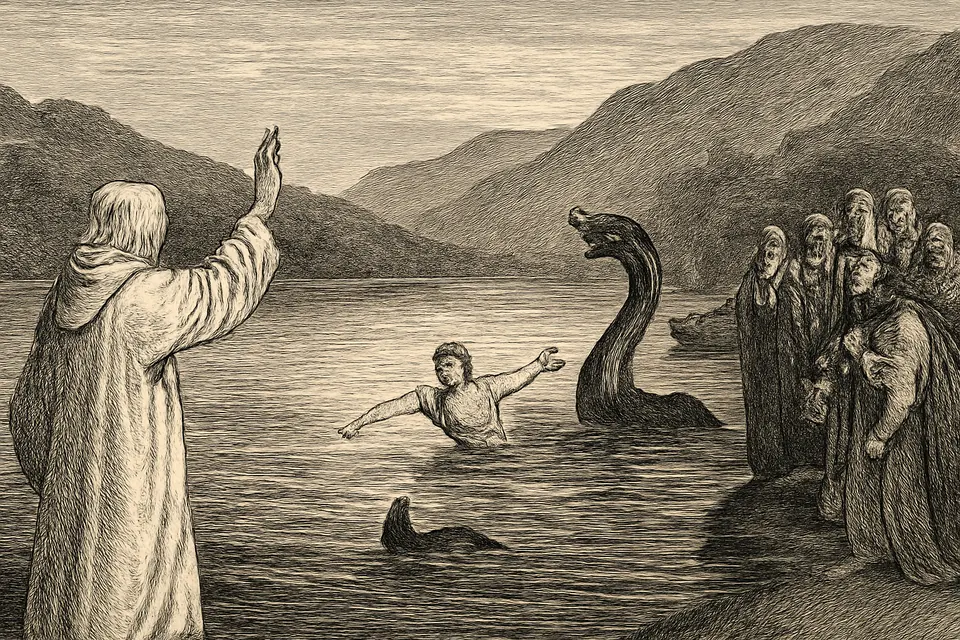
Two details are often lost in the retelling. The story takes place in the river, not in Loch Ness itself, and Adomnán tells it alongside other stories of wild beasts, such as a boar that dropped dead at Columba's word on Skye. Modern writers have made it the first "sighting" of the Loch Ness Monster. It is a traditional story from a source written over a century after the event.
Why St. Columba is a patron saint of Ireland and Scotland
Columba was born in Ireland and spent his life in Scotland, and both countries claim him. In Ireland he is one of three national patrons, with St. Patrick and St. Brigid; tradition even says the relics of all three rest together at Downpatrick. In Scotland he is honored as the apostle of the Picts. Catholic Culture lists his patronages as Ireland, Scotland, poets, bookbinders, protection against floods, and a long list of places, including the city and diocese of Derry and the Scottish dioceses of Argyll and the Isles and Dunkeld. See more on our patron saints page.


Symbols of St. Columba in art
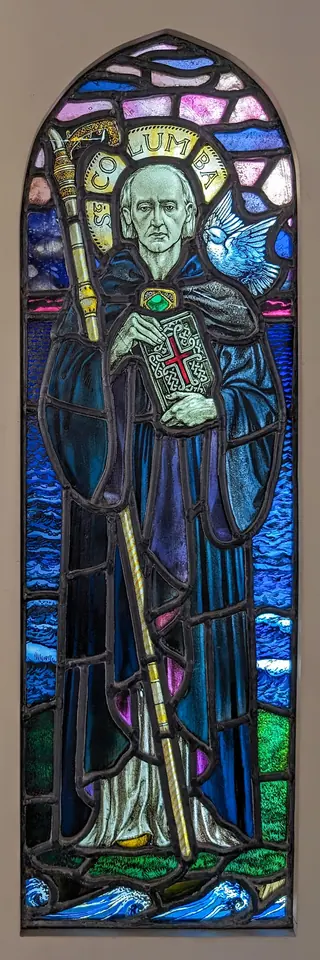
The Catholic Encyclopedia complained in 1908 that "no proper symbolical representation of St. Columba exists" and suggested how he should be shown: in a monk's habit and cowl with the Celtic tonsure and a staff, standing on a shell-strewn shore with a currach nearby and the ruins of Iona behind. Modern artists have largely followed that advice. Look for:
- A white or undyed monk's habit with a hood: the dress of an Irish monk.
- The Celtic tonsure: the front of the head shaved, unlike the round Roman tonsure.
- An abbot's staff and a book: his office and his love of copying Scripture.
- A currach or coracle: the boat that brought him to Iona.
- A white horse: from the story of his last day.
- A dove: a play on his name.
Karl Parsons's 1913 window gives him a staff, a red book and a sea at his feet.

Feast day and Iona today
His feast is June 9, kept in Ireland and Scotland. Find other saints of the season on our feast days page.
The monks of Iona buried Columba within the monastic enclosure. About a century later his bones were enshrined, and when Viking raids struck the island they were carried to Ireland for safety. The Catholic Encyclopedia says they were placed in the church at Downpatrick, and that "since the twelfth century history is silent regarding them."


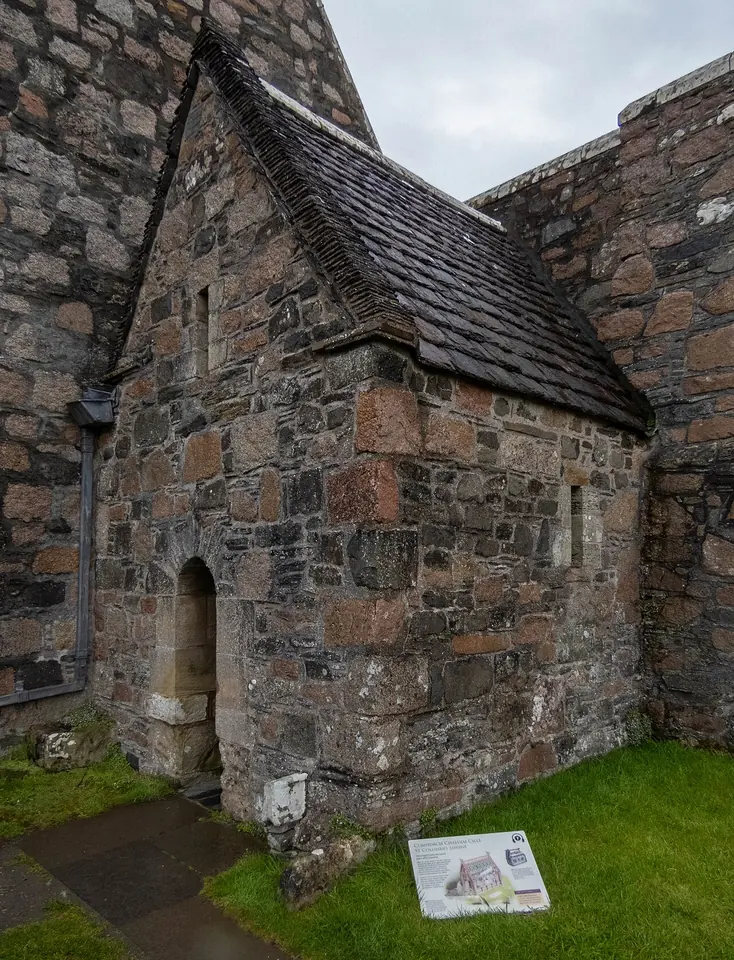
The present abbey church on Iona dates from the medieval Benedictine abbey. Beside its west front stands a tiny chapel known as St. Columba's Shrine. Catholic Culture recalls the words of Samuel Johnson, who visited in 1773: "That man is little to be envied, whose patriotism would not gain force upon the plain of Marathon, or whose piety would not grow warmer among the ruins of Iona!"

Prayer to St. Columba
No ancient prayer to St. Columba is in wide use. Catholics in Ireland and Scotland celebrate the Mass of his feast on June 9 and ask his intercession for their two countries.
The words of his most often repeated are his last instructions to his monks, recorded by Adomnán:
These, O my children, are the last words I address to you—that ye be at peace, and have unfeigned charity among yourselves; and if you thus follow the example of the holy fathers, God, the Comforter of the good, will be your Helper and I, abiding with Him, will intercede for you.
Frequently asked questions
Did St. Columba see the Loch Ness Monster?
Adomnán's Life, written around 700, tells how Columba drove off a "monster that lived in the water" by making the sign of the cross as it chased a swimming monk. The story happens in the River Ness, not the loch itself. It's a traditional miracle story. Modern writers like to call it the first written record of the Loch Ness Monster, but Adomnán tells it as one of several stories about wild beasts.
Why did St. Columba leave Ireland?
Adomnán says only that he sailed away "wishing to be a pilgrim for Christ." Later Irish tradition links his exile to the battle of Cooldrevny (561), fought after a quarrel over a psalter he had copied, and says his confessor sent him away to win as many souls as had died in the battle. The Catholic Encyclopedia notes that the earliest sources don't mention this, so it is traditional.
What is St. Columba the patron saint of?
He is a patron of Ireland (with Patrick and Brigid) and of Scotland, and of poets and bookbinders because he was a poet and copied books by hand. Catholic Culture also lists him as a patron against floods and of the city and diocese of Derry, the dioceses of Argyll and the Isles, Dunkeld and Raphoe, and others.
When is St. Columba's feast day?
June 9, the anniversary of his death in 597. It is kept in Ireland and Scotland, though it is not on the General Roman Calendar.
What is the Cathach of St. Columba?
A late 6th-century Latin psalter, now in the Royal Irish Academy in Dublin, that tradition says Columba copied with his own hand. Its name means "the Battler," because the O'Donnell clan once carried it into battle in a shrine as a pledge of victory.
Sources
- Catholic Encyclopedia (1908): St. Columba
- Adomnán, Life of Saint Columba, translated by William Reeves (Edinburgh, 1874), Internet Medieval Sourcebook
- Catholic Culture: St. Columba of Iona, Abbot (June 9)
- Bede, Ecclesiastical History of the English People, Book III, chapter 4