Our Lady of Grace
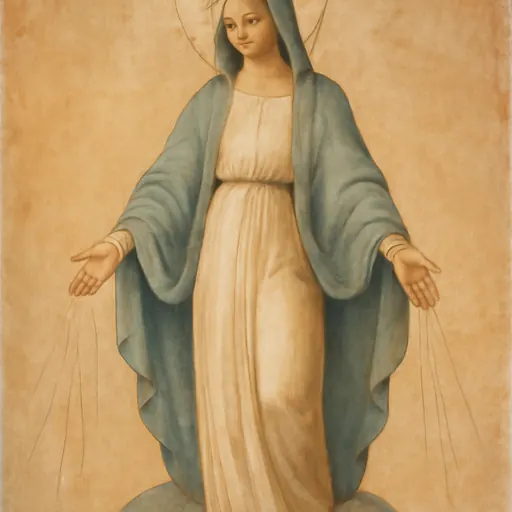
Our Lady of Grace is a title of the Virgin Mary, not a single apparition. It honors Mary as the one the angel greeted as "full of grace" and as the Mother of divine grace of the Litany of Loreto. The familiar Our Lady of Grace statue, with arms lowered and hands open, comes from the image on the Miraculous Medal of 1830. There is no single universal feast; this encyclopedia lists it on May 31, and the Augustinians keep it on May 8.
What is Our Lady of Grace?
Our Lady of Grace is a title of the Virgin Mary. It is not the name of one apparition, one shrine or one picture. Catholics have used it for centuries for many different images of Mary, from a 14th-century icon in northern France to a medieval English statue and the white garden statues sold in every Catholic shop today. What these share is an idea: Mary as the woman the angel called "full of grace," and as the mother of Christ, whom Christians believe to be the source of all grace.
This page explains where the title comes from, why the best-known Our Lady of Grace statue looks the way it does, which shrines and feasts carry the name, and how Catholics pray under it. For the full story of the 1830 apparition behind the statue, see Our Lady of the Miraculous Medal. For Mary herself, see the Blessed Virgin Mary.
The title appears in many languages: Mater divinae gratiae in Latin, Notre-Dame de Grâce in French, Madonna delle Grazie in Italian ("Our Lady of Graces," in the plural), Nossa Senhora da Graça in Portuguese and Nuestra Señora de Gracia in Spanish.
Where the title comes from
"Hail, full of grace"
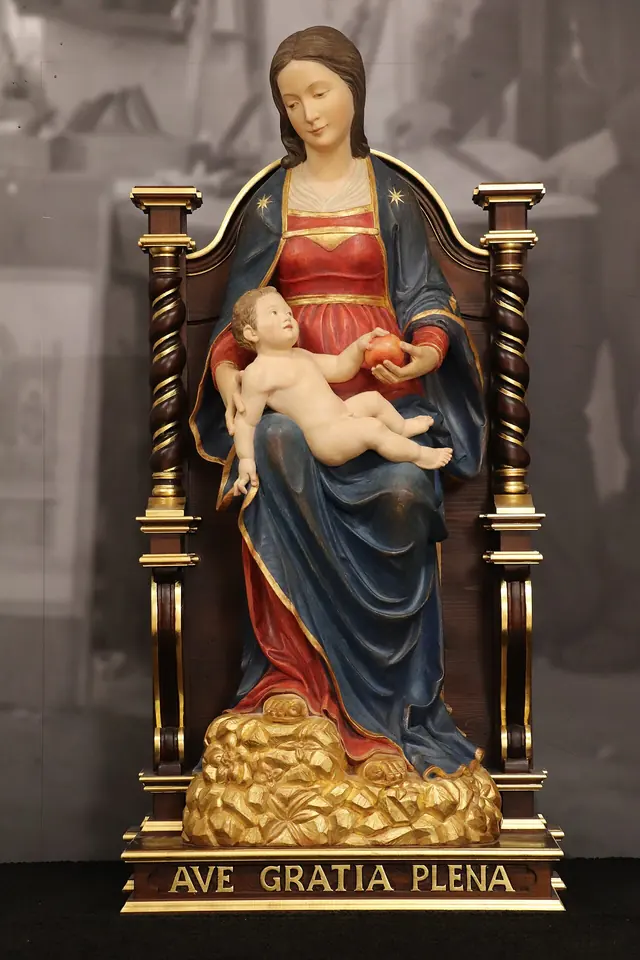
The root is the angel Gabriel's greeting at the Annunciation. In the Douay-Rheims translation of Luke 1:28: "Hail, full of grace, the Lord is with thee: blessed art thou among women." The Latin Vulgate's gratia plena, "full of grace," became the opening of the Hail Mary, the most common Catholic prayer to Mary. Statues of Our Lady of Grace sometimes carry the Latin words Ave gratia plena on their base.


"Mother of divine grace"
The second root is the Litany of Loreto, a Marian litany the Church has prayed for centuries. Among its invocations is "Mother of divine grace" (Mater divinae gratiae), placed right after "Mother of Mercy" in the version the Vatican publishes. Catholics pray it as a call-and-response: "Mother of divine grace," "pray for us." See Our Lady of Loreto for the shrine that gave the litany its name.
What Catholics mean by it
Catholic teaching does not treat Mary as the source of grace. The Second Vatican Council, in Lumen Gentium (1964), says that because she cooperated in Christ's work "she is our mother in the order of grace," and that the titles given her must be "so understood that it neither takes away from nor adds anything to the dignity and efficaciousness of Christ the one Mediator." The Augustinian friars, who call Our Lady of Grace their oldest Marian title, put it this way: as mother of the one Mediator, Jesus, she is "Mother of the Author of Grace."
Mediatrix of All Graces, and the 2025 note
In the early 20th century some Catholics pressed for a dogma declaring Mary "Mediatrix of All Graces." In 1921, at the request of the Belgian bishops led by Cardinal Désiré-Joseph Mercier, the Holy See allowed Belgium a feast of Mary Mediatrix of All Graces on May 31. The movement for a dogma did not succeed. The Second Vatican Council used the word "Mediatrix" but did not define the fuller title.
On November 4, 2025, the Vatican's Dicastery for the Doctrine of the Faith published a doctrinal note, Mater Populi Fidelis ("Mother of the Faithful People"), approved by Pope Leo XIV. It says the title "Mother of Grace" can be used in a precise sense, but warns against images in which Mary seems to own "a repository of grace separate from God," or is pictured "as a fountain from which all grace flows." The note says the title "Mediatrix of All Graces" poses difficulties, and asks that Mary's motherhood in the order of grace be understood as helping people receive the grace that comes from Christ. Catholics still use the title Our Lady of Grace; the note is about how its meaning is explained.
The Our Lady of Grace statue and the Miraculous Medal
Ask an American Catholic what Our Lady of Grace looks like, and the answer will usually be a white statue: Mary standing in a long robe and veil, arms lowered and held slightly out from her sides, palms open toward you, often on a globe with a serpent under her foot. Some versions add rays of light from her hands or a ring of twelve stars.
That figure comes from Paris in 1830. In November of that year a young novice of the Daughters of Charity, St. Catherine Labouré, reported seeing Mary standing on a globe, with rings on her fingers giving off rays of light. In Catherine's account Mary explained, "These rays are a symbol of the graces that I pour out on those who ask them of me." An oval of words formed around her: "O Mary, conceived without sin, pray for us who have recourse to thee." Catherine was told to have a medal struck from what she saw. The Archbishop of Paris approved it, and the first medals were made in 1832.
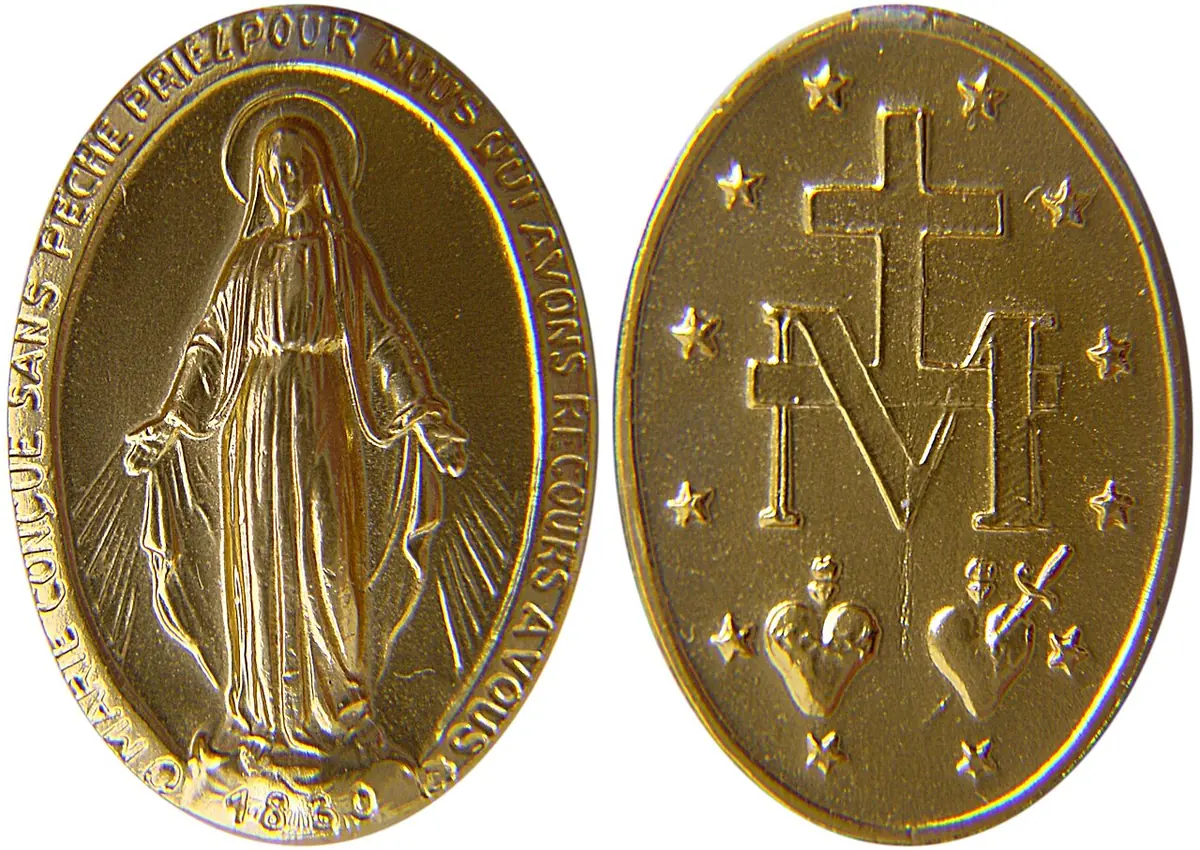

The medal's front became so familiar that the figure was copied as a statue, sometimes with its oval inscription and often without it. The medal itself is sometimes called the Medal of Our Lady of Graces, and Catholic shops sell the same statue as "Our Lady of Grace" or "Our Lady of the Miraculous Medal." The pose has nothing to do with the older Our Lady of Grace images described below, most of which show Mary holding the Christ Child. A good way to tell the two meanings apart: if Mary holds the Child, the title is the older one; if her hands are open and empty, the image comes from the 1830 medal.
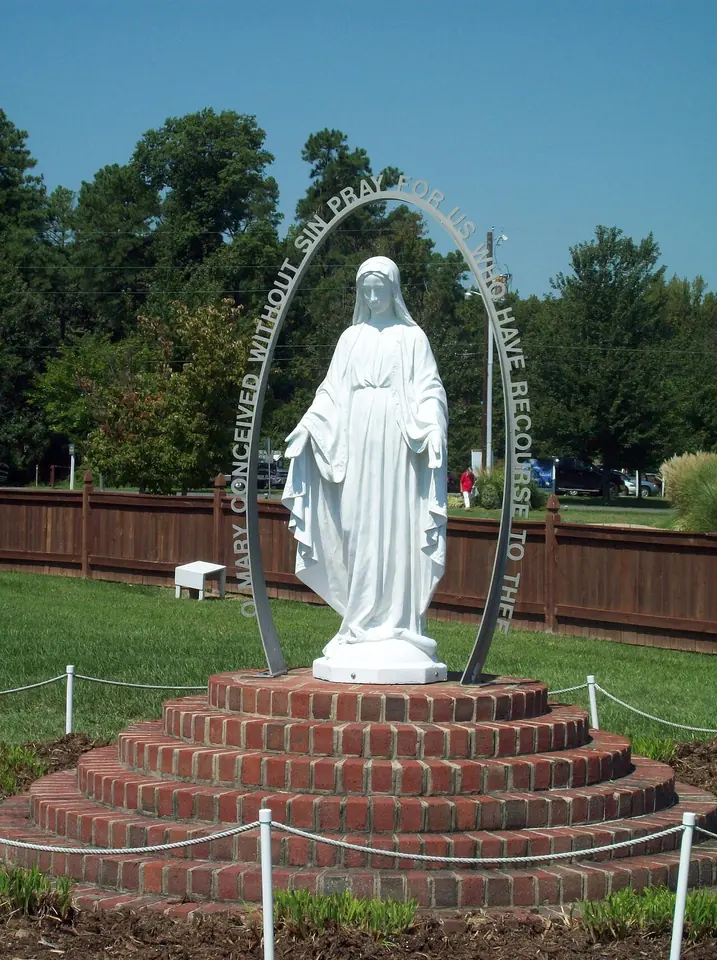


In the Philippines and elsewhere, the statue is often dressed in real cloth, crowned and surrounded by flowers for processions.


The Augustinians and Our Lady of Grace
The Order of Saint Augustine, the friars who follow the Rule of St. Augustine, says Our Lady of Grace is "the oldest" of the titles under which it honors Mary. According to the order's own account, its General Chapter of 1284 prescribed the daily singing of the antiphon Benedicta tu ("Blessed are you") in her honor. A confraternity of Our Lady of Grace existed in Augustinian friaries in Spain and Portugal by 1401 and spread through the order over the following century, and new friaries in Italy and Latin America took the name.
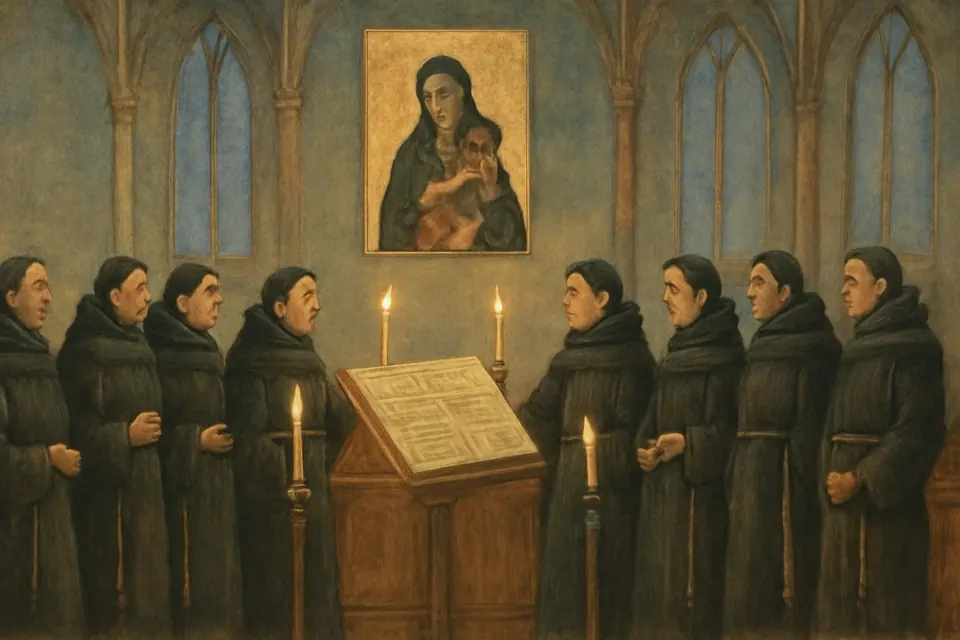
In 1807 Pope Pius VII, at the request of Venerable Joseph Menochio, the papal sacristan and the pope's confessor, granted the order a feast of Our Lady of Grace on June 1. The order now keeps it on May 8. Augustinians connect the title with their founder, sometimes called the Doctor of Grace for his writings on God's grace.
Shrines of Our Lady of Grace
Hundreds of churches carry the name. A few have long histories.
Cambrai, France
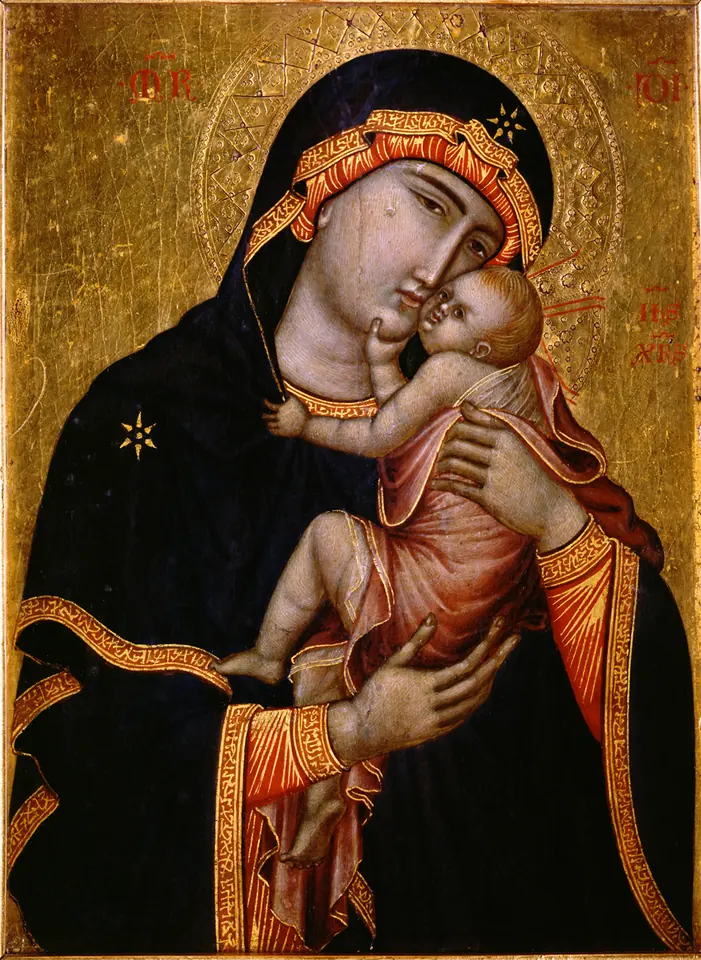
The cathedral of Cambrai is dedicated to Notre-Dame de Grâce, after an icon it keeps. The small panel, painted in the Italo-Byzantine style around 1340, shows the Virgin pressing her cheek to the Child's. A canon of Cambrai, Fursy de Bruille, brought it from Rome, and in 1450 he gave it to the cathedral, where it was installed in the Chapel of the Holy Trinity. For centuries people believed St. Luke had painted it from life, a traditional belief told of many old Marian icons. The icon is still carried through the streets of Cambrai every year on the eve of the Assumption.


Ipswich, England, and Nettuno, Italy
Before the Reformation, the shrine of Our Lady of Grace at Ipswich, in Suffolk, drew more pilgrims than any English Marian shrine except Walsingham. Henry VIII and Katherine of Aragon were among its visitors. In 1538 the statue was taken to London to be burned. Some claim it survived and is the wooden statue venerated at Nettuno, on the coast south of Rome; the Nettuno statue does appear to be English work, but the identification is unproven. Nettuno carries it in procession on the first Saturday of May. Its church, the Basilica of Our Lady of Graces, also holds the body of St. Maria Goretti. In Ipswich, Anglicans and Catholics walk together each year to the site of the old shrine.


Italy: the Madonna delle Grazie
In Italy, churches of Santa Maria delle Grazie are everywhere, many of them built in thanks for a grace received, such as the end of a plague. Faenza honors the Madonna delle Grazie as patron of its diocese; local tradition says that in 1412 Mary appeared to a woman of the city holding broken arrows, a sign that the plague would end. In Milan, the church of Santa Maria delle Grazie is famous for Leonardo da Vinci's Last Supper, painted in its convent. At San Giovanni Rotondo, Padre Pio lived for half a century in the Capuchin friary of Santa Maria delle Grazie.


Portugal: Nossa Senhora da Graça
In Lisbon, the Augustinian friars founded their convent of Our Lady of Grace in 1271, with the support of King Afonso III. It stands on the city's highest hill, facing a lookout over the Tagus River. The cathedral of Setúbal shares the title, and so do cathedrals or pro-cathedrals in the Portuguese-speaking world, at Belém in Brazil, Praia in Cape Verde and São Tomé.


Miracles and traditions
Because Our Lady of Grace is a title rather than one event, there is no single miracle attached to it. Sorted by this encyclopedia's labels:
- The Miraculous Medal apparitions (1830): the church-approved source of the familiar statue, approved by the Archbishop of Paris. See Our Lady of the Miraculous Medal.
- The Faenza apparition (1412): traditional, a local story of Mary promising an end to the plague.
- The Cambrai icon as a portrait by St. Luke: traditional; art historians date the panel to about 1340.
- The survival of the Ipswich statue at Nettuno: traditional and disputed.
- Healings and favors at shrines of Our Lady of Grace: reported. Many of the churches named Madonna delle Grazie were built to give thanks for such favors, but these have not been formally investigated as a group.
Symbols of Our Lady of Grace in art
You will meet two kinds of Our Lady of Grace in churches and museums.
The older images are simply images of Mary, usually with the Christ Child, that a shrine or confraternity honored under this title. The Cambrai icon shows the tender "Virgin of Tenderness" type, with Mother and Child cheek to cheek. The Ipswich image was a seated, crowned Virgin with the Child on her knee. The title, not the pose, makes them Our Lady of Grace. Often an inscription helps: Ave gratia plena, Mater gratiae or Madonna delle Grazie.
The modern statue follows the Miraculous Medal:
- Arms lowered and hands open: Mary offering graces to those who ask.
- Rays from her hands: the graces themselves, as in Catherine Labouré's account.
- A globe under her feet: the world.
- A serpent crushed under her foot: the promise of Genesis 3:15, read by Catholics as fulfilled in Mary and her Son.
- White robe and blue mantle: purity, and the color long associated with Mary.
- Twelve stars: from the woman "clothed with the sun" in Revelation 12.
Feast days of Our Lady of Grace
There is no feast of Our Lady of Grace in the General Roman Calendar. This encyclopedia lists the title on May 31, the last day of May, which Catholics call Mary's month. That date has a history: from 1921 the Mass of Mary Mediatrix of All Graces was celebrated on May 31 in Belgium and other places. In 1954 Pope Pius XII, in Ad Caeli Reginam, placed the new feast of Mary's Queenship on May 31; since the calendar reform of 1969, May 31 has been the feast of the Visitation.
Other dates that belong to the title:
- May 8: Our Lady of Grace in the calendar of the Augustinian Order (from 1807 the feast was on June 1).
- First Saturday of May: the procession of the Madonna delle Grazie at Nettuno.
- August 14: the procession of Notre-Dame de Grâce at Cambrai, the eve of the Assumption.
- November 27: the feast of Our Lady of the Miraculous Medal, kept by the Vincentian family.
See the full calendar on our feast days page.
The garden-statue custom
The white Our Lady of Grace statue is a familiar sight in Catholic yards and gardens. Many Catholics set one among flowers in what they call a Mary garden. The University of Dayton's Marian Library, which keeps the archive of the movement, traces it to medieval English names for plants, such as "Our Lady's Glove" for foxglove. The first Mary garden in the United States is acknowledged to have been at St. Joseph's Parish in Woods Hole, Massachusetts, where a parishioner, Frances Crane Lillie, gave the parish two stone bell towers in 1929 and later developed a garden for Mary on their grounds. Later in the century a Philadelphia engineer, John S. Stokes Jr., and his partner Edward McTague founded the Mary's Gardens company, which sold seed packets with Marian plant names.
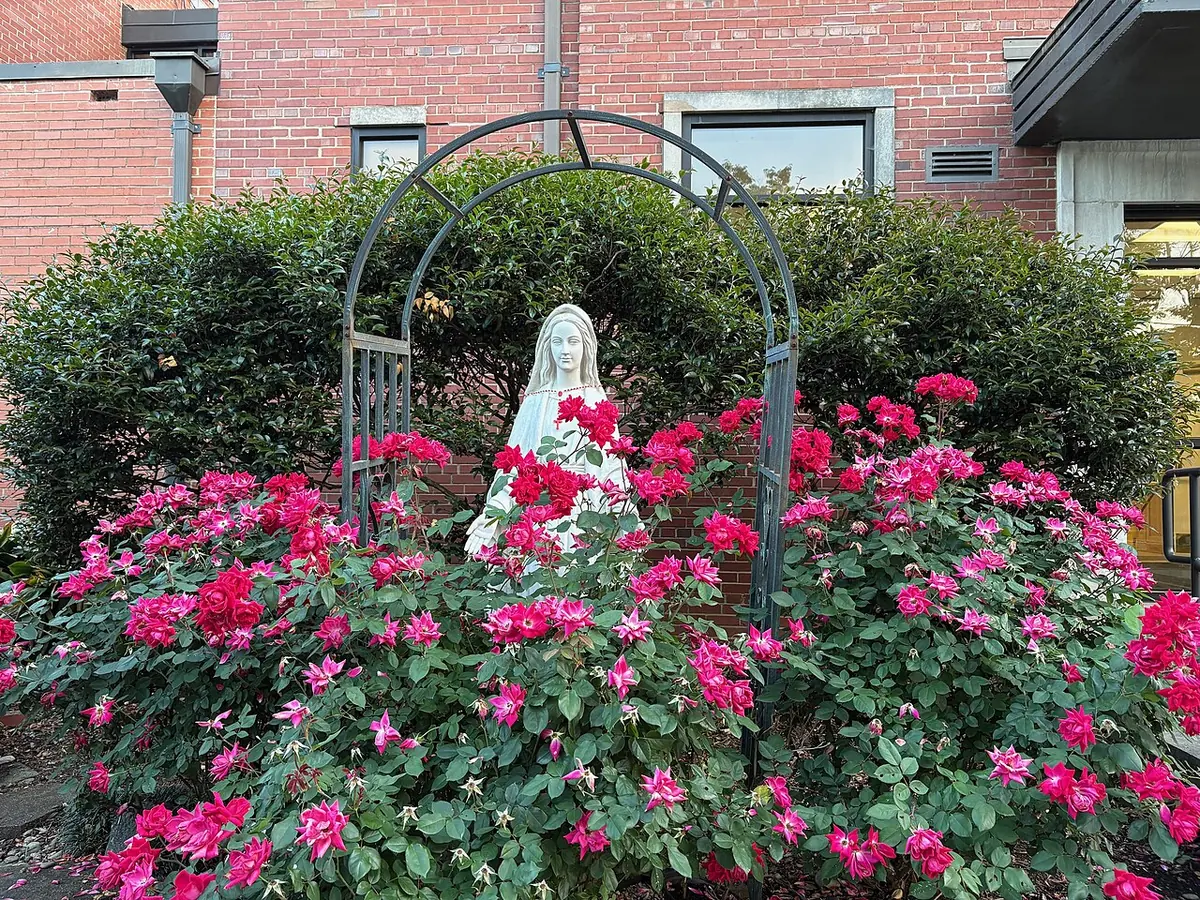

A Mary garden usually has a statue or image of Mary as its center. The open-armed Our Lady of Grace is a natural choice, since the pose looks outward toward whoever comes into the garden.
Prayers to Our Lady of Grace
No single traditional prayer belongs to this title, and the many "Prayer to Our Lady of Grace" cards in circulation are mostly modern texts without a known author. Catholics usually honor Our Lady of Grace with older prayers that carry the theme of grace.
The Hail Mary
It begins with the angel's words of Luke 1:28 and Elizabeth's of Luke 1:42, followed by the Church's petition:
Hail Mary, full of grace, the Lord is with thee; blessed art thou among women, and blessed is the fruit of thy womb, Jesus. Holy Mary, Mother of God, pray for us sinners, now and at the hour of our death. Amen.
The Miraculous Medal invocation
Those who pray before the open-armed statue often use the words of the medal:
O Mary, conceived without sin, pray for us who have recourse to thee.
The Litany of Loreto
The invocation "Mother of divine grace, pray for us" is part of the Litany of Loreto, which the Holy See publishes in full.
Maria, mater gratiae
A short Latin stanza addresses Mary as Mother of grace. It appears in older Catholic prayer collections, including the Raccolta, the 19th-century book of indulgenced prayers:
Maria, mater gratiæ, / Dulcis parens clementiæ, / Tu nos ab hoste protege, / Et mortis hora suscipe.
In plain English (our translation): "Mary, mother of grace, sweet parent of mercy, protect us from the enemy and receive us at the hour of death."
Frequently asked questions
Is Our Lady of Grace the same as Our Lady of the Miraculous Medal?
Not exactly. Our Lady of Grace is a much older title, used for many images of Mary since the Middle Ages. But the statue most Americans know as Our Lady of Grace, Mary with arms lowered and hands open, standing on a globe, is the figure from the front of the Miraculous Medal, which St. Catherine Labouré saw in Paris in 1830. Shops and parishes use both names for that statue.
When is the feast of Our Lady of Grace?
There is no single universal date. The Augustinians keep it on May 8. Many people associate it with May 31, the end of Mary's month and the old date of the feast of Mary Mediatrix of All Graces in Belgium. Local shrines have their own days, such as Cambrai's procession on August 14.
What does the title "Our Lady of Grace" mean?
It goes back to the angel Gabriel's greeting in Luke 1:28, "Hail, full of grace" (Douay-Rheims). Catholics call Mary "Mother of divine grace" because she is the mother of Jesus Christ, whom they believe to be the source of all grace. The Augustinians explain it this way: as mother of the one Mediator, she is "Mother of the Author of Grace."
Why does the Our Lady of Grace statue have her arms outstretched?
The pose copies the Miraculous Medal. In St. Catherine Labouré's account, rays of light streamed from rings on Mary's fingers, and Mary said, "These rays are a symbol of the graces that I pour out on those who ask them of me." Statues show the open hands, often with rays, as a sign of graces given to those who pray.
Why do Catholics put Our Lady of Grace statues in gardens?
Many keep a "Mary garden," a bed of flowers with Marian names planted around a statue of Mary. The custom recalls medieval English plant names such as "Our Lady's Glove" for foxglove. In the United States it spread from a parish garden at Woods Hole, Massachusetts, begun after 1929, and through the Mary's Gardens seed company of Philadelphia. The open-armed Our Lady of Grace is a common choice for such gardens.
Is there a prayer to Our Lady of Grace?
No single traditional prayer belongs to the title. Catholics honor Our Lady of Grace with the Hail Mary, which opens with the angel's words "full of grace," with the Miraculous Medal invocation "O Mary, conceived without sin, pray for us who have recourse to thee," and with the invocation "Mother of divine grace" in the Litany of Loreto. Prayer cards printed with other "Our Lady of Grace" prayers are usually modern and unsigned.
Does the Catholic Church teach that Mary is "Mediatrix of All Graces"?
It is not a defined doctrine. In November 2025 the Vatican's Dicastery for the Doctrine of the Faith, in the note Mater Populi Fidelis, said the title "Mother of Grace" can be understood correctly but warned against picturing Mary as a separate fountain of grace, and said the title "Mediatrix of All Graces" poses difficulties. It asks that Mary's role always be understood as pointing to Christ, the one Mediator.
Sources
- Douay-Rheims Bible, Luke 1:28 (Bible Gateway)
- The Holy See: The Litany of Loreto
- Second Vatican Council, Lumen Gentium, chapter 8 (paragraphs 61–62)
- Dicastery for the Doctrine of the Faith, Mater Populi Fidelis: Doctrinal Note on Some Marian Titles (November 4, 2025)
- Vatican News: Doctrinal Note on Marian titles: Mother of the faithful, not Co-redemptrix
- Order of Saint Augustine: Our Lady of Grace, May 8
- The Augustinians (Province of St. Thomas of Villanova): May 8, Our Lady of Grace
- Pius XII, Ad Caeli Reginam (1954)
- University of Dayton Marian Library: 'Mary gardens' bring Catholic piety to the garden
- California Augustinians: Our Lady of Grace in the Augustinian Tradition
- Wikipedia: Our Lady of Grace (Cambrai, Ipswich, Nettuno)
- Wikipedia: Our Lady of Graces (Madonna delle Grazie)
- Wikipedia: Mediatrix of all graces (the 1921 Belgian feast)
- Wikipedia: Graça Convent, Lisbon
- Wikipedia: Mary, Mother of Grace (Maria mater gratiae)