St. Erasmus (St. Elmo), Bishop and Martyr

St. Erasmus, also called St. Elmo, was a bishop and martyr honored at Formia, on the coast between Rome and Naples, who died around 303. Very little about his life is certain, but his grave was known in the sixth century and his relics are kept in Gaeta. He is the patron saint of sailors and of people with stomach and abdominal pain, and St. Elmo's fire is named after him. His feast day is June 2.
Who was St. Erasmus?
Erasmus was a bishop and martyr whose grave was honored at Formia, a port town on the Tyrrhenian coast between Rome and Naples. Sailors all over the Mediterranean called on him, and his name, worn down by many tongues into Ermo and Elmo, gave English the phrase "St. Elmo's fire." He is one of the Fourteen Holy Helpers, the saints whom Christians in medieval Germany invoked together in times of plague.
Almost everything about his life is uncertain. His legend mixes him with a Syrian bishop, Erasmus of Antioch, and the long story of his sufferings was written centuries after he died. What is certain is short: by 590 his grave at Formia was known, and his relics were later moved to Gaeta.

What history can say
The oldest firm evidence is a letter of Pope Gregory the Great, written in 590 to Bishop Bacauda of Formia, which mentions the grave of the martyr Erasmus there. Other letters of Gregory mention monasteries dedicated to Erasmus in Campania.
The old Roman Martyrology (in its 1916 English edition) says he was a bishop in Campania, that he was scourged and tortured without injury under two emperors, and that "finally, celebrated for his sufferings, and called by God, he closed his life by a peaceful and holy end. His body was afterwards transferred to Gaeta." Juliette Wood, a folklorist who has studied his cult, notes that the relics were carried to Gaeta, a few miles along the coast, in the ninth century to protect them from Muslim raiders. The cathedral there is dedicated to him.


The legend of St. Erasmus
The fuller story is traditional. A life of Erasmus was added to the English Golden Legend in the printings after Caxton's first edition of 1483 and kept until the edition of 1527; the modern editor prints it from Wynkyn de Worde's text as an appendix. In this telling Erasmus is a bishop of Campania who survives one torment after another, is set free by an angel each time, and goes back to preaching.
The hermit on Mount Lebanon
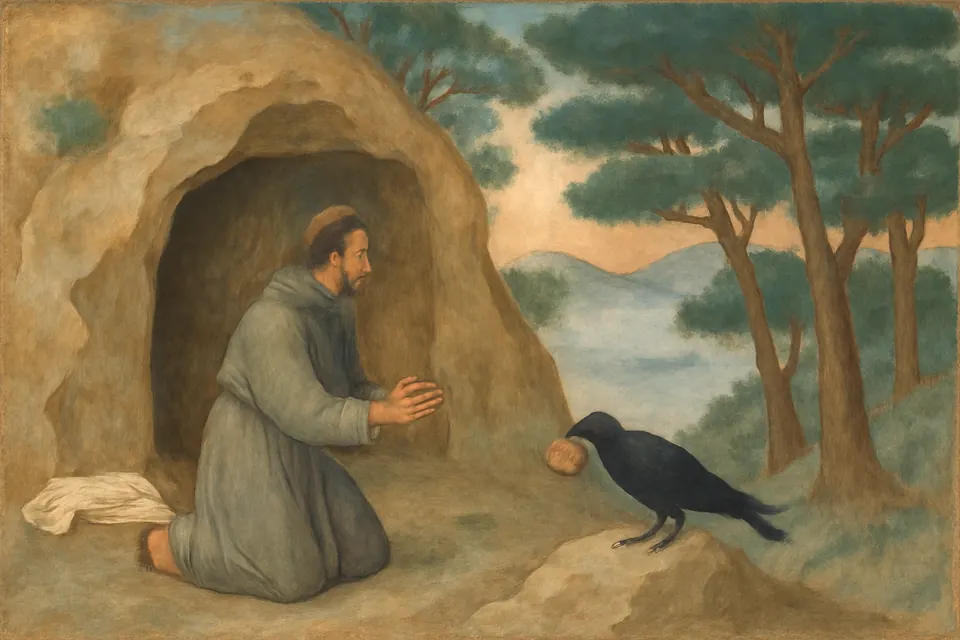
Other versions of the legend, summarized by Catholic Culture and by the University of Notre Dame's FaithND, say he fled the persecution of Diocletian to Mount Lebanon and lived there as a hermit, fed by a raven, until an angel sent him back to his people.
The thunderbolt and the windlass
One story says a thunderbolt struck the ground beside him while he preached, and he kept on preaching. Sailors, who feared lightning more than almost anything, took that as a reason to trust him in storms.
The best-known detail of all is the windlass, the drum-and-crank winch that hauled a ship's anchor cable. Late medieval legends turned it into the instrument of his death. Caxton's text includes it, and many paintings from the fifteenth and sixteenth centuries show it plainly. This encyclopedia doesn't dwell on it. The older sources say nothing about it: the Martyrology gives him a peaceful death. A likely explanation is that the windlass began as a sailor's emblem, put in his hand because he was the seamen's patron, and that later viewers read it as the instrument of his death. The Painted Church, describing a medieval wall painting at Chippenham in England, calls the windlass his emblem as a saint of the sea. The editor of the Golden Legend argued the reverse: that people with intestinal troubles prayed to him first, and seafarers followed, hoping he would spare them seasickness. Juliette Wood also thinks the legend came first. No early source settles it, and the martyrdom story is labeled a legend here.
The miracles of St. Erasmus
All of his miracles are traditional: protection of sailors in storms, the raven on Mount Lebanon, the angel who freed him from each torment, and a dead boy raised at a town the English text calls "Fremyana." None has been formally investigated by the Church.
Why St. Erasmus is the patron saint of sailors
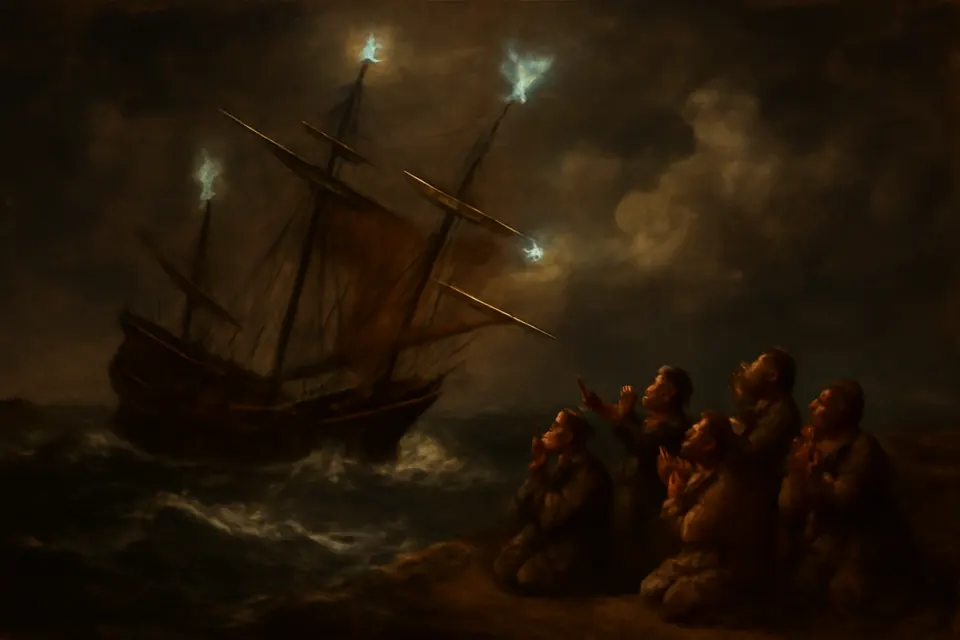
He belonged to two seaports, Formia and Gaeta, whose fishermen and sailors made him their own. The glow that sometimes crowns a ship's masts after a thunderstorm (a corona of electrically charged air, as Wood explains) came to be called St. Elmo's fire, and sailors took it as a sign that the danger was past. Columbus and Antonio Pigafetta, the chronicler of Magellan's voyage, both recorded seeing it.
Don't confuse him with Blessed Peter González, a thirteenth-century Dominican preacher to the sailors of Spain and Portugal who was also nicknamed San Telmo, after the older saint.
His patronage of stomach ailments, colic and women in labor comes from the windlass legend. FaithND notes that he is invoked by people with intestinal disorders. See our patron saints page for others who share his patronages, including St. Francis of Paola for sailors.
Symbols of St. Erasmus in art
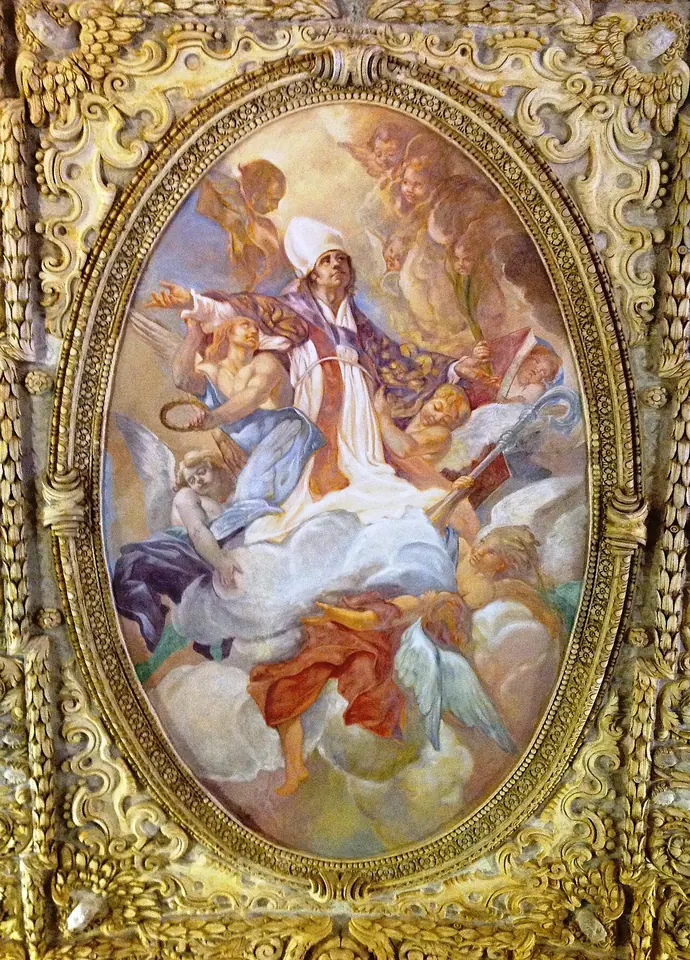
Erasmus is a bishop in miter and cope, usually holding a crozier. What sets him apart is the windlass or capstan, a wooden drum with a crank or spokes. Sometimes it is wound with rope; in many late medieval pictures it carries the legend's grisly detail. Look also for a ship in his hand or behind him, and in some Italian works a raven.
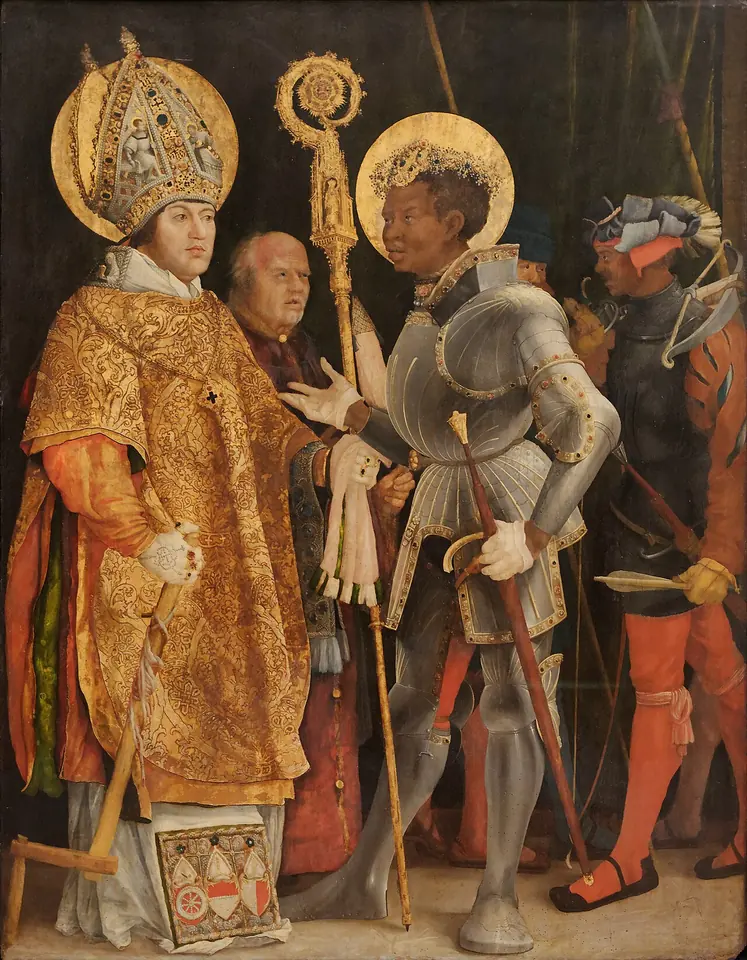
In groups of the Fourteen Holy Helpers he stands among the bishops beside St. Blaise, and the windlass tells them apart. Grünewald's panel near the top of this page is unusual in leaving it out of sight.

Feast day and where St. Erasmus is honored
His feast is June 2, the day the Roman Martyrology lists him; see our feast days page for his calendar neighbors.
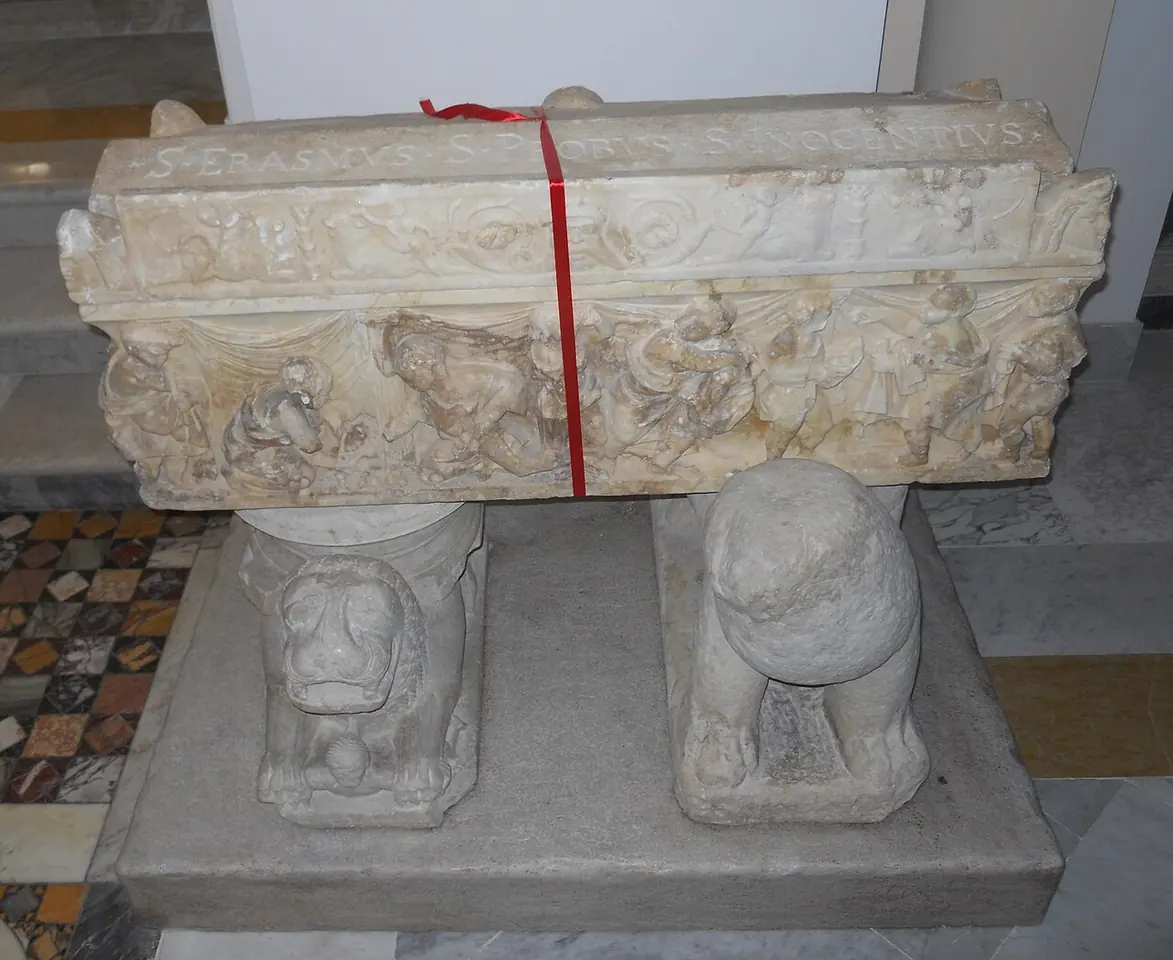
Gaeta Cathedral keeps his relics in its crypt, the succorpo, in an ancient sarcophagus shared with Sts. Probus and Innocent. St. Peter's Basilica in Rome has an altar of St. Erasmus, with relics brought from Old St. Peter's; Wood notes that Nicolas Poussin painted its altarpiece in 1628 and that a mosaic copy now takes its place. Wood also notes processions in his honor in the Abruzzi and a sailors' confraternity of St. Erasmus near Genoa, founded in 1638, whose oratory holds votive ship models.

Prayer to St. Erasmus
Catholic Culture reproduces a novena in honor of St. Erasmus, part of a traditional series of novenas to the Fourteen Holy Helpers. Its short prayer reads:
O God, grant us through the intercession of Thy dauntless bishop and martyr Erasmus, who so valiantly confessed the Faith, that we may learn the doctrine of this faith, practice its precepts, and thereby be made worthy to attain its promises. Through Christ our Lord. Amen.
Sailors also simply ask his prayers before a voyage.
Frequently asked questions
Why is St. Elmo's fire named after St. Erasmus?
St. Elmo's fire is the blue-white glow of static electricity that can appear on masts after a thunderstorm. Mediterranean sailors read it as a sign that their patron was watching over them. Folklorist Juliette Wood traces the name from Erasmus to "Ermo" and then "Elmo."
What is St. Erasmus the patron saint of?
Sailors and all who work at sea, and people suffering from stomach and intestinal pain, colic and the pains of childbirth. He is one of the Fourteen Holy Helpers, the saints whom medieval Germans called on together in times of sickness.
Why does St. Erasmus hold a windlass?
A windlass is the winch sailors used to haul anchor cables. It marks his patronage of seamen. A late legend says he was martyred on one, but the old Roman Martyrology says he died "by a peaceful and holy end," and the legend may have grown out of the emblem rather than the other way around.
When is the feast of St. Erasmus?
June 2. He is listed that day in the Roman Martyrology but is not on the General Roman Calendar, so his feast is kept mostly in places with a local devotion, such as Gaeta and Formia in Italy.
Sources
- Roman Martyrology (1916 English edition), June 2
- The Golden Legend, Life of St. Erasmus (Caxton's addition), Vol. 7 (Medieval Sourcebook)
- Catholic Culture: Fourteen Holy Helpers
- Catholic Culture: Liturgical calendar for June 2 (St. Erasmus in the Roman Martyrology)
- Catholic Culture: Novena in Honor of St. Erasmus
- Juliette Wood: St Elmo's Fire
- FaithND (University of Notre Dame): St. Erasmus
- The Painted Church: Medieval Painting of the Martyrdom of St. Erasmus, Chippenham
- Gregory the Great, Register of Letters 1.8 (590), to Bishop Bacauda of Formia (Cult of Saints database, University of Oxford, E02762)