St. Joachim, Father of the Virgin Mary
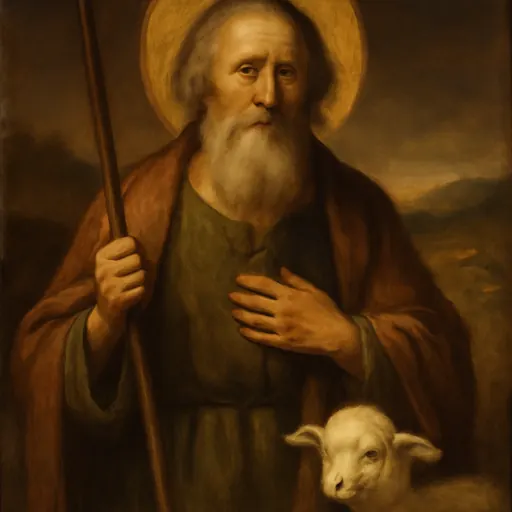
St. Joachim is the father of the Virgin Mary and the grandfather of Jesus, according to Christian tradition. The Bible does not name him; his name and story come from the Protoevangelium of James, an apocryphal book of the 2nd century. Catholics honor him with his wife, St. Anne, on July 26, and he is a patron of grandparents and fathers.
Who was St. Joachim?
St. Joachim is the father of the Virgin Mary and so the grandfather of Jesus. His wife was St. Anne. Nothing about him is in the Bible. His name and his story come from the Protoevangelium of James, an apocryphal gospel written in the 2nd century, outside the books the Church accepted as Scripture. The Catholic Encyclopedia puts it frankly: this tradition "seems to rest ultimately" on the Protoevangelium and two later books built on it, "and this origin is likely to rouse well-founded suspicions."
The same article adds that apocryphal does not mean worthless, since such books may preserve some old traditions alongside legend. The Church has never vouched for the details, but it has honored Joachim and Anne as Mary's parents since the early centuries. The Catholic Encyclopedia explains his name as "Yahweh prepares."
This page tells his part of the story. Anne's side, her shrines and her patronages, are on her own page.
The story of Joachim in the Protoevangelium
The rejected offering
The Protoevangelium begins with him: "In the records of the twelve tribes of Israel was Joachim, a man rich exceedingly." On a great feast he brings a double offering to the Temple, but a man named Rubim stops him: "It is not meet for you first to bring your offerings, because you have not made seed in Israel." Joachim and Anne have no children, and in his world that was taken as a sign of God's displeasure.


Later versions sharpen the scene. In the Gospel of Pseudo-Matthew, Ruben is a priest who turns him away "in the sight of the people." In the Gospel of the Nativity of Mary, the high priest Issachar spurns his gifts. That is the version painters followed.


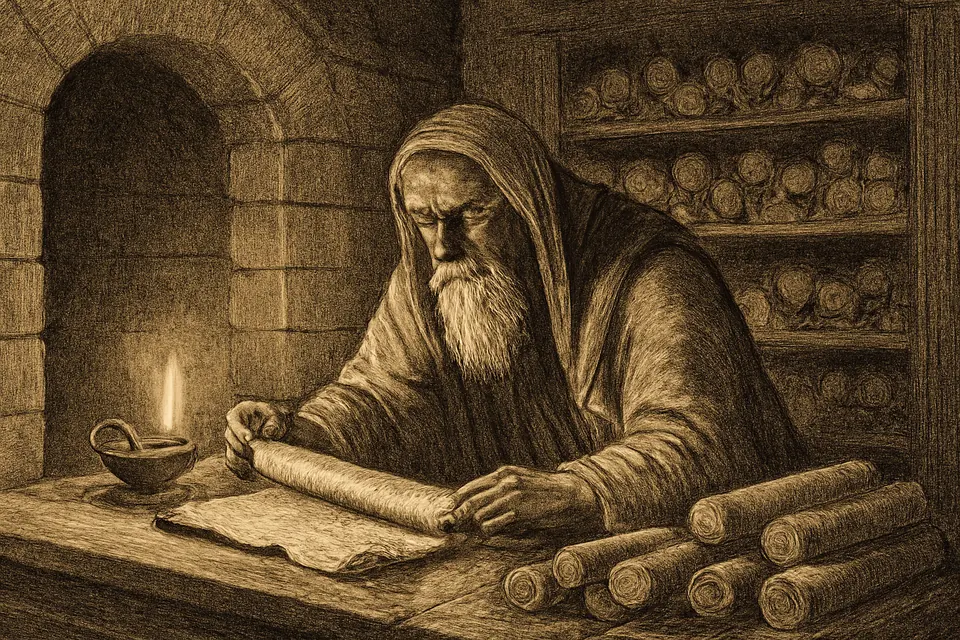
Joachim, ashamed, goes to "the registers of the twelve tribes" to see whether he alone has no child. He finds that "all the righteous had raised up seed in Israel," and remembers that God gave Abraham a son in old age.
Forty days in the wilderness
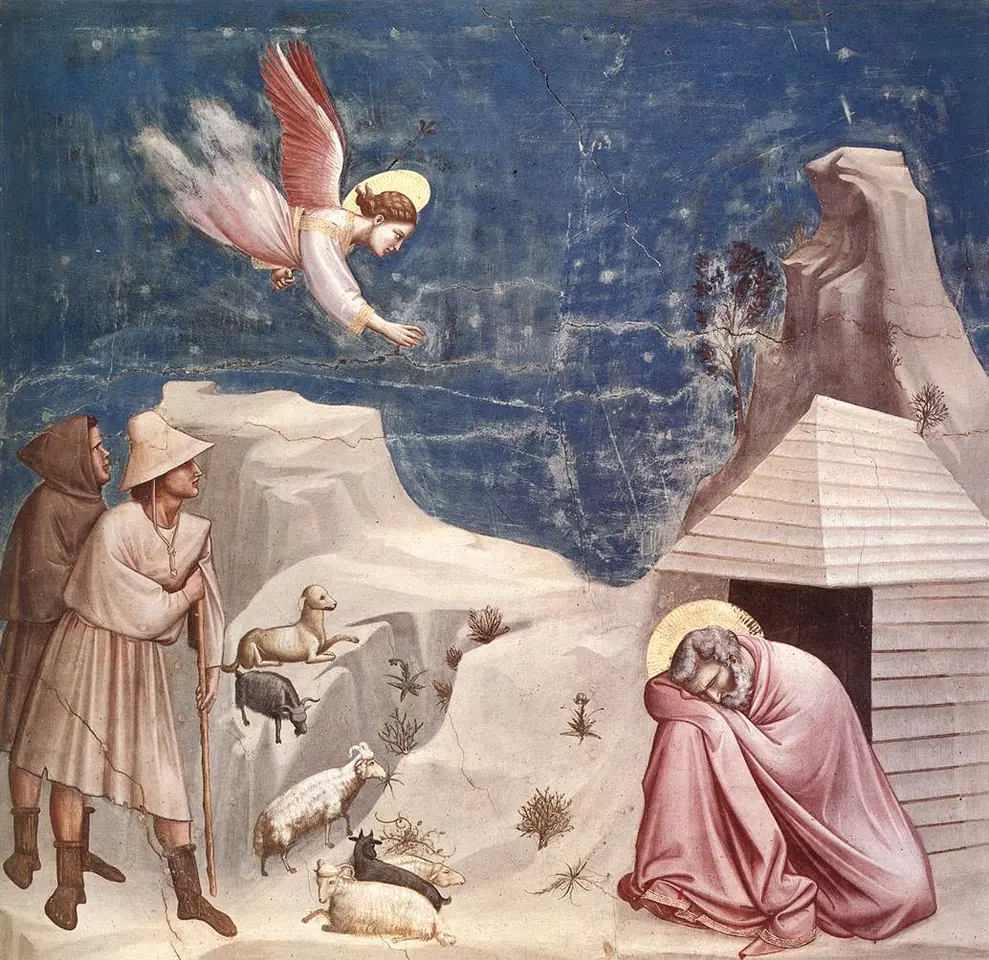
Joachim does not go home. He pitches a tent in the desert and fasts "forty days and forty nights," saying, "prayer shall be my food and drink." Pseudo-Matthew says instead that he went off with his shepherds and flocks to the mountains for five months.


The angel's message
An angel appears to Anne in her garden and then to Joachim: "Joachim, Joachim, the Lord God has heard your prayer. Go down hence; for, behold, your wife Anna shall conceive." He sends for lambs, calves and goats as offerings and goes home. Anne runs out to meet him at the gate and throws her arms around his neck. The Gospel of the Nativity of Mary names it the Golden Gate of Jerusalem, and the embrace there became one of the best-known scenes in Christian art.

The next day Joachim offers his sacrifice and goes home "justified." In the ninth month Anne gives birth to a girl and names her Mary.
Mary's first years
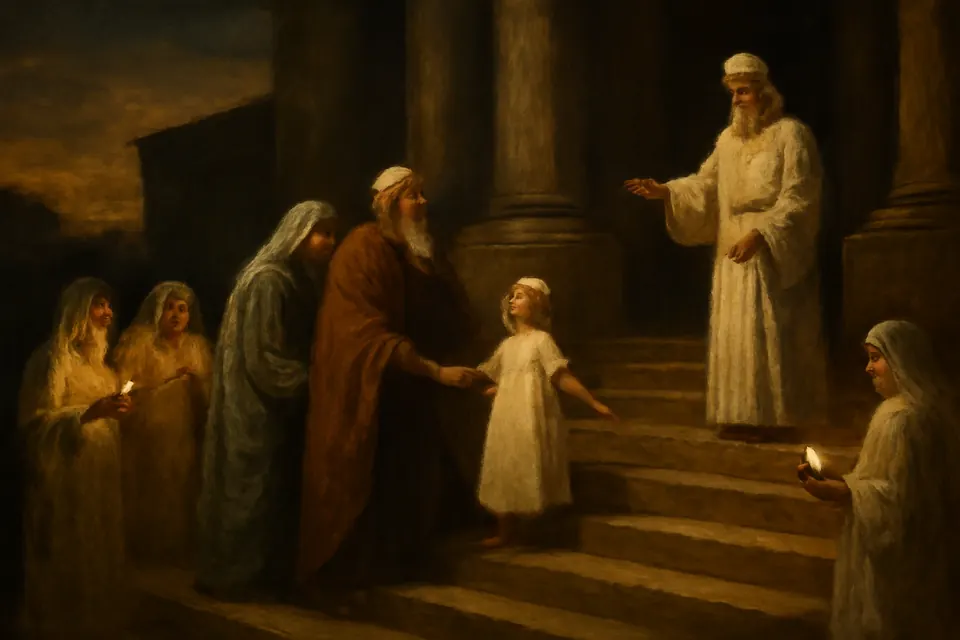
The Protoevangelium gives Joachim a few more scenes. On Mary's first birthday he holds "a great feast" and brings her to the priests to be blessed. When she is three, he and Anne keep their vow and take her to live in the Temple, with girls carrying lamps so that "the child may not turn back." Nothing more is told of him. The Orthodox life adds that he died at the age of 80, a few years later.
Miracles and legends
St. Joachim has no approved miracles. Everything told about him is traditional: the angel's message, the end of his and Anne's childlessness, and Mary's birth, all from the Protoevangelium of James and the books based on it. Catholics and Orthodox ask his prayers, especially for families and for couples who hope for children, but no healings are formally attributed to him.
Why St. Joachim is the patron of grandparents and fathers
As Mary's father and the grandfather of Jesus, Joachim is the natural patron of fathers and, with Anne, of grandparents. Pope Francis set the World Day for Grandparents and the Elderly on the fourth Sunday of July, he said, because it falls "close to the feast of Saints Joachim and Anne, Jesus' 'grandparents'." The Orthodox Church in America adds that Joachim and Anna "are often invoked by couples trying to have children," since their own prayer for a child was answered in old age. See more patron saints.
Symbols of St. Joachim in art
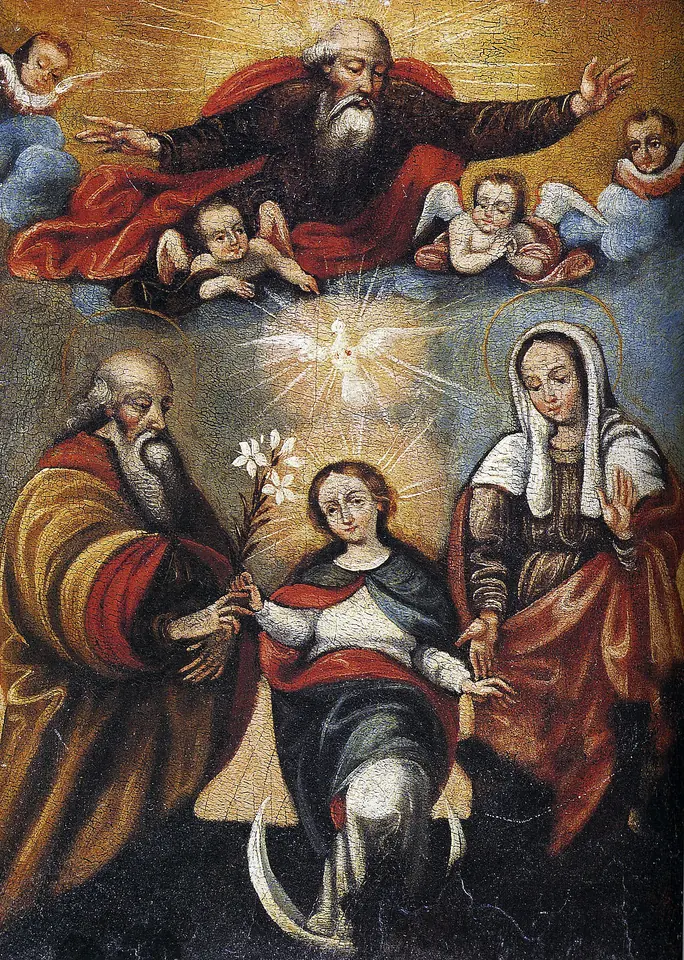
You'll rarely see Joachim alone. He is an old man with a gray or white beard, usually standing beside Anne or with the young Mary between them. His other attributes come from his story:
- A lamb or a flock of sheep: his rejected offering and his weeks with the shepherds. Giotto puts a lamb in his arms as he is driven from the Temple.
- The embrace at the Golden Gate: Joachim and Anne meeting and embracing before a city gate.
- The angel in the wilderness: Joachim asleep or praying among shepherds as an angel speaks to him.
- With the child Mary: in later Catholic art, Joachim and Anne stand on either side of the young Virgin, as in the colonial painting below.
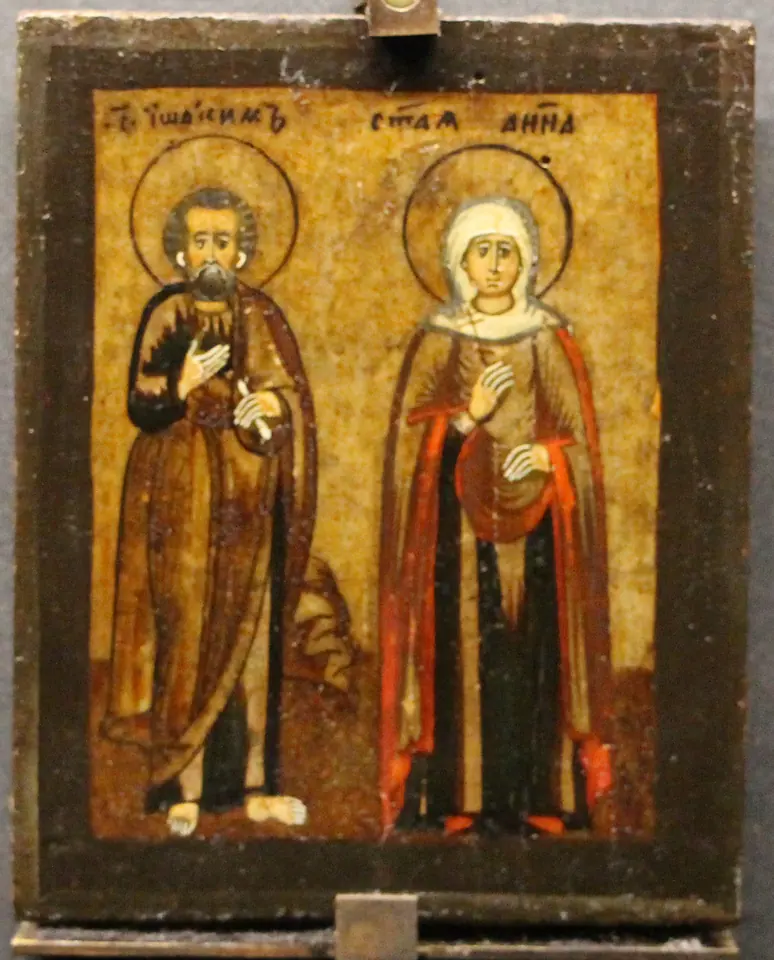

Eastern icons call him "the Righteous Joachim" and show him with Anne, often holding the infant Mary between them or embracing in front of a gold wall. Giotto's six Joachim frescoes in the Scrovegni Chapel in Padua, three of them on this page, are the most famous cycle of his life in the West.

Feast day and where St. Joachim is honored
His feast has moved more than any other saint's. The Catholic Encyclopedia says the Greeks honored him "very early" on the day after Mary's birthday, while the Latin Church was slow to add him. His feast was kept on September 16 or December 9 in some places, put on March 20 by Pope Julius II, dropped some fifty years later, restored by Gregory XV in 1622 and fixed by Clement XII in 1738 on the Sunday after the Assumption. Pope Leo XIII, whose baptismal name was Joachim, raised its rank in 1879, and in the 20th century it was kept on August 16. Since the calendar reform after the Second Vatican Council, Catholics honor him with Anne on July 26. The Orthodox Church keeps both on September 9. See the feast day calendar.
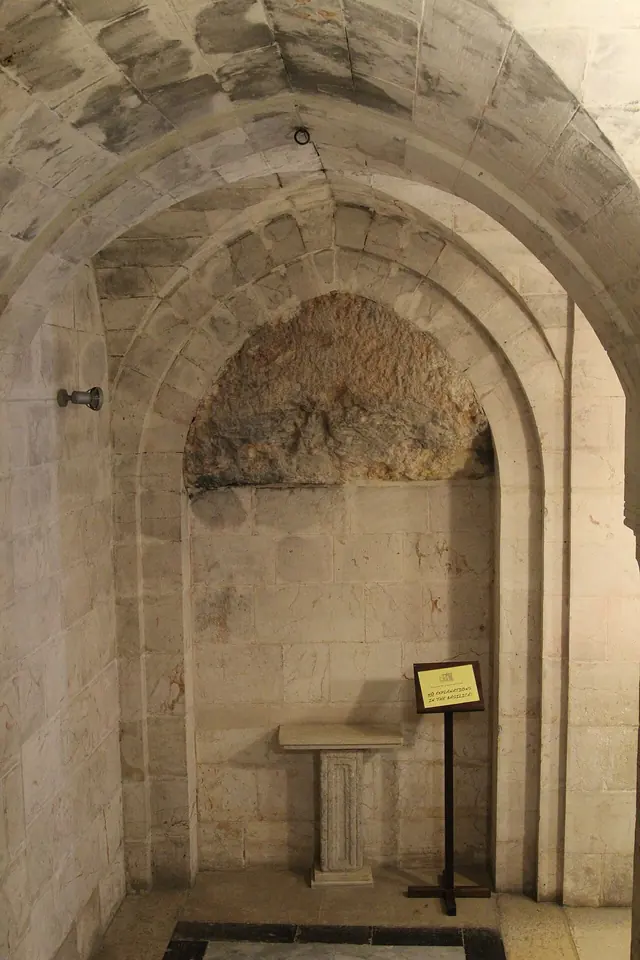
In Jerusalem, the Church of St. Anne near the Pool of Bethesda stands where tradition places the home of Joachim and Anne. The Catholic Encyclopedia says their tombs were honored in a church there until the end of the 9th century, and that the crypt was found again on March 18, 1889.

Prayer to St. Joachim
The Church's own prayer is the collect for the memorial of Sts. Joachim and Anne in the Roman Missal:
O Lord, God of our Fathers, who bestowed on Saints Joachim and Anne this grace, that of them should be born the Mother of your incarnate Son, grant, through the prayers of both, that we may attain the salvation you have promised to your people. Through our Lord Jesus Christ, your Son, who lives and reigns with you in the unity of the Holy Spirit, God, for ever and ever.
The Orthodox troparion for September 9, in the translation of the Orthodox Church in America:
Since you were righteous under the law of grace, O Joachim and Anna, / you gave birth to the God-given infant for our sake. / Therefore, the divine Church radiantly keeps feast today, / joyfully celebrating your honorable memory and giving glory to God / who has raised up a horn of salvation from the house of David.
Frequently asked questions
Who was St. Joachim?
The father of the Virgin Mary, the husband of St. Anne and the grandfather of Jesus. The Gospels don't name Mary's parents; Christians know Joachim from the Protoevangelium of James, an apocryphal book from the 2nd century, and from later writings based on it.
When is St. Joachim's feast day?
July 26, with St. Anne, in the Catholic Church. Before the calendar reform that followed the Second Vatican Council, his feast was August 16. The Orthodox Church honors Joachim and Anna on September 9.
Is the story of St. Joachim in the Bible?
No. It comes from the Protoevangelium of James, which the Church never accepted as Scripture. The Catholic Encyclopedia says such books mix "unwarranted and legendary facts" with some old traditions, and that it is hard to tell which is which.
What is St. Joachim the patron saint of?
Grandparents (with St. Anne), fathers, and couples who hope for a child. The Orthodox Church in America notes that Joachim and Anna "are often invoked by couples trying to have children."
Sources
- Catholic Encyclopedia (1910): St. Joachim
- Protoevangelium of James (Ante-Nicene Fathers translation, New Advent)
- The Gospel of Pseudo-Matthew (Ante-Nicene Fathers translation, New Advent)
- The Gospel of the Nativity of Mary (Ante-Nicene Fathers translation, New Advent)
- Orthodox Church in America: Holy and Righteous Ancestors of God, Joachim and Anna
- Orthodox Church in America: Joachim and Anna, Troparion and Kontakion
- Catholic Culture: Memorial of Sts. Joachim and Anne (collect)
- EBSCO Research Starters: Feast of St. Joachim and St. Anne
- Liturgy Office of England and Wales: Universal Calendar, July
- Pope Francis, Angelus of 31 January 2021 (World Day for Grandparents and the Elderly)