St. Charbel Makhlouf
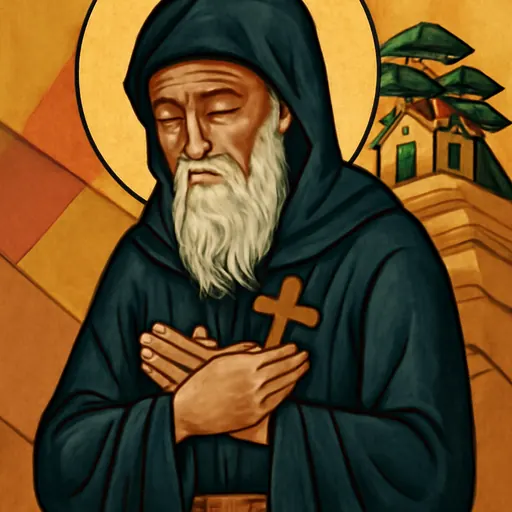
St. Charbel Makhlouf (1828–1898) was a Maronite Catholic monk and priest from Lebanon who spent his last 23 years as a hermit above the Monastery of St. Maron at Annaya. After his death, lights were reported over his grave and his body was found intact, and pilgrims of every faith have come to his tomb for healing ever since. Pope Paul VI canonized him in 1977. His feast day is July 24, and he is honored as the patron saint of Lebanon.
Who was St. Charbel?
St. Charbel Makhlouf was a monk and priest of the Lebanese Maronite Order, one of the Eastern Catholic churches in full communion with Rome. He was born Youssef Antoun Makhlouf in 1828 in Bekaa Kafra, a mountain village in northern Lebanon, and spent his whole adult life in and around one monastery, St. Maron at Annaya, in the hills above Byblos. For the last 23 years of his life he lived as a hermit in a small hermitage dedicated to Sts. Peter and Paul, on a hilltop above the monastery. He died there on Christmas Eve, 1898.
He wrote nothing and founded nothing. In his lifetime he was known only to his brother monks and the farmers nearby. His fame began after his death, with reports of light over his grave, a body that did not decay and healings at his tomb, which by the 1950s drew Christians and Muslims from across the Middle East.
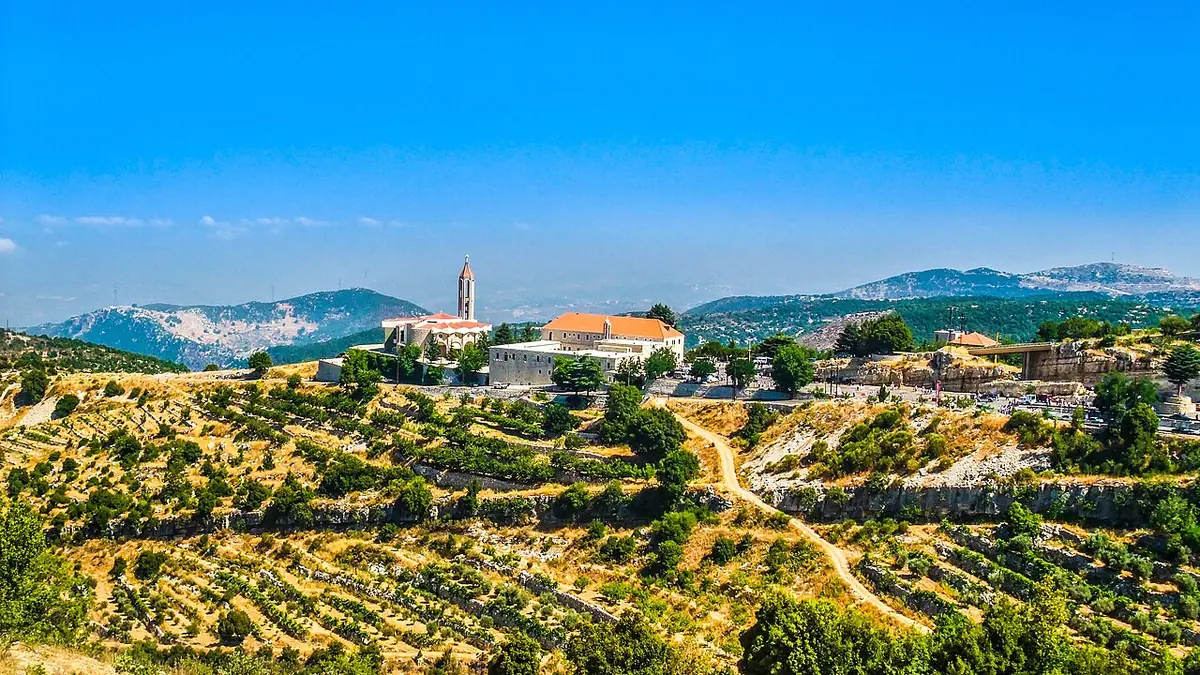

Pope Paul VI, who beatified and canonized him, called him a "fleur admirable de sainteté," an admirable flower of holiness, from Lebanon.
The life of St. Charbel
A shepherd boy in Bekaa Kafra
Youssef was the youngest of five children of a poor farming family. His father, Antoun, a mule driver, died in 1831 while returning from forced labor for the Ottoman army, when the boy was three. His mother, Brigitta, later married a devout man who became the village priest. Youssef tended the family's cows and sheep and spent hours praying at a grotto near the village where he kept an icon of the Virgin Mary. Two of his uncles were hermits, and he visited them often.
The monastery
In 1851, at 23, he left home before dawn without telling his family and went to the monastery of Our Lady of Mayfouq to begin his novitiate. He was later sent to St. Maron at Annaya and took the name Charbel, after a martyr of the early church in Antioch. He made his final vows on November 1, 1853, and studied philosophy and theology at the monastery of Sts. Cyprian and Justina at Kfifan, where one of his teachers was Nimatullah Kassab al-Hardini, another Maronite monk who is now a saint. He was ordained a priest at Bkerke, the seat of the Maronite patriarch, on July 23, 1859.
For the next sixteen years he lived as an ordinary monk at Annaya: praying the office, working in the fields and celebrating Mass. Paul VI said that in these years he gave "l'exemple d'une vie toute centrée sur la célébration de la messe," an example of a life centered entirely on the celebration of the Mass.
Twenty-three years as a hermit
In 1875 his superiors allowed him to move to the hermitage of Sts. Peter and Paul, a short climb above the monastery. Maronite hermits lived under a strict rule, in groups of no more than three, keeping long hours of prayer, fasting and silence, and working the land. Charbel stayed there until he died. Paul VI described these years in his canonization homily as "vingt-trois ans de vie complètement solitaire dans l'ermitage des Saints Pierre et Paul dépendant d'Annaya," twenty-three years of complete solitude in the hermitage of Sts. Peter and Paul belonging to Annaya.

A story the monks told about him is traditional: a servant filled his oil lamp with water by mistake, yet it burned all night.
On December 16, 1898, he suffered a stroke while celebrating Mass. He lingered for eight days and died on December 24, at about 70. Paul VI said he gave up his soul to God "la veille de Noël 1898." He was buried in the monastery cemetery on Christmas Day.
The light and the body at Annaya
What happened next made the hidden hermit famous. The accounts below are reported: they were recorded by the monks, by physicians and by pilgrims, and they are part of the history of his cause, but the Church did not canonize him for them.
- Light over the grave. In the months after his burial, monks and villagers reported a bright light around his tomb at night.
- The body found intact, 1899. The grave was opened in April 1899. According to Santi e Beati, the body was "trovato intatto e morbido," found intact and soft, and it gave off a reddish fluid, so that the monks had to change his vestments regularly. It was moved to a coffin in the monastery.
- Reburial, 1927. On July 24, 1927, the body was put into a zinc and wooden coffin and sealed in a tomb cut into the monastery wall.
- The fluid, 1950. In February 1950 a liquid was seen seeping through the wall of the tomb. It was opened on February 25 before the community. The body was again reported intact and supple, and Vatican News says that when the superior wiped the face, "son visage reste imprimé sur un tissu," his face remained printed on the cloth. In April 1950 a commission of three physicians found the fluid was the same as the samples examined in 1899 and 1927.
- The skeleton, 1976. Fr. Joseph Mahfouz, the postulator of the cause, reported that the body was still intact in 1965 but that by 1976 only the skeleton remained.


The opening of 1950 drew huge crowds. Santi e Beati says that sick people of every faith came and prayed outside the monastery, and that many said they were healed, "quasi come se le porte del cielo si fossero aperte," almost as if the gates of heaven had opened.
The face of St. Charbel
No photograph of Charbel is known from his lifetime. The face on millions of holy cards, a bearded monk with downcast eyes and his hood drawn up, comes from 1950. Devotional accounts say it came from a photograph taken at the hermitage that year by a group of visiting monks, on which the figure of a monk appeared that none of them had seen; others connect it with the face left on the cloth when his tomb was opened. Both accounts are reported. This encyclopedia could not confirm the details of either one from a primary source.
The miracles of St. Charbel
Three healings were formally investigated and approved by the Church:
- Sister Maria Abel Kamari of the Congregation of the Sacred Hearts, from Bikfaya, who had suffered for years with a stomach ulcer, was healed after praying at his tomb on July 11, 1950. This was one of the two miracles for his beatification.
- Iskandar Obeid of Baabdat, who had lost the sight of one eye to a detached retina and faced surgery to remove it, recovered his sight after praying at the tomb in 1950. This was the second beatification miracle.
- Mariam Assaf Awad of Hammana, an older woman with a cancer doctors had declared incurable, was healed in the late 1960s after praying at the tomb. This healing was accepted for his canonization in 1977.
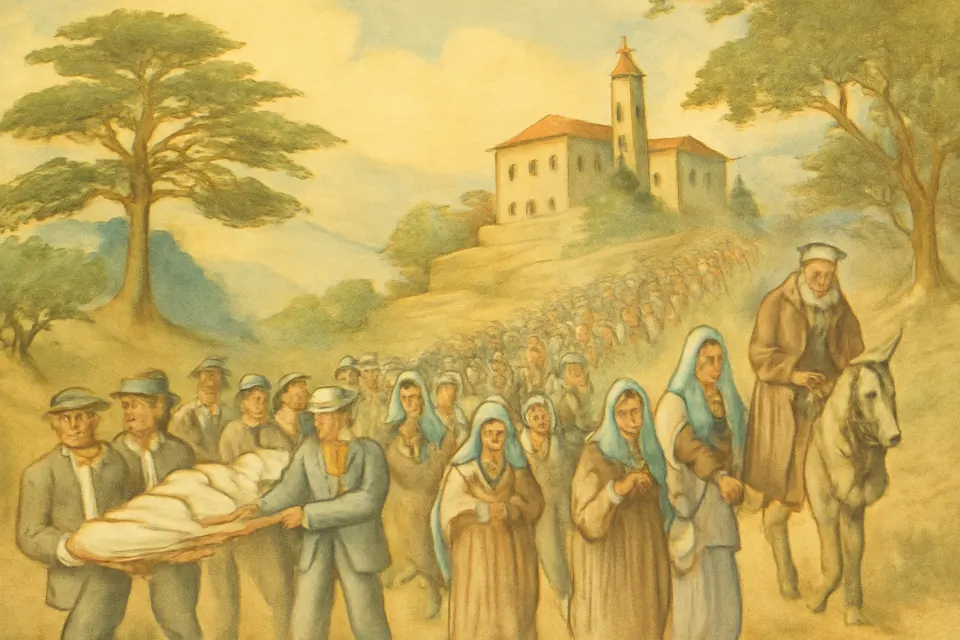
Thousands of other healings have been reported by pilgrims to Annaya. The best known is that of Nohad El Shami, a 55-year-old woman partly paralyzed after a stroke, who said she was healed after a dream of St. Charbel on the night of January 22, 1993, and that he asked her to come to his hermitage on the 22nd of every month. That healing has not been formally approved, but it began a custom: on the 22nd of each month pilgrims walk in a rosary procession from the hermitage down to the monastery.
Beatification and canonization
His cause was opened in the 1920s and gathered speed after the events of 1950. Pope Paul VI beatified him on December 5, 1965, in St. Peter's Basilica, three days before the close of the Second Vatican Council.
Paul VI canonized him on October 9, 1977, the first Maronite saint to be canonized in the modern way. The pope called him "un artisan paradoxal de la paix, puisqu'il l'a recherchée à l'écart du monde, en Dieu seul," a paradoxical peacemaker, since he sought peace apart from the world, in God alone. The canonization came two years into Lebanon's civil war, and Paul VI closed with a prayer for the country: "Qu'il intercède pour le cher pays du Liban, qu'il l'aide à surmonter les difficultés de l'heure," may he intercede for the dear land of Lebanon and help it overcome the difficulties of the hour.


Why St. Charbel is the patron saint of Lebanon
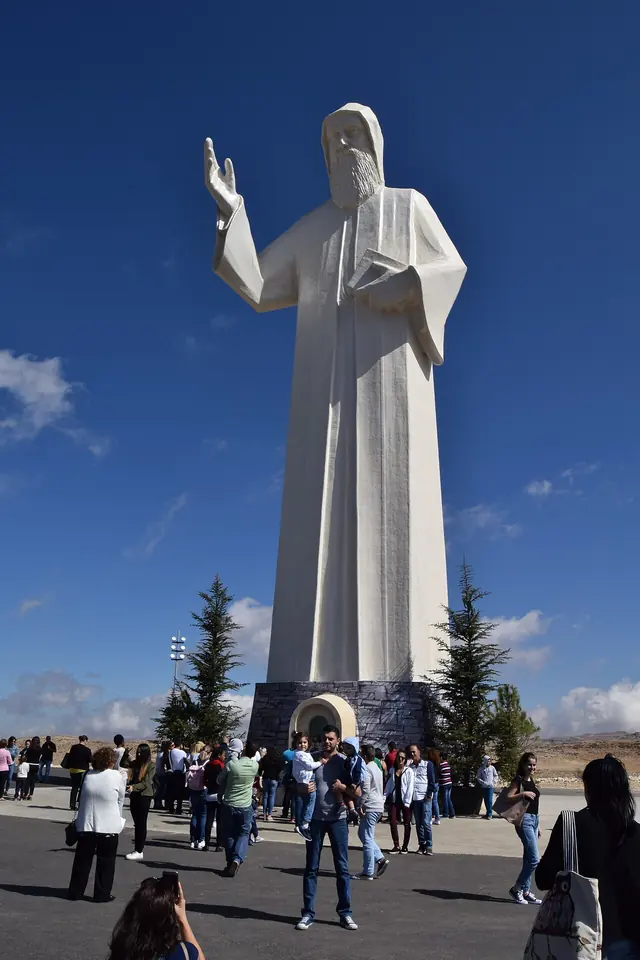
Lebanese Catholics, and many Lebanese of other faiths, honor Charbel as their country's patron saint. This encyclopedia found no formal decree giving him that title. It rests on devotion and on Paul VI's own prayer that he intercede for Lebanon. His statue stands in Sassine Square in Beirut, and a giant white statue of him rises over the mountain town of Faraya. See our list of patron saints for other national patrons.

Symbols of St. Charbel in art
Charbel is one of the easiest saints to recognize, because almost every picture follows the 1950 image:
- A black hooded habit: the habit of the Lebanese Maronite Order, with the hood drawn over his head.
- A long white beard and downcast eyes: the face of an old hermit lost in prayer, never looking out at the viewer.
- A cross or crossed hands: often a small wooden cross held to his chest.
- A hilltop hermitage: sometimes painted behind him, with cedars, the tree of Lebanon.
Statues in Lebanon and Latin America usually show him standing in his black habit, one hand raised in blessing. Some modern Maronite icons show him on a gold ground in the same habit, beside his teacher Nimatullah al-Hardini and St. Rafqa, the other Maronite saints of his century.
Where St. Charbel is honored
His tomb is in the Monastery of St. Maron at Annaya, and his hermitage on the hill above is open to pilgrims. The Maronite Church celebrates his feast on the third Sunday of July, and the Roman calendar keeps it as an optional memorial on July 24. You can find other saints of the season on our feast days page.
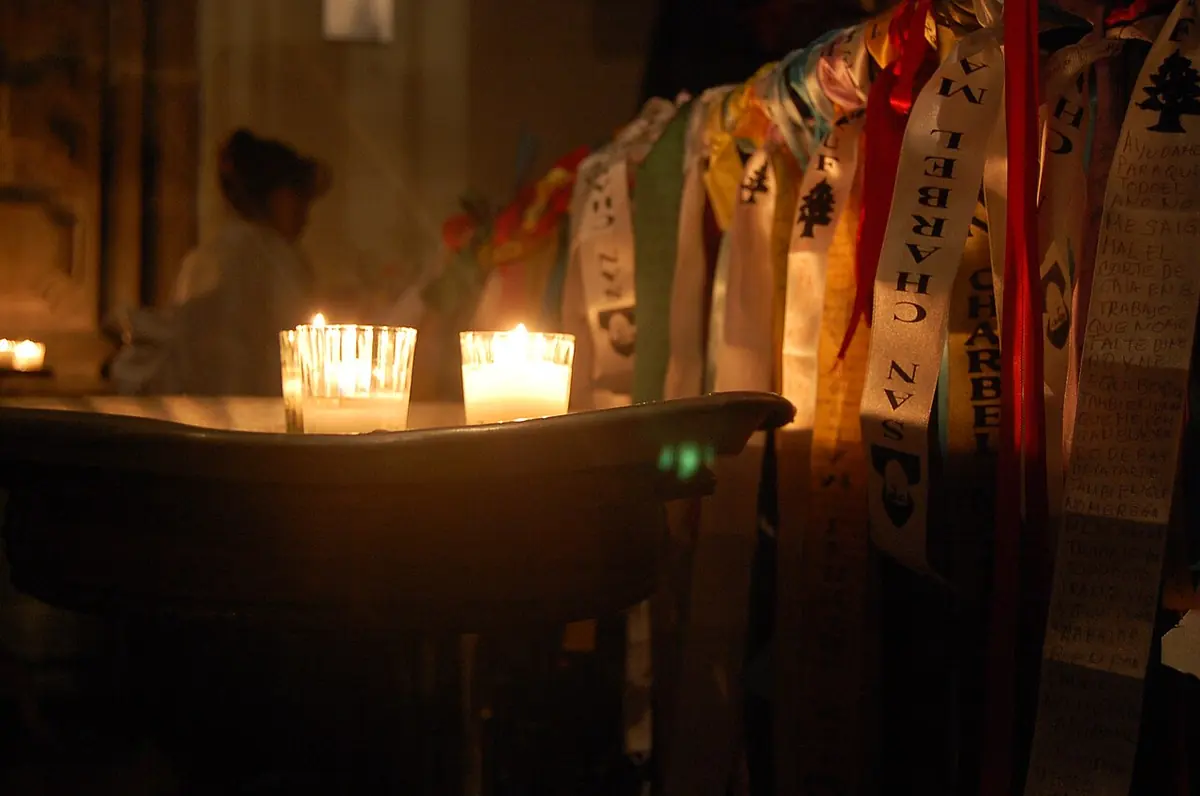
Lebanese emigrants carried his cult around the world, and it is especially strong in Mexico and the rest of the Americas. In Mexico he is San Chárbel. At his shrine in the Metropolitan Cathedral of Mexico City, devotees write their petitions on colored ribbons and leave them beside his statue.

Relics of the saint have been sent to Maronite parishes and cathedrals across the world, among them St. Raymond Maronite Cathedral in St. Louis, Missouri.


Prayer to St. Charbel
The Roman Missal gives a proper prayer, the collect, for his optional memorial on July 24. In the current English translation it reads:
O God, who called the Priest Saint Sharbel Makhlūf to the solitary combat of the desert and imbued him with all manner of devotion, grant us, we pray, that, being made imitators of the Lord's Passion, we may merit to be co-heirs of his Kingdom.
It ends with the usual conclusion of the collect. Outside the Mass, Catholics ask St. Charbel to pray for them for healing of body and soul, often with a novena, and many keep his picture at home. Pilgrims to the monastery pray at his tomb and climb to the hermitage, especially on the 22nd of the month.
Frequently asked questions
What is St. Charbel the patron saint of?
He is honored as the patron saint of Lebanon, though no formal decree naming him so has been found. People of many faiths ask his prayers for healing, especially for illnesses doctors have given up on, and in Mexico and Latin America he is a favorite saint of people in difficult situations.
When is St. Charbel's feast day?
July 24 in the General Roman Calendar, where it is an optional memorial. The Maronite Church celebrates him on the third Sunday of July, and December 24, the day he died, is also remembered. Pilgrims gather at Annaya on the 22nd of every month.
What miracles were approved for St. Charbel?
Three healings were approved by the Church. For his beatification in 1965, the healings of Sister Maria Abel Kamari and of Iskandar Obeid, both in 1950. For his canonization in 1977, the healing of Mariam Assaf Awad of Hammana from a cancer doctors judged incurable.
Is St. Charbel's body incorrupt?
For decades it was reported to be. The body was found intact when his grave was opened in 1899 and again in 1927, 1950 and later years, and it gave off a reddish fluid. The postulator of his cause reported that by 1976 only the skeleton remained.
Why do people go to Annaya on the 22nd of the month?
Nohad El Shami, a Lebanese woman partly paralyzed after a stroke, said she was healed on the night of January 22, 1993, after a dream of St. Charbel, and that he asked her to come to the hermitage on the 22nd of each month. Her healing is a reported miracle, not a formally approved one, but the monthly pilgrimage continues.
Sources
- Paul VI, Homily for the canonization of Charbel Makhlouf, October 9, 1977 (French)
- Paul VI, Address at the beatification of Charbel Makhlouf, December 5, 1965 (French)
- Vatican News: Saint Charbel Makhlouf, prêtre (saint of the day, July 24)
- Santi e Beati: San Charbel (Giuseppe) Makhluf, Sacerdote
- Catholic Culture: Optional Memorial of St. Sharbel Makhlūf, Priest (collect from the Roman Missal)
- Catholic News Herald: St. Charbel Makhluf, the wonderworker
- Catholic Readings: St Sharbel (Charbel) Makhluf
- Nominis: Saint Charbel Makhlouf
- Hozana: Saint Charbel
- Catherine Mayeur-Jaouen, Saint Charbel Makhlouf ou la consécration de l'identité maronite, in Saints et héros du Moyen-Orient contemporain (Paris, 2003)