St. Crispin and St. Crispinian
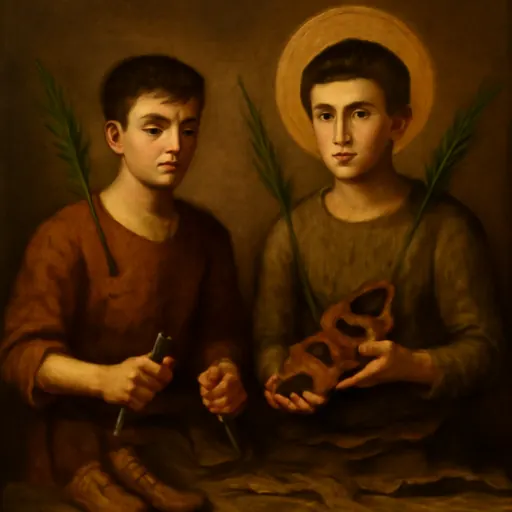
St. Crispin and his brother St. Crispinian were Christian martyrs of Soissons, in Roman Gaul, beheaded around 285 or 286 under the emperor Maximian. Their legend says they preached by day and made shoes by night, giving to the poor, so they are the patron saints of shoemakers, cobblers and leatherworkers. Their feast day is October 25, the "St. Crispin's Day" of Shakespeare's Henry V and the date of the Battle of Agincourt in 1415.
Who was St. Crispin?
St. Crispin is almost never alone. He and St. Crispinian were Christian martyrs of Soissons, a city in northern Gaul about sixty miles northeast of Paris, and the Church has always honored them together on October 25. Tradition calls them brothers, sometimes twins. The Catholic Encyclopedia (1908) notes that this "has not been positively proved."
What is certain is that Christians venerated them at Soissons very early. By the 6th century a large basilica stood over their graves there, and the goldsmith-bishop St. Eligius later made a costly shrine for St. Crispinian's head. Everything else comes from their Passio, the story of their martyrdom, written long after the events.

The legend of Crispin and Crispinian
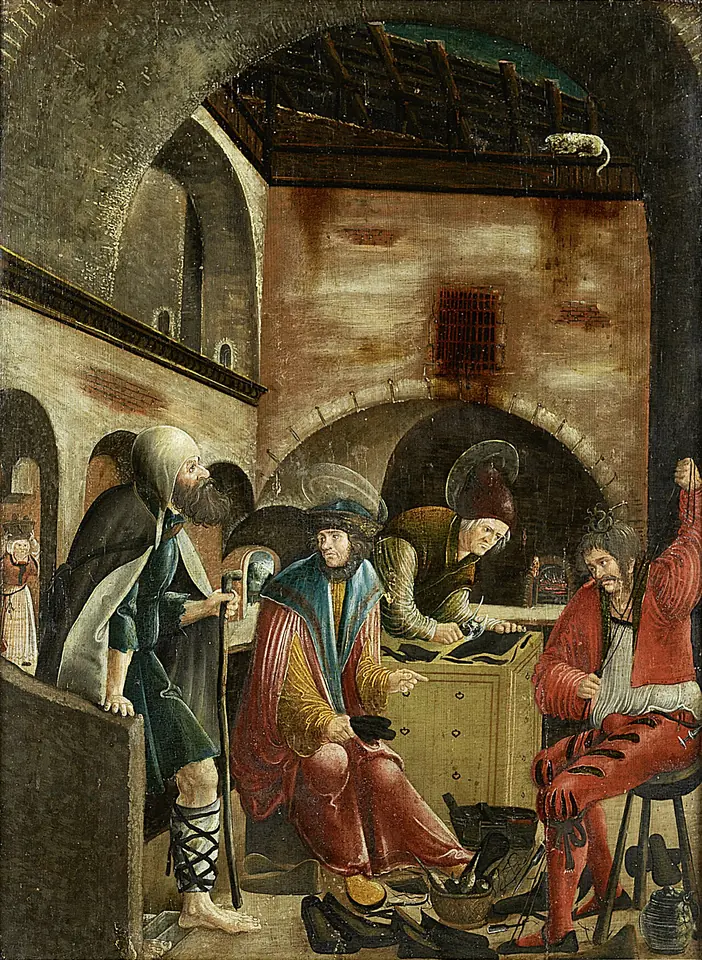
The Passio tells the story this way. Crispin and Crispinian were Romans of good family who went to Gaul as missionaries and chose Soissons as their field. Following St. Paul, who made tents so as not to burden anyone, they worked with their hands, making shoes, and earned enough to keep themselves and to help the poor. Later retellings add that they preached by day and worked at their bench by night, and that many people were won over by their kindness.

During the persecution under the emperor Diocletian, they were brought before his co-emperor Maximian, who tried promises and threats in turn. The Catholic Encyclopedia gives their answer from the legend:
Thy threats do not terrify us, for Christ is our life, and death is our gain.
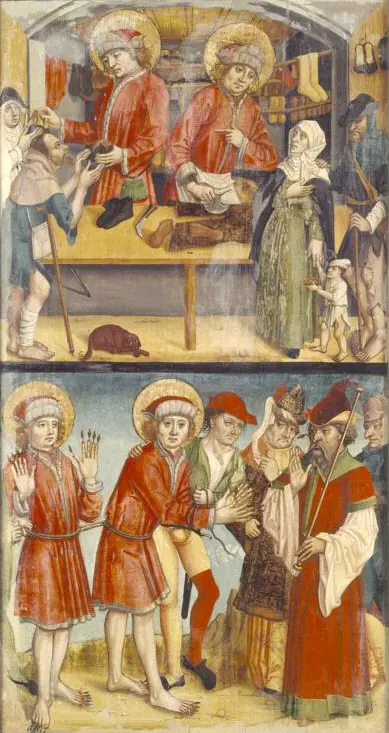
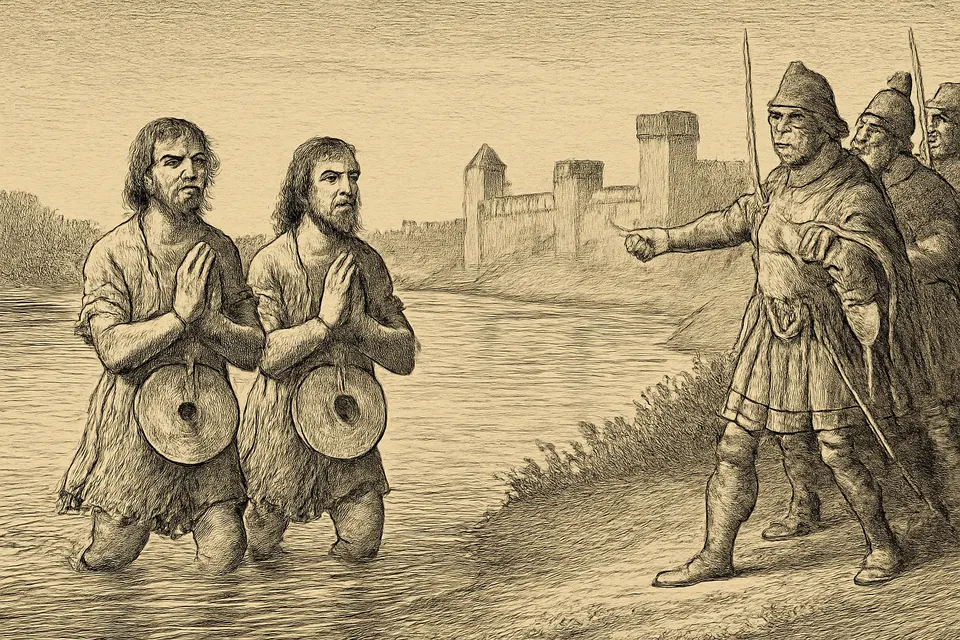
Maximian handed them to the governor Rictiovarus, whom the legend calls "a most cruel persecutor of the Christians." The Passio says the brothers were tortured, then thrown into the river Aisne with millstones tied around their necks, yet swam to the other bank. They also came through a great fire unharmed. In the end Maximian had them beheaded, on October 25 in 285 or 286.

History and legend
The Catholic Encyclopedia is frank about the Passio. Because it mentions a large church already built over the saints' graves, it can't have been written soon after their deaths. It "contains, moreover, many details that have little probability or historical worth and seems to have been compiled from various fabulous sources." The Bollandists, the Jesuit scholars who edit the lives of the saints, printed it in their great collection all the same, and it was read in many breviaries.
So the honest summary is this: two martyrs named Crispin and Crispinian were venerated at Soissons from an early date, and their deaths in the Roman persecutions are likely. The shoemaking, the missionary journey from Rome and the miracles at the river belong to legend.
The miracles of St. Crispin
- Surviving the river Aisne with millstones around their necks: traditional.
- Coming through the fire unharmed: traditional.
- Favors asked at their shrine and altars: reported in the long devotion of the shoemakers' trades, but never formally investigated, since their cult began centuries before the modern process.
Why St. Crispin is the patron saint of shoemakers
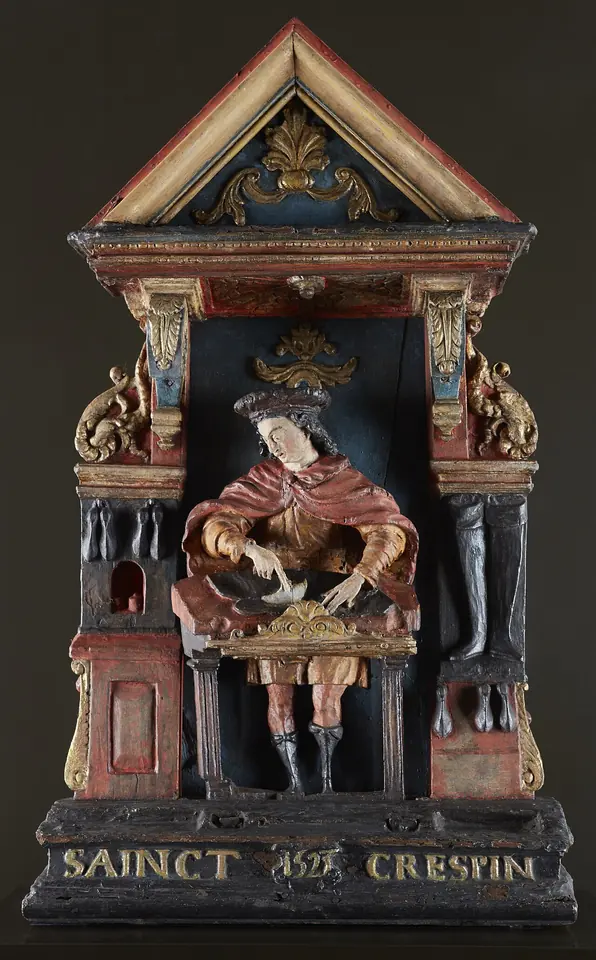
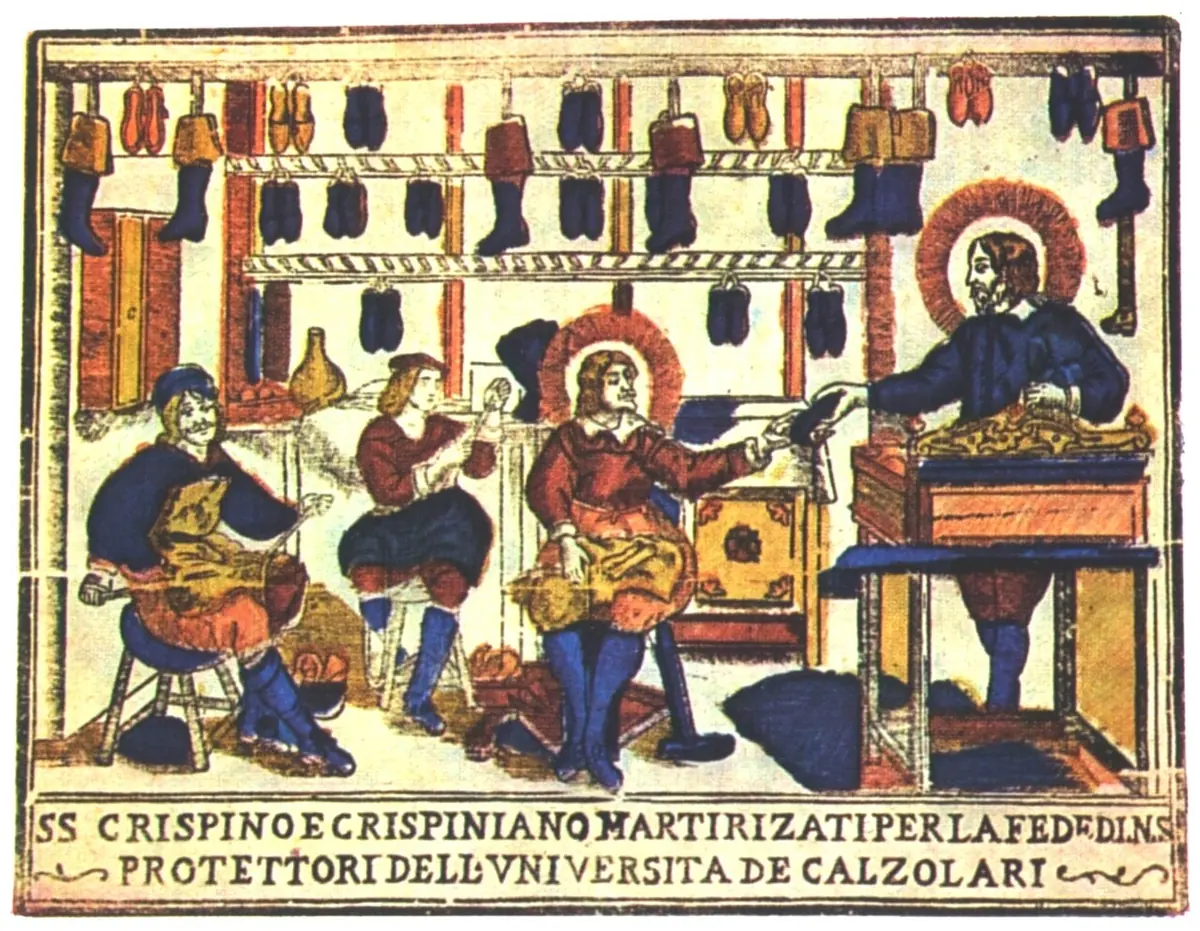
Because of their trade in the legend, Crispin and Crispinian became the patrons of shoemakers and cobblers all over Europe, and of the neighboring leather trades: the Catholic Encyclopedia names saddlers and tanners too. Shoemakers' guilds put the brothers on their banners, prints and altars; an 18th-century print from Bassano, Italy, calls them protectors of the shoemakers' guild. Even shop signs called on them, like the carved sign of a Paris bootmaker's shop made in 1593. See more patrons of trades on our patron saints page.

Symbols of St. Crispin in art
Look for two young men, often dressed alike, together:
- Shoemaker's tools: an awl, a curved leather knife, a last (the wooden foot form), or a hammer. These identify them at once.
- A shoe or boot: held up in one hand, or hanging in the workshop.
- A workshop scene: late medieval painters loved showing them at the bench, as in the paintings on this page.
- The palm of martyrdom: both often carry one.
- A millstone: less common, from the river legend.
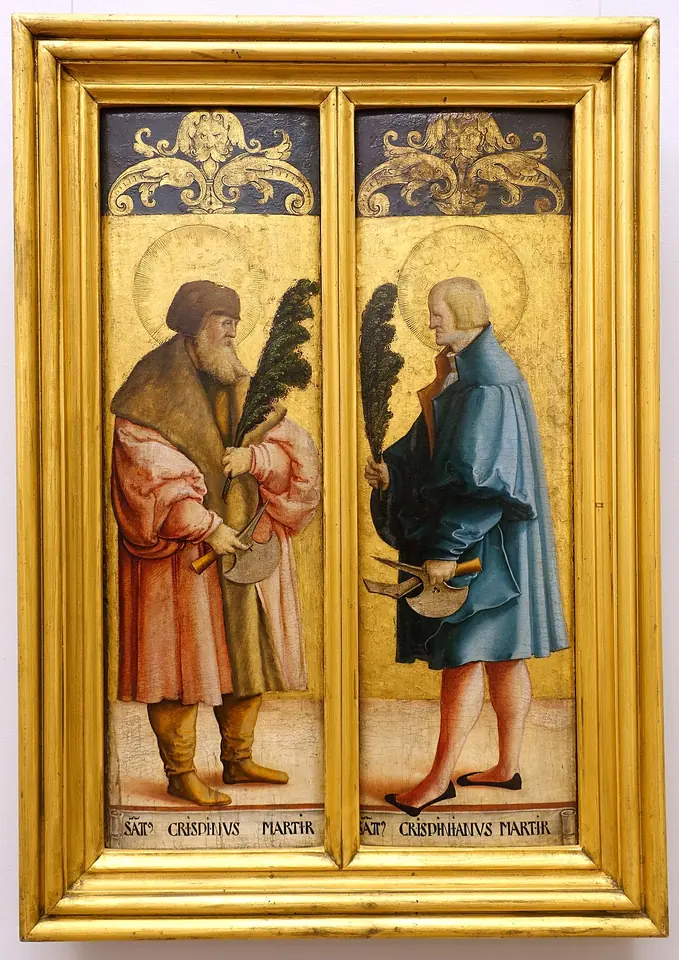
The panels from Messkirch show the usual pairing: each brother stands alone on his own gold-ground wing with a palm and a knife. Italian guild prints, like the one from the Remondini press in Bassano, show them working among ordinary cobblers. Painters also showed their martyrdom, sometimes in graphic detail.

St. Crispin's Day and Agincourt
On October 25, 1415, St. Crispin's Day, Henry V of England defeated a much larger French army at Agincourt in northern France. Shakespeare made the date immortal in Henry V (Act 4, Scene 3), where the king answers a wish for more soldiers:
This day is called the feast of Crispian:
He that outlives this day, and comes safe home,
Will stand a tip-toe when the day is named,
And rouse him at the name of Crispian.
A few lines later come the words most people know:
And Crispin Crispian shall ne'er go by,
From this day to the ending of the world,
But we in it shall be remember'd;
We few, we happy few, we band of brothers.
"Crispian" here is Crispinian, and "Crispin Crispian" is Shakespeare's way of naming both brothers at once. His audience knew the feast well: St. Crispin's Day was kept in medieval and Tudor England.

Feast day, calendar and relics
The feast of Crispin and Crispinian is October 25. The Roman calendar printed after the Council of Trent gave that day to Sts. Chrysanthus and Daria, so the two shoemakers lived on in local calendars rather than the universal one. When the General Roman Calendar was revised in 1969, they were again not included. They remain in the Roman Martyrology on October 25, and the Church of England keeps a commemoration that day. Our feast days page lists other saints of late October.
Their old basilica at Soissons is gone. According to the Catholic Encyclopedia, some of their relics were taken to Rome and placed in the church of San Lorenzo in Panisperna, and Charlemagne gave others to the cathedral he founded at Osnabrück, in Germany.
Prayer to St. Crispin
No traditional prayer to St. Crispin is known from the standard Catholic prayer books. Shoemakers, cobblers and leatherworkers ask the two brothers, in their own words, to pray for them and for their work. On October 25 the Roman Martyrology names them among the martyrs of the day, and the Church of England's calendar lists "Crispin and Crispinian, Martyrs" on the same date.
Frequently asked questions
What is St. Crispin the patron saint of?
Shoemakers and cobblers above all, and by extension leatherworkers, tanners and saddlers. The Catholic Encyclopedia lists shoemakers, saddlers and tanners. The patronage comes from the legend that he and his brother Crispinian supported themselves in Gaul by making shoes.
When is St. Crispin's Day?
October 25, the date given for the martyrdom of Crispin and Crispinian. They are commemorated that day in the Roman Martyrology, and the Church of England remembers them too, but their feast is not on the Catholic Church's General Roman Calendar.
Why is St. Crispin's Day famous?
Because the English army of Henry V defeated the French at Agincourt on October 25, 1415. In Shakespeare's Henry V, the king rallies his outnumbered men before the battle with the speech that begins "This day is called the feast of Crispian" and includes the line "We few, we happy few, we band of brothers."
Were Crispin and Crispinian real?
Their cult is old and real: a basilica stood over their graves at Soissons by the 6th century. But their Passio (the account of their martyrdom) was written long after their deaths, and the Catholic Encyclopedia judges that it has "many details that have little probability or historical worth." Even their being brothers is unproven.
Sources
- Catholic Encyclopedia (1908): Sts. Crispin and Crispinian
- Catholic Culture: Liturgical calendar, October 25 (Sts. Crispin and Crispinian, Roman Martyrology)
- William Shakespeare, Henry V, Act 4, Scene 3 (MIT Complete Works)
- Catholic Encyclopedia (1909): St. Eligius
- Church of England: The Calendar (Common Worship)
- Wikipedia: Tridentine calendar (October 25)
- The Tudor Society: 25 October, Twin saints and a local legend
- Roman Martyrology, October 25