St. Eligius (St. Eloi)
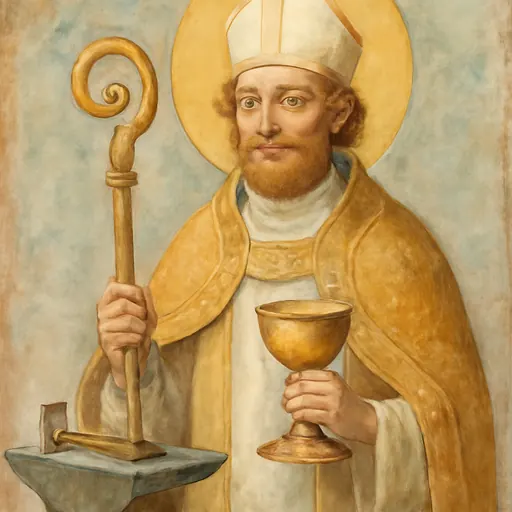
St. Eligius (c. 588–660), called St. Eloi in French, was a Frankish goldsmith who became master of the mint and chief adviser to King Dagobert I, then bishop of Noyon. He used his wealth to free captives and found monasteries. He is the patron saint of goldsmiths, metalworkers and blacksmiths, and also of farriers, horses, veterinarians and coin collectors. His feast day is December 1.
Who was St. Eligius?
St. Eligius, known in French as St. Eloi, was a goldsmith who rose to become the most trusted adviser of the Frankish king Dagobert I, and then bishop of Noyon in northern France. He was born around 588 at Chaptelat, near Limoges, and died at Noyon on December 1, 660. Few saints of his century are as well documented. His Life was written by his close friend St. Ouen, bishop of Rouen, who had lived with him at court.
The Catholic Encyclopedia (1909) calls him the patron "of goldsmiths, blacksmiths, and all workers in metal." Over the centuries farriers, veterinarians and coin collectors claimed him too.
The life of St. Eligius
The goldsmith of Limoges
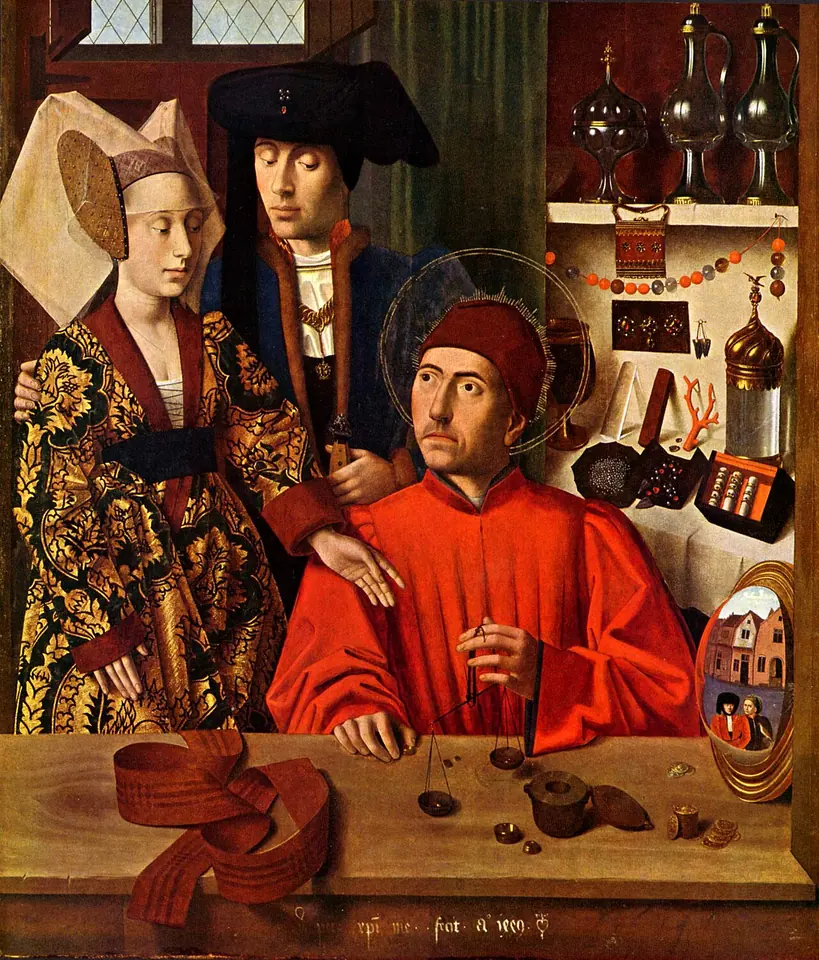
His parents, Eucherius and Terrigia, were free people "of an ancient Christian line," Ouen writes. Seeing his son's skill, Eucherius apprenticed him to Abbo, a goldsmith who ran the public mint at Limoges. As a young man Eligius moved north to the Frankish court, where the royal treasurer, Bobo, took him on.
Two thrones from the gold for one
His big chance came when King Clothar II wanted a seat made of gold and jewels and none of the palace craftsmen could make it. Bobo recommended Eligius, and the king gave him a large weight of gold. When Eligius brought the finished seat to the palace, he produced a second one, made from the same gold. He had worked "without any fraud," Ouen says, not blaming the file or the furnace for missing gold as other craftsmen did. The astonished king began to trust him above everyone.
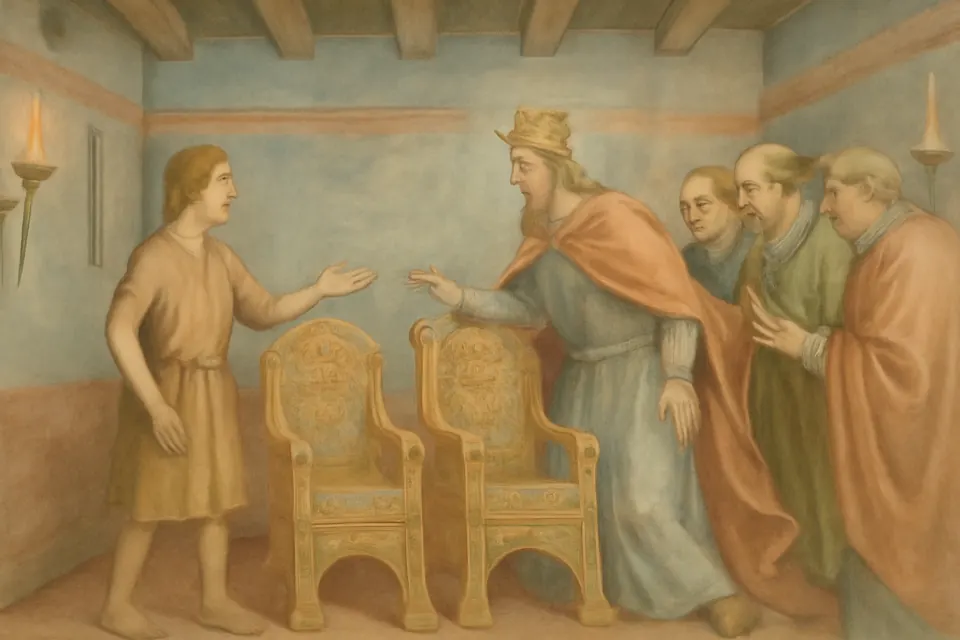
He became master of the mint at Marseilles and joined the king's household. Under Dagobert, who succeeded in 629, he was the king's chief counselor. Ambassadors, the Catholic Encyclopedia says, paid their respects to Eligius before going to the king.
Rich man, poor man
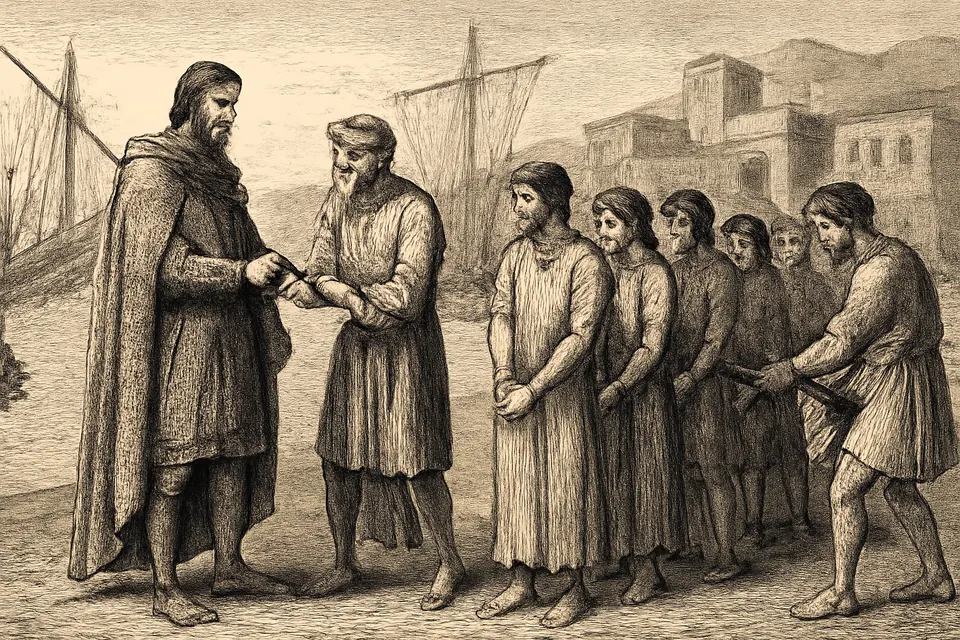
Ouen describes him as tall and rosy-faced with curly hair, and at first dressed in gold, silk and jewels. Underneath he wore a hairshirt, and in time he gave all his finery to the poor and went about "with a rope for a belt." He spent his fortune freeing captives. When he heard that slaves were to be sold, Ouen writes, he hurried to buy their freedom, twenty, thirty, fifty at a time. Romans, Gauls, Bretons, Saxons and Moors arriving at the slave market of Marseilles were among them.
He founded the abbey of Solignac near Limoges in 632 and a convent in Paris for three hundred women. With Ouen he lived by the Irish monastic rule that St. Columbanus had brought to Gaul. His workshop made shrines for the saints, among them St. Martin of Tours, St. Denis and, at Soissons, the head of St. Crispinian, the brother of St. Crispin.
Bishop of Noyon
After Dagobert died in 639, Eligius and Ouen left court for the priesthood. Around 641, in the third year of King Clovis II, the two friends were consecrated bishops together at Rouen on the same day, Ouen for Rouen and Eligius for Noyon. His huge diocese ran north into Flanders, and he spent his last two decades preaching to its largely pagan people around Ghent, Courtrai and Antwerp. Ouen preserves one of his sermons:
Before all else, I denounce and contest, that you shall observe no sacrilegious pagan customs. For no cause or infirmity should you consult magicians, diviners, sorcerers or incantators.
Past seventy, he fell ill with a fever and died on the first of December, 660.
Miracles and legends of St. Eligius
- Healings and wonders in his Life: traditional. Ouen records many, including a ball of light like a cross seen rising from his house at his death.
- His horse after death: traditional. The Life says the gentle horse Eligius used to ride sickened and turned wild when a greedy bishop seized it from the abbot of his church, and recovered as soon as it was given back.
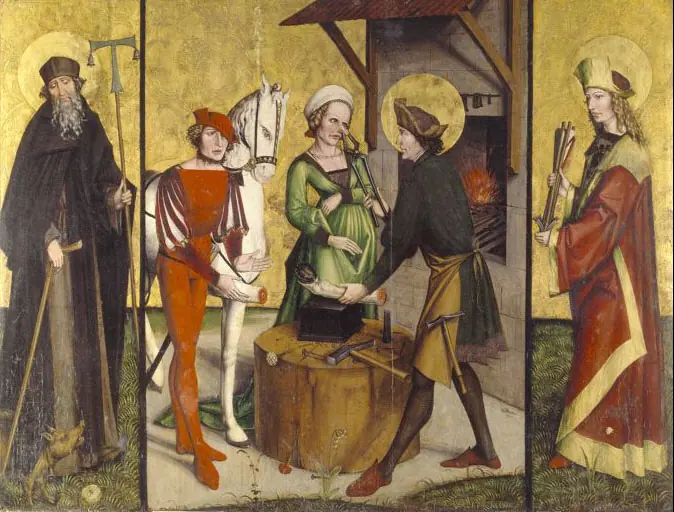
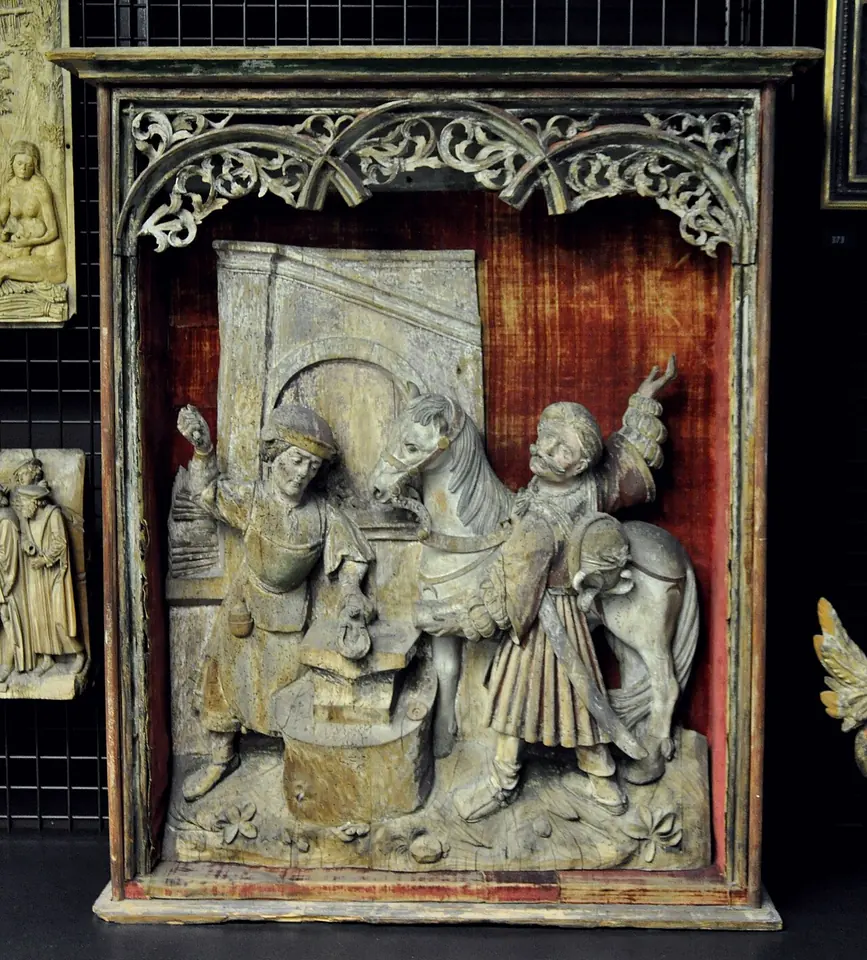
- The horse's leg: traditional and much later. In this legend he cut off the leg of a horse that would not stand to be shod, fitted the shoe at the anvil and put the leg back. Richard Stracke of Christian Iconography found it in no medieval text, neither Ouen's Life nor the Golden Legend nor the breviary. Artists loved it anyway.
Why St. Eligius is the patron of metalworkers, horses and coin collectors
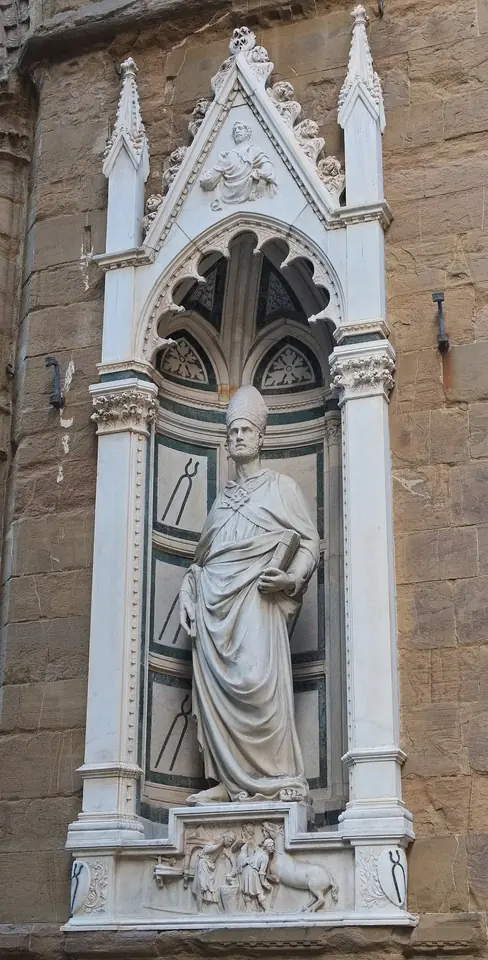
Goldsmiths and blacksmiths claimed him first, as one of their own. Old custom counted goldsmiths, blacksmiths and the moneyers who struck coins as one profession, so his patronage spread across every metal trade. The farriers' guild of Florence set his statue on Orsanmichele. The horse legend, and his own horse in the Life, made him the saint of horses, farriers and veterinarians. Numismatists honor him as a master of the mint, and coin clubs still mark his feast on December 1. See more on our patron saints page.
Symbols of St. Eligius in art
He usually appears in one of two ways. As a bishop, he wears miter and cope and holds a crozier, often with a golden chalice or a small model of a church on his hand, the attribute the Catholic Encyclopedia mentions. As a craftsman, he works at an anvil with a hammer and pincers, forging a chalice or shoeing a horse. A detached horse's leg or a horseshoe points straight to the farrier legend. Some late medieval images show him pinching the devil's nose with his pincers.
Feast day and devotion
His feast is December 1. He was popular all over medieval Europe: Chaucer's Prioress in the Canterbury Tales swears "by Seinte Loy." The Catholic Encyclopedia notes special devotion in Flanders, in the province of Antwerp, and at Tournai, Courtrai, Ghent, Bruges and Douai. His relics were moved at least five times, in 881, 1066, 1137, 1255 and 1306. Find other early-December saints on our feast days page.
Prayer to St. Eligius
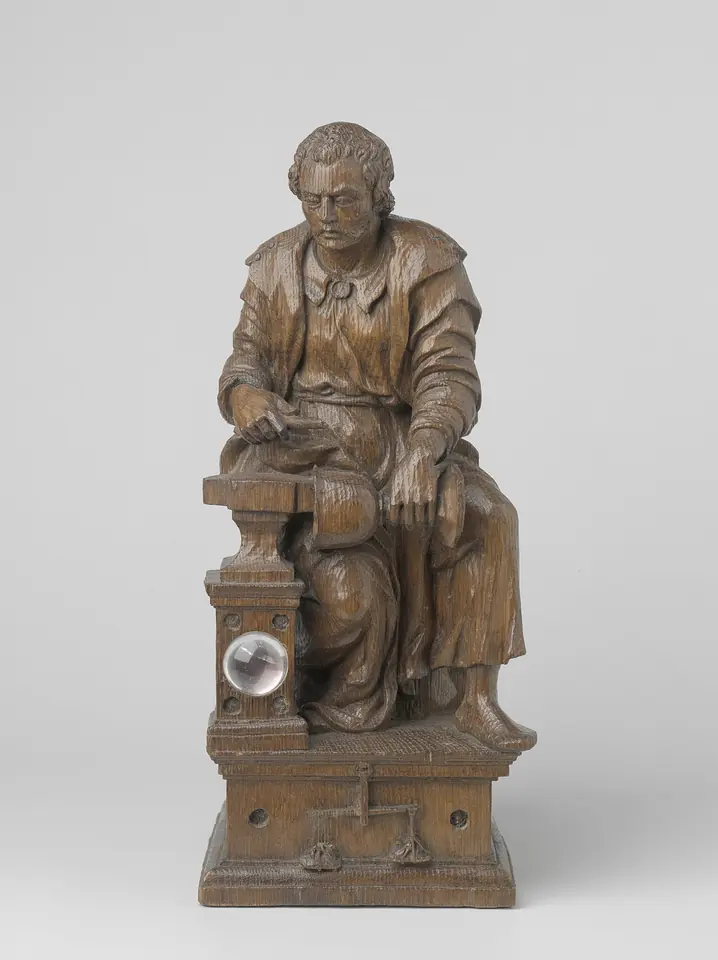
No traditional prayer to St. Eligius has come down in the standard Catholic prayer books. Metalworkers, farriers, veterinarians and horse owners ask for his intercession in their own words, often on his feast.
Frequently asked questions
What is St. Eligius the patron saint of?
Goldsmiths, blacksmiths and all metalworkers, according to the Catholic Encyclopedia, which adds cab drivers. He is also claimed by farriers, horses and veterinarians, because of a legend that he shod a horse, and by coin collectors, because he was a moneyer and master of the mint.
When is St. Eligius's feast day?
December 1, the day he died at Noyon in 660. It is kept in the Roman Martyrology and in many local calendars, especially in France, Belgium and the Netherlands.
What is the story of St. Eligius and the horse's leg?
A legend says a horse would not stand still to be shod, so Eligius cut off its leg, fitted the shoe at his anvil and put the leg back, and the horse was unharmed. The story is traditional and late. It is not in his seventh-century Life, the Golden Legend or the breviary.
Who wrote the Life of St. Eligius?
His close friend St. Ouen (also called Dado or Audoin), bishop of Rouen, who knew him at the Frankish court. Ouen writes as an eyewitness of some events, which makes the Life an unusually close source for a saint of the 600s.
Sources
- Catholic Encyclopedia (1909): St. Eligius
- Internet Medieval Sourcebook (Fordham): The Life of St. Eligius, 588-660, trans. Jo Ann McNamara
- Christian Iconography: St. Eligius, Art, Iconography, Legend
- Numismatic News: Patron Saint of hobby recalled
- Catholic Encyclopedia (1908): Sts. Crispin and Crispinian
- Roman Martyrology, December 1