St. Peter Chanel
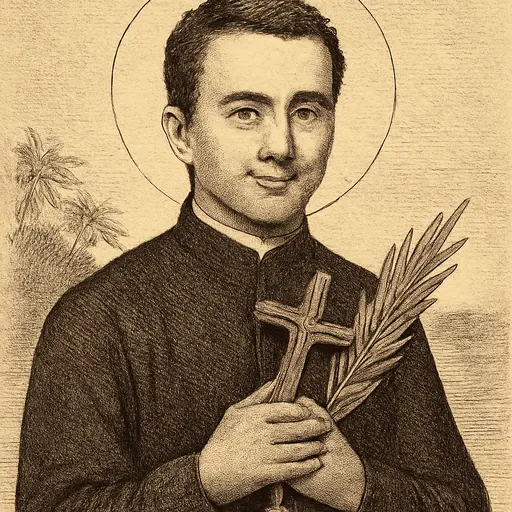
St. Peter Chanel (1803–1841) was a French Marist priest who brought the Gospel to the Pacific island of Futuna and was killed there on April 28, 1841, the first martyr of Oceania. Within a few years of his death the whole island had become Catholic. His feast day is April 28, and the Church honors him as the patron of Oceania.
Who was St. Peter Chanel?
St. Peter Chanel was a French missionary priest of the Society of Mary, the Marists, and the first martyr of Oceania. He landed on the small Pacific island of Futuna in November 1837, lived among its people for three and a half years, and was killed there on April 28, 1841, at the age of 37. He had baptized very few adults. Within a few years of his death, the whole island was Catholic.
He is not to be confused with the apostle St. Peter or with any of the places named St. Peter. In the Pacific he is often called by his Futunan name, Petelo Sanele, and in France by his own, Pierre Chanel.
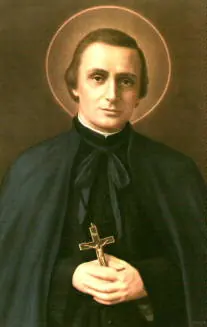
The Church remembers him less for great deeds than for his gentleness. The people of Futuna gave him a name that the old Catholic Encyclopedia translates "the man with the kind heart." When Pope Pius XII canonized him in 1954, he described a life spent "in humility, gentleness, patience and charity," drawn from a burning love for the Virgin Mary. We keep his feast on April 28.
The life of St. Peter Chanel
A shepherd boy in the Bresse
Peter Chanel was born on July 12, 1803, in the hamlet of La Potière, in the parish of Cuet, near Bourg-en-Bresse in eastern France. His parents, Claude and Marie-Anne, farmed a small holding with sheep, a few cows and some crops. The Marist Fathers record that his mother, who had lost a child, dedicated this one to the Virgin Mary before he was born. Later, when he learned of it, Peter added "Mary" to his name, and at confirmation he took the name of the young Jesuit St. Aloysius Gonzaga. That is how he became Peter Louis Mary Chanel.
The France of his childhood was still recovering from the Revolution, and his schooling came in pieces between farm work. In 1812 the Abbé Trompier, parish priest of the neighboring village of Cras, met the nine-year-old shepherd and saw a vocation in him. Peter went to live at Cras under the priest's care, studied at the presbytery, and went on to the minor and major seminaries of the Diocese of Belley.
Parish priest in the mountains
Bishop Alexander Devie ordained him a priest on July 15, 1827, in the church of Brou at Bourg-en-Bresse. He celebrated his first Mass at Our Lady's altar in the church of Cras. After a year as curate at Ambérieu, the bishop gave the 25-year-old priest the run-down parish of Crozet, high in the Jura near the Swiss border, where the Church was still in disarray a generation after the Revolution. Fr. M. O'Meeghan, S.M., writes that he "transformed it" with quiet zeal and tact. The people of Crozet later set up a statue of him beside their church.
His motto from these years was Aimer Marie et la faire aimer: to love Mary and to make her loved. Pius XII quoted it in his canonization address.
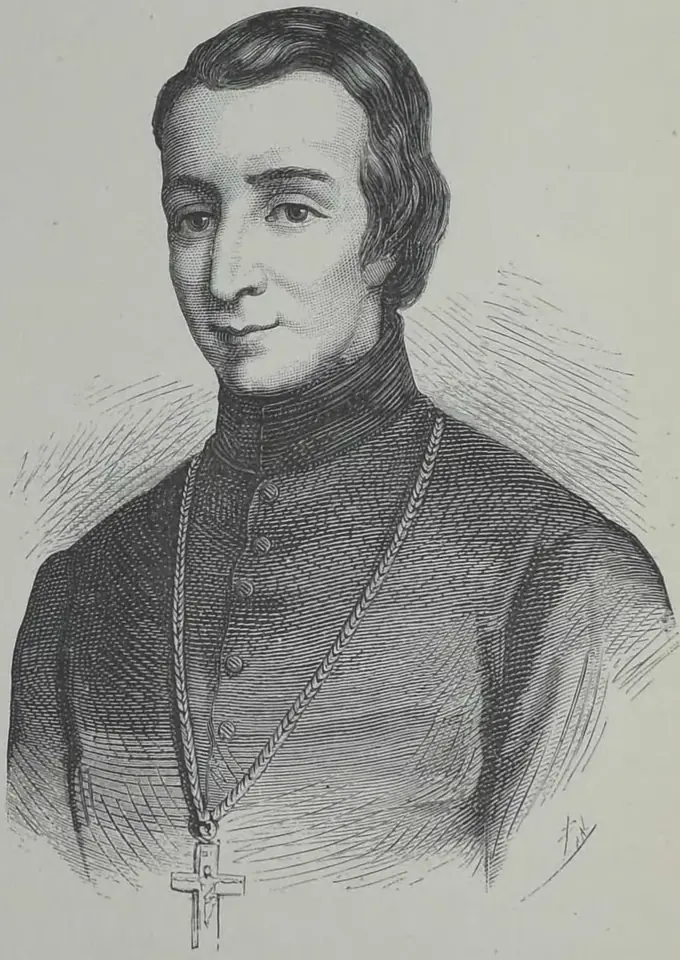
A Marist and a teacher
Letters from missionaries overseas had set his heart on the foreign missions. In 1831, with his bishop's permission, he joined a small group of diocesan priests gathered around Fr. Jean-Claude Colin, who hoped to found a Society of Mary. Colin put him to work at the college of Belley, first as spiritual director and then as superior, and the boys and staff remembered his kindness. A statue of him with a student stands on the school grounds today.
In 1833 Colin chose Chanel as a companion for his first journey to Rome to seek the pope's approval for the Marists. On the way the two men prayed together at the shrine of Our Lady of Loreto, the house that tradition holds was the home of the Holy Family at Nazareth.
To the ends of the earth
In 1836 the Holy See asked for missionaries for the vast new mission field of Western Oceania, the islands of the southwestern Pacific. The Marists accepted and asked first for their own approval, which came on April 29, 1836. Peter Chanel made his religious vows on September 24, 1836, at the chapel of La Capucinière in Belley, among the first Marists to do so.
On Christmas Eve 1836 he sailed from Le Havre with Bishop Jean-Baptiste Pompallier, three other priests and three brothers. In the first weeks at sea his friend Fr. Claude Bret fell ill. Chanel nursed him in their tiny cabin until he died. The ship rounded Cape Horn to Valparaíso, and from there the missionaries worked their way west through Tahiti and Tonga.
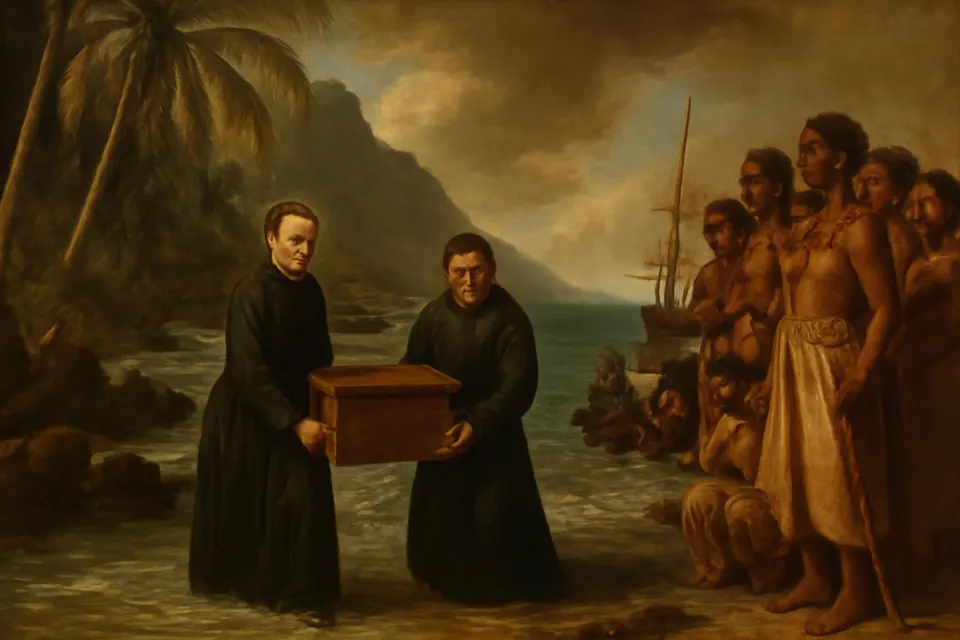
In November 1837, Bishop Pompallier left Fr. Peter Bataillon and a brother on Wallis Island and then, about 170 kilometers away, Fr. Chanel and 20-year-old Br. Marie-Nizier Delorme on Futuna. No Christian missionary had set foot there before. The island is roughly 13 kilometers long, and constant warfare between its two rival factions had reduced its people to about a thousand.
Four years on Futuna
The man with the kind heart
King Niuliki received the two missionaries kindly at first and gave them a place to live near his own house at Poi. According to the Dicastery for the Causes of Saints, Chanel celebrated his first Mass on the island quietly on December 8, 1837, in the hut the king had built for them, and at Christmas he invited the king and his family to the midnight Mass as a great feast.
Then came the hard, slow work. Chanel and Marie-Nizier had to learn a language no outsider had studied, grow their own food and win the trust of a people who feared their gods. After six months, the Marist Fathers record, he had baptized one Futunan, a dying child. He visited the villages, cared for the sick and the old, and baptized the dying when he could. The Catholic Encyclopedia says he won "from all the name of 'the man with the kind heart.'"

His letters home were full of affection. He wrote to his family, his fellow Marists and his old students at Belley, calling each one by name and asking about their concerns.
The king turns against him
As people began to ask for instruction, the king grew afraid for his own authority, which rested on the worship of the island's gods. The Dicastery says Niuliki had the missionaries insulted, robbed and harassed, and forbade anyone to give them food. Raids stripped their garden. At one point, the Marists record, the two men were reduced to eating their dog. Chanel stayed patient and kept going.
The breaking point was the king's own son. Meitala, Niuliki's eldest, asked to be baptized. The king, enraged, took counsel with his family, and Musumusu, a chief he loved like a son, took it upon himself to stop the new religion.
The martyrdom of St. Peter Chanel
At daybreak on April 28, 1841, a band of the king's men surprised and wounded a number of new Christians as they slept and then went to Chanel's hut at Poi. Br. Marie-Nizier was away on the other side of the island. The Catholic Encyclopedia gives the account that went to Rome for his cause: one man shattered his arm and wounded his temple with a war club; another struck him down with a bayonet; a third beat him with a club. Through it all he said only words of gentle resignation: "Malie fuai," "it is well for me." Then Musumusu, "enraged at the tardiness of death," split his skull with an adze.
The oral tradition of Futuna tells the same morning a little differently. In the version the Futunan Br. Petelo Sekeme learned at his mother's knee, Musumusu had fought with Meitala and been hurt. He came to the priest, who was home alone with an injured foot, and asked him to dress the wound on his forehead. While Chanel went inside, Musumusu's companions burst in and began to loot the house. One speared the priest, who staggered outside and sat against the wall. When a garden hoe fell out of a trunk, Musumusu took it and struck the final blow. Two of the king's daughters tended the dying man.
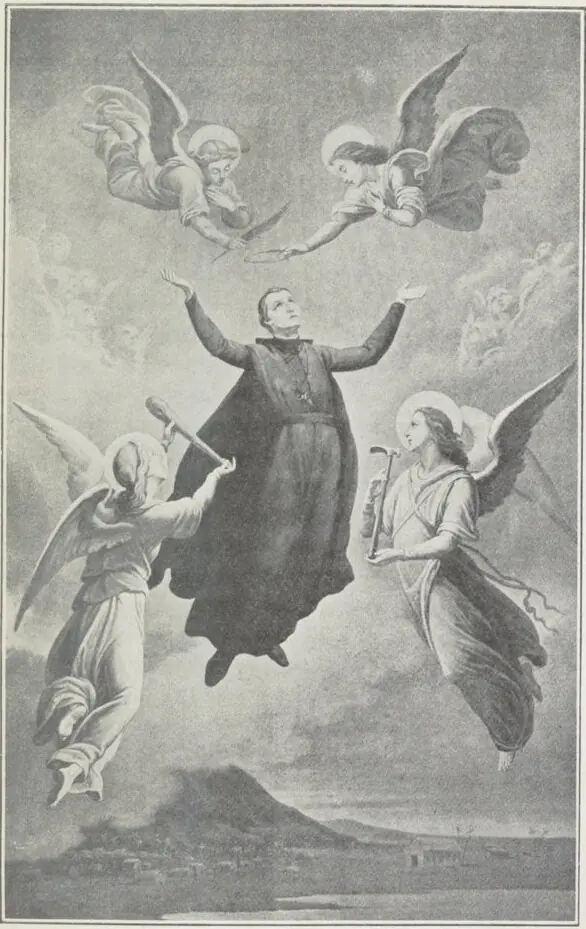
Sympathetic women wrapped his body in mats of tapa cloth and buried it in the Futunan way. Br. Marie-Nizier escaped to Wallis two weeks later on a passing American trading ship.
The harvest
The king believed he had ended Christianity on Futuna. In January 1842, Fr. Philippe Viard came back on a French warship to recover Chanel's body, refused the captain's offer to fire the ship's guns, and went ashore unarmed. Missionaries returned for good later that year. The Dicastery records that by 1844 all the people of the island were Christian. Meitala became a Catholic, and so, in time, did Musumusu. The oral tradition says that as he was dying, he asked to be buried where visitors coming to honor Peter Chanel would walk over his grave. His grave lies on the lawn in front of the basilica at Poi.

Pius XII put it simply in 1954: no sooner had the martyr given his life on that island, "until then indocile to grace," than a harvest rose up "rich beyond every expectation."
The miracles of St. Peter Chanel
No dramatic wonders are told of Peter Chanel's life. His story is one of patience. The graces linked to him fall into these groups:
- Reported: the conversion of Futuna itself. An island where he baptized almost no adults in four years became entirely Catholic within three years of his death, including the king's son and the man who killed him. The faithful have always seen this as the fruit of his blood; it is a grace of history, not a miracle the Church formally examined.
- Reported: cures and favors attributed to his intercession after his beatification. A booklet of them, Quelques guérisons et grâces signalées obtenues par l'intercession du Bienheureux P. M. L. Chanel, was published in Lyon in 1891, and the parish church of Cuet shows images of two miracles attributed to him.
The decisive judgment the Church made was about his death: that he was truly a martyr. His canonization in 1954 followed the procedures of the time, but the sources we consulted don't describe which cures, if any, were approved for it, so we don't name any here.
O'Meeghan notes that the cause took time for another reason. Eyewitnesses were few, and Rome had to be sure that Chanel died out of hatred for the faith, not over his few possessions or his efforts to make peace between warring factions. The decree of 1889 settled it and gave him the official title "protomartyr of Oceania."
Why St. Peter Chanel is the patron saint of Oceania
When Pius XII canonized him on June 12, 1954, together with St. Dominic Savio, he proclaimed Peter Chanel protomartyr and patron of Oceania. He was the first person to die for Christ in the Pacific islands, and his mission was the start of the Catholic Church in a whole region.
His ties to New Zealand and Australia are close. Futuna belonged to Bishop Pompallier's mission, based at Kororareka (now Russell) in the Bay of Islands, and Chanel's bones stayed there for seven years. Sydney's Marist house kept them for a time on their way to France. Parishes, schools and colleges named for him fill both countries, and New Zealand keeps his day as a feast. In the island nations of the Pacific, from Tonga to Wallis, he is honored as one of their own.
He stands with other great missionaries of distant peoples: St. Francis Xavier in Asia, St. Isaac Jogues in North America, and later St. Damien of Molokai and St. Peter To Rot in the Pacific. See all the patron saints.

Symbols of St. Peter Chanel in art
St. Peter Chanel lived in the age of lithographs and holy cards, so his face in art is fairly consistent: a young, clean-shaven priest with dark hair and a gentle expression. These are the signs to look for.
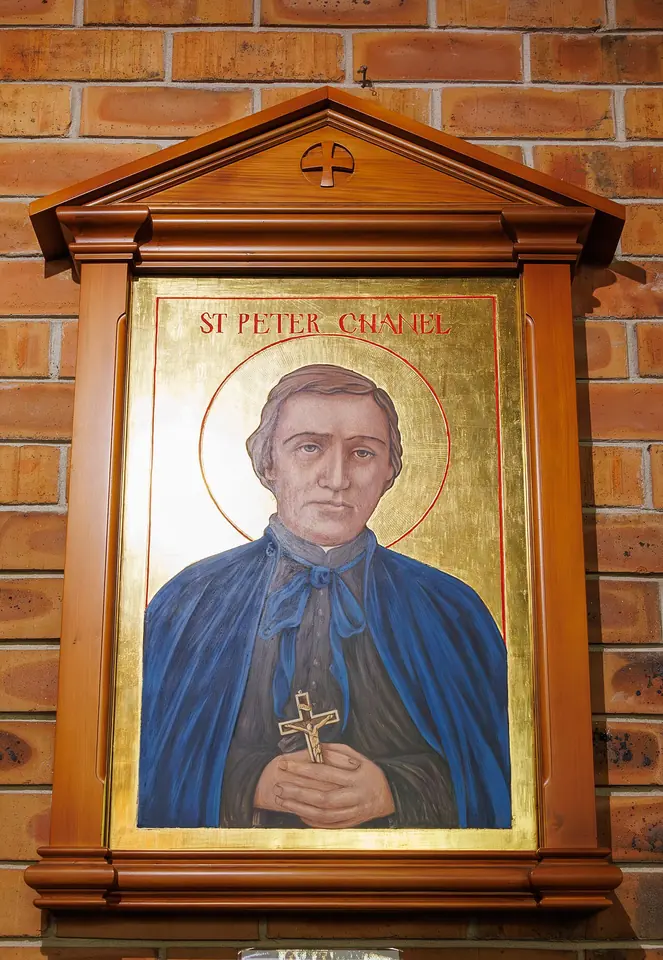
- The black cassock: he is almost always shown in the plain dress of a 19th-century French priest, sometimes with a short cape. Some modern images add a blue cloak, Mary's color, for the Marist who loved her.
- A crucifix held to the chest: the missionary's cross, which he carried to Futuna and preached there.
- The palm: the ancient sign of a martyr's victory, as in the Wellington window and the Boston statue on this page.
- The war club and the adze (or axe): the weapons that killed him. Older prints and windows put them at his feet or in the hands of angels. Some images show an axe or a hoe, following the different accounts of his death.
- Pacific setting: palm trees, the sea and island huts, and sometimes Futunan figures, place him unmistakably in Oceania.

How do you tell him from other priest-martyrs? A young French priest in a cassock with a palm and a club, or with Pacific scenery, is almost always Peter Chanel. Without those clues he can look like St. John Vianney, his near-contemporary from the same region of France, who is usually shown older, thin and white-haired, in a surplice.

Modern icons, written for the Marist communities of the Pacific, follow the old holy cards. The icon in St. Mary's Church in Northcote, Auckland, shows him half-length on gold in a blue cloak, holding a small crucifix with folded hands.
Feast day and where St. Peter Chanel is honored
The Church celebrates St. Peter Chanel on April 28, the day of his death. It falls in the Easter season, and the collect of the Mass speaks of "these days of paschal joy." It is an optional memorial in the General Roman Calendar, shared with St. Louis de Montfort, and a feast in New Zealand. See the feast day calendar.
Poi, Futuna
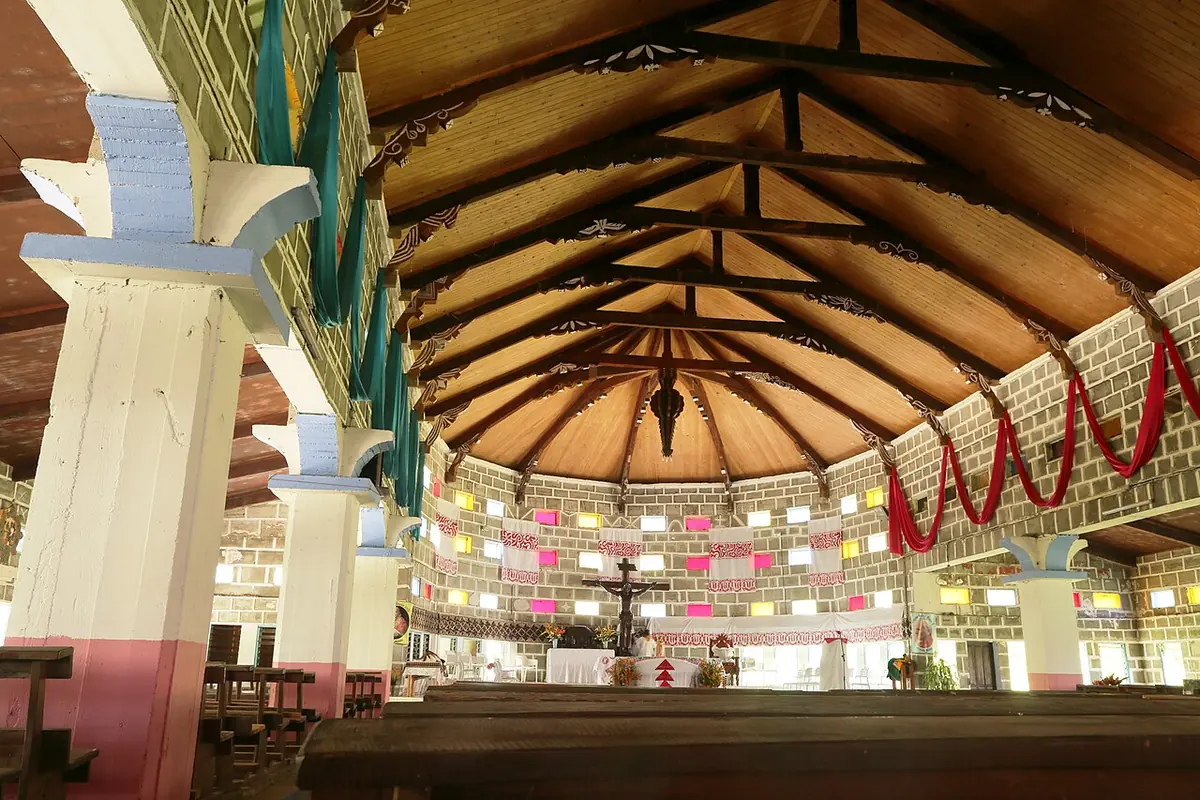
The basilica of St. Peter Chanel stands at Poi, on the north coast of Futuna, on the place where he died. Pilgrims come from across the Pacific, especially for April 28. His remains came home there on April 28, 1977, and his skull followed on November 7, 1985.

The long journey of his relics
The story of his bones is a pilgrimage in itself. Fr. Brian Quin, S.M., traced it from the Marist archives. In January 1842 a chief named Maligi, who had not agreed to the killing, dug up the body and brought it to the French ship. The ship's doctor, M. Rault, confirmed the identity from the wounds Br. Marie-Nizier had described, embalmed the remains and sealed them in a cask. They were taken to Kororareka in New Zealand, placed in a linen-lined tin chest and kept there until 1849. Then they went to Sydney, then by sea to London, and arrived at the Marist motherhouse in Lyon on June 1, 1850, "to the great joy," Quin writes, of Fr. Colin. Bishop Pompallier sent the axe that had shattered the saint's skull to the Society for the Propagation of the Faith in Lyon.
Small relics were shared out after the beatification of 1889; a rib is at the Marist seminary in Auckland. The skull went to the Marist General House in Rome in 1954. In 1977, at the request of the bishop of Wallis and Futuna, the main reliquary was flown back across the Pacific, stopping at the shrine at Russell in the Bay of Islands on March 30 and then in Fiji, Vanuatu, New Caledonia and Wallis. The Marists' General Chapter of 1985 sent the skull after it. As someone remarked at the time, "what God has joined together."
France
His home parish of Cuet keeps a reliquary with some of his remains, and two stained-glass windows there show his arrival on Futuna and his martyrdom. The baptismal font at Montrevel, the church at Cras where he said his first Mass, the parish church at Crozet and the chapel of La Capucinière at Belley, where he made his vows, are stops for Marist pilgrims.
Prayers to St. Peter Chanel
We ask St. Peter Chanel to pray for missionaries, for the Church in Oceania, for vocations, and for anyone whose patient work seems to bear no fruit. These prayers come from published sources.
The collect of his feast
This is the opening prayer of the Mass on April 28, from the Roman Missal in its current English translation:
O God, who for the spreading of your Church crowned Saint Peter Chanel with martyrdom, grant that, in these days of paschal joy, we may so celebrate the mysteries of Christ's Death and Resurrection as to bear worthy witness to newness of life. Through our Lord Jesus Christ, your Son, who lives and reigns with you in the unity of the Holy Spirit, God, for ever and ever.
A Marist prayer to St. Peter Chanel
This prayer was published by the Marists of New Zealand for the bicentenary of his birth in 2003:
St Peter Chanel you left your homeland to proclaim Jesus, Saviour of the world, to the peoples of Oceania. Guided by the spirit of God, who is the strength of the gentle, you bore witness to love, even laying down your life. Grant that like you we may live our daily life in peace, joy, and in love. May your prayer and example call forth from our midst many workers for the Gospel so that God's kingdom may reach to the ends of the earth. Amen.
The Marist Fathers also publish a novena to St. Peter Chanel for vocations. A simple way to keep his feast is to pray one of these prayers each day from April 20 to April 28, with an Our Father, a Hail Mary and a Glory Be, and then to do as he did: love Mary and help others love her.
Declared Venerable by Pius IX
One more link ties St. Peter Chanel to the wider Church of his century. His cause opened in 1857, and it was Blessed Pius IX who declared him Venerable that year. Leo XIII beatified him on November 17, 1889, in St. Peter's Basilica, and Pius XII canonized him on June 12, 1954. He was the first saint of the Society of Mary. Fr. Colin, who welcomed him into the Marists and shared with him the dream of doing Mary's work "on whatever distant shore," is himself now a candidate for sainthood.
Frequently asked questions
Who was St. Peter Chanel?
A French priest of the Society of Mary (the Marists), born in 1803 near Bourg-en-Bresse. He sailed for the Pacific in 1836, spent three and a half years on the island of Futuna and was clubbed to death there in 1841. He is the first martyr of Oceania and the first Marist saint.
When is St. Peter Chanel's feast day?
April 28, the anniversary of his martyrdom. It is an optional memorial in the General Roman Calendar, which he shares with St. Louis de Montfort, and a feast in New Zealand.
What is St. Peter Chanel the patron saint of?
Oceania, the islands of the Pacific. When Pius XII canonized him in 1954 he gave him the title of protomartyr and patron of Oceania. Many parishes and schools in Australia, New Zealand and the Pacific islands carry his name.
How did St. Peter Chanel die?
At daybreak on April 28, 1841, men sent by the king's circle attacked his hut at Poi. One broke his arm with a club, another struck him with a bayonet, and Musumusu, a chief close to King Niuliki, killed him with a blow of an adze to the head. The king had turned against him after his own son Meitala asked to become a Christian.
What did St. Peter Chanel say as he died?
The Catholic Encyclopedia reports that he spoke only words of gentle resignation, "Malie fuai," which it translates "it is well for me." The Futunan oral tradition adds that two of the king's daughters cared for him in his last moments.
Where are St. Peter Chanel's relics?
On Futuna, in the basilica built at Poi on the place of his martyrdom. His bones were kept in New Zealand and then in Lyon, France, for over a century, returned to Futuna on April 28, 1977, and joined by his skull in 1985. A reliquary in his home church at Cuet, France, keeps some of his remains.
Why is he called the protomartyr of Oceania?
Because he was the first Christian missionary to die for the faith in the Pacific islands. The Congregation of Rites used the title "protomartyr of Oceania" in the decree for his beatification in 1889.
Sources
- Catholic Encyclopedia (1911 and 1908): St. Peter-Louis-Marie Chanel (two articles, by Joseph Freri and J. P. Sollier)
- Dicastery for the Causes of Saints: Pietro Chanel, with Pius XII's canonization address of June 12, 1954
- Fr. Brian Quin, S.M., The Story of His Relics (St. Peter Chanel: 200 Years On)
- M. O'Meeghan, S.M., First Martyr of Oceania (St. Peter Chanel: 200 Years On)
- How Peter died: the oral tradition of Futuna, as told by Br. Petelo Sekeme (Marist Messenger)
- Marist Fathers, Jean-Claude Colin Cause: St. Peter Chanel
- St. Peter Chanel: 200 Years On, Prayers
- Catholic Culture, Liturgical Year: April 28, Collect for the Optional Memorial of St. Peter Chanel