St. Basil of Ostrog

St. Basil of Ostrog (1610–1671) was a Serbian Orthodox bishop of Zahumlje and Skenderija in Herzegovina who spent his last years in prayer at Ostrog, a monastery built into a cliff in Montenegro. His incorrupt body rests there, and pilgrims of every background come to ask his prayers for healing. His feast is April 29 (May 12 civil).
Who was St. Basil of Ostrog?
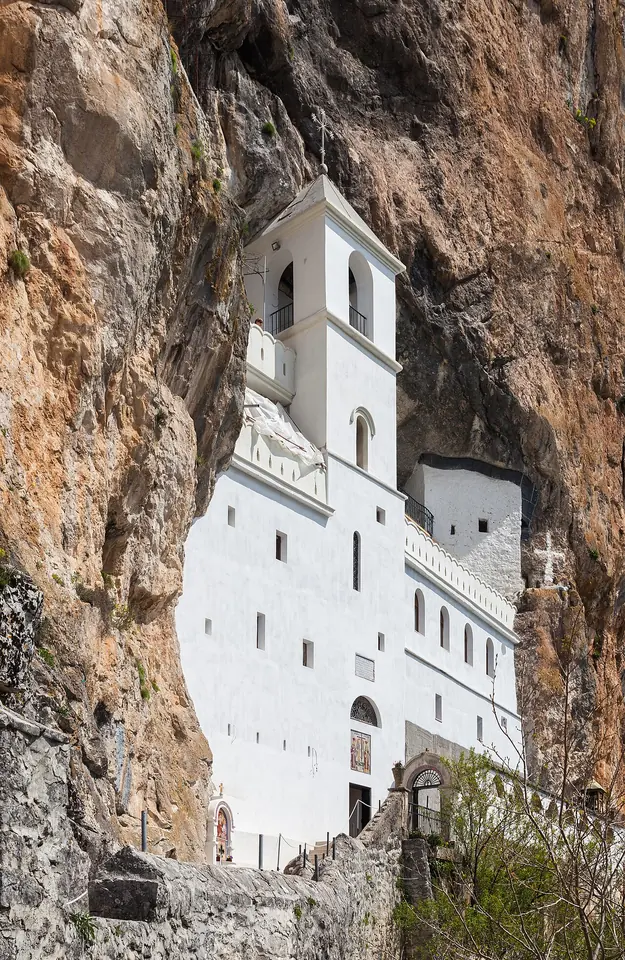
St. Basil of Ostrog is the best-loved saint of Montenegro and one of the great wonderworkers of the Serbian Orthodox Church. He was a seventeenth-century bishop in Herzegovina who served his people under Ottoman rule, defended their faith, and ended his life in prayer at Ostrog, a monastery built into a sheer cliff above the plain of Bjelopavlići. His incorrupt body has rested there since a few years after his death in 1671, and the stream of pilgrims who come to it has never stopped.
The monks say that the door of his little cave church is so low that only children and the very old can pass through it without bowing deeply. Everyone else must bend.
The life of St. Basil
A boy of Popovo Polje
He was born Stojan Jovanović, by one tradition on December 28, 1610, in the village of Mrkonjići in Popovo Polje, a flood plain in the stony karst country of eastern Herzegovina. His parents, Petar and Ana, were poor and devout. The monastery's life says that much of his childhood is known only from old notes and popular tradition: a quiet, prayerful boy who worked hard and went to church every Sunday and feast.
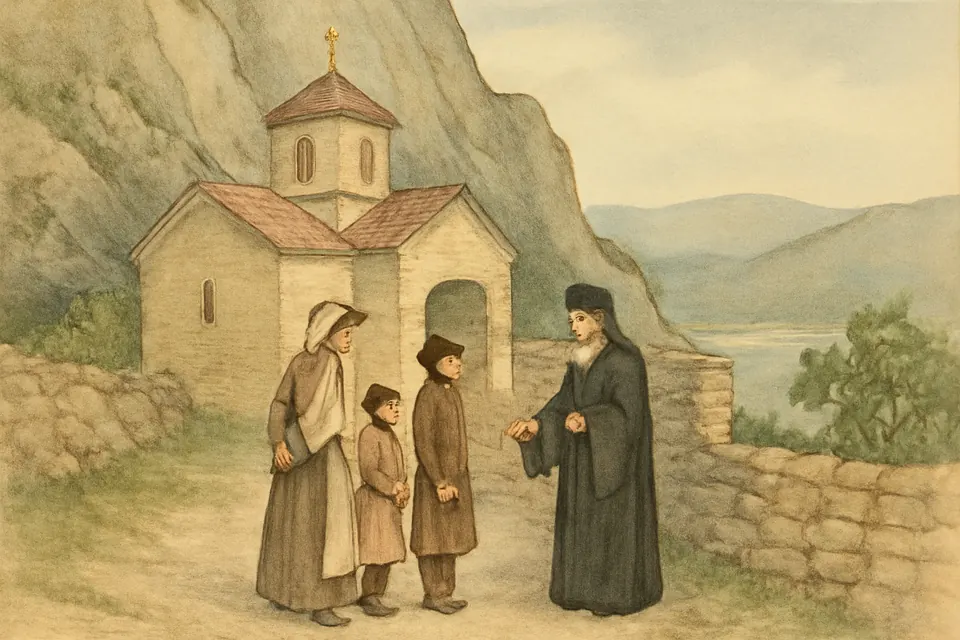
Afraid that the Ottomans would take their only son for the janissaries, his parents gave him as a boy to the nearby monastery of the Presentation of the Mother of God at Zavala.
Monk and bishop
From Zavala he went on to the monastery of Tvrdoš near Trebinje, where he took monastic vows with the name Basil (Vasilije), probably in his twenties. He later spent time on Mount Athos. On the feast of the Transfiguration in 1638, the monastery's life records, Patriarch Paisije of Peć consecrated him a bishop. He became bishop of Zahumlje and Skenderija, the eastern Herzegovina of today, at a time of war, poverty and heavy pressure on his Orthodox flock to abandon their faith.
He traveled constantly among his scattered flock, encouraging the clergy, restoring churches and strengthening the monasteries as the anchors of his people's faith and culture.
The last years at Ostrog
Basil came to Ostrog, where monks had lived in caves in the cliff since the start of the century, and made it his home and the base of his diocese. He spent his last five years there in prayer day and night, while still caring for his churches. He died in his cell on the Saturday of Bright Week in 1671, on April 29 by the Julian calendar, and the monastery's life says that his cell shone with heavenly light at the moment of his death. The brothers buried him below the church.
The miracles of St. Basil of Ostrog
The monastery records two signs that followed his death. A grapevine soon grew from the bare rock above the place where his cell had been, where there is no soil at all, and it still bears fruit. Seven years later, St. Basil appeared in dreams to Rafailo, abbot of the monastery of St. Luke in Župa Nikšićka, and told him to go to Ostrog and open his grave. When the monks opened it after fasting and prayer, they found his body incorrupt, in the words of the monastery's life "yellow as wax and fragrant as basil." They clothed it in new vestments and placed it in the cave church, where it lies today.
Since then the monastery has gathered reports of healings, of the sick, the troubled and the childless, and keeps letters from the faithful who give thanks. We count all of these as reported miracles: they come from the monastery's own records and the living tradition of the Orthodox Church, not from a formal inquiry.

Why St. Basil is the patron of the sick
The Church has given St. Basil no formal patronage. The faithful have chosen him as the helper of the sick in body and mind, because so many healings have been reported at his relics. Pilgrims of every background come to Ostrog, Orthodox, Catholic and Muslim alike, and many spend the night on the terraces outside his church.
Symbols of St. Basil of Ostrog in art
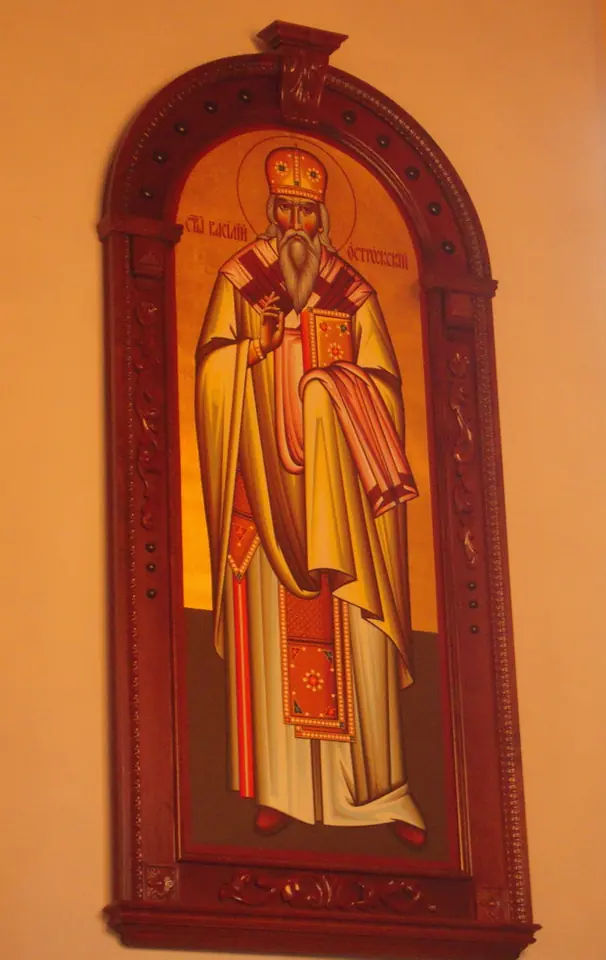
- Bishop's vestments: a rounded miter, the brocade sakkos and the omophorion marked with crosses, as a Serbian hierarch.
- The Gospel book: his duty to teach and guard the faith.
- A blessing hand: his care for his flock.
- A long white beard: he is always painted as a venerable elder.
- Ostrog itself: some icons show the white cliff monastery behind him.
A bishop with these marks could be one of many, but in Serbian and Montenegrin churches the inscription "Sveti Vasilije Ostroški" or the cliff monastery in the background identifies him. Do not confuse him with St. Basil the Great, the fourth-century Father of the Church.
Feast day and pilgrimage to Ostrog
We keep his feast on April 29 of the Julian calendar, May 12 on the civil calendar. On that day, and on Pentecost, enormous crowds climb the mountain road to the Upper Monastery; some walk the last stretch barefoot from the Lower Monastery. See the other saints of April on our feast days page.
Praying with St. Basil
The Serbian Church sings a troparion and akathist to St. Basil. We have not found an English translation with a published source to print here. At Ostrog, pilgrims pray before his relics in their own words. Let us ask St. Basil of Ostrog to pray for the sick and the suffering, and for peace among all the peoples who come to his shrine.
Frequently asked questions
Who was St. Basil of Ostrog?
A Serbian Orthodox bishop of the seventeenth century. Born Stojan Jovanović in Herzegovina, he became a monk, then bishop of Zahumlje and Skenderija under Ottoman rule, defending his people's faith. He spent his last five years at Ostrog, where he died in 1671. He is honored as a wonderworker.
When is the feast of St. Basil of Ostrog?
April 29 on the Julian calendar used by the Serbian Orthodox Church, which falls on May 12 of the civil calendar. Great crowds of pilgrims come to Ostrog for it.
Where is St. Basil of Ostrog buried?
His incorrupt body rests in a reliquary in the small cave church of the Presentation of the Mother of God, in the Upper Monastery of Ostrog, built into a cliff near Nikšić, Montenegro.
Why do people of other faiths visit St. Basil?
Ostrog is one of the most visited shrines in the Balkans, and Orthodox, Catholic and Muslim pilgrims alike come to pray at his relics, especially for the sick. The Orthodox monks receive them all.
Sources
- Manastir Ostrog: Žitije Svetog Vasilija (Life of St. Basil), official site of Ostrog Monastery. His birth, parents, monastic years, consecration in 1638, death, the vine and the finding of his incorrupt body
- Manastir Ostrog: Istorija manastira (History of the monastery). The Upper and Lower Monasteries, the cave church and the vine
- Saint Basil, Bishop of Zakholmsk in Montenegro, Serbia, Orthodox Church in America. The April 29 commemoration (this short life misdates him to the sixteenth century)