St. Dwynwen, Welsh Patron Saint of Lovers

St. Dwynwen was a 5th-century Welsh holy woman, a daughter of King Brychan of Brycheiniog, who settled on Llanddwyn Island off Anglesey. Welsh tradition says that after a painful love affair she asked God to help all true lovers, and she is the patron saint of lovers in Wales. Her feast day, January 25, is kept as Dydd Santes Dwynwen, the Welsh St. Valentine's Day.
Who was St. Dwynwen?
St. Dwynwen was a Welsh holy woman of the 5th century, a daughter of King Brychan of Brycheiniog, who gave her life to God on Llanddwyn Island off the coast of Anglesey. Welsh tradition remembers her as the saint of true lovers, and her feast, January 25, is Dydd Santes Dwynwen, the day the Welsh send cards and flowers to the ones they love.
Almost nothing about her life can be pinned down by history. The early Welsh genealogies name her among the many children of Brychan, a ruler of the small kingdom of Brycheiniog in south Wales, whose family filled the Welsh calendar with saints. They place her in Anglesey as a near neighbor of her sister Cain, or Ceinwen. Everything else comes from legend, place names, poetry and the devotion of the people who came to her shrine for a thousand years.
Her name
The oldest list of Brychan's children, the Latin Cognatio Brychani, calls her simply Dwyn. That form survives in Llanddwyn ("the church of Dwyn") and Porthddwyn, her harbor. Sabine Baring-Gould and John Fisher explain in The Lives of the British Saints (1908) that Dwynwen is really Dwyn Wen, "the Blessed Dwyn," just as the Welsh call Our Lady Mair Wen. In Latin she became Donwenna, and a figure of her under that name once stood in a window of the choir of Bangor Cathedral.
The legend of St. Dwynwen and Maelon
The story that made her the saint of lovers is first found in the Iolo Manuscripts, published in 1848 from the papers of the Welsh antiquarian Edward Williams, better known as Iolo Morganwg. Iolo was a brilliant collector who is also known to have invented some of what he "found," so historians treat this tale as late and uncertain. It is a traditional story, and a lovely one. The Lives of the British Saints gives it in this translation:
Maelon Dafodrill and Dwynwen, the daughter of S. Brychan, mutually loved each other. Maelon sought her in unappropriated union, but was rejected, for which he left her in hatred, and aspersed her, which caused her extreme sorrow and anguish. Being one night alone in a wood, she prayed that God would cure her of her love, and He, appearing to her while she was asleep, gave her a delicious liquor, which entirely cured her; and she saw the same draught administered to Maelon, who thereupon became frozen into a lump of ice.
God then granted her three requests. She asked first that Maelon be thawed. Second, that her prayers would always be heard for "all true-hearted lovers, so that they should either obtain the objects of their affection, or be cured of their love-passion." Third, that she would never wish to marry. All three were granted, the legend says, "whereupon she took the veil, and became a Saint."

Read as a story of grace, the legend is more than a romance. A young woman wronged by the man she loved asks God to heal her heart, forgives him, and asks for nothing for herself except to belong to God. Her second wish is a prayer for everyone who loves: that they find their beloved, or find peace.
Llanddwyn: the island of St. Dwynwen
Dwynwen chose for her home a rocky spur of land at the southwest corner of Anglesey, rising above wide sand dunes. The Royal Commission's survey describes Llanddwyn as about 1.1 kilometers long, rising to some 16 meters at its southern end, where the lighthouse stands. A manuscript of about 1714 in Cardiff records that "some say that she was martyred" there; nothing else supports it.
A medieval pilgrimage
In the Middle Ages her church became one of the great shrines of north Wales. Late in the 15th century the poet Sir Dafydd Trefor wrote a cywydd, a formal Welsh poem, in her honor. He described her church, her statue and the miracles at her holy wells, and he told how young men and women and sick folk "from diverse countries" crowded to Llanddwyn with candles and offerings. Wax lights burned constantly at the shrine, The Lives of the British Saints says, and by the time of Henry VIII the gifts of pilgrims had made Llanddwyn one of the richest church livings in Wales. After the Reformation the shrine was stripped, and the church slowly fell into ruin.
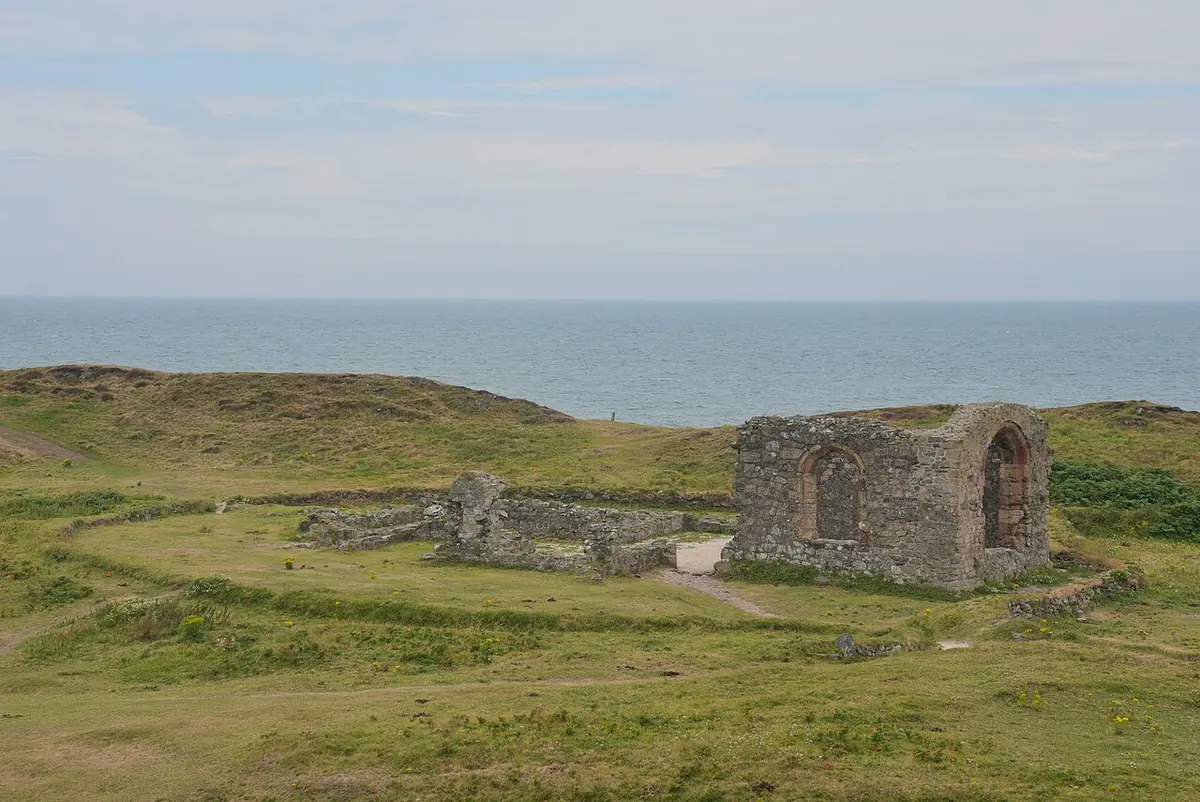
The ruined church that stands today is cruciform, which is unusual in the region. The Royal Commission on the Ancient and Historical Monuments of Wales notes that its surviving details date only from the early 16th century, so it is the last of several churches on the site. Its east and south windows still stand, without their tracery.


The holy well and the fish
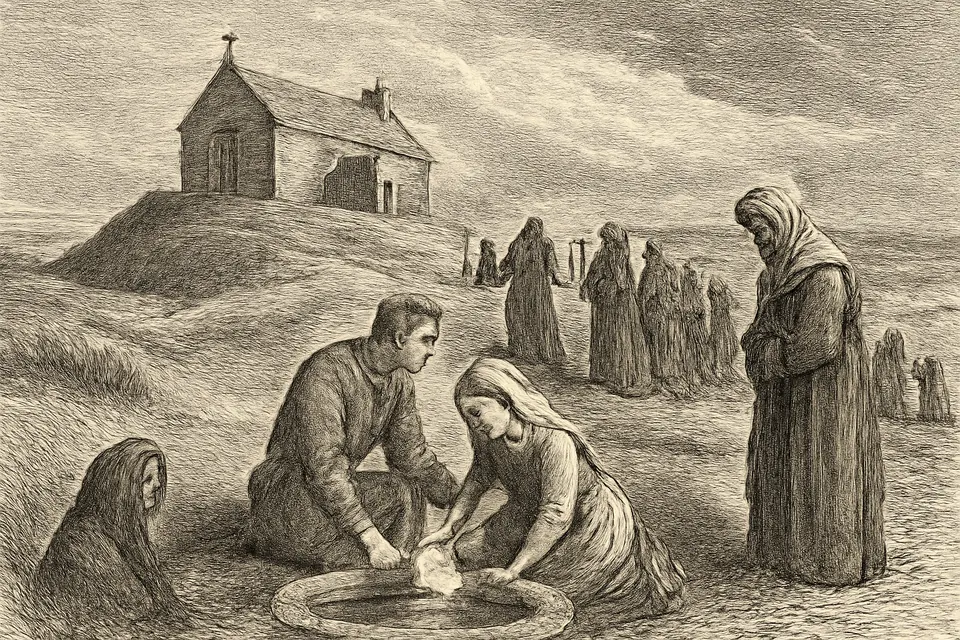
Llanddwyn had more than one holy well. The Royal Commission records Ffynnon Dwynwen near the church, and The Lives of the British Saints tells of another, Ffynnon Fair (Mary's Well), that was said to hold a sacred fish or eel. Long after the Reformation, lovers still came to the well to learn their fortunes, and the old custom was less than orthodox. Around 1800 William Williams of Llandegai wrote down what he had heard: an old woman from Newborough would spread a lover's handkerchief on the water and read the future from the movements of small eels in the well. One old woman, he wrote, had been told her husband would be a stranger from the south of Caernarfonshire, and soon one came and married her. "This couple," Williams added, "was my father and mother."
That well has long been choked with sand. A smaller wishing well, Crochan Llanddwyn, was still visited by "love-sick lads and lasses" in 1908.
Miracles and favors of St. Dwynwen
No miracle of Dwynwen's has ever been formally investigated. Everything below is traditional, handed down by poets and local people:
- The healing of her heart and the three wishes: traditional, from the Iolo Manuscripts.
- Healings at her wells: traditional, described by Sir Dafydd Trefor in the 15th century.
- Cures of aches and pleurisy: traditional. Sufferers would sleep on a rock at Llanddwyn called Gwely Esyth, then cut their names in the turf and go home believing they were cured.
- Protection of cattle: traditional. Williams tells how the plow oxen of the farm of Bodeon ran off a cliff into the sea on St. Mark's Day, about 1650. The owner vowed to keep the feast holy ever after and to burn two candles each year in the porch of Llanddwyn church, asking Dwynwen's protection for his animals.
Why St. Dwynwen is the patron saint of lovers
She is the patron of lovers because of her second wish, that God would always hear her prayers for true-hearted lovers. The fourteenth-century poet Dafydd ap Gwilym, the greatest of medieval Welsh poets, wrote a playful cywydd asking her to carry a message to his beloved Morfydd. His opening lines, in the translation printed by Baring-Gould and Fisher, call her "Tear-bedewed Dwynwen, essence of beauty" and praise her "golden image" that "cures of ailments the tortured and miserable ones all."
Dwynwen also has a quieter patronage: farmers asked her to protect their beasts, as the Bodeon story shows. The Welsh "Sayings of the Wise" give one saying in her name: "There is none so lovable as the cheerful." See more on our patron saints page, and for married couples, our page on the patron saints of marriage.
Symbols of St. Dwynwen in art
No medieval image of Dwynwen survives; the "golden image" Dafydd ap Gwilym saw and the statue Sir Dafydd Trefor praised were lost at the Reformation, along with the Bangor window. Modern images of her, from cards to illustrations, draw on her legend and her island:
- A nun's veil: she "took the veil" after her three wishes were granted.
- A cup or draught: the drink God gave her in her dream to heal her love.
- Maelon frozen in ice: the man she loved and then forgave.
- A holy well, sometimes with fish or eels: the wells of Llanddwyn and their lovers' customs.
- Llanddwyn Island with its ruined church, cross and lighthouses: her home and shrine.
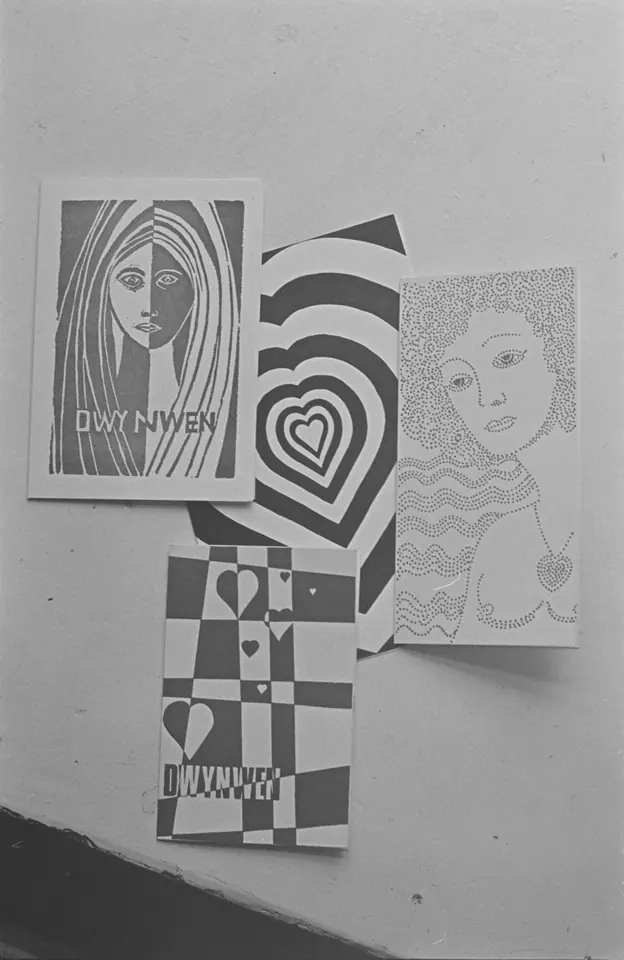
- Hearts: the modern emblem of her day, as on the 1969 cards below.
To recognize her in a Welsh church, look for a young woman in a simple veil on a sea-girt island, often holding a cup, sometimes with a frozen figure nearby.
St. Dwynwen's Day on January 25
Her feast is January 25, the date in Welsh calendars from the 15th century on. Nicholas Roscarrock, an English Catholic recusant of the 1600s, once gave July 13, but his own calendar returns to January 25. It is the same day the universal Church keeps the Conversion of St. Paul. See other saints of the season on our feast days page.
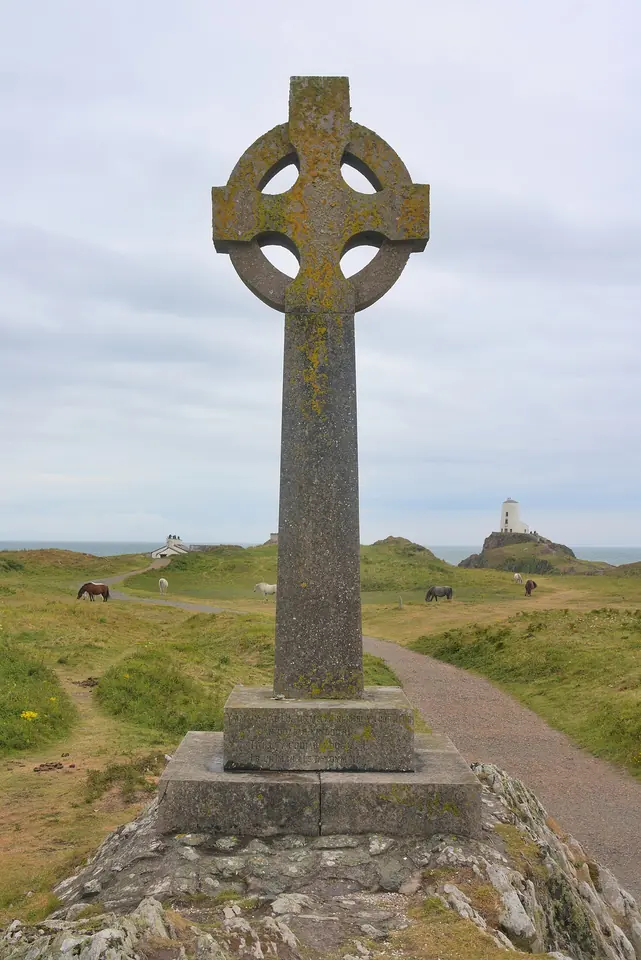
In the 20th century Dydd Santes Dwynwen came back as a Welsh celebration of love, three weeks before St. Valentine's Day. The Welsh send cards, flowers and messages, and visitors to Llanddwyn find a Celtic cross about fourteen feet high was raised in her memory in 1903 by the Hon. F. G. Wynn.

Her cult reached beyond Anglesey. A sea cave near Llantwit Major in Glamorgan was called the Cave of Dwynwen, and people threw pebbles over a natural arch inside it to learn how long they must wait to marry. Baring-Gould and Fisher thought she may also be the patron of Advent church near Camelford in Cornwall, and perhaps the Ste. Douine of a chapel at Plouha in Brittany.
Prayer to St. Dwynwen
No traditional prayer to St. Dwynwen survives in common use; the medieval poems written to her are poetry, not liturgy, and Dafydd ap Gwilym's is half a joke. We won't invent words in her name. We can ask her intercession simply, as pilgrims did for centuries at Llanddwyn: St. Dwynwen, pray for us.
Let us bring her the people who are looking for someone to love, the couples preparing to marry, husbands and wives who have grown apart, and everyone whose heart has been broken. Let us ask her to pray that each of them, in her own words, will either find the one they love or be healed in heart, and that all of us will learn from her to forgive.
Frequently asked questions
Who was St. Dwynwen?
A Welsh holy woman of the 5th century, one of the many saintly children Welsh genealogies give to Brychan, king of Brycheiniog in south Wales. She settled on Llanddwyn, a small tidal island at the southwest tip of Anglesey, near her sister Ceinwen. Her oldest name is Dwyn; Dwynwen means "blessed Dwyn."
Why is St. Dwynwen the patron saint of lovers?
Because of a Welsh legend. Dwynwen and a young man named Maelon loved each other, but when she refused him he left her in anger. She prayed to be healed of her love, and God gave her a draught that cured her, while Maelon was turned to ice. Granted three wishes, she asked that Maelon be thawed, that God would always hear her prayers for true-hearted lovers, and that she would never marry. The story is traditional, first written down in the Iolo Manuscripts, published in 1848.
When is St. Dwynwen's Day?
January 25. That date appears in Welsh church calendars from the 15th century onward. In Wales, Dydd Santes Dwynwen is celebrated with cards, flowers and dinners, much like St. Valentine's Day three weeks later.
Can you visit St. Dwynwen's church?
Yes. The ruins of St. Dwynwen's Church stand on Llanddwyn Island, off Newborough in southwest Anglesey, and the island can usually be reached on foot across the beach. Nearby are a Celtic cross raised in her memory in 1903, a later cross and an old lighthouse.
Is St. Dwynwen a Catholic saint?
She is one of the early saints of Wales, honored long before the Church had a formal canonization process. She has never been on the Church's universal calendar, but her cult was strong in medieval Catholic Wales, when pilgrims crowded her shrine, and January 25 appears in Welsh calendars from the 15th century.