The Three Holy Hierarchs

The Three Holy Hierarchs are St. Basil the Great, St. Gregory the Theologian (Gregory of Nazianzus) and St. John Chrysostom, the great bishops and teachers of the fourth-century Church. The Byzantine churches honor them together on January 30, a feast begun at Constantinople in the eleventh century to end a quarrel over which of them was greatest. In Greece they are the patrons of students and teachers.
Who are the Three Holy Hierarchs?
The Three Holy Hierarchs are three fourth-century bishops whom the Christian East has always loved as its great teachers: St. Basil the Great, St. Gregory the Theologian and St. John Chrysostom. Each has his own feast day. On January 30 the Byzantine churches, Orthodox and Eastern Catholic alike, honor all three together in one celebration.
They lived in the generation after the Council of Nicaea, when the Church was still fighting for the faith that the Son is truly God. Basil and Gregory were friends from their student days in Athens. John, younger, came from Antioch. None of them knew a joint feast; it was born seven hundred years after them.
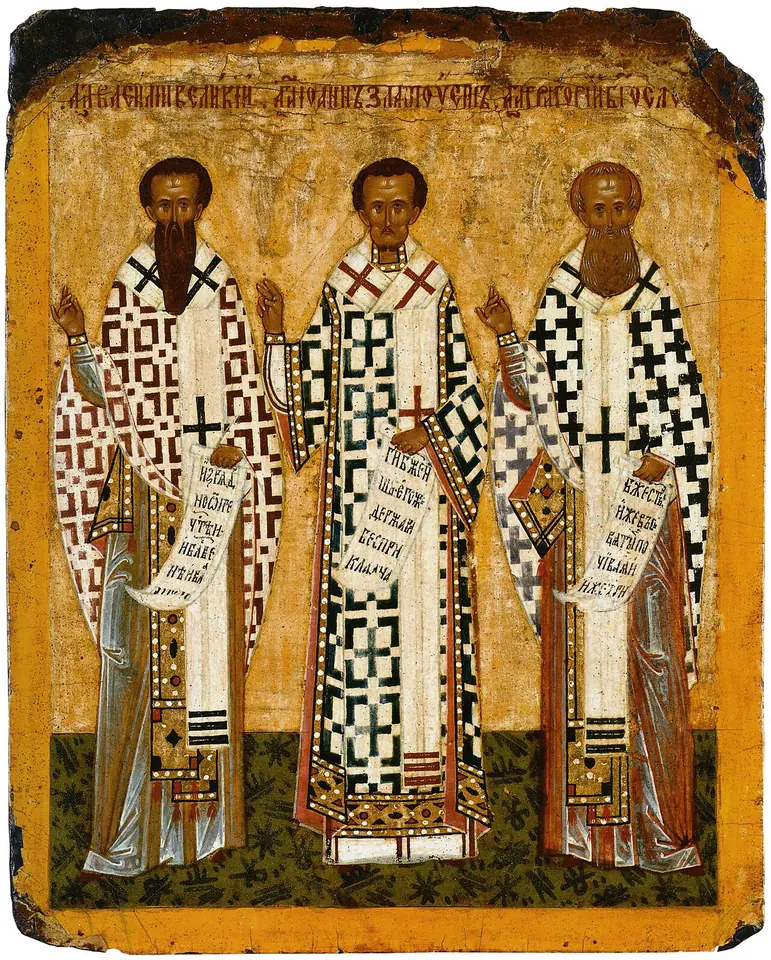
St. Basil the Great
Basil (about 330 to 379) was archbishop of Caesarea in Cappadocia. He organized monastic life in the East, founded a great complex for the poor and sick outside his city, and defended the divinity of the Son and the Holy Spirit against the Arians. The Divine Liturgy that bears his name is still served on certain days of the year.
St. Gregory the Theologian
Gregory of Nazianzus (about 329 to about 390) was Basil's closest friend, a poet and a reluctant bishop. In Constantinople he preached the five Theological Orations on the Holy Trinity, which earned him the title "the Theologian," given in the East only to him, the Apostle John and St. Symeon the New Theologian. He resigned the see of Constantinople for the sake of peace.
St. John Chrysostom
John (about 349 to 407) was a priest of Antioch and then archbishop of Constantinople, so famous a preacher that he was called Chrysostomos, "golden-mouthed." He spoke fearlessly against luxury at court, was twice exiled, and died on the road to exile. The most common Divine Liturgy of the Byzantine churches bears his name.
How the feast of the Three Hierarchs began
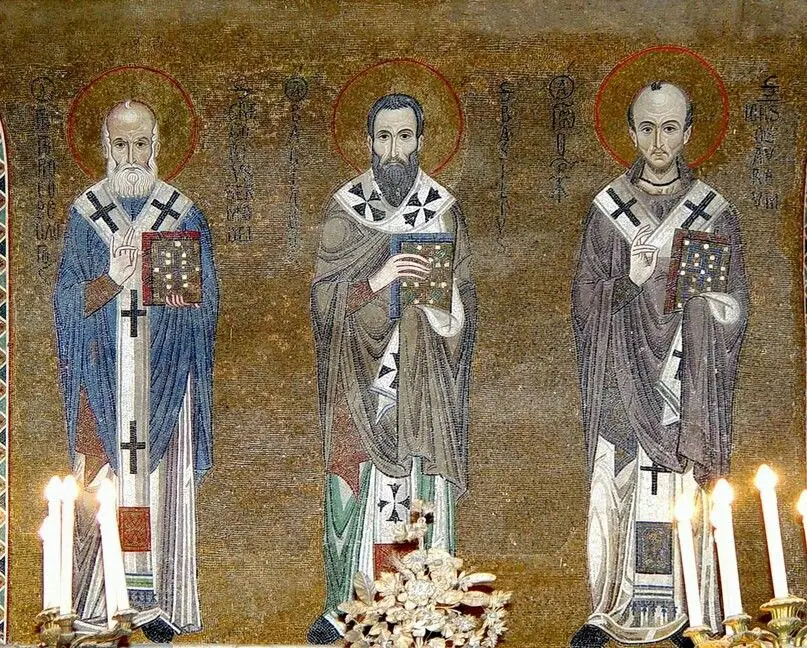
The Orthodox Church in America tells the story. In the eleventh century, disputes raged in Constantinople over which of the three was greatest. Some honored Basil above the others, some Gregory, some John, and the people split into parties: "Basilians," "Gregorians" and "Johnites."
Then, in 1084, the three hierarchs appeared to St. John, bishop of Euchaita, and said that they were equal before God: "There are no divisions among us, and no opposition to one another." They told him the disputes should stop and that they should be commemorated together on a single day. Bishop John chose January 30, and the quarrel ended. This vision is traditional: it comes to us through the Church's own memory of the feast, not from a formal investigation. Bishop John of Euchaita is himself honored as a saint, on June 14.
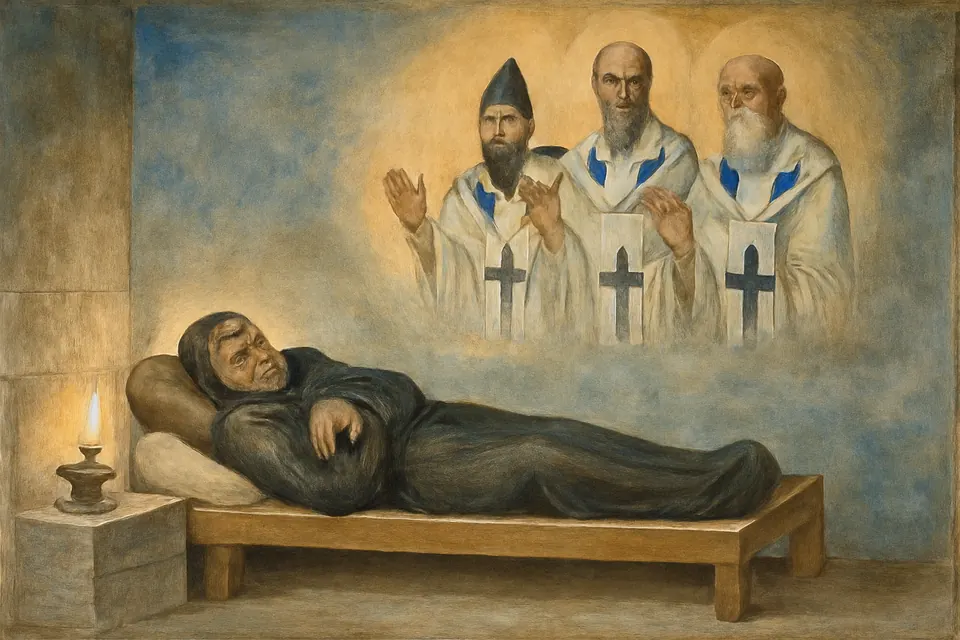
The three in the art of East and West
Long before the joint feast, painters set these Fathers side by side. In Rome, on the walls of Santa Maria Antiqua in the Forum, an eighth-century fresco painted under Pope Paul I (757 to 767) shows Eastern and Western Fathers of the Church together, among them Basil, Gregory and John, with their names in Greek.

Symbols of the Three Holy Hierarchs in art
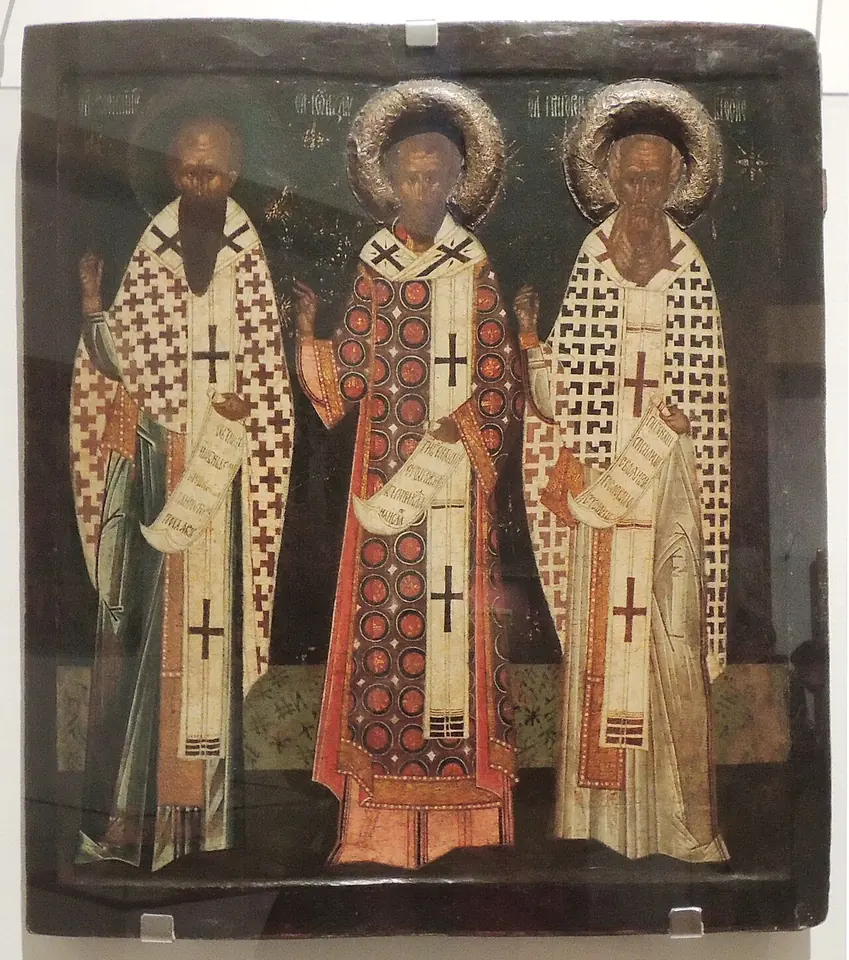
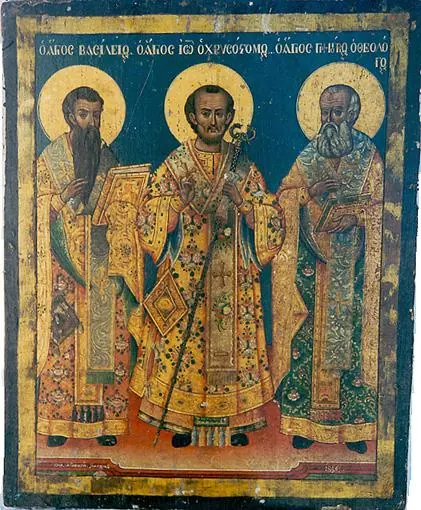
In an icon of the Three Holy Hierarchs you will see three bishops standing in a row, full length, facing us. Each wears the omophorion, the long white stole of a bishop marked with large black or red crosses, over a patterned vestment. Each holds a Gospel book or an unrolled scroll with words from his writings or liturgy, and often raises his right hand in blessing.
You can tell them apart by their faces, which icon painters have kept for a thousand years:
- Basil has a long, dark, pointed beard and dark hair, and a serious, ascetic face.
- Gregory the Theologian is an old man with a broad, bushy white beard.
- John Chrysostom is thin, with a high, balding forehead, hollow cheeks and a short, sparse beard.
The order changes from icon to icon. Some Russian icons, like the Novgorod tablet above, place John in the middle; Greek icons, like the 1846 icon from the village of Adam near Thessaloniki, label each figure by name. Western churches rarely show the three as a group, since the Latin calendar honors them on separate days.
Patrons of education
All three were among the best-educated men of their age. Basil and Gregory studied rhetoric and philosophy at Athens, and John trained under the famous pagan teacher Libanius. They took the learning of the Greeks and used it to teach the Gospel. For this reason Greece honors them as the patrons of students, teachers and education, and January 30 is kept there as a day for letters and learning, with celebrations in schools and universities.
The return of the relics
For centuries, relics of St. Gregory and St. John were kept in Rome, in later times at St. Peter's Basilica. Ecumenical Patriarch Bartholomew spoke of an "involuntary age-old separation" imposed by unhappy circumstances in the Church's history. On November 27, 2004, Pope John Paul II gave portions of them back to Ecumenical Patriarch Bartholomew I. In his letter for the occasion the pope called them "two Fathers of the Eastern Church" who, "with St Basil the Great, have always been honoured with a feast day in the Catholic Church." The relics now rest in the Patriarchal Church of St. George at the Phanar in Istanbul.
Hymn to the Three Holy Hierarchs
The Byzantine churches sing this troparion on January 30, in the translation of the Orthodox Church in America:
Let us who love their words come together, honoring with hymns, the three greatest luminaries of the Three-Sunned divinity: / Basil the Great, Gregory the Theologian, together with the renowned John Chrysostom, of golden speech. / They have illumined the entire world with the rays of divine doctrines; / they are sweetly-flowing rivers of wisdom, / who with divine knowledge have watered all of creation with clear streams; / for they always intercede with the Trinity for us.
Holy Basil, holy Gregory, holy John, pray for us, and for all who teach and study in the light of Christ.
Frequently asked questions
Who are the Three Holy Hierarchs?
St. Basil the Great, archbishop of Caesarea; St. Gregory the Theologian, archbishop of Constantinople; and St. John Chrysostom, archbishop of Constantinople. All three were fourth-century bishops, preachers and Fathers of the Church.
When is the feast of the Three Holy Hierarchs?
January 30 in the Byzantine calendar (February 12 on the Julian calendar). Each also has his own feast; in the Roman calendar Basil and Gregory share January 2 and John Chrysostom is honored on September 13.
Why do the Three Hierarchs share a feast?
In the eleventh century the people of Constantinople argued over which of them was greatest, splitting into "Basilians," "Gregorians" and "Johnites." According to the Orthodox Church in America, the three appeared to Bishop John of Euchaita in 1084, said they were equal before God, and asked for one common feast. He chose January 30.
Why are the Three Hierarchs patrons of education?
All three were highly educated men who used the best learning of their day in the service of the Gospel. In Greece their feast is kept as a day honoring letters and learning, and schools mark it with celebrations.
Sources
- Orthodox Church in America: Synaxis of the Ecumenical Teachers and Hierarchs: Basil the Great, Gregory the Theologian, and John Chrysostom
- Orthodox Church in America: Troparion and Kontakion of the Three Hierarchs
- John Paul II, Letter to Ecumenical Patriarch Bartholomew I on the return of the relics of Sts. Gregory Nazianzen and John Chrysostom (November 27, 2004)