St. Paul of Thebes, the First Hermit
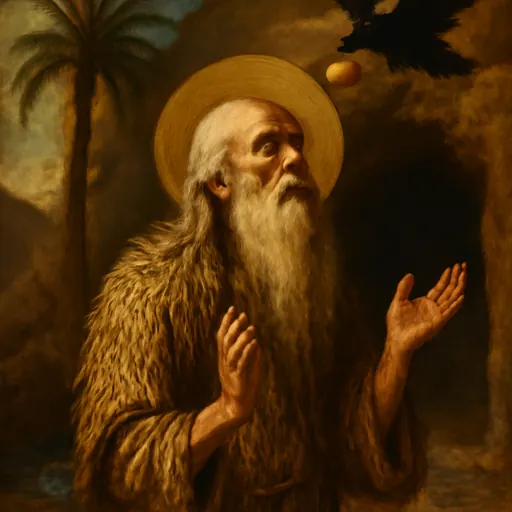
St. Paul of Thebes (about 228–341), also called St. Paul the First Hermit, fled to the Egyptian desert as a young man during the persecution of Decius and lived alone in a cave for about ninety years. St. Jerome's Life tells how a raven brought him bread and how St. Anthony the Great found him shortly before his death and buried him with the help of two lions. His feast day is January 15.
Who was St. Paul of Thebes?
St. Paul of Thebes, also known as St. Paul the First Hermit, was an Egyptian Christian who fled into the desert around the year 250 to escape the persecution of the emperor Decius, and stayed there in prayer for the rest of a very long life. He is honored as the first Christian hermit. We know him through St. Jerome, who wrote The Life of Paulus the First Hermit around 375, and through the story of his meeting with St. Anthony the Great, the father of monks.
The life of St. Paul the Hermit
Flight into the desert
Jerome says Paul was born in the Thebaid, in Upper Egypt, to wealthy parents who died when he was about sixteen. He was "highly skilled in both Greek and Egyptian learning, gifted with a gentle disposition and a deep love for God." During the persecution, his own brother-in-law planned to betray him to get his inheritance. Paul fled into the mountains to wait out the danger.
Far into the desert he found a cave closed by a stone, and inside it "a large hall, open to the sky, but shaded by the wide-spread branches of an ancient palm," with a clear spring. He took it as a gift from God, and "there in prayer and solitude spent all the rest of his life." The palm gave him dates for food and leaves to weave his clothing.
Anthony's journey
When Paul was 113 and Anthony 90, Anthony was tempted to think that no monk in the desert was more perfect than he. In the night it was revealed to him that there was "a much better man than he" farther out in the desert, and he set out with his staff to find him. After a long search he came to Paul's cave, and the two old men greeted each other by name and embraced.
Bread from the raven
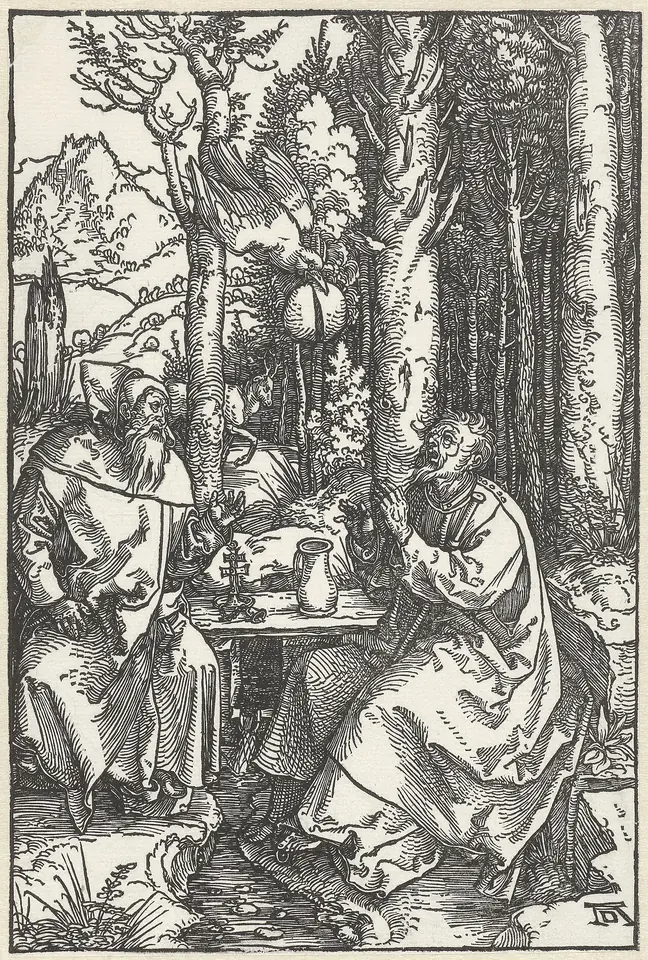
As they talked, a raven flew down and laid a whole loaf before them. Paul said:
See, said Paul, the Lord truly loving, truly merciful, has sent us a meal. For the last sixty years I have always received half a loaf: but at your coming Christ has doubled his soldier's rations.
Jerome adds, with a smile, that they spent nearly the whole day arguing courteously over who should break the bread, until each took one side and pulled.
Death and burial
The next morning Paul told Anthony that he was about to die, and asked him to fetch the cloak that Bishop Athanasius had given him, to wrap his body. Anthony hurried home and back. Within three hours of the cave, he saw Paul "in robes of snowy white ascending on high among the bands of angels, and the choirs of prophets and apostles." He found the body kneeling, "with head erect and hands uplifted," as if still at prayer.
Anthony had no tool to dig a grave. Then, Jerome says, two lions came running out of the desert and scraped out a grave with their paws. Anthony buried his friend and took home Paul's tunic of woven palm leaves, which he wore only on the feasts of Easter and Pentecost. To his disciples he said: "I have seen Elias, I have seen John in the desert, and I have really seen Paul in Paradise."

Miracles and legends
All the wonders of Paul's life come from Jerome's account and are traditional: the raven's daily half loaf, the whole loaf when Anthony came, the vision of his soul rising to heaven, and the lions who dug his grave. Jerome also tells of a centaur and a satyr that Anthony met on his way, which the Catholic Encyclopedia notes appear in the Greek versions of the Life as demons. Scholars have long debated whether Jerome's Latin or a shorter Greek text came first, but the same encyclopedia observes that devotion to Paul "seems to have existed quite independently of the Life."

Why St. Paul is the patron of hermits
Paul never founded a monastery and had no disciples, but his life became the pattern of the solitary vocation in East and West: a hidden life of prayer, poverty and trust in God's providence. In Hungary in the 13th century, Blessed Eusebius of Esztergom gathered hermits into the Order of St. Paul the First Hermit, the Pauline Fathers, who now keep the shrine of Our Lady of Częstochowa at Jasna Góra in Poland. The raven with bread on their coat of arms is his. See more on our patron saints page.
Symbols of St. Paul of Thebes in art
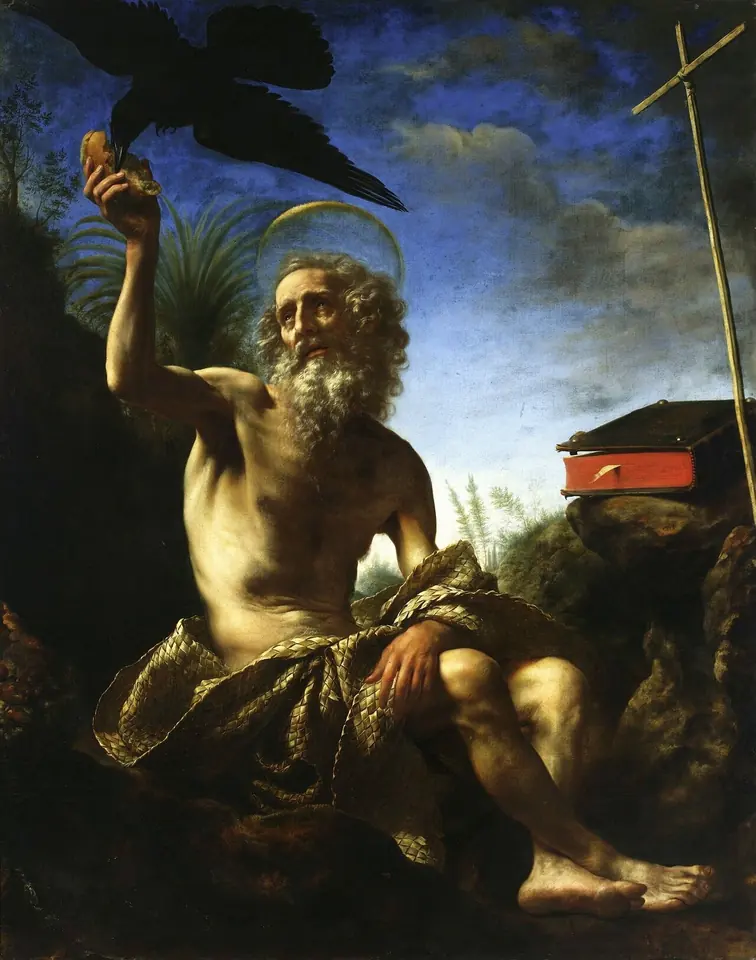
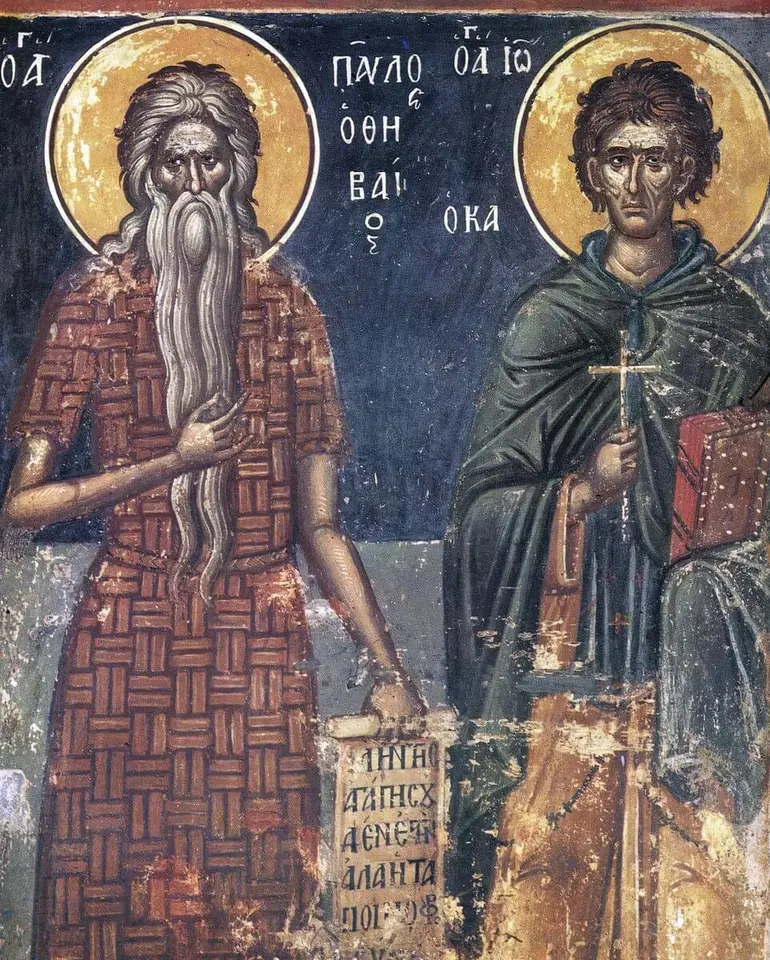
St. Paul is an old man with a very long white beard, nearly naked or dressed in a tunic woven of palm leaves, as in the Athonite fresco below, where the weave is painted as a lattice. His surest sign is a raven carrying bread, often with Anthony beside him. Two lions recall his burial, and a palm tree and spring stand for the cave that sheltered him. Western painters such as Ribera and Dolci show him gaunt and praying with a skull or book; Eastern icons show him standing with hands raised or holding a scroll. If two old hermits share a loaf under a flying raven, they are Paul and Anthony.
Feast day and where he is honored
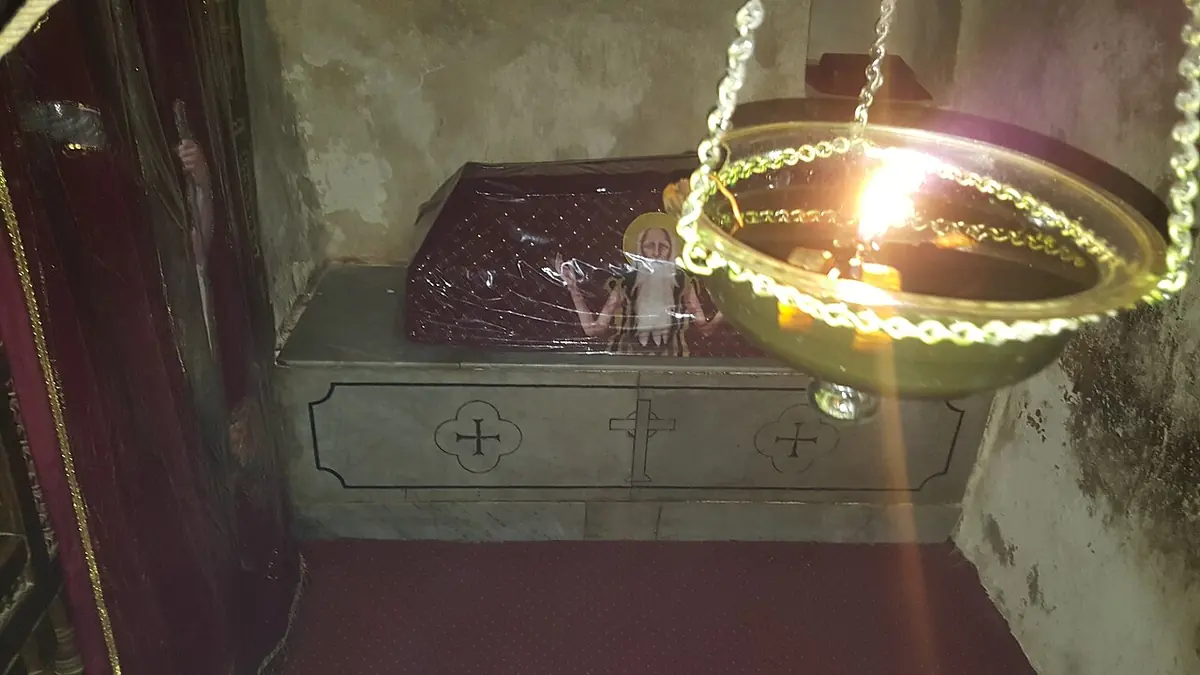
We keep his feast on January 15, two days before St. Anthony's. The Coptic Monastery of St. Paul the Anchorite, Deir Anba Bula, stands in the Eastern Desert near the Red Sea, over the cave where he is believed to have lived; its cave church holds his tomb. According to the Orthodox Church in America, his relics were taken to Constantinople under Emperor Manuel I in the 12th century, then to Venice and finally to Buda in Hungary, and part of his head is in Rome. Find other January saints on our feast days page.
Prayer to St. Paul the Hermit
No traditional prayer to St. Paul of Thebes is widely used in English. Jerome closes his Life with a request we can make our own: "I beseech you, reader, whoever you may be, to remember Jerome the sinner." Let us ask St. Paul, who trusted God for his daily bread for ninety years, to teach us to pray without ceasing and to trust the Father's care. St. Paul the First Hermit, pray for us.
Frequently asked questions
Who was the first Christian hermit?
Tradition, following St. Jerome, gives that title to St. Paul of Thebes, who went into the desert around 250, before St. Anthony the Great. Anthony is called the father of monks because so many disciples gathered around him; Paul lived entirely alone.
Why is St. Paul the Hermit shown with a raven?
Jerome writes that a raven brought him half a loaf of bread every day for sixty years. When Anthony came to visit, the raven brought a whole loaf, and Paul said, "Christ has doubled his soldier's rations." The raven recalls the ravens that fed the prophet Elijah (1 Kings 17:6).
When is the feast of St. Paul the Hermit?
January 15, two days before the feast of his friend St. Anthony the Great on January 17. It is the date in the Roman Martyrology and the Orthodox calendar.
Did St. Paul of Thebes really exist?
Almost everything we know comes from Jerome's Life, written about 375, and scholars have long debated how much of it is history. The Catholic Encyclopedia notes that belief in St. Paul "seems to have existed quite independently of the Life," and the Coptic Church has kept his cave and tomb near the Red Sea for many centuries.
Sources
- St. Jerome, The Life of Paulus the First Hermit (Nicene and Post-Nicene Fathers, Second Series, vol. 6), New Advent. Source of all quotations from the Life
- Francis Joseph Bacchus, "St. Paul the Hermit," The Catholic Encyclopedia, vol. 11 (1911). The Latin and Greek versions of the Life and the debate over which is original
- Orthodox Church in America: Venerable Paul of Thebes (January 15). The translation of his relics to Constantinople under Manuel I, then to Venice and Buda, and part of the head in Rome