St. Remigius of Reims (St. Remi), Apostle of the Franks

St. Remigius, or St. Remi (about 437–533), was bishop of Reims for more than sixty years and the Apostle of the Franks. Around 496 he baptized Clovis, king of the Franks, with thousands of his warriors, the event French tradition counts as the birth of Catholic France. The Roman Martyrology remembers him on January 13, and France keeps his feast on January 15.
Who was St. Remigius?
St. Remigius of Reims, called St. Remi in French, was the bishop of Reims in northern Gaul from his early twenties until his death in his nineties, around the year 533. He is called the Apostle of the Franks because he instructed and baptized Clovis, the pagan king of the Franks, and thousands of his warriors, which made the Franks the first of the Germanic peoples to accept the Catholic faith rather than Arianism. Towns all over France, from Saint-Rémy-de-Provence to dozens of village churches, bear his name.
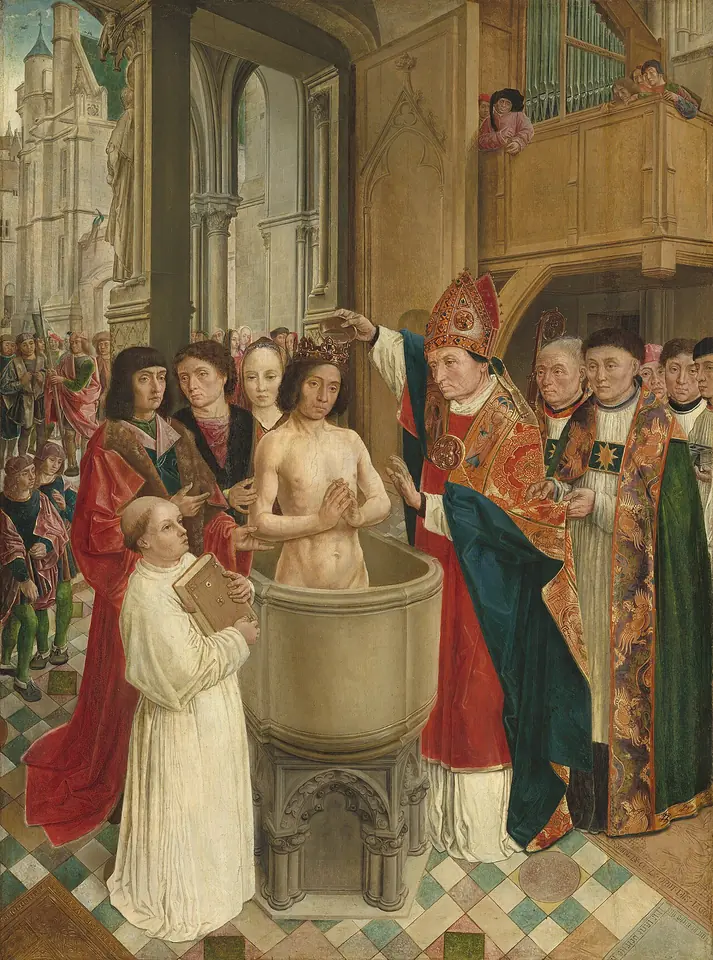
The life of St. Remigius
A young bishop
Remigius was born around 437 near Laon into a Gallo-Roman noble family; the Catholic Encyclopedia names his father as Emile, count of Laon, and his mother is venerated as St. Céline. He studied at Reims and was so respected for learning and holiness that he was chosen bishop of the city at about twenty-two. Sidonius Apollinaris, the great Gallo-Roman letter-writer, admired his sermons, though none survive.
Counselor to a pagan king
When the young Clovis became king of the Salian Franks around 481, Remigius wrote him a letter of advice that still exists. Nominis quotes it in French, and in English it runs: "Help the unfortunate, protect widows, feed orphans... Let your tribunal stay open to all, and let no one leave it sad!" Gregory of Tours tells the story of the vase of Soissons: a Frankish soldier claimed for himself a precious vessel taken from a church, and Clovis tried to return it to the bishop.
The baptism of Clovis
Clovis's wife, St. Clotilde, was a Catholic Burgundian princess who prayed for his conversion. In a hard battle against the Alamanni, Gregory writes, Clovis called on "Jesus Christ, whom Clotilda asserts to be the son of the living God," and won. Clotilde then asked Remigius to instruct him in secret. The baptistery of Reims was hung with white curtains and filled with candles and incense, and when the king came to the font, the bishop said:
Gently bend your neck, Sigamber; worship what you burned; burn what you worshipped.
Gregory says that "of his army more than 3000 were baptized." The Catholic Encyclopedia gives the date as Christmas Day, December 25, 496; historians have proposed dates up to about 508.
A long ministry
With the king's support Remigius founded or restored bishoprics at Tournai, Cambrai, Thérouanne, Arras, where he placed St. Vedast, and Laon. In 517 he won back an Arian bishop at a synod, and in 530 he consecrated St. Medard as bishop of Noyon. He died at Reims on January 13, after more than sixty years as bishop.
The miracles of St. Remigius
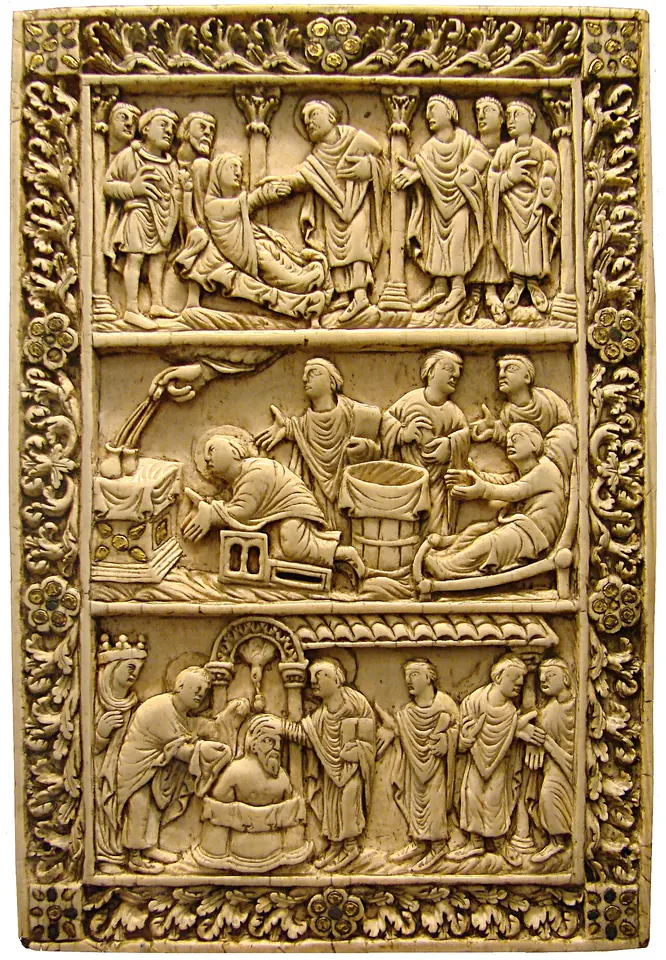
- Raising the dead (traditional). Gregory of Tours, writing about ninety years after his death, says that "there is extant a book of his life which tells that he raised a dead man." The Reims ivory shows him raising a girl.
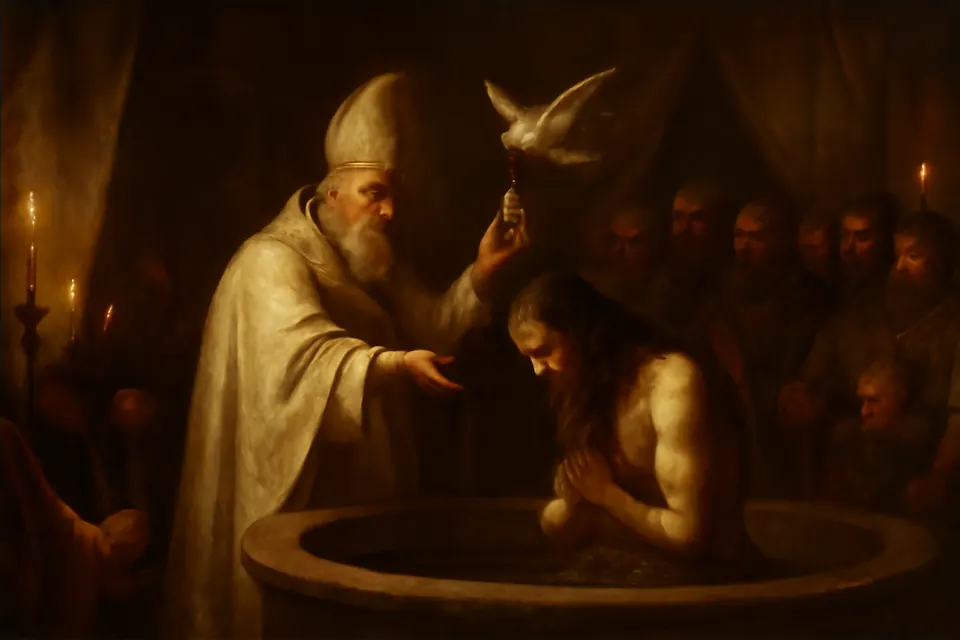
- The Holy Ampulla (traditional). In the 9th century Archbishop Hincmar of Reims wrote that at Clovis's baptism the cleric carrying the chrism could not get through the crowd, and a dove came down from heaven with a small flask of holy oil. The flask, the Sainte Ampoule, was kept at the Abbey of Saint-Remi and used to anoint the kings of France at Reims for centuries, until a revolutionary smashed it in 1793.
- The flasks filled by God (traditional). The Reims ivory also shows the Hand of God filling two flasks for him, one of the wonders of his medieval Life.
Why St. Remigius is a patron of France
Because the baptism of Clovis is remembered as the moment the Frankish kingdom became Catholic, French tradition honors Remigius, with St. Denis, St. Martin of Tours and St. Joan of Arc, among the patrons of the nation. Nominis names him patron of the Diocese of Reims, where French kings were crowned from the Middle Ages to 1825. When St. John Paul II visited Reims in 1996, it was for the 1,500th anniversary of the baptism of Clovis. See more on our patron saints page.
Symbols of St. Remigius in art
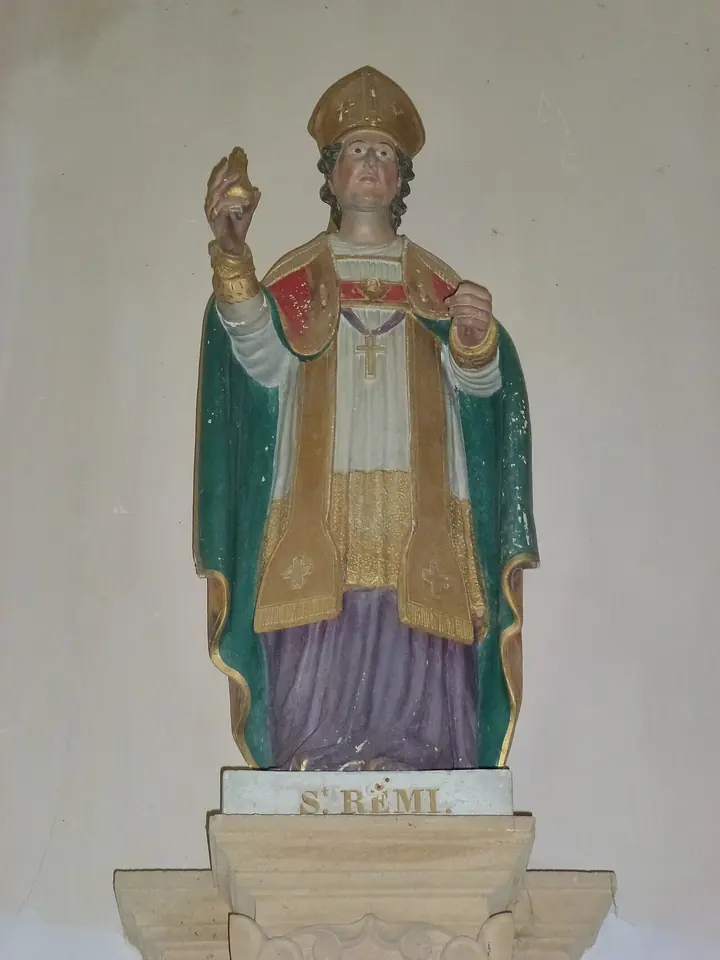
St. Remigius is a bishop with miter and crozier, often very old and white-bearded. His particular sign is the Holy Ampulla, a small flask of oil he holds up in his hand, as in the village statue below, or a dove bringing the flask down from heaven. Many pictures show him at the baptismal font pouring water over Clovis, who stands in the font wearing his crown. A French bishop raising a small flask is almost always St. Remi.
Feast day and where he is honored
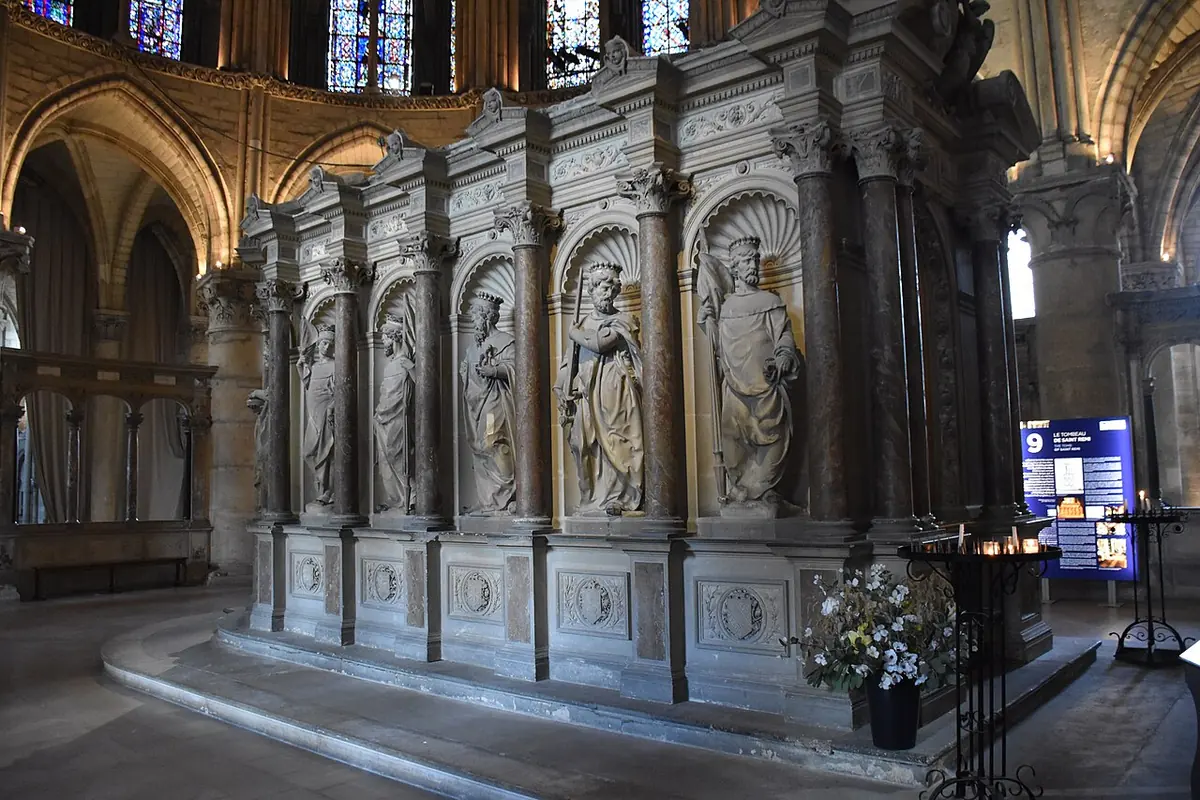
The Roman Martyrology remembers him on January 13; in France we keep his memorial on January 15, and Reims celebrates him on October 1. His body was kept at first in a chapel outside Reims; in 1049 Pope Leo IX consecrated the great Romanesque abbey church built over it and translated his relics there. That church is now the Basilica of Saint-Remi, a UNESCO World Heritage site, and his tomb stands in the choir. Find other January saints on our feast days page.
Prayer to St. Remigius
We know of no widely used traditional prayer to St. Remigius in English; on his feast the Church in France prays with the Common of Pastors for a bishop. His own counsel to Clovis can guide our prayer: to relieve the afflicted, protect widows and feed orphans. Let us ask St. Remigius, who brought a king and a people to the waters of baptism, to pray for France, for the Church in Europe, and for all who are preparing for baptism. St. Remi, pray for us.
Frequently asked questions
What did St. Remigius say when he baptized Clovis?
According to St. Gregory of Tours, Remigius said to the king as he came to the font: "Gently bend your neck, Sigamber; worship what you burned; burn what you worshipped." The Sicambri were an old Frankish people, and Remigius was telling the king to turn from his idols to Christ.
When is the feast of St. Remigius?
January 13 in the Roman Martyrology, the day he died. France keeps his memorial on January 15, because January 13 is St. Hilary's day, and the Archdiocese of Reims celebrates him on October 1, the anniversary of the translation of his relics, which was also his date in the older Roman Calendar.
What is the Holy Ampulla of St. Remigius?
The Holy Ampulla was a small glass flask of chrism used to anoint the kings of France at Reims. A traditional story first written down by Archbishop Hincmar of Reims in the 9th century says a dove brought it from heaven to Remigius at Clovis's baptism. The flask was broken in 1793 during the French Revolution.
Is Saint-Rémy-de-Provence named after St. Remigius?
Yes. The town in Provence, like many places called Saint-Rémy or Saint-Remi in France and Belgium, is named for St. Remigius of Reims.
Sources
- Gregory of Tours, History of the Franks, Book II, trans. Ernest Brehaut (1916), Medieval Sourcebook, Fordham University. The baptism of Clovis, the words at the font and the report of a raised dead man
- Joseph Dedieu-Barthe, "St. Remigius," The Catholic Encyclopedia, vol. 12 (1911)
- Joseph Dedieu-Barthe, "Abbey of Saint Remy," The Catholic Encyclopedia, vol. 12 (1911)
- Nominis (Conférence des évêques de France): Saint Remi, with the Roman Martyrology entry and his letter to Clovis. January 13 in the Martyrology, January 15 in France, October 1 in Reims