St. Margaret of Hungary

St. Margaret of Hungary (1242–1270) was the daughter of King Béla IV, promised to God by her parents in thanks for Hungary's deliverance from the Mongols. She lived from early childhood as a Dominican nun, most of her life in the convent on the Danube island in Buda now called Margaret Island, and refused a royal marriage. Pope Pius XII canonized her in 1943. Her feast is January 18.
Who was St. Margaret of Hungary?
St. Margaret of Hungary was a king's daughter who never lived as a princess. Her parents, King Béla IV and Queen Maria Laskarina, promised her to God before she was born, and she spent almost her whole life, from the age of three until her death at twenty-seven, as a Dominican nun. She is the niece of St. Elizabeth of Hungary, and Budapest's Margaret Island still bears her name.

A family of saints
Margaret was born into a remarkable family. Her father's sister was St. Elizabeth of Hungary, the princess who gave everything to the poor. Her older sister Kinga (Kunigunde) married the Polish duke Bolesław the Chaste, lived with him in consecrated continence and ended her days as a Poor Clare; St. John Paul II canonized her in 1999. Another sister, Yolanda, is honored as a blessed. In Hungary they are remembered together among the holy members of the House of Árpád.
A child promised to God
Margaret was born in 1242 at the fortress of Klis on the Dalmatian coast, where the royal family had fled from the Mongols, who had overrun Hungary the year before. The king and queen vowed that if their country was set free, their next child would be given to God. The Mongols withdrew, and the vow passed to the baby girl.
In 1245 her parents brought her to the Dominican nuns at Veszprém. The Catholic Encyclopedia says she was clothed in the habit at four. When she was about ten she moved to the new convent of the Blessed Virgin her parents had built on an island in the Danube near Buda, then called Rabbit Island. She lived there for the rest of her life.
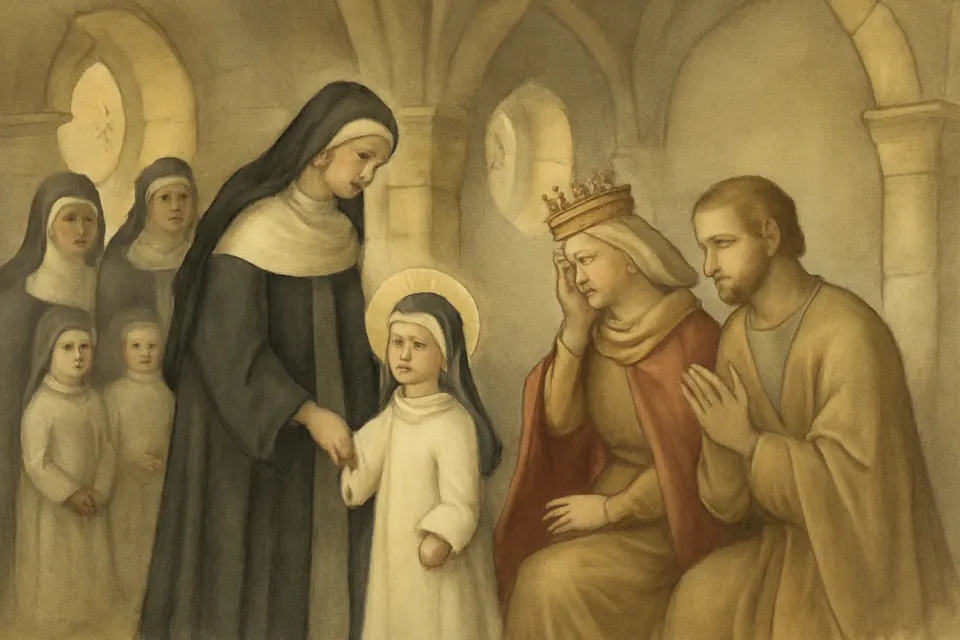
The Roman Martyrology says she "totally consecrated herself to God in religious profession" at twelve, "to ardently desire to assimilate to Christ crucified." The Dominican nuns of North Guilford write that she made her profession before Humbert of Romans, the Master of the Order, at the general chapter held in Buda in 1254.
A princess who said no to a crown
Béla IV loved his daughter, but he was a king, and a king's daughter was a treasure in his alliances. He wanted to marry her to King Ottokar II of Bohemia. Margaret refused. She had been given to Christ, and she would not be taken back. She appears to have made her solemn vows at eighteen, which closed the question.

Her life in the convent
The sisters who lived with her gave their testimony after her death, and it is vivid. Margaret took the lowest work in the house: scrubbing, carrying, caring for the sick, washing in winter until her hands bled from the cold. She refused fine clothes and royal comforts. She gave away whatever her family sent her to the poor. The North Guilford nuns record her remark that she would rather have the odor of sanctity in death than smell sweet only while alive.
Her penances were hard, and the Catholic Encyclopedia lists them plainly: a hair shirt, an iron girdle, shoes with nails, frequent scourging. We need not imitate them to honor her. They may well have shortened her life. Underneath them was a simple, burning love for Christ crucified and for the Eucharist.
She died in the convent on January 18, 1270, aged twenty-seven. (The Catholic Encyclopedia gives 1271.)

The miracles of St. Margaret of Hungary
Steps toward her canonization began almost at once, and an inquiry was held between 1271 and 1276. Its minutes record seventy-four miracles, most of them cures of illness and one a return from death. Twenty-seven of the witnesses were the people who had been healed. These miracles are reported: carefully taken down under oath, but the medieval process was never completed.
Later attempts in 1640 and 1770 also stalled. Pope Pius VI permitted her veneration as a saint in 1789, and Pope Pius XII canonized her in 1943, in the middle of the Second World War.
Relics and Margaret Island
When Emperor Joseph II dissolved Hungary's convents in 1782, her remains had already passed to the Poor Clares, who kept them in Pozsony (Bratislava) and later in Buda. The relics were destroyed in 1789, the very year her veneration was approved, but some portions survived and are kept at Esztergom, Győr and the Archabbey of Pannonhalma.
The ruins of her convent and church still stand on the island, which is now a park in the middle of Budapest. A marker shows where her tomb lay.
Symbols of St. Margaret of Hungary in art
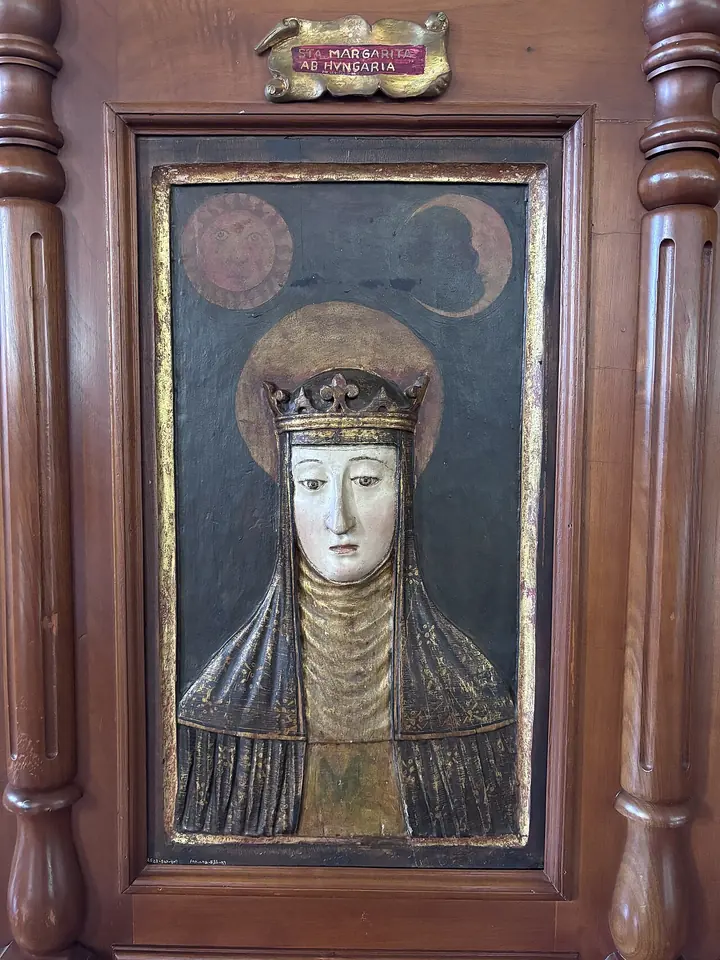
Margaret is shown as a young Dominican nun, in the white habit and black veil. The Catholic Encyclopedia notes that she is painted with a lily and a book. Look also for:
- A crown at her feet or above her veil: the royal life she refused.
- The double cross of Hungary: the arms of her family's kingdom.
- A crucifix: her devotion to Christ crucified.
Her image spread with the Dominicans as far as Quito in Ecuador, and in the 20th century Hungarian churches gave her stained-glass windows, like the one in the Votive Church of Szeged.

Feast day and prayer
We keep the feast of St. Margaret of Hungary on January 18, the day of her death. Hungarian Catholics honor her with a whole family of saints of the House of Árpád, among them St. Stephen and her aunt Elizabeth. You can find the other saints of mid-January on our feast days page.
There is no traditional prayer to St. Margaret with a known origin in common English use. Let us ask her prayers for young people discerning their vocation, for those tempted by the comforts of power, and for her homeland of Hungary.
Frequently asked questions
Who was St. Margaret of Hungary?
A princess of the House of Árpád, daughter of King Béla IV and Queen Maria Laskarina, niece of St. Elizabeth of Hungary. Her parents vowed her to God during the Mongol invasion, and she entered the Dominican nuns as a small child. She spent her life in prayer, penance and humble work and died in 1270, aged twenty-seven.
When is St. Margaret of Hungary's feast day?
January 18, the day she died, in the Roman Martyrology and the Dominican calendar.
When was Margaret of Hungary canonized?
The first inquiry began right after her death but was never finished. Pope Pius VI allowed her to be venerated as a saint in 1789, and Pope Pius XII canonized her in 1943, about seven centuries after her birth.
Is Margaret Island in Budapest named after her?
Yes. The island in the Danube, once called Rabbit Island, takes its name from her. The ruins of her convent church still stand there.