St. Clement of Rome
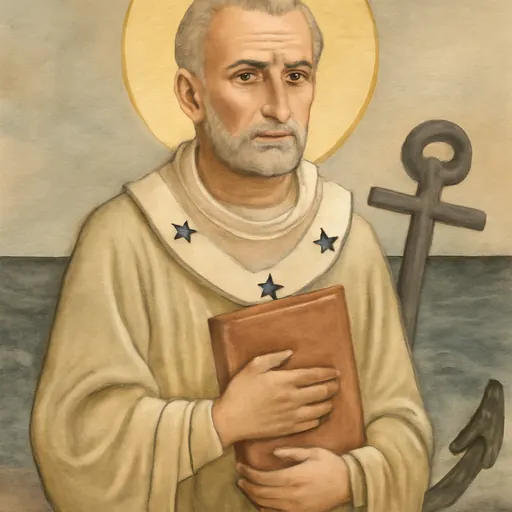
St. Clement of Rome, also called Pope St. Clement I, was a bishop of Rome at the end of the first century and the author of the Letter to the Corinthians, written about 96, one of the oldest Christian writings outside the New Testament. His feast day is November 23. Tradition says he died in exile in the Crimea, thrown into the sea with an anchor, which made him a patron saint of sailors.
Who was St. Clement of Rome?
Clement was a leader of the Church in Rome in the last years of the first century. The Catholic Encyclopedia calls him "the first of the successors of St. Peter of whom anything definite is known," and he heads the list of the Apostolic Fathers, the generation of writers who had known the apostles or their disciples. He left one letter that is certainly his, written to the Christians of Corinth around the year 96. Almost everything else told about him is legend, some of it very old.
He is not Clement of Alexandria, the Egyptian theologian who died around 215. Writers in Latin called our Clement Clemens Romanus, "Clement the Roman," to keep the two apart.


St. Clement's life: what history can tell us
One of the first bishops of Rome
The oldest witness is St. Irenaeus of Lyon, writing around 180. In his book Against Heresies he gives the line of Roman bishops: after the apostles came Linus, then Anacletus, and "in the third place from the apostles, Clement was allotted the bishopric." Irenaeus adds a detail that made Clement precious to later Christians:
This man, as he had seen the blessed apostles, and had been conversant with them, might be said to have the preaching of the apostles still echoing [in his ears], and their traditions before his eyes.
That order, Linus, Cletus (another form of Anacletus), Clement, is the one still said in the Roman Canon of the Mass. Other early lists differ. Tertullian, around 199, reports that the Roman Church claimed Peter ordained Clement himself, and St. Jerome says that in his day "most of the Latins" counted Clement as Peter's immediate successor. Benedict XVI, in a 2007 audience, followed Irenaeus and called him "the third Successor of Peter, after Linus and Anacletus." See St. Irenaeus for the bishop who preserved that list.
Dates are uncertain. Working from the second-century writer Hegesippus, the Catholic Encyclopedia concludes that around 160 Christians believed Clement died in 99, the second year of the emperor Trajan. The Orthodox Church in America gives his years as bishop as 92 to 101.
Who he was before
Nobody knows. Origen and Eusebius identified him with the Clement whom St. Paul calls a fellow worker in Philippians 4:3, though that man was probably a Philippian. Nineteenth-century writers liked to make him the consul Titus Flavius Clemens, a cousin of the emperor Domitian, executed in 95. The Catholic Encyclopedia rejects both ideas and suggests he was more likely a freedman, or the son of one, from the vast imperial household. His letter quotes the Old Testament so constantly that the English bishop and scholar J. B. Lightfoot thought he was of Jewish origin.
The Letter to the Corinthians
Around 96 the Church of Corinth, the same community Paul had scolded forty years earlier, was split again. A few members had pushed out their presbyters. The Church of Rome wrote to restore peace, and every early writer names Clement as the author. Benedict XVI, following the usual dating, placed it "immediately after the year 96," just after Domitian's persecution, which the letter calls "the sudden and repeated calamities and reverses which are befalling us."

The letter is long, earnest and full of Scripture. It names the messengers carrying it, Claudius Ephebus and Valerius Bito, men who had "walked among us from youth unto old age unblameably." It is also the earliest witness outside the New Testament to the deaths of St. Peter and St. Paul, "the greatest and most righteous pillars of the Church," who "contended even unto death." And it gives one of the first descriptions of apostolic succession: the apostles appointed bishops and deacons and provided that "other approved men should succeed to their ministration."
Its most quoted passage is a hymn to love that echoes 1 Corinthians 13. In Lightfoot's translation (1890):
Love joineth us unto God; love covereth a multitude of sins; love endureth all things, is long-suffering in all things. There is nothing coarse, nothing arrogant in love. Love hath no divisions, love maketh no seditions, love doeth all things in concord.
Near the end comes a long prayer that scholars compare to the prayers of early liturgies. Benedict XVI singled it out as the "great prayer" with which Clement closes the letter. Part of it reads:
We beseech Thee, Lord and Master, to be our help and succor. Save those among us who are in tribulation; have mercy on the lowly; lift up the fallen; show Thyself unto the needy; heal the ungodly; convert the wanderers of Thy people; feed the hungry; release our prisoners; raise up the weak; comfort the fainthearted.
Corinth treasured it. Around 170, Bishop Dionysius of Corinth wrote to Rome that the letter "written through Clement" was still read aloud in church on Sundays. A Greek manuscript of the whole Bible from the 5th century, the Codex Alexandrinus, even bound it in with the New Testament. Lightfoot called the letter's confident tone "the first step towards papal domination," and Benedict XVI, from the other side, called it "a first exercise of the Roman primacy after St Peter's death." Protestant and Catholic readers disagree about what that authority meant, but they agree the letter is genuine and very early.

Other works were later published under his name: a sermon called the Second Epistle of Clement, two letters on virginity, and the Clementine Recognitions, a novel-like story of Clement's family. None of them is by him.
The legend of St. Clement's martyrdom
Clement is first called a martyr around 400, by Rufinus, and in 417 Pope Zosimus chose Clement's church for a trial because, he said, Clement had learned the faith from Peter and given his life for it. The full story comes from the Greek Acts of Clement, which the Catholic Encyclopedia says is "not older than the fourth century." Everything in this section is traditional.
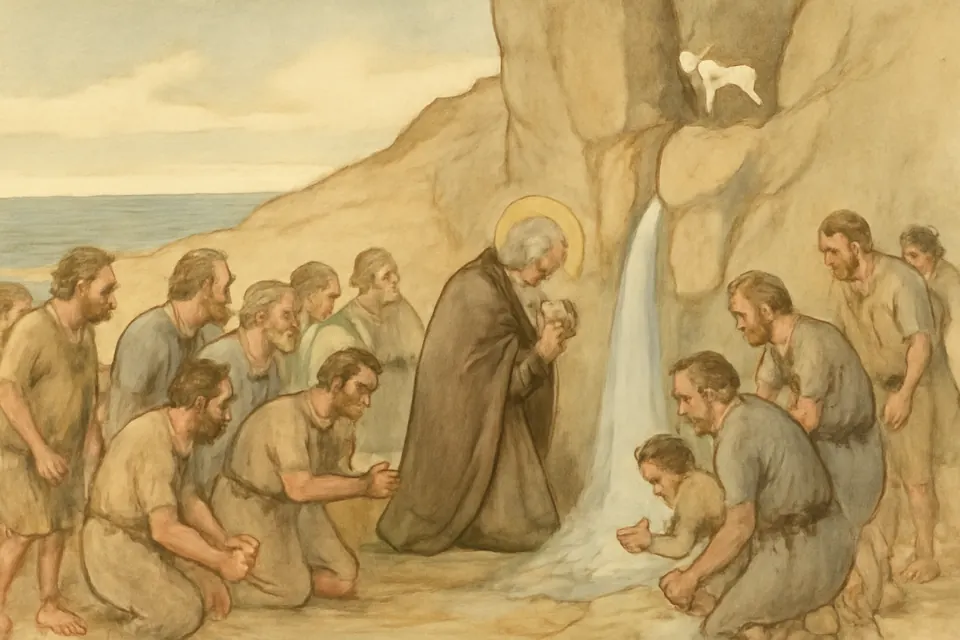
The Acts say Clement converted Theodora, the wife of a courtier named Sisinnius, and then Sisinnius himself. The emperor Trajan banished Clement to a stone quarry near Chersonesus in the Crimea. He found two thousand Christian prisoners there suffering from thirst. In the Orthodox telling, he prayed with them, the Lord appeared to him in the form of a lamb and showed him the place of a spring, and "a veritable river of water" gushed out. So many people were converted that seventy-five churches were built.
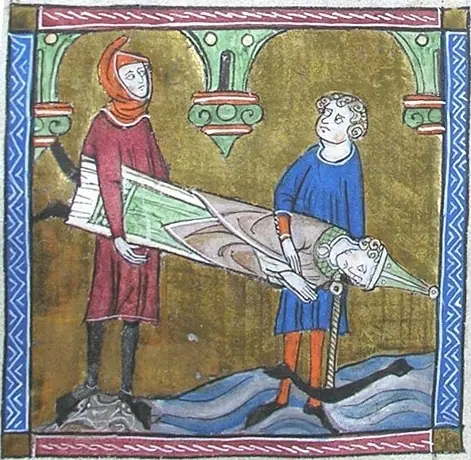
Trajan's officials then had Clement thrown into the sea with an iron anchor tied to his neck. His disciples prayed, and the sea drew back, revealing a marble shrine shaped like a church, which the Orthodox life calls an "Angelic Church" formed by God, with his body inside. For years afterward the tide is said to have withdrawn on his feast so that pilgrims could walk out and pray at the tomb. One legend, painted in San Clemente, tells of a child left behind when the water returned and found alive a year later.

The Catholic Encyclopedia notes that modern critics wonder whether the martyrdom story borrowed from the execution of the consul Flavius Clemens, but it adds that the lack of any tradition of a grave in Rome favors his having died in exile.
Sts. Cyril and Methodius and the relics
Around 861, on a mission to the Khazars, the brothers Cyril and Methodius stopped at Chersonesus. According to Cyril's own report, as the Basilica of San Clemente retells it, he recovered the body of St. Clement there, together with the anchor. The Catholic Encyclopedia says he dug the bones from a mound on dry land, not from a tomb under the sea, and calls the story of the translation "evidently quite truthful," while doubting that the bones can be proved to be Clement's.
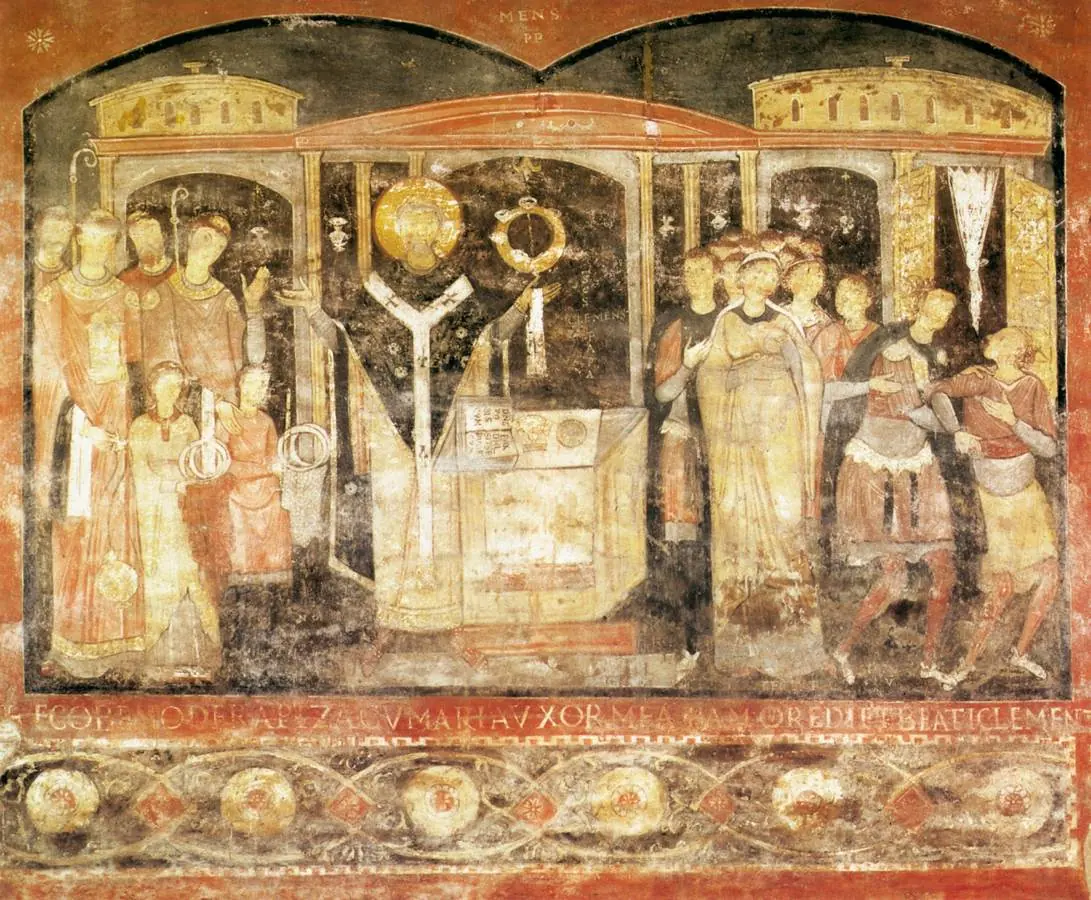
The brothers carried the relics to Rome, arriving in 868, and Pope Hadrian II went out in procession to meet them. The relics were laid in the basilica of St. Clement, where St. Ignatius of Antioch also rests. Cyril died in Rome a year later and was buried in the same church. The Orthodox life adds that part of the relics went to Constantinople and later to Kyiv. You can read the whole story in our entry on Sts. Cyril and Methodius.
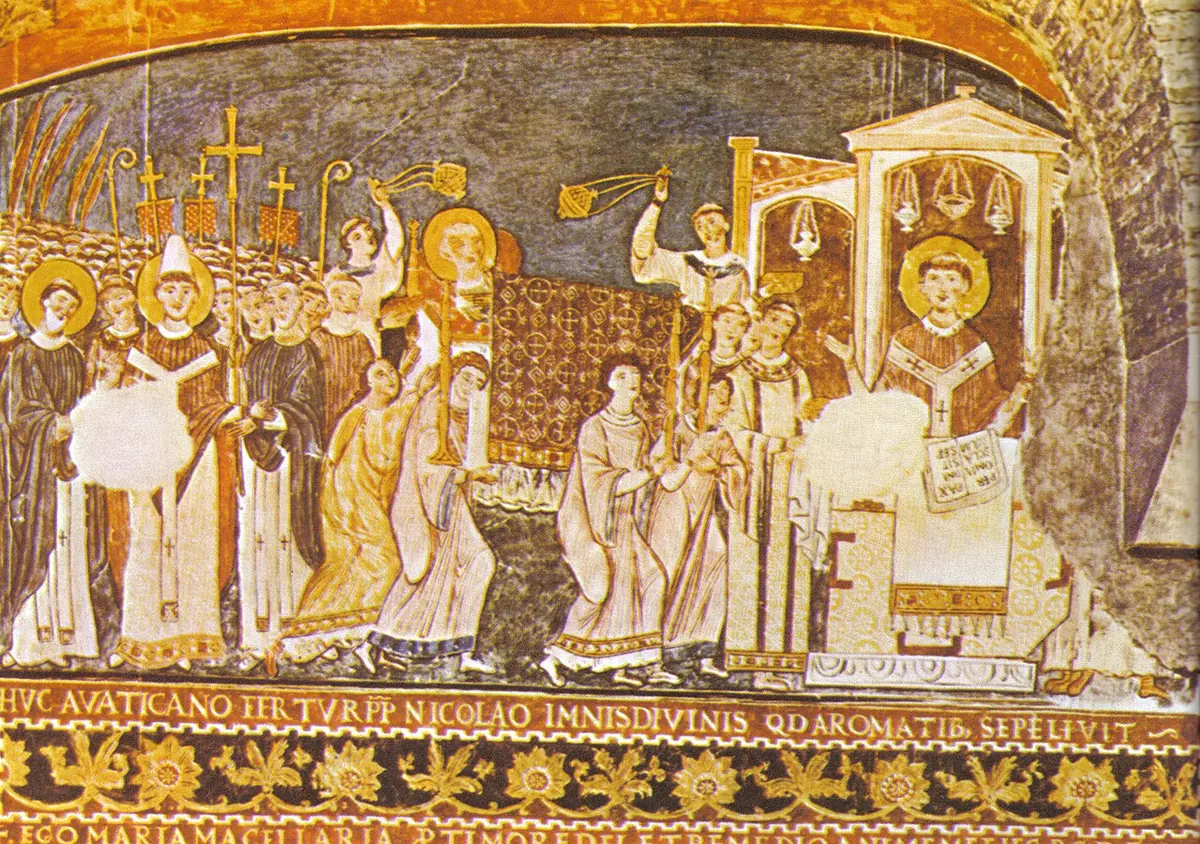

The basilica's own guide points out that the painter labeled the pope "Nicholas," though it was Hadrian II who received the brothers.
Why St. Clement is the patron saint of sailors
The anchor of his legend made him a patron of sailors and mariners, and many port towns and seamen's churches took his name. The quarry of the Crimean legend made him a patron of stonecutters. The Roman Martyrology for November 23 sums up the tradition: during Trajan's persecution he was sent to Chersonesus, "an anchor was tied onto his neck and he was thrown into the sea." Find other patrons of the sea on our patron saints page, including St. Nicholas.
Symbols of St. Clement in art
Clement is shown as a pope or bishop, and the clues are these:
- The anchor: his chief attribute, from the legend of his drowning. He may hold it, have it at his feet or have it tied around his neck. Don't confuse him with St. Nicholas, who also protects sailors but is shown with three gold balls or a ship.
- Papal tiara and vestments: in Western art from the Middle Ages on, as the early pope he was. In older images he wears a simple chasuble and pallium.
- A book or letter: his Letter to the Corinthians, or the Gospel book of a bishop.
- The sea, a boat or a sea-shrine: in story scenes of his drowning or of the shrine revealed by the receding tide.
- The palm of martyrdom or a martyr's crown. In the 6th-century mosaics of Sant'Apollinare Nuovo in Ravenna he leads the procession of martyrs carrying their crowns.
Eastern icons show him as a hierarch in an omophorion, often beardless or short-bearded, holding a Gospel book, like the Santa Maria Antiqua fresco near the top of this page. In Tiepolo's altarpiece he is an old pope in a golden cope, kneeling on red altar steps.


St. Clement's feast day and the Basilica of San Clemente
His feast is November 23, an optional memorial in the General Roman Calendar. Most Byzantine churches keep it on November 24, and the Russian Orthodox Church on November 25. See his neighbors on our feast days page; St. Cecilia comes the day before.
The Basilica of San Clemente stands between the Colosseum and the Lateran. It is really three buildings stacked one on another. The present church, with its marble choir and gold apse mosaic, was built in the early 12th century under Pope Paschal II. Beneath it lies a 4th-century basilica, rediscovered in 1857 by the Irish Dominican prior Joseph Mullooly, with some of the largest groups of early medieval frescoes in Rome. Below that are first-century Roman rooms and a shrine of the god Mithras. St. Jerome already knew the church in the 390s; he wrote that a church built in Rome kept the memory of Clement's name. Irish Dominicans have looked after it since the 17th century.
The basilica says Clement's relics lie beneath the high altar. On November 23 they are exposed for veneration and carried in procession through the nearby streets.


Prayer to St. Clement
There is no widely used traditional prayer to St. Clement in English. Catholics honor him on November 23 with the Mass of the day, and his name is remembered in every celebration of the Roman Canon among the first bishops of Rome. Orthodox Christians sing the troparion of the hieromartyr on his feast.
Many readers instead pray with Clement, using the words of his own letter. The great prayer quoted above, which asks God to "lift up the fallen" and "comfort the fainthearted," is one of the oldest Christian prayers to survive outside the New Testament.
Frequently asked questions
When is St. Clement of Rome's feast day?
November 23 in the Catholic Church, where it is an optional memorial, and in the Anglican and Lutheran calendars. Most Byzantine churches remember him on November 24, and the Russian Orthodox Church and the Orthodox Church in America on November 25.
Was St. Clement the fourth pope?
Yes, in the usual count. St. Irenaeus, writing around 180, lists Linus, Anacletus and then Clement as bishops of Rome after the apostles, which makes Clement the fourth bishop counting St. Peter. The same order is named in the Roman Canon of the Mass ("Linus, Cletus, Clement"). Some early writers, Tertullian among them, say Peter ordained Clement himself.
Why is St. Clement shown with an anchor?
Because of the legend of his death. The Greek Acts of his martyrdom, which the Catholic Encyclopedia dates no earlier than the 4th century, say the emperor Trajan exiled him to the Crimea and had him thrown into the sea with an iron anchor. The story is traditional, but the anchor has been his emblem ever since, and it made him a patron of sailors.
Is St. Clement of Rome the same as Clement of Alexandria?
No. Clement of Alexandria was a theologian and teacher in Egypt who died around 215, more than a century later. He quoted Clement of Rome's letter but is a different man. The Latin name "Clemens Romanus" was used for centuries precisely to tell the two apart.
What did St. Clement write?
Only one writing is certainly his, the First Epistle of Clement to the Corinthians, sent from the Church of Rome around 96 to settle a revolt against the leaders of the Church in Corinth. The so-called Second Epistle of Clement is an anonymous sermon, and the Recognitions and Homilies that carry his name are later romances.
Sources
- Catholic Encyclopedia (1908): Pope St. Clement I
- Benedict XVI, General Audience of 7 March 2007: Saint Clement, Bishop of Rome
- First Clement, translated by J. B. Lightfoot (Early Christian Writings)
- St. Irenaeus, Against Heresies, Book III, chapter 3 (New Advent)
- Orthodox Church in America: Hieromartyr Clement, Pope of Rome
- Basilica di San Clemente: Key Figures
- Basilica di San Clemente: The Frescos of the Lower Basilica
- Christian Iconography: St. Clement in Art
- Roman Martyrology, November 23