St. Sava of Serbia
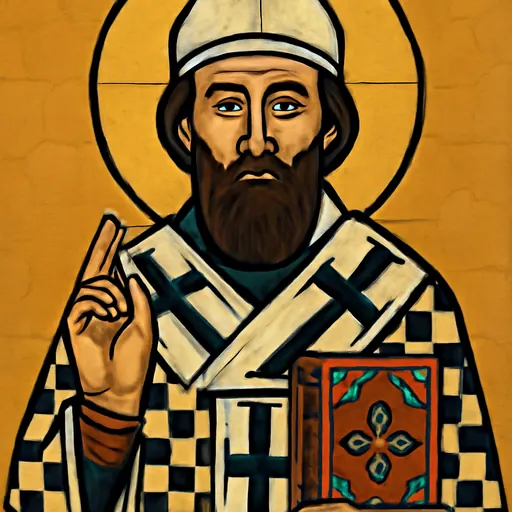
St. Sava (1169–1236) was a Serbian prince, the youngest son of Stefan Nemanja, who became a monk on Mount Athos, founded the monastery of Hilandar with his father and in 1219 became the first Archbishop of the self-governing Serbian Orthodox Church. He gave Serbia its church law and is honored as the patron of Serbia and of Serbian schools. His feast day is January 14 (January 27 on the civil calendar, called Savindan).
Who was St. Sava?
St. Sava is the best-loved saint of the Serbian people. Born a prince, the youngest son of Grand Prince Stefan Nemanja, he ran away as a teenager to become a monk on Mount Athos, persuaded his own father to follow him into monastic life, and founded with him the monastery of Hilandar, which is still the spiritual home of Serbian monks. In 1219 he was consecrated the first Archbishop of the autocephalous, or self-governing, Serbian Church. He organized its dioceses, gave it a book of church law and taught a young nation how to live as Christians.
The Orthodox Church calls him Sava the Enlightener and keeps his feast on January 14. In Serbia, which follows the Julian calendar, that day falls on January 27, and every school in the country keeps it as Savindan.
Two medieval monks of Hilandar, Domentijan and Teodosije, wrote his life in the 13th century, within living memory of the saint. Later Orthodox lives, such as the Prologue from Ohrid by St. Nikolai Velimirovich, draw on them. Historians sometimes differ on dates: his birth is placed in 1169 or 1174, and his death in 1235 or 1236.

The life of St. Sava
The prince who ran away to Athos
He was baptized Rastko. His parents were Stefan Nemanja, founder of the Nemanjić dynasty, and his wife Anna. As a youth he was given the land of Hum, near the Adriatic, to govern, but the Holy Trinity Orthodox Church life says worldly power held no interest for him.
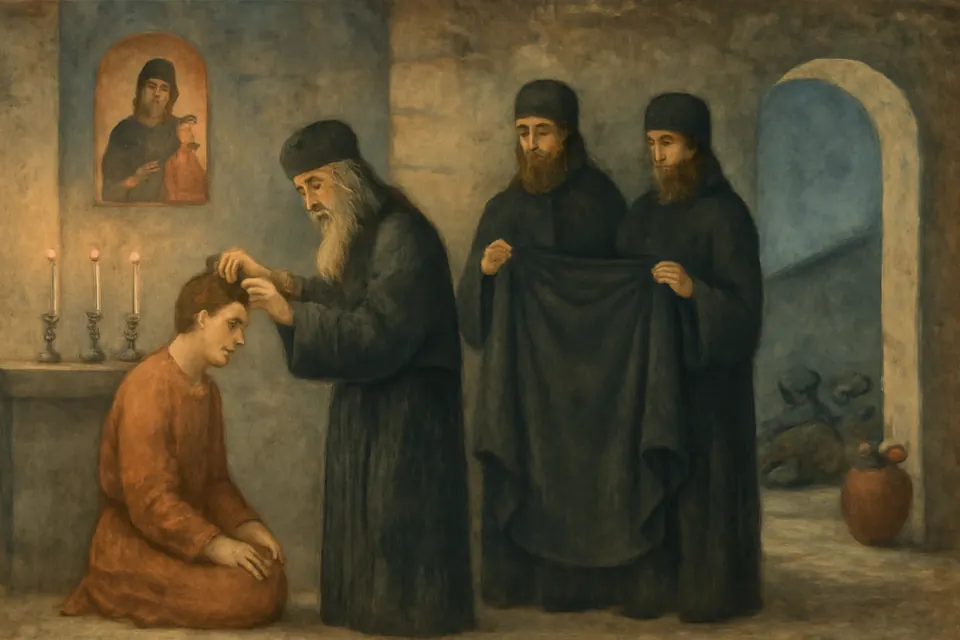
When he was about seventeen he met monks from Mount Athos and secretly left his father's house with them. The Orthodox life tells what happened next. Nemanja sent soldiers to bring the boy home. They found him at the Russian monastery of St. Panteleimon, but during the evening services, while the soldiers slept off their wine, the monks tonsured the prince. He took the name Sava, after St. Sabbas the Sanctified, and sent his worldly clothes and his cut hair home to his parents with a letter.
Father and son at Hilandar
Sava kept writing to his parents, urging them toward the monastic life. In 1196 Stefan Nemanja did something few rulers have done: he gave up his throne to his middle son, Stefan, and became a monk named Simeon. His wife Anna took the veil as the nun Anastasia. Simeon joined his son on Athos.
Together they restored an abandoned monastery, Hilandar, which the Byzantine emperor granted to them as a home for Serbian monks. Sava wrote its rule, its typikon.

The Holy Trinity life records a tender detail: the old monk Simeon could not keep all the fasts and vigils of younger men, so Sava doubled his own labors and told his father, "I am your ascesis." Simeon died in about 1200, and the Orthodox Church honors him as St. Simeon the Myrrh-streaming.
Peacemaker at his father's tomb
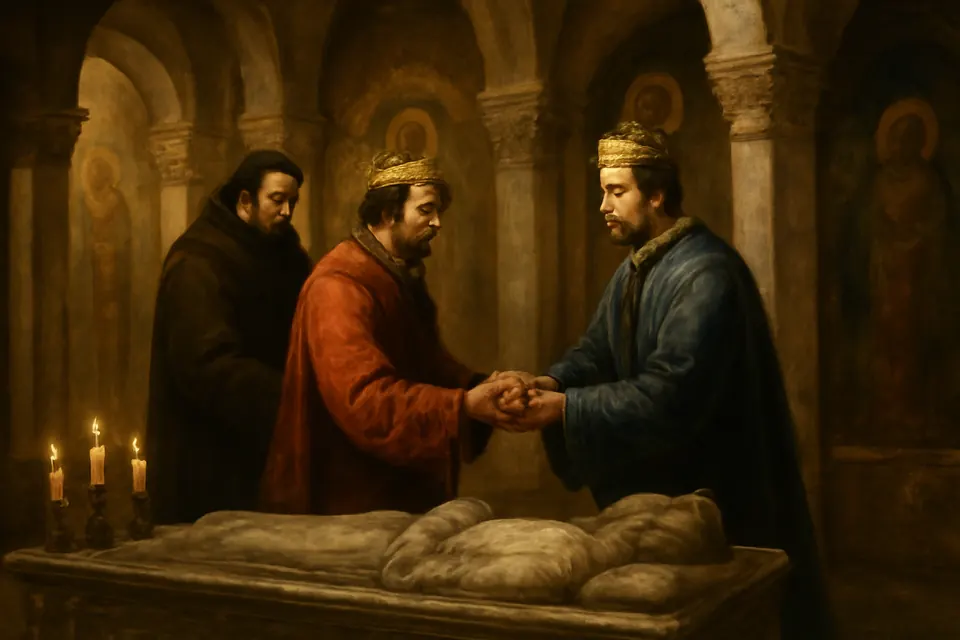
Back in Serbia, Sava's older brothers Vukan and Stefan went to war over the throne. Sava came home, bringing Simeon's relics with him, and the two brothers made peace over their father's tomb at Studenica Monastery. The Orthodox life says that when Sava censed the tomb, the relics gave off fragrant myrrh. Sava stayed on as abbot of Studenica, and the people of Serbia would not let him go back to the Holy Mountain for many years.
First Archbishop of Serbia
Sava wanted Serbia to have its own church, governed by its own bishops and rooted in the Orthodox East. In 1219, on the feast of the Dormition of the Theotokos, the Ecumenical Patriarch, then living in exile at Nicaea, consecrated him Archbishop of Serbia, and the emperor agreed that future Serbian archbishops could be chosen and consecrated at home. The Holy Trinity life notes that he accepted the office against his will.
He came home, consecrated bishops from among his own disciples and sent them out to new dioceses across the land. He crowned his brother Stefan king, and later his nephew Vladislav. The Orthodox life says he reformed monastic life on the model of Athos and Palestine and built and consecrated many churches.

Last pilgrimage and repose
Sava made two pilgrimages to the Holy Land. Before the second he handed the archbishopric to his disciple Arsenije. He traveled through Palestine, Egypt, Sinai and Syria, gathering relics and talking with ascetics. On the way home he stopped in Tarnovo, the Bulgarian capital, as the guest of Tsar Ivan Asen II. The Prologue from Ohrid says he fell ill after the Divine Liturgy on the feast of Theophany and died there on January 14, 1236.
St. Sava's Nomocanon and Serbian learning
Sava was a writer and a lawgiver as well as a pastor. He wrote the life of his father, St. Simeon, one of the first works of Serbian literature. For his new church he compiled a Nomocanon, a book of church canons with Byzantine commentary, known in Serbian as the Zakonopravilo. The OCA life describes how far it reached: a copy went from Bulgaria to Metropolitan Cyril of Kiev in 1270, and from it came the Russian Church's book of canons, printed in 1653 and reprinted many times since. Hilandar still lives by his typikon.

This is why Serbs remember him as the father of their schools and their learning, and why children sing to him on his feast.
The miracles of St. Sava
The Orthodox Church has no formal investigation of miracles like the Catholic canonization process, and Sava was honored as a saint from his death. Sorted by the labels this encyclopedia uses:
- The myrrh from St. Simeon's relics: traditional. The Orthodox life says the relics gave off fragrant myrrh as Sava censed his father's tomb.
- The Theotokos in a dream: traditional. As he left Athos, sad to go, the Mother of God told him in a dream, "Having My Patronage, why do you remain sorrowful?" He commissioned icons of Christ and the Theotokos at Thessalonica in thanksgiving.
- Healings at the translation of his relics: traditional. When his body was carried from Tarnovo to Mileševa in 1237, the OCA life says, so many were healed that the Bulgarians complained that their tsar "had given up such a treasure."
- Healings at his tomb at Mileševa: reported. The Orthodox life says his relics at Mileševa bestowed healing on all who approached with faith, and pilgrims came to his tomb for centuries.
The burning of St. Sava's relics
For more than 350 years Sava's relics lay at Mileševa, a pilgrimage site for all the peoples of the Balkans. In 1594 Serbs in the Banat rose against Ottoman rule and carried banners bearing his image. In reprisal, Sinan Pasha had the relics brought to Belgrade and burned on the Vračar plateau on April 27. The Prologue from Ohrid gives the year as 1594 in its April entry and 1595 in its January entry, and historians still debate both the year and the exact spot.
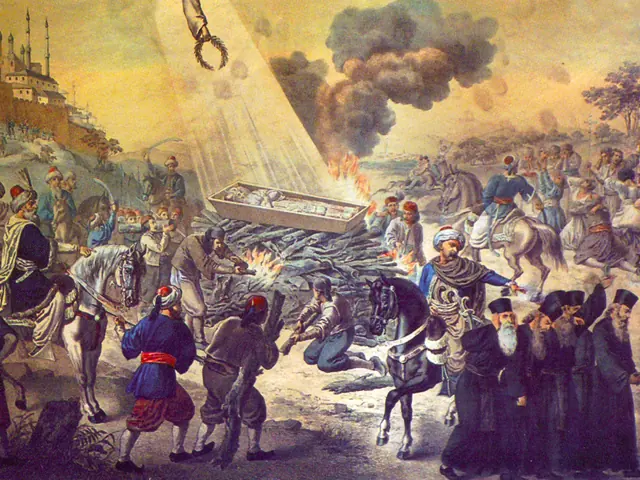
The Prologue says it plainly: the pasha "did not burn the saint who remained alive before the Throne of God in the heavens and in the hearts of his people on earth." The Serbian Church remembers the burning every April 27 (May 10 civil date).
Symbols of St. Sava in art
Hardly a Serbian church lacks his image. To recognize him:
- Archbishop's vestments: a white sakkos or phelonion patterned with black crosses, and an omophorion, the bishop's stole, around his shoulders.
- A Gospel book or scroll: the book of a teacher and lawgiver. At Peć his scroll carries words of instruction.
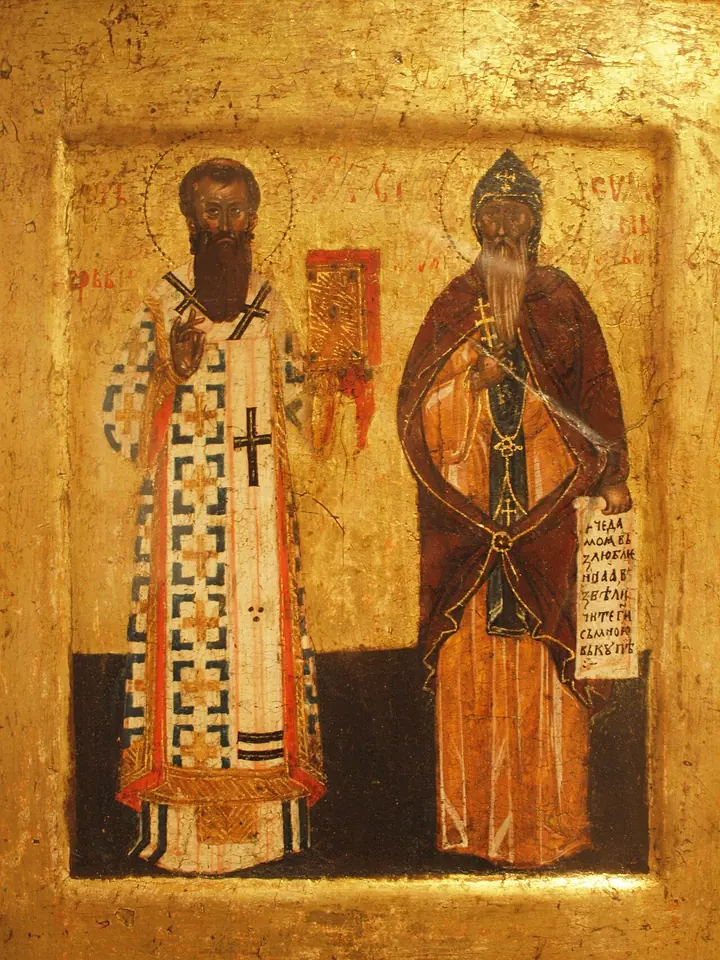
- His father beside him: Sava and St. Simeon are often painted as a pair, Sava as a bishop and Simeon as a monk in a dark habit, as in the Belgrade icon above.
- Hilandar: the two sometimes hold the monastery between them, or the Three-handed Theotokos, the Hilandar icon Sava brought back from Palestine.
- The beard: in the oldest frescoes, such as Mileševa, he has a short dark beard; later icons give him a long gray beard.
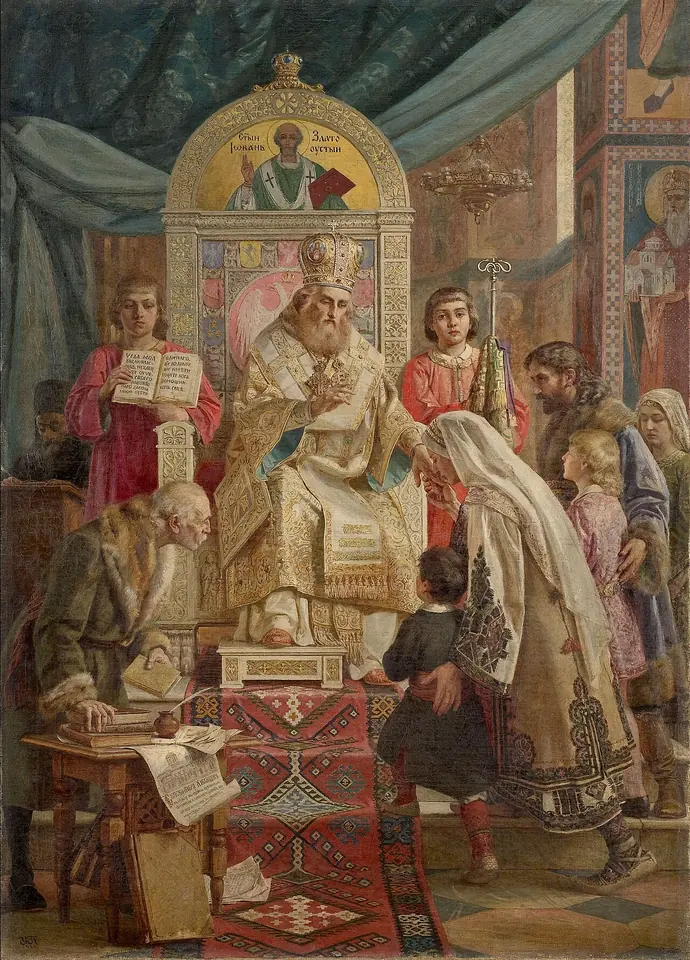
Eastern icons follow these old patterns closely. Modern Serbian painters, like Uroš Predić, added scenes of Sava blessing children and teaching.
Savindan and where St. Sava is honored
Savindan, January 27 on the civil calendar, is the great school feast of the Serbian world. Schools in Serbia and in the Serbian diaspora hold a church service, bless the slava bread and wheat, and the children give recitals and sing the hymn to St. Sava. Lessons are not held that day.
The Church of St. Sava in Belgrade stands on the Vračar plateau, where tradition places the burning of his relics. Building began in 1935 and, after long interruptions through war and communist rule, the exterior was finished in 2004. It is one of the largest Orthodox churches in the world. Mileševa Monastery, where he lay for centuries, and Hilandar on Mount Athos, which he founded, are the other great places of pilgrimage.

Prayer to St. Sava
The Orthodox Church honors St. Sava with the troparion and kontakion of his feast. In the English translation used by the Orthodox Church in America, the troparion (Tone 4) reads:
In truth you were revealed to your flock as a rule of faith, / an image of humility and a teacher of abstinence; / your humility exalted you; / your poverty enriched you. / Hierarch Father Savva, / entreat Christ our God / that our souls may be saved.
And the kontakion (Tone 2):
O Hierarch Savva, divine thunder, spiritual trumpet, / planter of faith and pruner of heresies, great favorite of the Trinity, / while standing with the Angels before God, / pray unceasingly for us all.
On his feast, and whenever we need a teacher of humility, let us ask Holy Father Sava to pray to Christ our God for us.
Frequently asked questions
When is St. Sava's feast day?
January 14. The Serbian Orthodox Church follows the Julian calendar, so in Serbia and in Serbian parishes worldwide Savindan is celebrated on January 27 of the civil calendar. Orthodox churches on the revised calendar keep it on January 14. A second day, April 27 (May 10 civil date), remembers the burning of his relics.
What is Savindan?
Savindan, "Sava's Day," is the feast of St. Sava on January 27 (civil date). Because Sava is honored as the father of Serbian education, Serbian schools keep the day as their patron feast, with a church service, the blessing of the slava bread and recitals by the children. Classes are not held, but schools stay open for the celebration.
Why is St. Sava important to Serbia?
He won independence for the Serbian Church in 1219, became its first archbishop, set up its first dioceses, gave it a law code (the Nomocanon, or Zakonopravilo) and wrote the life of his father, one of the first works of Serbian literature. He also made peace between his quarreling brothers and crowned his brother Stefan king.
What happened to St. Sava's relics?
He died in Tarnovo, Bulgaria, and in 1237 his body was moved to Mileševa Monastery in Serbia. In 1594, after Serbs rose against the Ottomans carrying banners with his image, Sinan Pasha had the relics taken to Belgrade and burned on the Vračar plateau. The Church of St. Sava now stands on that plateau.
Is St. Sava a Catholic saint?
St. Sava is a saint of the Orthodox Church, and the Serbian Orthodox Church is his spiritual home. He lived after the break of 1054 and served within the Orthodox Church all his life.
Sources
- Orthodox Church in America: Saint Savva I, first Archbishop of Serbia
- Orthodox Church in America: Saint Savva I, Troparion and Kontakion
- Prologue from Ohrid (Bishop Nikolai Velimirovich): St. Sava, Archbishop of Serbia
- Prologue from Ohrid: The Burning of the Relics of Saint Sava, April 27
- Holy Trinity Orthodox Church: St. Sava I, enlightener and first archbishop of Serbia