Eusebio Kino
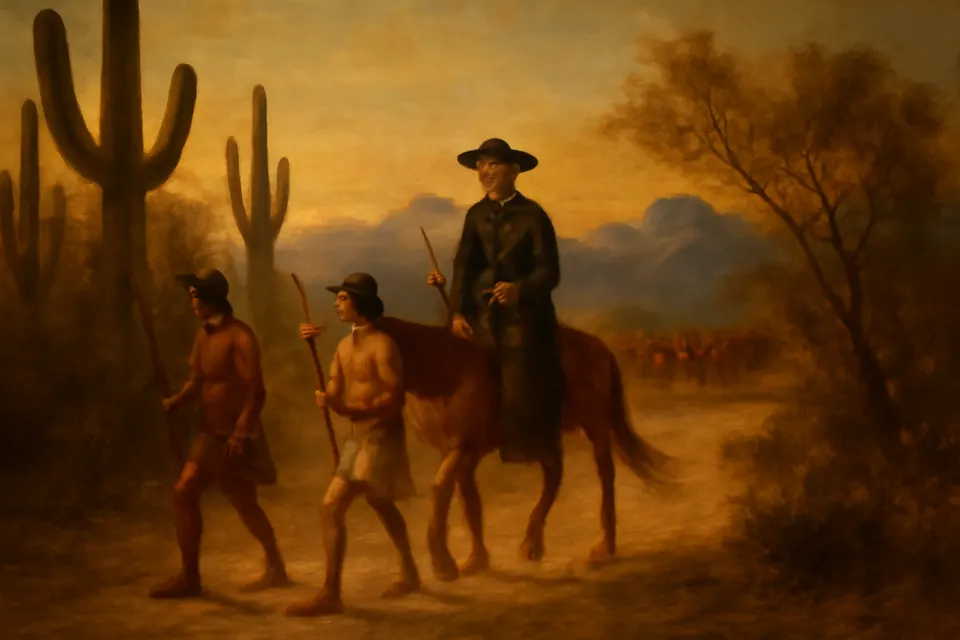
Eusebio Kino (1645–1711), known as Padre Kino, was an Italian-born Jesuit missionary, mapmaker and rancher who spent 24 years among the O'odham peoples of the Pimería Alta, today southern Arizona and northern Sonora. He founded missions including San Xavier del Bac, showed by land that California is not an island, and died at Magdalena, Sonora. Pope Francis declared him Venerable in 2020; he is not yet Blessed or a saint.
Who was Eusebio Kino?
Eusebio Francisco Kino was a Jesuit priest from the Italian Alps who became the great missionary of the Pimería Alta, the desert country of the O'odham (Pima) peoples that is now southern Arizona and northern Sonora. From 1687 until his death in 1711 he rode its trails, founded missions, baptized, built churches, raised cattle for the people of his missions and drew the first accurate maps of the region. The people of Arizona and Sonora still call him Padre Kino.
He is not yet a saint. The Church has declared him Venerable, which means that after a long study of his life, the Pope has recognized that he lived the Christian virtues to a heroic degree. We can admire him, imitate him and ask him privately to pray for us while his cause goes forward.
From Segno to Ingolstadt
He was born Eusebio Chini on August 10, 1645, in Segno, a village in the Val di Non above Trent, then part of the Tyrol. Kino is the Spanish form of his family name. He entered the Society of Jesus in the Upper German Province on November 20, 1665, and studied in Germany, where he did brilliant work in mathematics.
He owed his vocation, he said, to St. Francis Xavier. In his own account of the missions, the Favores Celestiales, he wrote: "To the most glorious and most pious thaumaturgus and Apostle of the Indies, San Francisco Xavier, we all owe very much. I owe him first my life, which I was caused to despair of by the physicians in the city of Hala, of Tirol, ... second, my entry into the Company of Jesus; and third, my coming to these missions." In gratitude he added Francisco to his name.
Herbert Bolton, the historian who rescued Kino's writings, records that in 1676 the Duke of Bavaria and the Elector, after a conversation about mathematics, offered him a professorship at the University of Ingolstadt. He turned it down. He wanted the missions.

The road to New Spain
Kino hoped to be sent to the missions of the Far East, but he was assigned to the Spanish missions in the Americas. Delays kept him in Spain until 1681. At Cádiz he watched the great comet of 1680, and in Mexico City he published an astronomical study of it. He arrived in Mexico on May 3, 1681, and soon went north with the Atondo expedition to Baja California, which tried and failed to plant a lasting mission there.
Padre on horseback in the Pimería Alta
On March 13, 1687, Kino entered the Pimería Alta and founded his first mission, Nuestra Señora de los Dolores, Our Lady of Sorrows, in the valley of the San Miguel River in Sonora. His first convert was a chief named Coxi. Dolores was his home for the rest of his life, and Bolton called it "mother of them all."
Before he even arrived, he had fought for the people he would serve. Spanish settlers took Native men away to work in the silver mines. Kino asked the royal court at Guadalajara for an order that, for five years, no natives would be taken to work from the places where he went. A royal decree of May 14, 1686, which he copied with joy into his memoir, went further: for twenty years recent converts were not to be taken away for forced labor.
In 1691, on a journey north with the Jesuit visitor Juan María de Salvatierra, messengers from the villages of the Santa Cruz valley came to meet them, kneeling and offering crosses, and begged the priests to visit their people too. Salvatierra told Kino "that those crosses which they carried were tongues that spoke volumes and with great force." They went, to the village of San Cayetano del Tumacácori, in what is now Arizona.

In April 1700 he founded the mission of San Xavier del Bac, south of today's Tucson, and within two years those of Tumacácori and Guevavi. His journeys were missions on horseback: he preached, taught and baptized in village after village along the Gila and the lower Colorado.

Rancher for the poor
Kino brought cattle, sheep and horses into the valleys of the Pimería, so that his missions would have food and the means to support themselves. Bolton lists ranches begun by Kino or under his direction at nearly twenty places, from Dolores and Caborca to Tumacácori and San Xavier. In 1700 he divided the fourteen hundred head of cattle at Dolores and sent half to Bac, and he sent seven hundred head across the Gulf to the struggling missions of California, more than once. Bolton adds a detail that says a great deal: "he did not own a single animal."
The work was not peaceful. In 1695 an uprising broke out among the Pima, and his young fellow Jesuit, Father Francisco Xavier Saeta, was killed at Caborca. Kino worked for peace afterward and went on with the missions.
Proving California was not an island
Many maps of the 1600s showed California as a great island. Kino had been taught at Ingolstadt that it was a peninsula, but in Mexico he came to accept the island theory, and as late as 1698 he called California "the largest island of the world."
Then, on a journey of 1699 near the junction of the Gila and Colorado Rivers, the people gave him some blue shells. He had seen shells like them only once, on the Pacific coast of Baja California in 1685. If they had come overland from the Pacific, he reasoned, there must be a land connection. In "long talks" by night at Bac, the elders assured him the shells could only come from the South Sea.

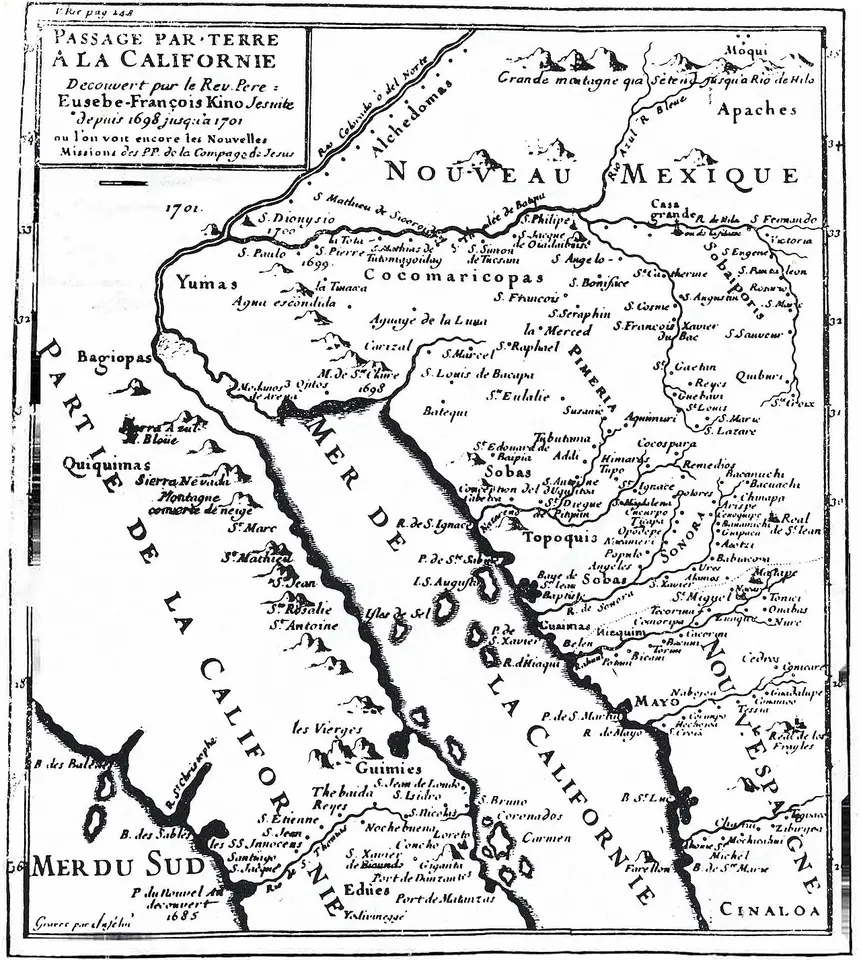
He spent the next three years finding out. In 1701 he crossed the Colorado, towed on a raft by Native swimmers while sitting in a basket, and in 1702 he followed the river down to the Gulf and watched the sun rise over its head. California was joined to the mainland. His map, "Passage by Land to California," was printed across Europe and helped end the myth of the island.
His death at Magdalena
In March 1711 Kino went to the village of Santa María Magdalena to dedicate a new chapel to his patron, St. Francis Xavier. His fellow Jesuit Luis Velarde wrote what happened next:
He died as he had lived, with extreme humility and poverty. In token of this, during his last illness he did not undress. His deathbed, as his bed had always been, consisted of two calfskins for a mattress, two blankets such as the Indians use for covers, and a pack-saddle for a pillow. Nor did the entreaties of Father Agustin move him to anything else.
Velarde says he fell ill while singing the Mass of dedication, "and it seems that the Holy Apostle, to whom he was ever devoted, was calling him, in order that, being buried in his chapel, he might accompany him, as we believe, in glory." He died on March 15, 1711, about sixty-five years old, with his companion of many years, Father Agustín de Campos, beside him.

Velarde, his companion for eight years, also left a portrait of the man's habits: he wept as he prayed his breviary, he prayed much, took wine only at Mass, slept on his horse's saddle blankets, owned two coarse shirts because he gave everything else away, and "was merciful to others, but cruel to himself." The Catholic Encyclopedia of 1910 repeated a report that rebels shot him. Bolton, who read Velarde, found no confirmation and judged the story "altogether improbable."
The lost grave and the plaza at Magdalena
The chapel disappeared, and for more than two centuries no one knew where Kino lay. Bolton himself guessed in 1919 that his bones had been moved to San Ignacio. Later study of Campos's burial records pointed back to Magdalena. In 1965 and 1966 a team of Mexican and American scholars dug for the foundations of the old chapel, and on the afternoon of May 19, 1966, a worker's pick struck a skull. The burial position on the Gospel side, the records, a small bronze crucifix lying on the collarbone and a study of the bones convinced them it was Kino.
The town cleared the area around the grave and built a plaza and mausoleum, finished in 1970 and dedicated the next year. The town itself is now called Magdalena de Kino.
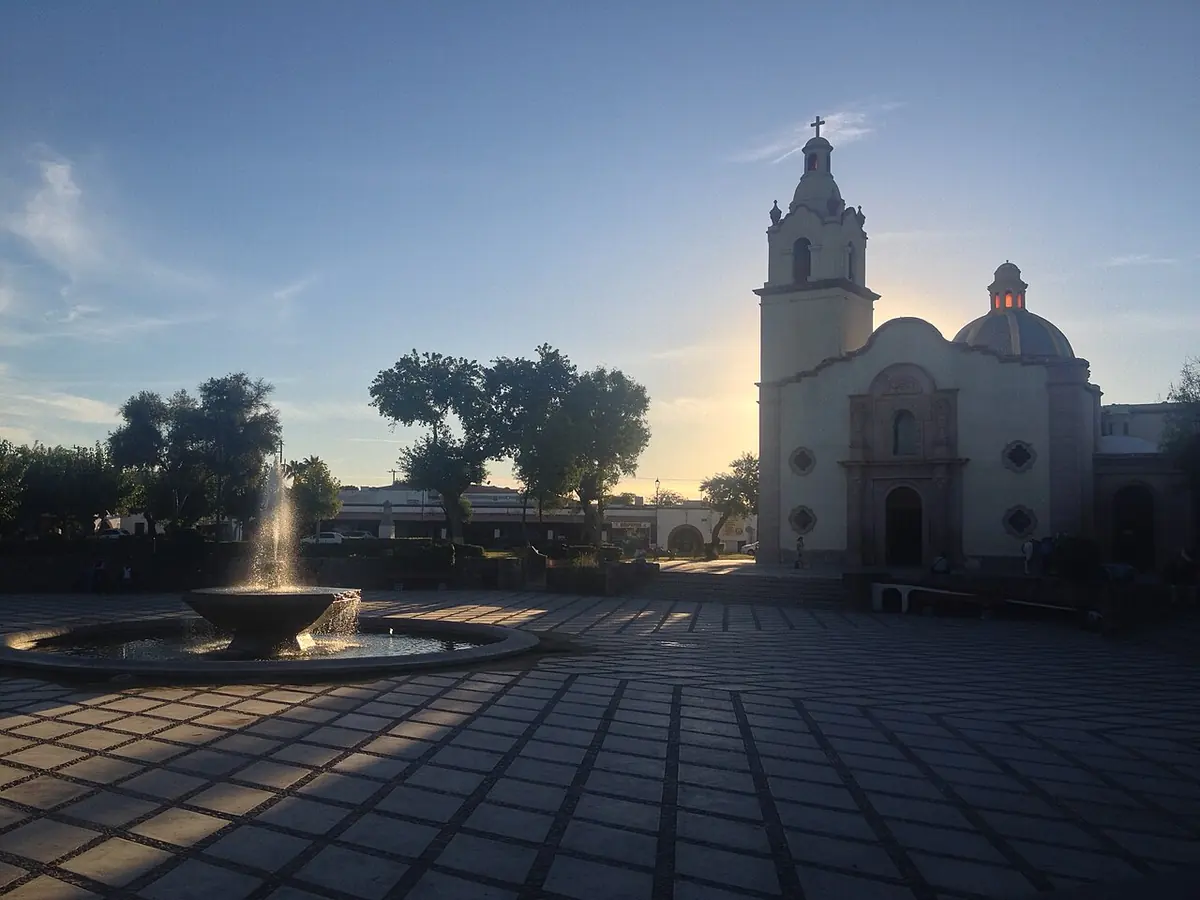
Pilgrims can look down through the open crypt at his remains, lying where they were found on the Gospel side of the vanished chapel he had built for St. Francis Xavier. Let us pause there in spirit and thank God for a priest who gave his whole life to this desert.

Is Eusebio Kino a saint? His canonization cause
Not yet, though the Church has taken real steps. According to the Kino Heritage Society, the diocesan stage of his cause opened in Sonora in May 1972, and he was named a Servant of God in 1998. In May 2006 the documents of the diocesan inquiry went to Rome, and in November 2016 the positio, the formal study of his life and virtues, was submitted. On July 10, 2020, Pope Francis authorized the Congregation for the Causes of Saints to promulgate the decree on "the heroic virtues of the Servant of God Eusebio Francesco Chini (known as Kino)." From that day he has been Venerable.
The cause is led by the Archdiocese of Hermosillo in Sonora, and Tucson and his native Trent support it. The next step, beatification, requires a miracle obtained through his intercession and approved by the Church. There is no feast day for him yet, and no public liturgy in his honor, but the faithful may ask him privately to pray for them.

Why Padre Kino matters today
In 1965 the state of Arizona chose Kino as one of its two figures in the National Statuary Hall Collection. Towns, schools, streets and a parkway bear his name on both sides of the border, and people on both sides sometimes call him the patron of the borderlands, though that is an affectionate title, not a Church patronage.
For us, the heart of his story is simpler. He gave up a university chair to sleep on calfskins in the desert, he owned nothing, and he spent his strength feeding, teaching and protecting the people entrusted to him. When we pray for his beatification, we pray also that the Church in the Southwest and northern Mexico will have missionaries like him again. You can read about other holy men and women of this continent on our pages on St. Junípero Serra, who built on Kino's work in California, and on American saints, and about Kino's patron, St. Francis Xavier, and the founder of his order, St. Ignatius of Loyola.
Let us ask Venerable Eusebio Kino to pray for the missions he loved, and for all who work among the poor of the desert borderlands today.
Frequently asked questions
Is Eusebio Kino a saint?
Not yet. His cause opened in the Archdiocese of Hermosillo, Mexico, and he was named a Servant of God. On July 10, 2020, Pope Francis approved the decree recognizing his heroic virtues, so the Church now calls him Venerable. Beatification would require a miracle attributed to his intercession, and canonization normally a second one.
What is Padre Kino known for?
For the missions he founded in the Pimería Alta, including San Xavier del Bac near Tucson and the first missions in what is now Arizona; for his maps, which showed that California is a peninsula; for bringing cattle ranching to the region; and for defending the Native peoples he served. Arizona chose him for its statue in the U.S. Capitol.
Where is Father Kino buried?
At Magdalena de Kino, Sonora, Mexico, in the chapel of San Francisco Xavier he had come to dedicate when he died in 1711. The chapel was lost and the grave forgotten until a Mexican and American team found his remains on May 19, 1966. They now rest in an open mausoleum on the town's main plaza.
How did Eusebio Kino die?
Of illness, not violence. His fellow Jesuit Luis Velarde wrote that Kino fell ill while singing the Mass to dedicate the chapel at Magdalena and died there, lying on two calfskins with a pack-saddle for a pillow. An old story that he was shot by rebels, repeated in the 1910 Catholic Encyclopedia, has no support in the documents.
Did Padre Kino found Mission San Xavier del Bac?
Yes. He founded the mission at the O'odham village of Bac in 1700. The famous white church that stands there today was built later, by Franciscans, at the end of the 18th century, after the Jesuits had been expelled from Spain's empire.
Can I pray to Eusebio Kino?
Yes, privately. You may ask a Venerable to pray for you, but there is no feast day or public liturgy for him until beatification. Favors received through his intercession matter to his cause and should be reported to the Church authorities promoting it.
Sources
- Holy See Press Office: Promulgation of decrees of the Congregation for the Causes of Saints (July 11, 2020). Heroic virtues of the Servant of God Eusebio Francesco Chini (known as Kino), born August 10, 1645, in Segno, died March 15, 1711, in Magdalena
- Kino's Historical Memoir of Pimería Alta, translated and edited by Herbert E. Bolton (1919), vol. 1. Kino's debt to St. Francis Xavier, the Ingolstadt offer, the 1686 cédula, the 1691 crosses at Tumacácori, the blue shells, the ranches and Velarde's account of his death
- Kino Heritage Society: Kino Sainthood Cause. Servant of God (1998), the documents sent to Rome (2006), the positio (2016) and the decree (2020)
- Kino Heritage Society: The Grave Site History. Discovery of the remains on May 19, 1966, and how they were identified
- Catholic Encyclopedia (1910): Eusebius Kino. Coxi, his first convert, and the unsupported report that he was shot
- U.S. Capitol Visitor Center: Eusebio Kino (National Statuary Hall Collection)