Sacramentals

Sacramentals are sacred signs instituted by the Church, such as blessings, holy water, blessed candles, ashes, palms, the crucifix, the rosary, scapulars and medals. They resemble the sacraments but do not give grace in the same way; through the Church's prayer, they prepare us to receive grace and help us cooperate with it, making ordinary moments of life holy.
Holy water by the church door. A palm frond tucked behind the crucifix at home. A smudge of ashes on the forehead in Lent. A medal on a chain, a rosary in a coat pocket, a candle blessed at Candlemas and lit during a storm. Sacramentals are the Church's way of filling ordinary life with small, holy signs, so that almost nothing we touch need stay outside our prayer.
What are sacramentals?
The Second Vatican Council gave the definition the Catechism repeats:
Holy Mother Church has, moreover, instituted sacramentals. These are sacred signs which bear a resemblance to the sacraments: they signify effects, particularly of a spiritual kind, which are obtained through the Church's intercession. By them men are disposed to receive the chief effect of the sacraments, and various occasions in life are rendered holy.
That is Sacrosanctum Concilium, no. 60, quoted in the Catechism of the Catholic Church, no. 1667. Canon law says the same in fewer words: sacramentals are "sacred signs by which effects, especially spiritual effects, are signified in some imitation of the sacraments and are obtained through the intercession of the Church" (canon 1166).
Three things in that definition matter. Sacramentals are signs: water, salt, wax, ashes, a medal, a gesture. They are instituted by the Church, not by Christ directly. And whatever good they do is obtained through the Church's intercession, her prayer to God, not by any power of the object.
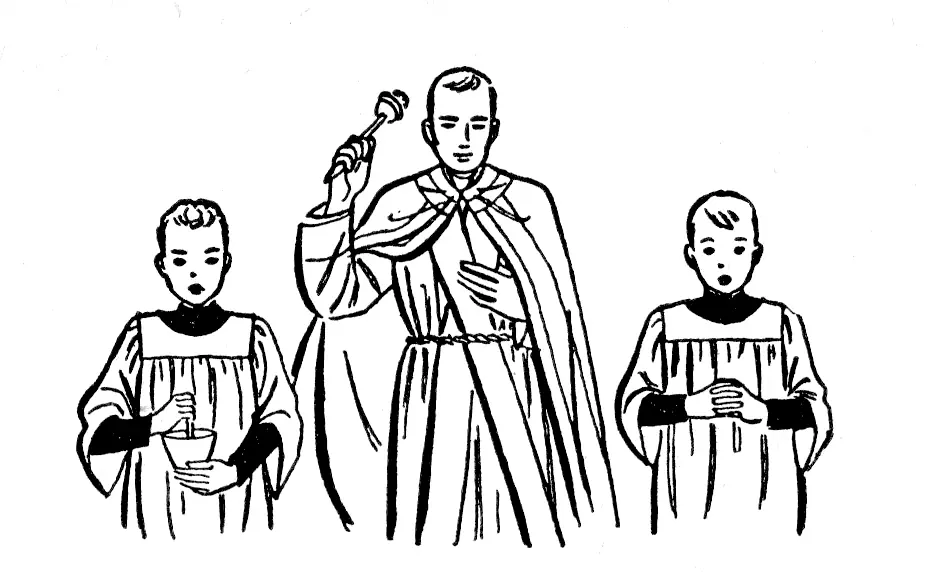
The Catechism adds that sacramentals "always include a prayer, often accompanied by a specific sign, such as the laying on of hands, the sign of the cross, or the sprinkling of holy water (which recalls Baptism)" (no. 1668). The prayer is the heart of it. The sign gives the prayer a body.
Sacraments vs. sacramentals
The words sound alike, and for centuries Christians used "sacrament" loosely for both. The Catholic Encyclopedia notes that "numerous confusions resulted," and only after Peter Lombard in the 12th century did "sacramental" settle into its present meaning. Today the difference is clear.
- Who instituted them. Christ instituted the seven sacraments: Baptism, Confirmation, the Eucharist, Penance, the Anointing of the Sick, Holy Orders and Matrimony. The Church instituted the sacramentals, and so the Church can add, change or drop them. Canon law reserves that power to the Apostolic See alone (canon 1167).
- How they work. In the sacraments Christ himself acts, and the rite gives the grace it signifies. Sacramentals "do not confer the grace of the Holy Spirit in the way that the sacraments do, but by the Church's prayer, they prepare us to receive grace and dispose us to cooperate with it" (Catechism, no. 1670).
- How the Church prays. The Catholic Encyclopedia points out that in the blessings of sacramentals the Church does not use declaring words, as in "I baptize you," but asks God to bless. She "looks directly to Divine mercy for the effect."
- Whether they are necessary. The sacraments are necessary for the Christian life. No single sacramental is required of anyone, though the Church warmly recommends them.
Still, both flow from the same source. The Council says that for well-disposed believers, the liturgy of sacraments and sacramentals sanctifies "almost every event in their lives," drawing on "the paschal mystery of the passion, death, the resurrection of Christ, the font from which all sacraments and sacramentals draw their power." Then it adds a line worth remembering: "There is hardly any proper use of material things which cannot thus be directed toward the sanctification of men and the praise of God" (Sacrosanctum Concilium, no. 61).
Blessings come first
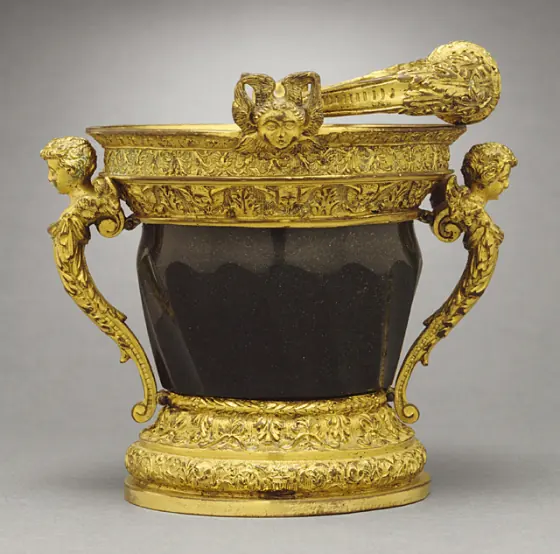
"Among sacramentals blessings (of persons, meals, objects, and places) come first," the Catechism teaches. "Every blessing praises God and prays for his gifts" (no. 1671). A blessing is the basic sacramental; blessed objects are simply things over which the Church has prayed.
Some blessings have a lasting effect because they set a person or thing apart for God: the consecration of virgins, religious profession, the blessing of an abbot, the dedication of a church or altar, the blessing of holy oils, chalices and bells (no. 1672). Others are for daily life: the blessing of a home, a car, a field, a sick person, a pregnant mother, a family meal.
Who may bless? The Catechism says that "every baptized person is called to be a 'blessing,' and to bless," so lay people may preside at certain blessings, like parents tracing a cross on a child's forehead at bedtime. "The more a blessing concerns ecclesial and sacramental life, the more is its administration reserved to the ordained ministry (bishops, priests, or deacons)" (no. 1669). Medals, rosaries and other objects of devotion are blessed by a priest or deacon.
The Catechism also counts exorcism among the sacramentals: the Church's public prayer, in the name of Jesus, that a person or object be protected from the Evil One. A simple form of it is part of every Baptism. A major exorcism may be performed only by a priest with the bishop's permission (no. 1673; canon 1172).
Sacramentals are not superstition
Because sacramentals are things we can hold, they can be misused. The Church has always said so plainly. The Catechism: "To attribute the efficacy of prayers or of sacramental signs to their mere external performance, apart from the interior dispositions that they demand, is to fall into superstition" (no. 2111).
The Vatican's Directory on Popular Piety applies this to particular sacramentals. Blessed palms "should not be kept as amulets, or for therapeutic or magical reasons to dispel evil spirits"; they are kept in the home "as a witness to faith in Jesus Christ, the messianic king, and in his Paschal Victory" (no. 139). Medals are "never to be regarded as a talisman" (no. 206). Ashes are "far from being a merely external act" (no. 125).
So a sacramental is never a charm. Its value comes from God, through the prayer of the Church and the faith of the one who uses it. A St. Benedict medal worn by someone who never prays is just a piece of metal on a chain. Worn by someone who turns to God through it, it is a prayer carried all day.
A Catholic sacramentals list
There is no closed list; the Church can bless almost anything put to good use. The Catholic Encyclopedia recalls an old memory verse that sorts them by action: Orans, tinctus, edens, confessus, dans, benedicens, meaning praying, sprinkling or anointing, eating blessed food, confessing (as in the Confiteor at Mass), giving alms, and blessing. Here are the sacramentals Catholics meet most often, with our guides to each.
Holy water
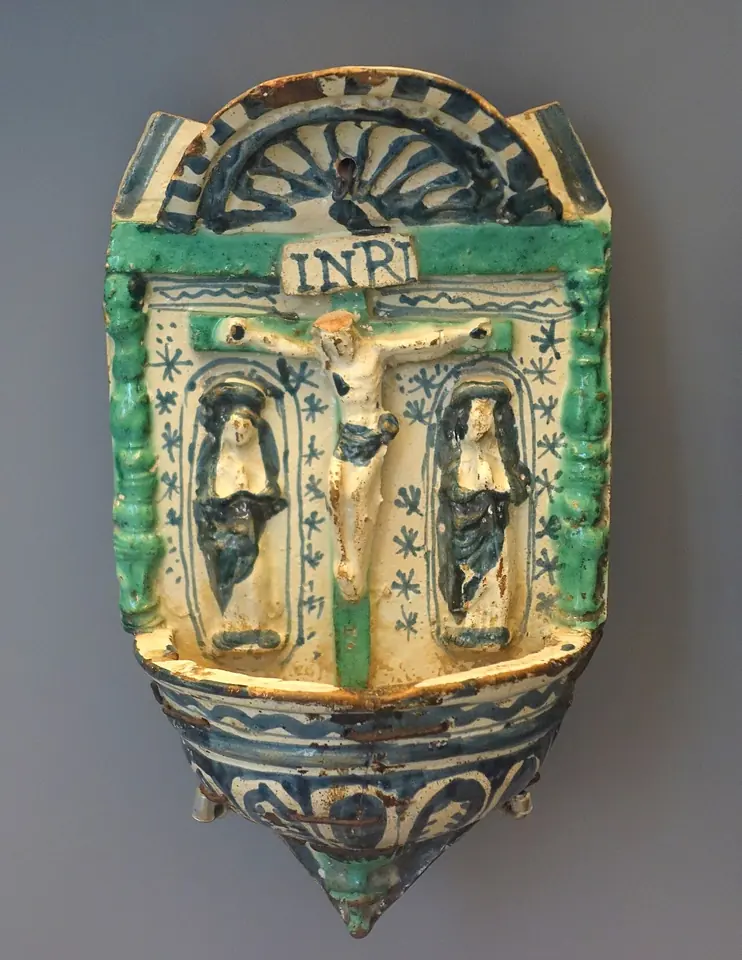
Water blessed by a priest or deacon, recalling our Baptism. We bless ourselves with it at the church door, keep it at home, sprinkle the sick and our houses with it, and use it in nearly every blessing. Our guide to holy water covers its history, its uses and how to get it.
Blessed salt
Salt has a sacred meaning from the Old Testament, where the prophet Elisha healed the waters of Jericho with it (2 Kings 2:19–22). The Catholic Encyclopedia explains that in the Roman Rite salt is "exorcized and blessed in the preparation of holy water" and also "for the use of the faithful in their homes," with a formula taken from the ancient Gregorian Sacramentary. The old Roman Ritual even had a blessing of salt for animals, and another in honor of St. Hubert. Families still ask for blessed salt to sprinkle in their homes and to put a pinch in food or in their holy water, with prayer. We don't yet have a full page on it.
Blessed candles
The Church blesses candles on February 2, the feast of the Presentation of the Lord, called Candlemas, and the faithful take them home. They are lit at prayer, during storms and danger, and at the bedside of the dying. The Catholic Encyclopedia notes the old symbolism of beeswax: the wax for the flesh of Christ, the wick for his soul and the flame for his divinity.
On February 3, the day after Candlemas, two crossed candles are used in the blessing of throats on the feast of St. Blaise, asking God, through the saint's intercession, to free us from ailments of the throat and from every other illness.

Ashes
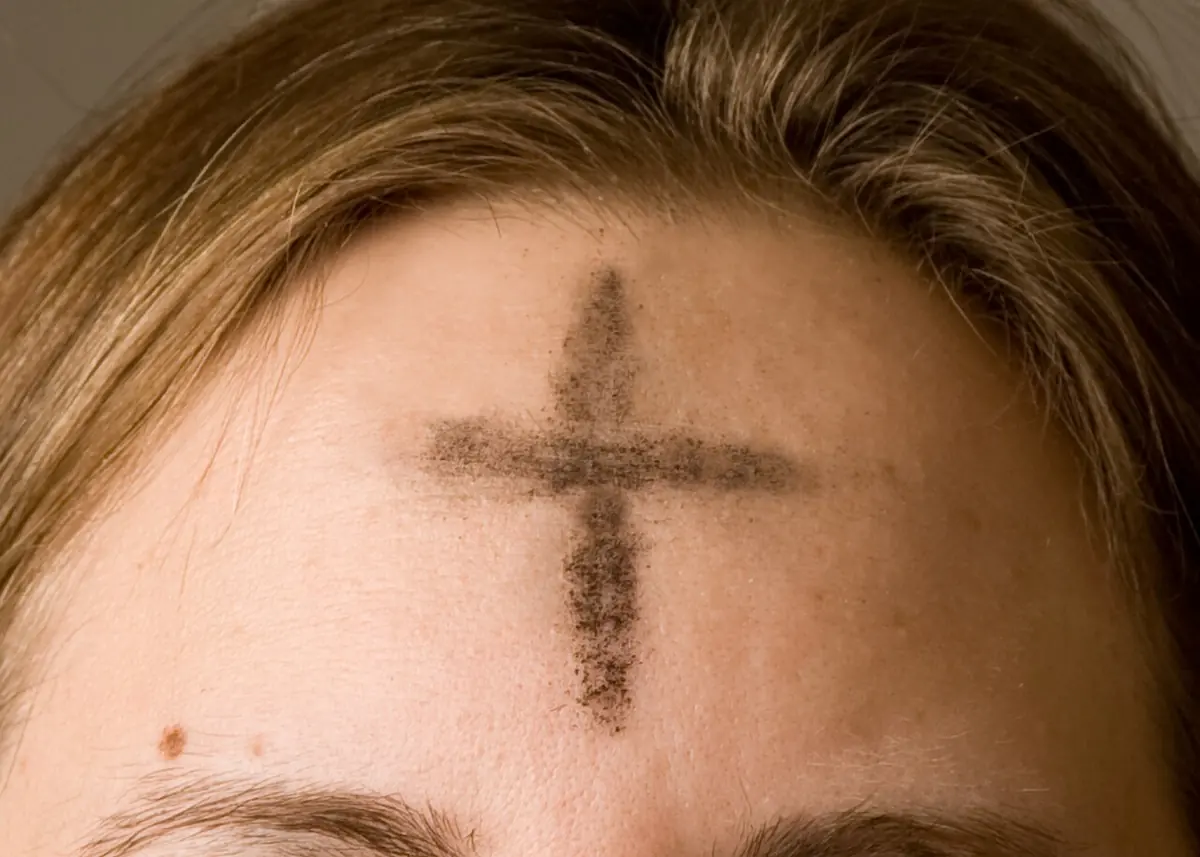
Blessed ashes, traditionally made by burning the palms of the previous Palm Sunday, are placed on our foreheads on Ash Wednesday with the words "Remember that you are dust, and to dust you shall return," or "Repent, and believe in the Gospel." The Directory on Popular Piety says the ashes symbolize "fragility and mortality, and the need to be redeemed by the mercy of God" (no. 125). See Ash Wednesday 2027 and Lent 2027.
Palms
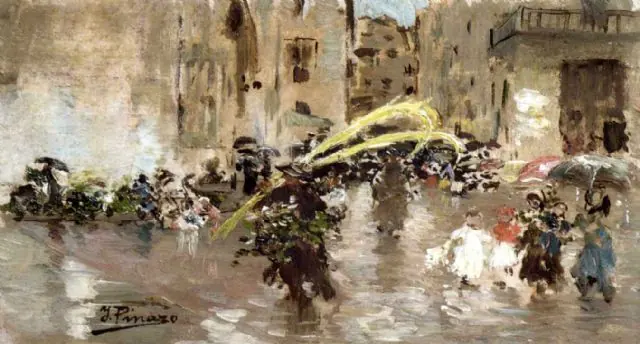
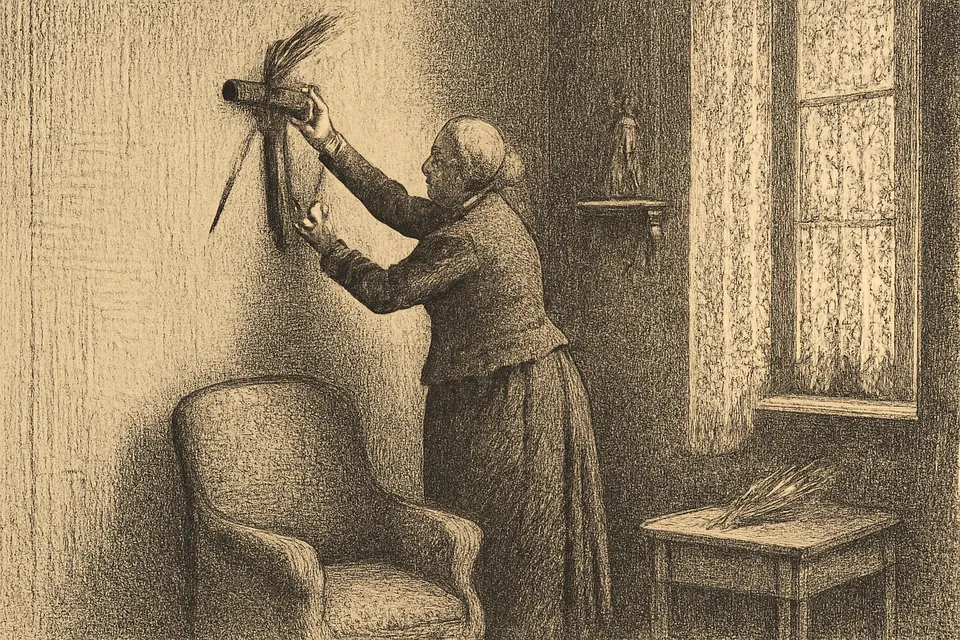
On Palm Sunday the Church blesses palm or olive branches and carries them in procession, remembering Christ's entry into Jerusalem. We take them home and tuck them behind a crucifix or a holy picture until the next Lent, when they go back to the parish to be burned for ashes. More on the days of Holy Week is on our page for Easter 2027.
The crucifix
A cross bearing the figure of Christ crucified. The Church requires one on or near every altar where Mass is offered, and blesses crucifixes for the home. Our page on the crucifix explains crucifix vs. cross, the title INRI and famous crucifixes.
The rosary
Blessed beads used to count the Hail Marys while we meditate on the life of Christ with Mary. The rosary is both a prayer and a sacramental. Learn how to pray the Rosary, or try the Seven Sorrows Rosary and the Divine Mercy Chaplet.
Scapulars
Small forms of a religious habit worn over the shoulders. The best known is the brown scapular of Our Lady of Mount Carmel, received once through enrollment. The green scapular of the Immaculate Heart of Mary is really a double holy picture on one cord, given especially for the conversion and happy death of others.
Medals
Blessed medals of Christ, Our Lady and the saints, worn as a witness of faith and a request for prayer. See our guide to saint medals, and our pages on the St. Benedict medal, the St. Christopher medal and the St. Michael medal. The most worn of all, the Miraculous Medal, is explained in our entry on Our Lady of the Miraculous Medal.
Statues and holy images
Statues, icons and holy pictures, blessed for the home, help us keep the Lord, Our Lady and the saints before our eyes. One much-loved American custom involves a small statue of St. Joseph and a house for sale; our page on the St. Joseph statue for selling a house explains where it came from and how to make it a real prayer. To read the images themselves, see saints' symbols in art.
Blessings of the home
At Epiphany many families bless their homes and write the year and the initials C+M+B over the door in blessed chalk. Our page on the Epiphany house blessing has the custom and its prayers.
The Agnus Dei
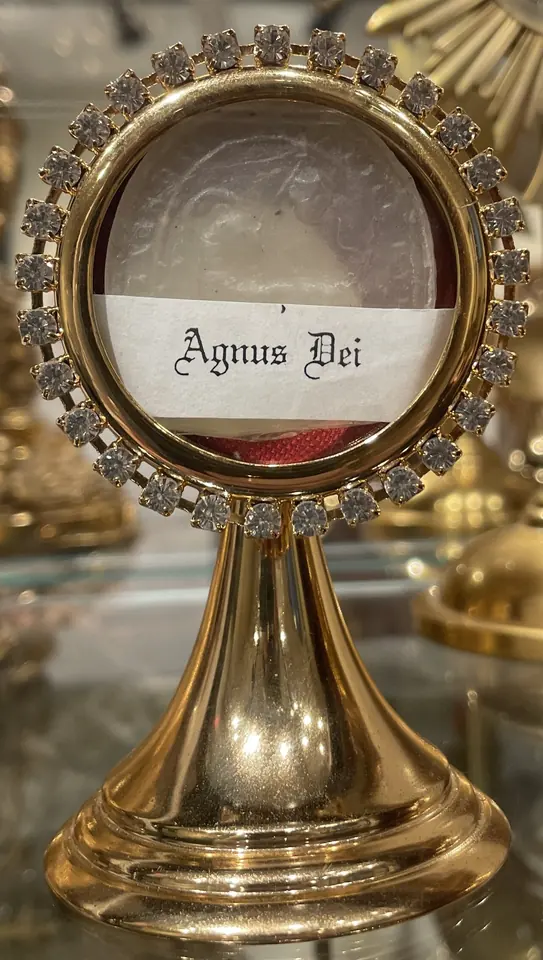
A less familiar sacramental with a long history: a disc of wax stamped with the Lamb of God and blessed by the pope. The Catholic Encyclopedia records that when we first hear of them, around 820, they were made from the remains of the previous year's paschal candle. They were worn around the neck or kept as objects of devotion, and the Church counts them, "like holy water, blessed palms, etc.," among the sacramentals.
Examples of sacramentals in daily life
Sacramentals are meant to be used, not kept in a drawer. A few simple habits:
- Bless yourself with holy water coming into church and going out, and keep a font by your front door at home.
- Wear a blessed medal, scapular or cross, and touch it as a short prayer during the day.
- Keep a crucifix in the main room of the house and in each bedroom.
- Light a blessed candle when you pray for someone in danger or sickness.
- Ask the priest to bless a new home, a new car, a rosary for a First Communion, a medal for a soldier.
- Make the sign of the cross before meals and say grace; that too is a blessing.
How to treat blessed objects
Once something has been blessed for divine worship or devotion, canon law asks that it be treated with reverence and not "employed for profane or inappropriate use even if they are owned by private persons" (canon 1171). Blessed objects shouldn't go into the trash. The custom is to burn blessed items that will burn, such as palms, holy cards and worn cloth scapulars, and to bury the ashes or the item. Many parishes collect old palms before Lent.
The Church also attaches indulgences to the devout use of certain blessed objects (a crucifix or cross, a rosary, a scapular, a medal); the details, and why a blessed object should never be sold, are on our page on saint medals. Relics are a different matter from sacramentals, and canon law flatly forbids selling them (canon 1190); see relics and incorruptible saints.
A prayer to begin every blessing
Nearly every blessing in the Church's books begins with the same versicle from the Psalms. It makes a good prayer whenever we take up holy water, a medal or a candle:
Our help is in the name of the Lord, who made heaven and earth.
That is Psalm 123:8 in the Douay-Rheims numbering (Psalm 124:8 in most modern Bibles). Let us pray it, and make the sign of the cross, the first and simplest sacramental of all.
Frequently asked questions
What are sacramentals in the Catholic Church?
Sacramentals are sacred signs instituted by the Church that resemble the sacraments. The Second Vatican Council says they "signify effects, particularly of a spiritual kind, which are obtained through the Church's intercession." They include blessings, and blessed things such as holy water, candles, ashes, palms, crucifixes, rosaries, scapulars and medals.
What is the difference between a sacrament and a sacramental?
Christ instituted the seven sacraments, and they give grace by the power of Christ acting in the rite itself. The Church instituted the sacramentals, and they do not give grace in that way; through the Church's prayer, they prepare us to receive grace and dispose us to cooperate with it. The sacraments are necessary in the Christian life; no single sacramental is.
What are some examples of sacramentals?
Blessings of people, homes, meals and objects; holy water; blessed salt; blessed candles; ashes on Ash Wednesday; palms on Palm Sunday; the crucifix; the rosary; the brown and green scapulars; medals such as the Miraculous Medal and the St. Benedict medal; statues and holy pictures; the blessing of throats on St. Blaise's day; and the chalk used to bless homes at Epiphany.
Are sacramentals superstitious?
No, but they can be misused superstitiously. The Catechism says it is superstition "to attribute the efficacy of prayers or of sacramental signs to their mere external performance, apart from the interior dispositions that they demand." A sacramental is a prayer joined to a sign, used with faith; it is never a charm or an amulet.
Who can bless sacramentals?
Most blessings of objects are given by a priest or deacon. The Catechism teaches that every baptized person is called to be a blessing and to bless, so lay people may lead certain blessings, such as parents blessing their children or a family blessing a meal; the more a blessing concerns the Church's sacramental life, the more it is reserved to the ordained.
Are relics sacramentals?
Not in the strict sense. Relics are the remains of saints or objects connected with them, and we venerate them for the saint's sake. Sacramentals are signs the Church blesses or institutes for our use in prayer. Both belong to the Church's popular piety. Canon law flatly forbids selling sacred relics (canon 1190).
What do you do with old or broken sacramentals?
Treat them with reverence. Canon law says blessed objects are not to be put to "profane or inappropriate use." The custom is to burn blessed items such as palms or a worn scapular, or to bury them; old palms are often returned to the parish to be burned for next year's ashes.
Sources
- Second Vatican Council, Sacrosanctum Concilium (1963), nos. 60–61 and 79
- Catechism of the Catholic Church, nos. 1667–1679: Sacramentals and popular piety
- Catechism of the Catholic Church, no. 2111: Superstition
- Code of Canon Law, canons 1166–1172 (sacramentals) and 1190 (relics)
- Congregation for Divine Worship, Directory on Popular Piety and the Liturgy (2001), nos. 125, 139 and 206
- Catholic Encyclopedia (1912): Sacramentals (Henri Leclercq). The verse "Orans, tinctus, edens, confessus, dans, benedicens"; deprecatory formulas
- Catholic Encyclopedia (1912): Salt
- Catholic Encyclopedia (1907): Agnus Dei