Desert Fathers

The Desert Fathers were the Christian hermits and monks who went out into the deserts of Egypt, Palestine and Syria from the late 200s on, to give their whole lives to prayer. St. Anthony the Great is the first famous one. Women went too, the Desert Mothers, and their wisdom survives in the Sayings of the Desert Fathers.
The Desert Fathers were men who went out into the wilderness to seek God alone, and the Desert Mothers were the women who did the same. In the late 200s and the 300s thousands of Christians left the towns along the Nile for the deserts of Egypt, then Palestine and Syria. They lived in caves, huts and walled monasteries, wove baskets, sang the Psalms, fasted and kept vigil. Pilgrims came from across the Roman world to ask them for "a word," and the words they gave are still read, prayed over and loved.
Why they went into the desert
St. Athanasius tells us how it began for St. Anthony. Around the year 270, a young Egyptian who had lost his parents walked into church and heard the Gospel being read: "If you would be perfect, go and sell that you have and give to the poor." He took it as spoken to him. He gave away his family's land, placed his younger sister with a community of consecrated virgins, and went to live as an ascetic, first near his village and then deeper and deeper in the desert.
He was not looking for escape. The desert, in the Scriptures, is where Israel was tested and where Christ fasted forty days and met the devil. The monks went there to fight the same fight. When the persecutions ended under Constantine, it became easy, even comfortable, to be a Christian, and the desert offered a new kind of martyrdom: a daily dying to self.
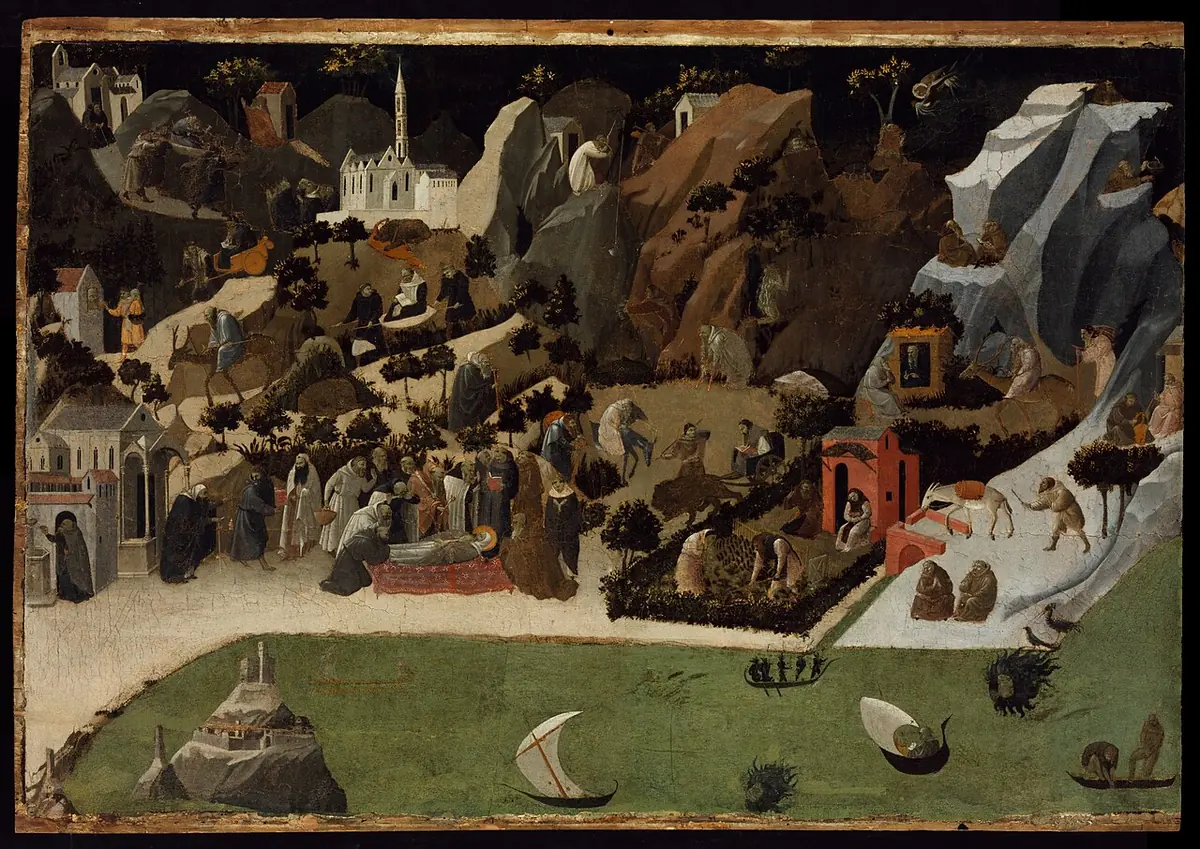
Anthony's example drew others. Athanasius writes that "cells arose even in the mountains":
And thus it happened in the end that cells arose even in the mountains, and the desert was colonised by monks, who came forth from their own people, and enrolled themselves for the citizenship in the heavens. (Athanasius, Life of St. Anthony, 14)
The great Desert Fathers
St. Anthony the Great (about 251 to 356)
Anthony lived more than eighty years as a monk and died at about 105 on his "inner mountain" near the Red Sea, where the Monastery of St. Anthony still stands. He fought fierce temptations, came out of his solitude to strengthen the martyrs in Alexandria during the last persecution, and later went to Alexandria again to stand with Athanasius against the Arians. He is honored as the father of monks. St. Jerome adds the story of his visit to St. Paul of Thebes, an even older hermit, which tradition loves and painters often showed.

St. Pachomius (about 292 to 348)
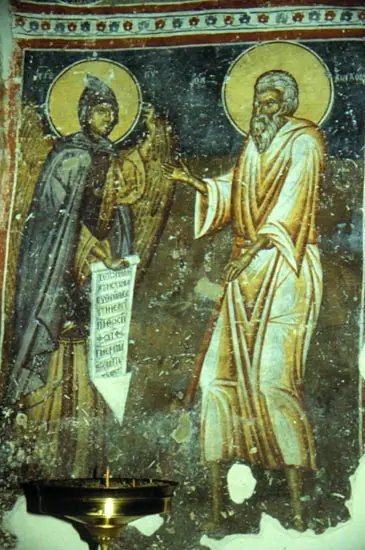
Anthony shaped the hermit's life; Pachomius shaped life in community. He was a young pagan conscript when, according to the early accounts of his life, Christians came to feed the hungry soldiers, and their charity moved him to ask who they were. After his release he was baptized, trained under an old hermit named Palaemon, and around 320 founded a monastery at Tabennisi in Upper Egypt. His monks lived together under a rule, with common prayer, common meals and shared work. By his death there were nine monasteries for men and two for women.
Tradition holds that an angel gave Pachomius the rule written on a tablet. The story is told in the Lausiac History of Palladius, and Budge summarizes it from the Syriac: an angel told him "to go and collect the wandering monks, to live with them, and to lay down such laws as he should tell him." This is a traditional account, but the Rule of Pachomius itself is real, and it is the oldest monastic rule we have. The Eastern churches keep his feast on May 15.
St. Macarius the Great (about 300 to 391)
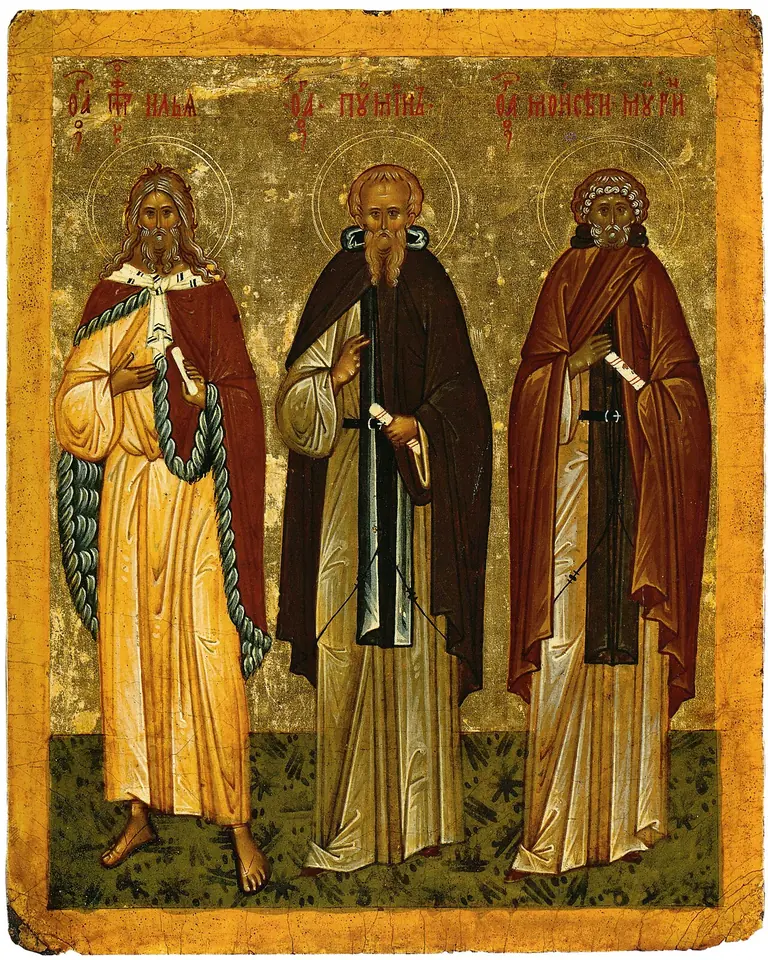
Macarius of Egypt was a camel driver who became a disciple of Anthony and a founder of monastic life at Scetis, in the Wadi El Natrun west of the Nile Delta. The monasteries there are still alive today in the Coptic Church, among them the Monastery of St. Macarius. The Sayings remember him as gentle with sinners and fierce with himself. Once, after the liturgy, he told the brothers to flee. One of them asked where they could possibly flee farther than this desert:
Then Macarius laid his hand upon his mouth, saying, "Flee in this manner," and straightway he went to his cell and, shutting the door, sat down.

St. Moses the Black (about 330 to 405)
St. Moses the Black was an Ethiopian slave who became the leader of a gang of robbers in Egypt before he repented and became a monk at Scetis. Few saints show so plainly that no past is beyond God's mercy. Some of the brothers mocked him for his color, and he kept silence. When the brethren met to judge a brother who had sinned, Moses came carrying a leaking basket of sand:
He took a basket with a hole in it and filled it with sand, and carried it upon his shoulders, and those who went out to meet him said unto him, "What meaneth this, O father?" And he said unto them, "[The sands are] my sins which are running down behind me and I cannot see them, and I, even I, have come this day to judge shortcomings which are not mine." And when they heard [this] they set free that brother and said nothing [further] to him.
Moses died around 405 when raiders attacked the monastery and he refused to run. His feast is August 28.
The Desert Mothers
Women went into the desert too, and the Sayings call them amma, mother, as the men were called abba. Amma Syncletica of Alexandria gave away her inheritance in the 300s and lived a life of prayer outside the city, where other women gathered around her. Her Life came down to us under the name of St. Athanasius, and her teachings stand among those of the great abbas in the Greek collection of Sayings. Amma Sarah lived for decades by the Nile, and the sayings of Amma Theodora on patience and humility were kept as well. One saying of Amma Sarah, in Budge's translation:
Mother Sarah said, "If I were to pray to God that all men might be built up through me I should be found expressing contrition at the door of each one of them; but I pray to God especially that my heart may be pure with Him and with every man."
The most famous woman of the desert is St. Mary of Egypt. Her Life, attributed to St. Sophronius of Jerusalem in the 600s, tells how a young woman of Alexandria who had lived in sin was converted at the door of the Church of the Holy Sepulchre, crossed the Jordan and lived alone in the desert for forty-seven years, until the monk Zosimas found her and gave her Holy Communion. The story is traditional, and historians debate its dates, but the Eastern churches still read her Life during Great Lent as an icon of repentance.

The Sayings of the Desert Fathers
Most of what we know of the desert comes from short sayings and stories, called in Greek the Apophthegmata Patrum. Disciples remembered what their elders said and did, and in the 400s and 500s these memories were gathered into collections, some arranged alphabetically by the name of the abba, others by subject (humility, obedience, prayer, charity). They were translated into Latin as the Verba Seniorum, "the words of the elders," and into Syriac, Coptic, Armenian, Ethiopic and Georgian.
Here are a few, all from E. A. Wallis Budge's 1907 English translation of the Syriac collection, The Paradise or Garden of the Holy Fathers:
A certain brother went to Abba Moses in Scete, and asked him to speak a word; and the old man said unto him, "Get thee gone, and sit in thy cell, and thy cell shall teach thee everything."
Abba Anthony said, "I saw all the snares of the Enemy laid out upon the ground, and I groaned and said, 'Who can escape from these?' And the devils said unto me, 'Humility maketh a man to escape from these, for we cannot attain unto it.'"
On one occasion the Fathers in Scete were gathered together, and because certain folk were wishing to see Abba Moses, they treated him with contumely, saying, "Why doth this Ethiopian come and go in our midst?" But Moses hearing this held his peace. And when the congregation was dismissed, they said unto him, "Abba Moses, wast thou not afraid?" And he said unto them, "Although I was afraid I uttered not a word."
The sayings are short, often surprising, sometimes funny. They rarely explain themselves. The monks meant them to be carried in the heart and chewed on slowly, like a verse of a Psalm.
How the desert shaped the whole Church
The desert did not stay in the desert. St. Athanasius's Life of St. Anthony, written soon after 356, was read across the empire. In his Confessions, St. Augustine tells how a visitor named Ponticianus spoke to him about Anthony, "whose name was in high repute" among Christians, and how two court officials had given up their careers after reading the book. Within days Augustine heard a child's voice say "take up and read," opened St. Paul's letters, and was converted.
St. Basil the Great visited the monks of Egypt and wrote rules for the East. St. John Cassian lived among them and carried their teaching to Gaul in his Institutes and Conferences. St. Benedict, at the end of his Rule, sends his monks to the Conferences, the Institutes and the Lives of the Fathers. Through Benedict the wisdom of Scetis reached every monastery of the West. The hermits of the Syrian desert, like St. Simeon Stylites on his pillar, are part of the same story.
Today the Desert Fathers still speak to anyone who wants to pray. We don't have to move to Egypt to learn from them. We can keep a little silence each day, guard our tongue, refuse to judge, and stay at our post when we'd rather run. Holy Fathers and Mothers of the desert, pray for us, that we may find God in the quiet of our own hearts.
Frequently asked questions
Who were the Desert Fathers and Mothers?
They were Christian men and women who left the cities of the Roman Empire, especially in Egypt, from the late third century on, to live as hermits or in monastic communities in the desert. The best known are St. Anthony the Great, St. Pachomius, St. Macarius the Great, St. Moses the Black, Abba Poemen, Amma Syncletica, Amma Sarah and St. Mary of Egypt.
What are the Sayings of the Desert Fathers?
The Sayings (in Greek, Apophthegmata Patrum) are short stories and words of advice from the desert monks, gathered by their disciples in the 400s and 500s. They survive in Greek, Latin, Syriac, Coptic and other languages. The old Latin version is called the Verba Seniorum, "the words of the elders."
Who was the first Desert Father?
St. Anthony the Great (about 251 to 356) is usually called the father of monks, because his Life, written by St. Athanasius, made the desert life known everywhere. St. Jerome wrote that St. Paul of Thebes had gone into the desert even earlier, and tradition honors Paul as the first hermit.
Why did the Desert Fathers go into the desert?
To follow Christ with nothing held back. When the persecutions ended and it became easy, even fashionable, to be a Christian, many believers sought the desert as a new kind of martyrdom, a daily dying to self through prayer, fasting, work, silence and charity. They also went to fight the devil where Christ himself had been tempted.
Who are the Desert Mothers?
Women who lived the desert life, often called amma, "mother." The Sayings preserve the words of Amma Syncletica, Amma Sarah and Amma Theodora, and the Church honors St. Mary of Egypt as the most famous woman of the desert.
What is a good book of the Desert Fathers' sayings?
Several modern translations are in print. Free, public-domain English versions include E. A. Wallis Budge's 1907 The Paradise or Garden of the Holy Fathers, translated from the Syriac, and the 19th-century translation of St. Athanasius's Life of St. Anthony on newadvent.org.
Sources
- E. A. Wallis Budge, The Paradise or Garden of the Holy Fathers, vol. 2: The Sayings of the Fathers (1907), Internet Archive. The text of every saying quoted here (Anthony, Moses, Macarius, Sarah)
- E. A. Wallis Budge, The Paradise or Garden of the Holy Fathers, vol. 1 (1907), Internet Archive. Introduction to the Rule of Pachomius and the angel's tablet
- Athanasius, Life of St. Anthony (NPNF). The call in church (ch. 2); "the desert was colonised by monks" (ch. 14)
- Augustine, Confessions, Book VIII (NPNF). Ponticianus tells Augustine about Anthony and the Life of Anthony (VIII.6)