Warrior saints

Warrior saints are soldiers, knights and military leaders the Church honors as saints, along with St. Michael the Archangel, the leader of heaven's army. The best known are St. Michael, St. George, St. Joan of Arc, St. Martin of Tours, St. Sebastian, St. Maurice, St. Theodore and St. Demetrius. Most were Roman soldiers martyred for refusing to deny Christ.
The Church has always had soldiers among her saints. Some were Roman legionaries who laid down their lives rather than offer incense to the emperor's gods. Some were knights and kings who fought, prayed and ruled with justice. Some left the army to follow Christ in another way. What makes them saints is never the fighting itself. It is courage given to God, loyalty that would not bend, and in many cases a death accepted for the faith (see what is a martyr).
Here are the warrior saints most loved in East and West, with their feast days. For the patrons of soldiers and why they hold the title, see the patron saint of soldiers.
The captain of heaven's army
St. Michael the Archangel (September 29) is the first of all warrior saints. In the Book of Revelation "Michael and his angels fought with the dragon," and the Greek liturgy calls him Archistrategos, the commander-in-chief. Soldiers, paratroopers and police officers have taken him as patron for centuries. We call on him in the St. Michael prayer: "Saint Michael the Archangel, defend us in battle."

The soldier-martyrs of the early Church
These saints served in the Roman army during the persecutions, mostly under Diocletian and his co-emperors around 300.
- St. George (April 23), the most famous warrior saint of all, a soldier martyred at or near Lydda in Palestine. The dragon came into his story centuries later; the martyrdom is the history.
- St. Sebastian (January 20), honored as an officer of the imperial guard in Rome, according to his 5th-century Passion, who encouraged other Christians in prison and was martyred for it.
- St. Maurice and the Theban Legion (September 22). The Catholic Encyclopedia gives the legend: a legion of Christians from Egypt, ordered at Agaunum in the Swiss Alps to sacrifice to the gods, refused, and was decimated twice and then massacred, around 287. Historians debate the numbers, but the cult at Agaunum, now Saint-Maurice in Switzerland, is very old. Maurice is often painted as a knight in armor with a banner and a palm, sometimes as an African.
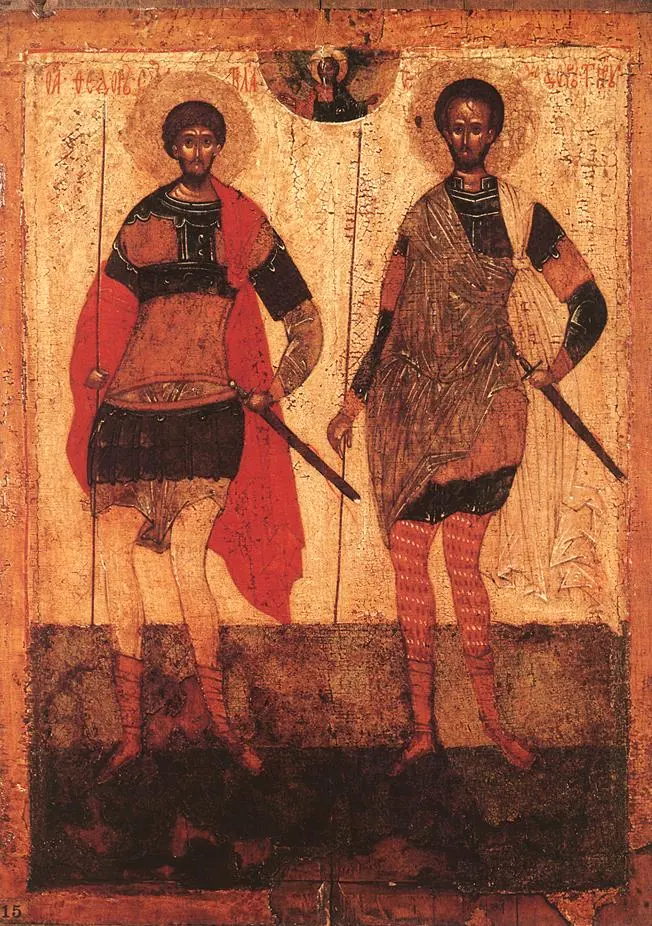
- St. Theodore Tyron, "the Recruit" (February 17 in the East, November 9 in the Roman Martyrology). The Catholic Encyclopedia explains that his surname comes from his unit, not his youth. Arrested in Pontus, he set fire to a pagan temple and was burned alive, probably in 306. St. Gregory of Nyssa preached a sermon on his feast.
- St. Theodore Stratelates, "the General" (February 8 in the East), by tradition a commander martyred at Heraclea. Icons often pair the two Theodores.
- St. Demetrius of Thessaloniki (October 26), martyred about 306, the great soldier saint of the Greek and Slavic world, often shown riding beside St. George.
- Sts. Sergius and Bacchus (October 7), frontier officers in Syria who were tortured and martyred around 303. Their martyrdom, the Catholic Encyclopedia says, "is well authenticated by the earliest martyrologies."
- St. Florian (May 4), a Roman official in Noricum, today's Austria, drowned in the Enns River in 304. Firefighters claim him now.
- St. Longinus (October 16), by tradition the centurion at the cross who said, "Indeed this was the Son of God."
- St. Expedite (April 19), one of the martyrs of Melitene in Armenia. Little is known of him; popular art pictures him as a Roman legionary.

Soldiers who laid down the sword
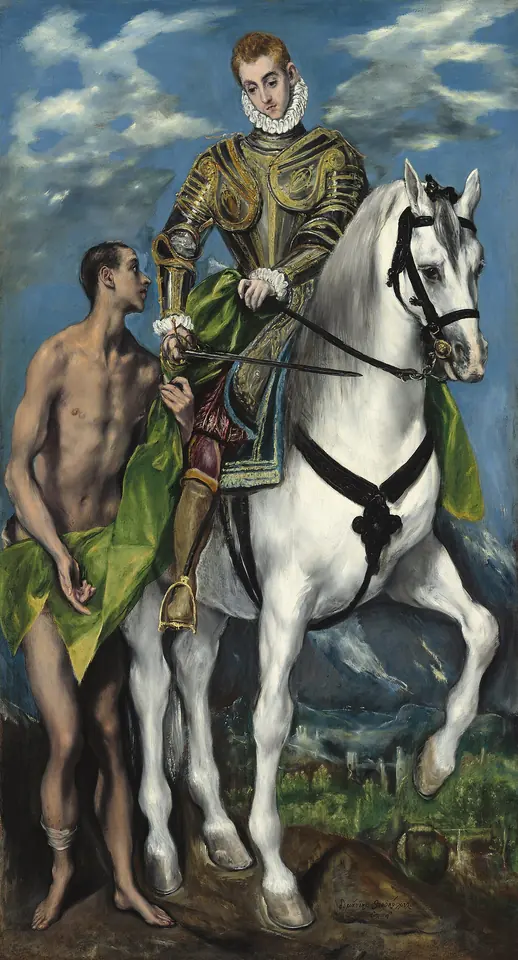
St. Martin of Tours (November 11) was a Roman cavalryman who cut his cloak in half for a freezing beggar at Amiens. His biographer Sulpicius Severus says that before a battle he told the emperor, "I am the soldier of Christ: it is not lawful for me to fight." He became a monk and bishop, and his feast falls on Veterans Day.
Others followed the same road. St. Ignatius of Loyola (July 31) was a Basque officer whose leg was shattered by a cannonball at Pamplona in 1521; on his sickbed he read the lives of the saints and gave himself to God. St. Camillus de Lellis (July 14) was a soldier and gambler before he founded an order to nurse the sick. St. Charles de Foucauld (December 1) was a French cavalry officer before he became a hermit in the Sahara.
Knights, kings and captains
- St. Joan of Arc (May 30), the peasant girl who led French armies in 1429, lifted the siege of Orléans and saw her king crowned at Reims. She forbade her soldiers to swear and urged them to confession.
- St. Louis IX (August 25), King of France, who led two crusades and died of illness at Tunis in 1270.
- St. Nuno of St. Mary (November 6), Nuno Álvares Pereira, Constable of Portugal, who won the battle of Aljubarrota in 1385. According to the Vatican's biography, his banner bore the cross, Mary and "the saintly knights James and George." He gave most of his wealth to veterans and, in 1423, entered the Carmelite house he had founded in Lisbon to serve the poor. Benedict XVI, canonizing him in 2009, said his life shows that "even military or in war time, it is possible to act and to put into practice the values and principles of Christian life."
- St. Olaf (July 29), the Viking king of Norway, killed at Stiklestad in 1030.
- St. Wenceslaus (September 28), Duke of Bohemia, honored by Czechs as their eternal prince and protector.
- St. John of Capistrano (October 23), the Franciscan who marched with the army that relieved Belgrade in 1456, carrying the cross; patron of military chaplains.


A prayer with the warrior saints
The warrior saints teach the virtue every Christian needs: courage to stand firm for Christ, whatever it costs. Let us ask their help for those who serve in uniform today, and for ourselves in our own battles:
St. Michael, St. George, St. Martin, St. Joan and all you holy soldiers of Christ, pray for us. Pray for every soldier, sailor and airman far from home, and bring them safely back to those who love them.
See also the St. Michael medal, St. Michael's chaplet and our guide to saints' symbols in art.
Frequently asked questions
Who is the greatest warrior saint?
St. Michael the Archangel, the "prince" of the heavenly host who casts down the dragon in the Book of Revelation. Among human saints, St. George is the most widely honored warrior saint, in East and West alike.
Who are the warrior saints of the Orthodox Church?
The Orthodox and Eastern Catholic churches honor a group of "great martyr" soldier saints, above all St. George, St. Demetrius of Thessaloniki, St. Theodore the Recruit (Tyron) and St. Theodore the General (Stratelates), as well as Sts. Sergius and Bacchus and St. Mercurius. Icons show them in Roman armor, often on horseback.
Is there a female warrior saint?
Yes. St. Joan of Arc led French armies in 1429 and 1430, wearing armor and carrying her own banner into battle. She was burned at Rouen in 1431 and is honored on May 30.
Who is the patron saint of soldiers?
St. Michael the Archangel is the chief patron of soldiers, together with St. George, St. Martin of Tours, St. Sebastian and St. Joan of Arc. Our page on the patron saint of soldiers gives the reasons for each.
Sources
- Catholic Encyclopedia (1911): St. Maurice
- Catholic Encyclopedia (1912): St. Theodore of Amasea
- Catholic Encyclopedia (1912): Sergius and Bacchus
- Sulpicius Severus, On the Life of St. Martin (New Advent)
- Holy See: Nuno de Santa Maria Álvares Pereira (1360-1431), biography for his canonization
- Benedict XVI, Homily for the canonization of five new saints (April 26, 2009)