John Bradburne
John Bradburne (1921–1979) was an English soldier, wanderer and poet who became a Catholic in 1947, joined the Third Order of St. Francis, and spent the last ten years of his life caring for leprosy patients at Mutemwa, Zimbabwe. He was abducted and killed on September 5, 1979. He is a Servant of God: his cause for canonization was opened in Harare in 2019.
Who was John Bradburne?
John Bradburne was an Englishman who spent most of his life looking for the place God wanted him to be and found it, at forty-eight, in a leprosy settlement in the bush of north-eastern Zimbabwe. He was a soldier, a pilgrim, a would-be monk, a hermit, a musician and a poet who wrote thousands of poems. He lived the last ten years of his life with the leprosy patients of Mutemwa and was killed there in 1979.
He is not a canonized saint. The Church calls him a Servant of God, the title given to someone whose cause for canonization has formally begun. We can admire him, learn from him and ask his prayers privately, while we wait for the Church's judgment. (Searchers for "St. John" may also find places in Newfoundland and the U.S. Virgin Islands; this page is about John Bradburne of Mutemwa.)
His life
Soldier and seeker
John Randal Bradburne was born on June 14, 1921, at Skirwith in Cumbria, the son of an Anglican clergyman. He was educated at Gresham's School in Norfolk. In 1940 he was commissioned into the 9th Gurkha Rifles, served in Malaya and Burma, and from 1943 to 1945 fought with the Chindits, the British long-range jungle force in Burma. The Memorial Society calls him "a reluctant hero of the Second World War."
After the war he searched for years. He stayed with the Benedictines of Buckfast Abbey in Devon and was received into the Catholic Church in 1947. He tried the Carthusians and the Benedictines of Prinknash, walked as a pilgrim from Rome toward Jerusalem, lived as a hermit, worked as a porter and a bookshop clerk, and served as sacristan of Westminster Cathedral. None of it lasted. In 1956 he became a lay member of the Third Order of St. Francis, and he kept its rule faithfully for the rest of his life, singing the Little Office of Our Lady at its hours.

"Is there a cave in Africa where I can pray?"
In 1962 he wrote to his friend Fr. John Dove, asking that question, and went out to Southern Rhodesia. Soon after he arrived, he told a Franciscan priest that he had three wishes: to serve people with leprosy, to die a martyr, and to be buried in the habit of St. Francis. He worked with the Franciscans at the Wedza mission and then at Silveira House, a Jesuit center.
Mutemwa
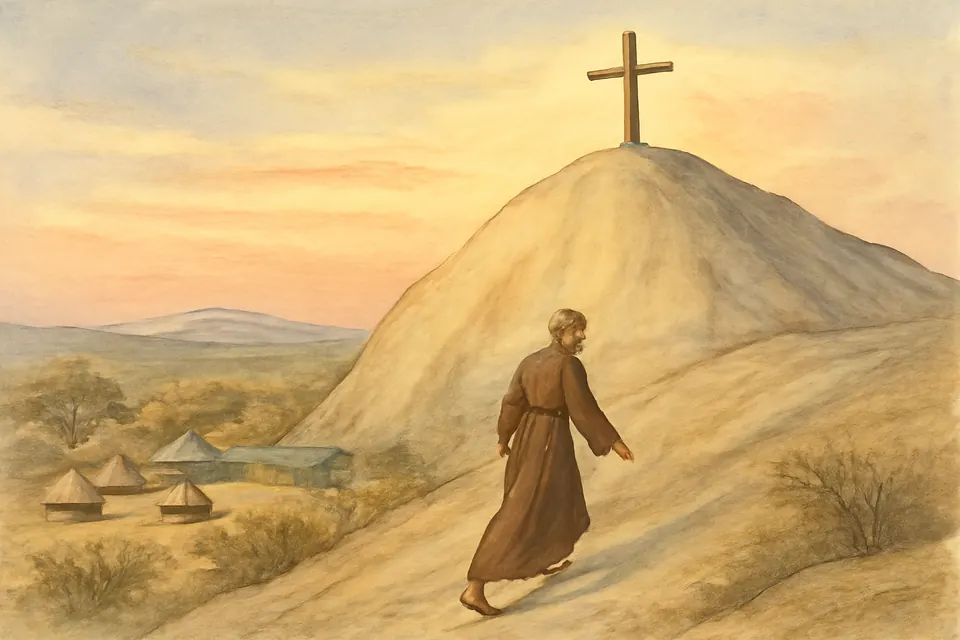
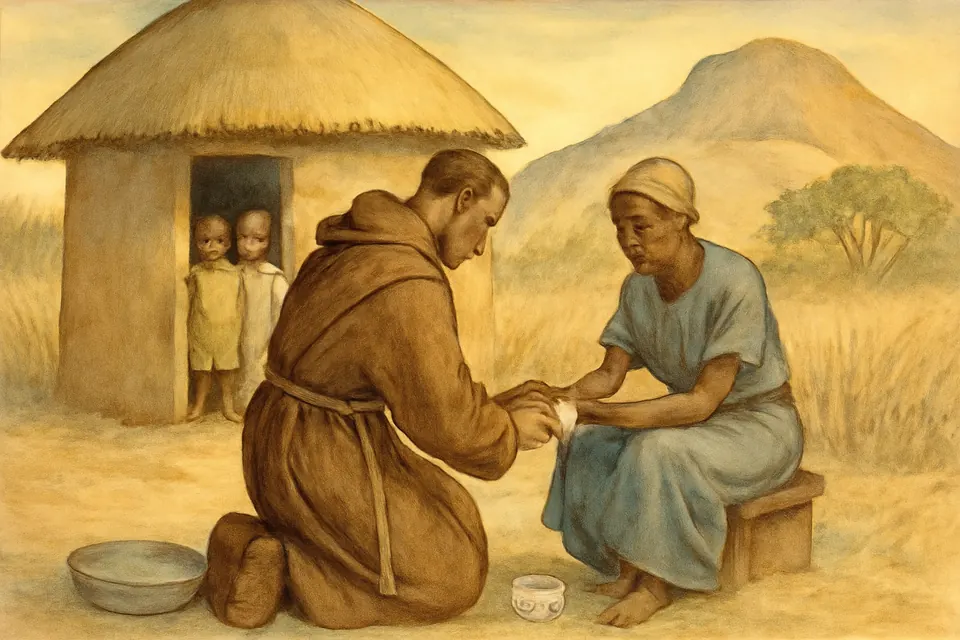
In 1969 he visited the Mutemwa leprosy settlement, almost by chance, and stayed as its warden. He washed, fed and bandaged the patients. Agenzia Fides reports that for a decade he rose at three in the morning, and the Catholic Medical Quarterly says he ran up Mount Chigona, the great granite rock above the settlement, every morning. A cross stands on its summit today.
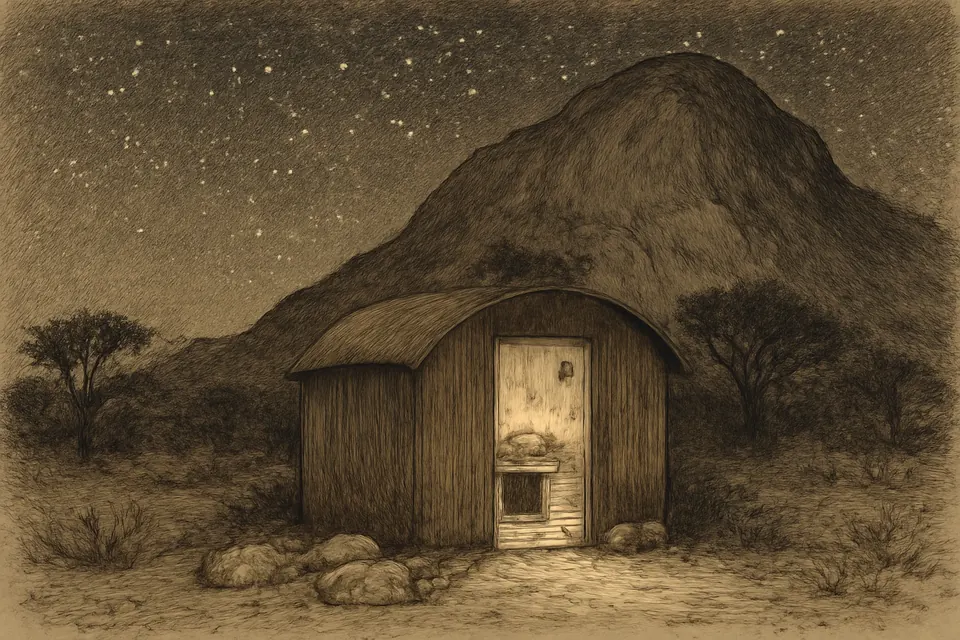
When the settlement's management committee wanted to cut the patients' food and hang numbered tags around their necks, he refused, and was dismissed. He moved into a small tin hut just outside the compound, without water or sanitation, and went on caring for the patients as best he could. In that hut he played his harmonium and wrote poetry, by the Memorial Society's count some 6,000 poems in his last decade alone. One of them, quoted by the society, holds the heart of his spirituality:
God's love within you is your native land.
So search none other, never more depart.
For you are homeless save God keeps your heart.
His death
By 1979 the Rhodesian Bush War had reached the district, and friends urged him to leave. He would not abandon the patients. In September 1979 armed men came to Mutemwa by night and took him away. Dr. Peter Doherty's account in the Catholic Medical Quarterly says they marched him to their local commander, who admired his work and ordered him returned unharmed, but on the way back his captors shot him by the roadside. Fr. Anthony Gibbs found the body the next day.
His Requiem Mass was celebrated in the cathedral in Salisbury. During it, mourners saw drops of blood fall from his coffin; it was opened and nothing was found, but those present noticed he had not been dressed in the Franciscan habit he had asked for. The mistake was put right, and he was buried at the Jesuit mission of Chishawasha. Two of his three wishes, and perhaps all three, had been granted.
John Bradburne's cause for canonization
Pilgrims have gathered at Mutemwa every September since his death, by the thousands. The Memorial Society, founded in England in 1995, still supports the care center at Mutemwa. According to the society, the Congregation for the Causes of Saints issued a nihil obstat on July 1, 2019, and Archbishop Robert Ndlovu of Harare formally opened the cause at Mutemwa on September 5, 2019, the fortieth anniversary of his death. He is a Servant of God. The next stage would be a decree that he lived the virtues to a heroic degree, which would make him Venerable.
Two cures have been reported through his intercession, one in South Africa and one in Scotland. Neither has been investigated or approved by the Church. He himself once asked his friends: "Pray for my sanctification, because it would encourage so many souls if such a wreckage might come to canonisation."
Prayer for his intercession
The John Bradburne Memorial Society publishes a novena prayer. It remembers how he let the Holy Spirit and Mary guide him and searched without ceasing for God's will, asks a favor through his intercession from the Holy Trinity, and is followed by an Our Father, a Hail Mary and a Glory Be.
Let us pray it for the sick, for all who live with leprosy, and for every restless soul still looking for the place God has made for them.
Frequently asked questions
Is John Bradburne a saint?
Not yet. He is a Servant of God, the first stage of a cause for canonization. The Congregation for the Causes of Saints issued its nihil obstat on July 1, 2019, and the Archbishop of Harare opened the cause at Mutemwa on September 5, 2019. The next step would be a decree of heroic virtue, which would make him Venerable.
Who was John Bradburne?
An Englishman born in Skirwith, Cumbria, in 1921, the son of an Anglican clergyman. He served with the Gurkha Rifles and the Chindits in the Second World War, became a Catholic in 1947, and after years of wandering went to Rhodesia, now Zimbabwe, in 1962. From 1969 he lived among the leprosy patients of Mutemwa.
How did John Bradburne die?
During the Rhodesian Bush War, a group of armed men took him from Mutemwa by night on September 5, 1979, and marched him to a guerrilla commander. The Catholic Medical Quarterly reports that the commander ordered him returned unharmed, but on the way back his captors shot him by the roadside, apparently fearing he could identify them. He had refused to leave the patients.
Where is John Bradburne buried?
At the Jesuit-run Chishawasha Mission near Harare, after a Requiem Mass in the cathedral in Salisbury (now Harare). He is not buried on Mount Chigona at Mutemwa, as many people assume, though pilgrims climb the mountain every September.
What miracles are attributed to John Bradburne?
Two cures have been reported through his intercession, according to Independent Catholic News as cited by Catholic World Report in 2019, a woman in South Africa who recovered the use of her legs and a man in Scotland cured of a brain tumor. Neither has been approved by the Church. At his funeral, mourners said drops of blood fell from his coffin; when it was opened, nothing was found.
Is there a prayer for John Bradburne's cause?
Yes. The John Bradburne Memorial Society publishes a novena prayer asking a favor through his intercession, followed by the Our Father, Hail Mary and Glory Be. It is printed below. Favors received should be reported to the society.
Sources
- John Bradburne Memorial Society: Petition for support for the beatification of John Bradburne. Nihil obstat of July 1, 2019, and the opening of the cause at Mutemwa on September 5, 2019
- John Bradburne Memorial Society: The John Bradburne story (biography, timeline and novena prayer)
- Agenzia Fides: A lay missionary, an apostle of lepers, towards beatification (October 23, 2019)
- Catholic World Report: Church leaders in Zimbabwe discuss beatification cause of lay missionary (September 6, 2019). His conversion in 1947, the three wishes and the two reported cures
- Peter Doherty, Travels in Zimbabwe: John Bradburne and the lepers, Catholic Medical Quarterly 63(3), August 2013. His death, the funeral and burial at Chishawasha