Peter the Hermit
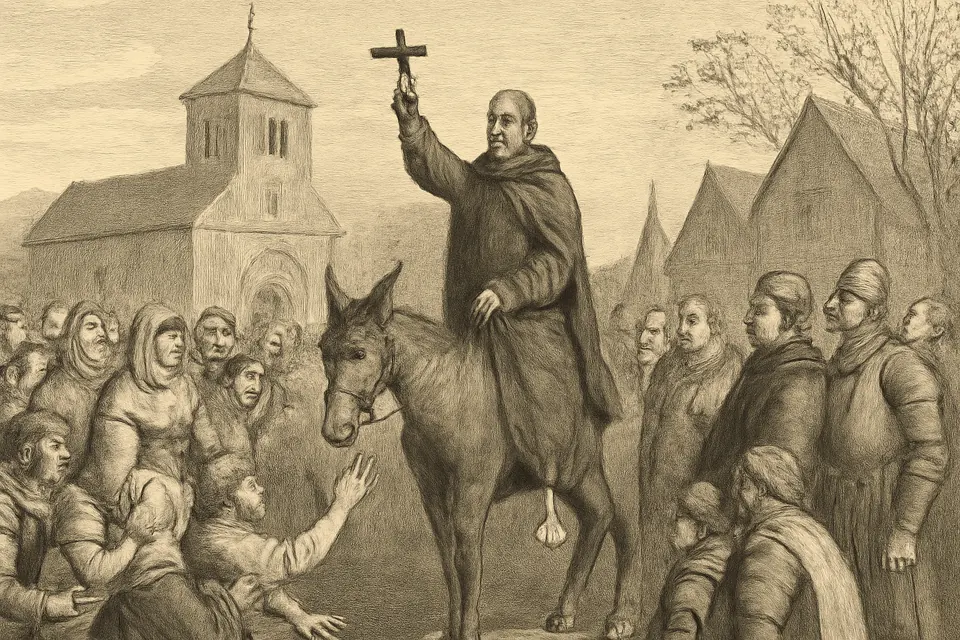
Peter the Hermit (about 1050–1115) was a hermit-preacher from Amiens who stirred up crowds for the First Crusade and led the ill-fated People's Crusade of 1096. He later founded the priory of Neufmoustier near Huy, in present-day Belgium, where he died on July 8, 1115. He has never been beatified or canonized; old books call him "venerable" only as a mark of respect.
Peter the Hermit was a small, barefoot preacher from Amiens who, in the months after Pope Urban II called the First Crusade in 1095, roused tens of thousands of poor men and women to take the cross and march for Jerusalem. He led the doomed People's Crusade of 1096, survived its destruction, marched on with the great army, and prayed with the crusaders on the Mount of Olives before Jerusalem fell in 1099. Then he came home and spent his last fifteen years as the prior of a small community of canons near Huy, in what is now Belgium, where he died on July 8, 1115.
He has never been beatified or canonized. He is a figure of history, admired and criticized in turn, and his life is wrapped in more legend than almost any other man of his age. Let us look at what the old sources really say about him, separate the history from the stories, and pray for all those whose lives were swept up in the crusade he preached.
Who was Peter the Hermit?
Peter was born at Amiens, in Picardy, around 1050. The Catholic Encyclopedia (1911) gives that date and adds at once a warning: "His life has been embellished by legend." Almost nothing is known of his youth. Later writers gave him a noble family, a career as a soldier, a wife and children, but none of that appears in any source written in his lifetime. By the time the chroniclers notice him, he was already a hermit, a man who had left the world to live in prayer and penance, and a priest who preached with fire.
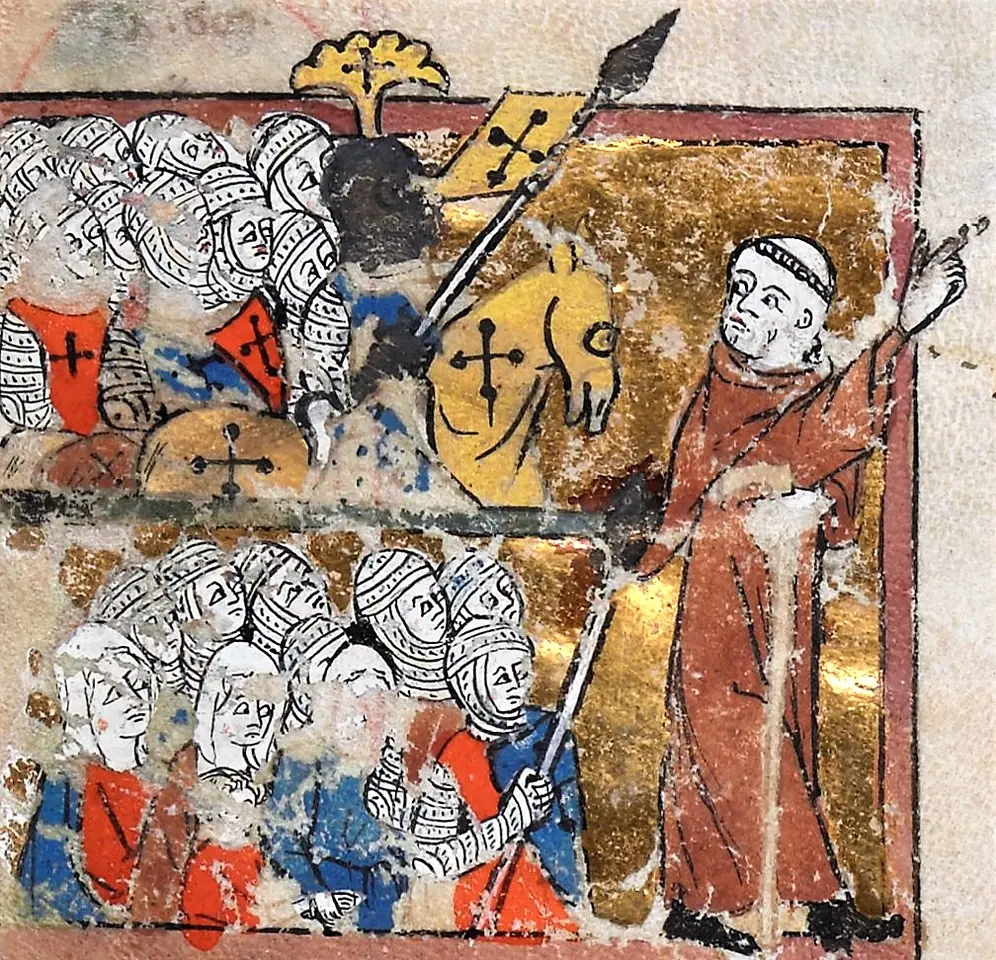
The best portrait of him comes from Guibert of Nogent, a Benedictine abbot who knew the crusaders of his own region and wrote his history of the crusade about a decade after it. Guibert says Peter "wore a wool shirt, and over it a mantle reaching to his ankles; his arms and feet were bare." He "lived on wine and fish; he hardly ever, never, ate bread." He gave away nearly everything he received: he "was very liberal in the distribution to the poor," and he "restored prostitutes to their husbands with gifts." Crowds followed him everywhere. Guibert, a careful man, adds that people even plucked hairs from Peter's mule to keep as relics, though he does not vouch for every story.
The Byzantine princess Anna Comnena, who wrote her history decades later in Constantinople, called him "a certain Gaul, Peter by name, surnamed KukuPeter." The meaning of the nickname is still argued over.
The legend of the vision at the Holy Sepulchre
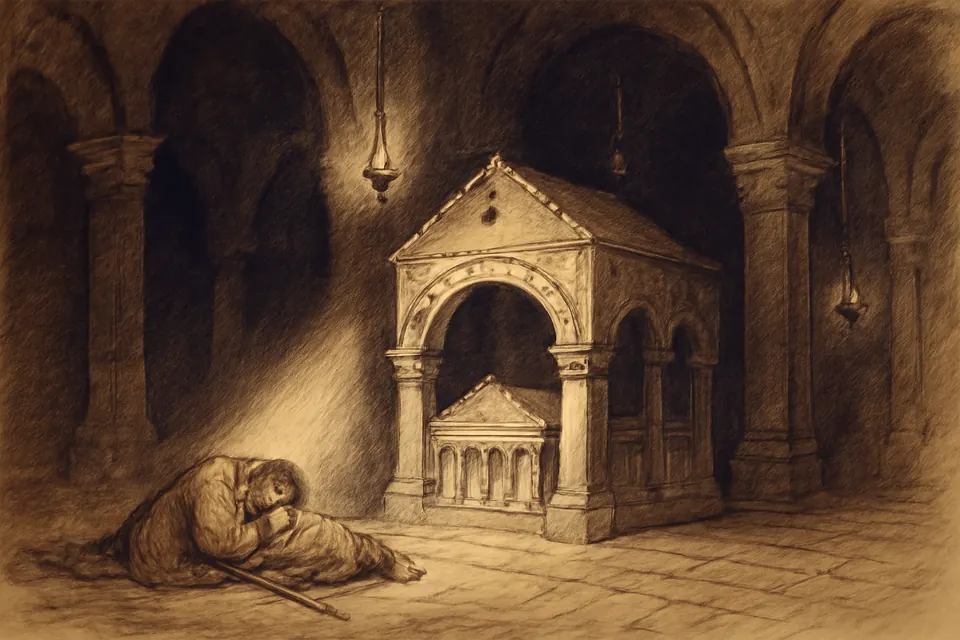
The most famous story about Peter is that he started the crusades. According to Albert of Aachen, who wrote in the early 1100s, Peter made a pilgrimage to Jerusalem and suffered much at the hands of the Turks. One night, as he slept in the Church of the Holy Sepulchre, Our Lord appeared to him and told him to take letters from the Patriarch of Jerusalem and go to Europe to tell of the miseries of the Christians of the East. Peter obtained the letters, found Pope Urban II, and the pope, moved by his account, called the crusade at Clermont. William of Tyre, writing later in the 12th century, told the story again without the vision, and it passed into every history book.
The Catholic Encyclopedia rejects it firmly. No writer who lived through the crusade mentions the vision or Peter's meeting with the pope. Even the pilgrimage is "doubtful." Anna Comnena says only that Peter tried to reach Jerusalem, failed, and came home resolved to go back "attended by goodly company." The encyclopedia concludes that the credit for the crusade "belongs solely to Pope Urban II" and that "it was only after the Council of Clermont that Peter commenced to preach the crusade." The vision at the tomb of Christ is traditional: a legend, and a very old one, but not history.
Preaching the First Crusade
On November 27, 1095, at Clermont in Auvergne, Pope Urban II called on the knights of the West to go to the aid of the Christians of the East and to free Jerusalem. Preachers carried the call across France, and Peter was the most famous of them. Albert of Aachen says he began in Berry, in central France. From there he worked his way north and east, riding his mule from town to town, and by Holy Saturday, April 12, 1096, he had reached Cologne. The chroniclers agree that he drew enormous crowds. Albert of Aachen describes his followers as "innumerable as the sands of the sea."
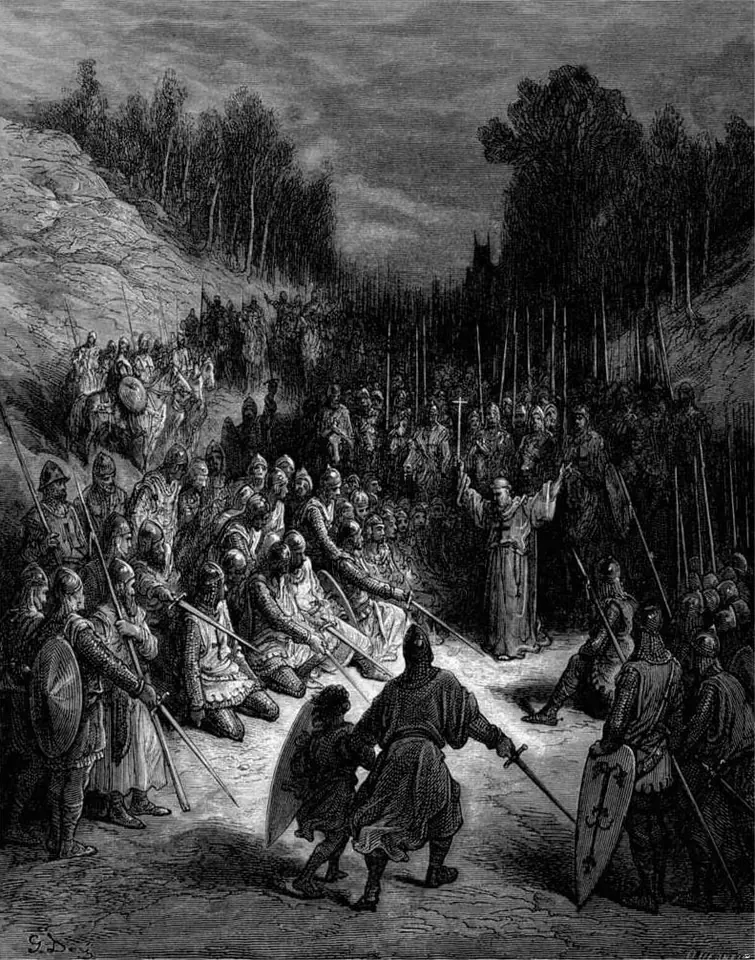
The people who came to him were mostly poor: peasants, townspeople, women and children, with only a handful of knights. They could not wait for the great lords to raise their armies, and in March 1096, months before the princes were ready, they set out under Peter's leadership. It was the beginning of what historians now call the People's Crusade.

The People's Crusade of 1096
Peter's band followed the old pilgrim road down the Danube, through Hungary and the Balkans. There was trouble on the way. The marchers had little money and less discipline, and fighting broke out over food and plunder in Hungary and Bulgaria. Peter reached Constantinople at the beginning of August 1096. The Catholic Encyclopedia gives the date as August 1; Hagenmeyer, the careful German historian of Peter, places it on July 30.
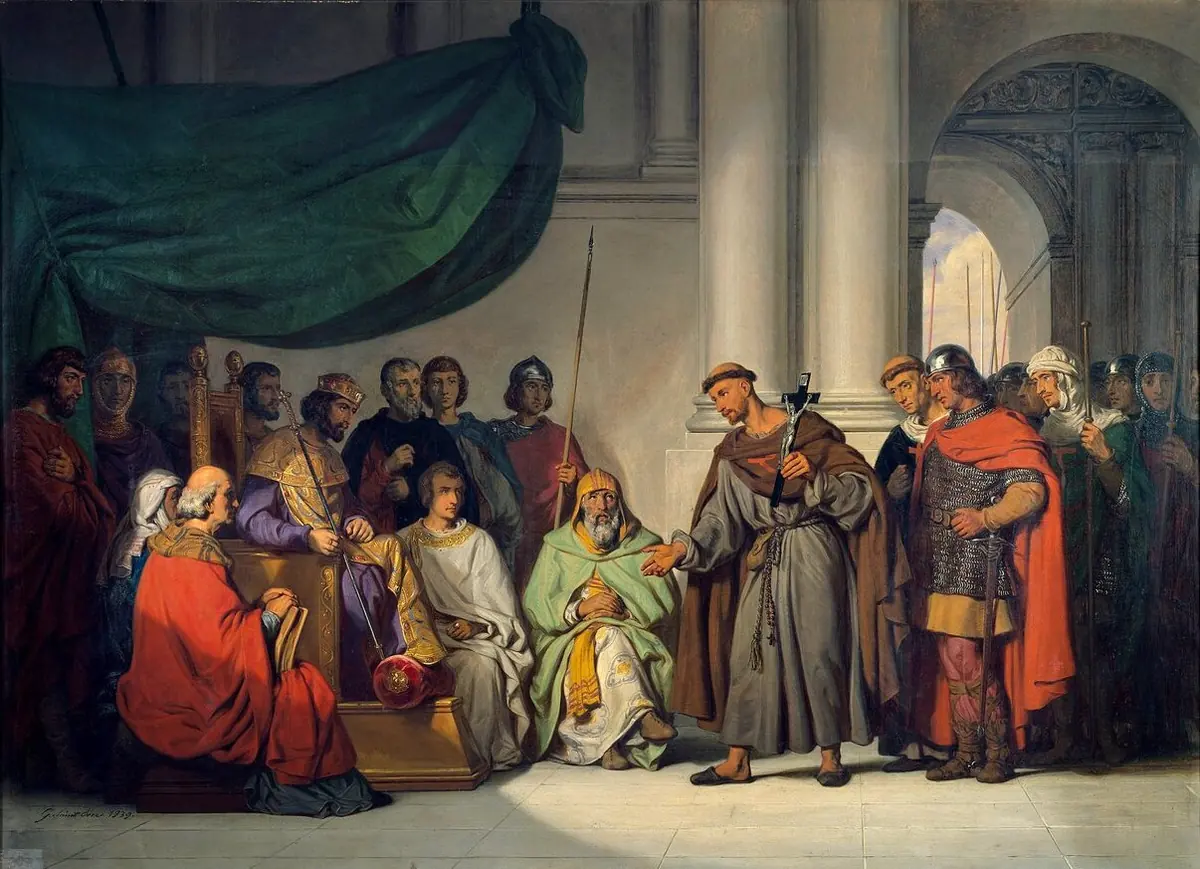
The Emperor Alexios Komnenos received him. Anna Comnena writes that her father, "aware of what Peter had suffered from the Turks before, urged him to await the arrival of the other counts." Peter did not heed the warning. His people crossed into Asia Minor and camped at Civetot, near Nicaea, deep in Turkish territory.
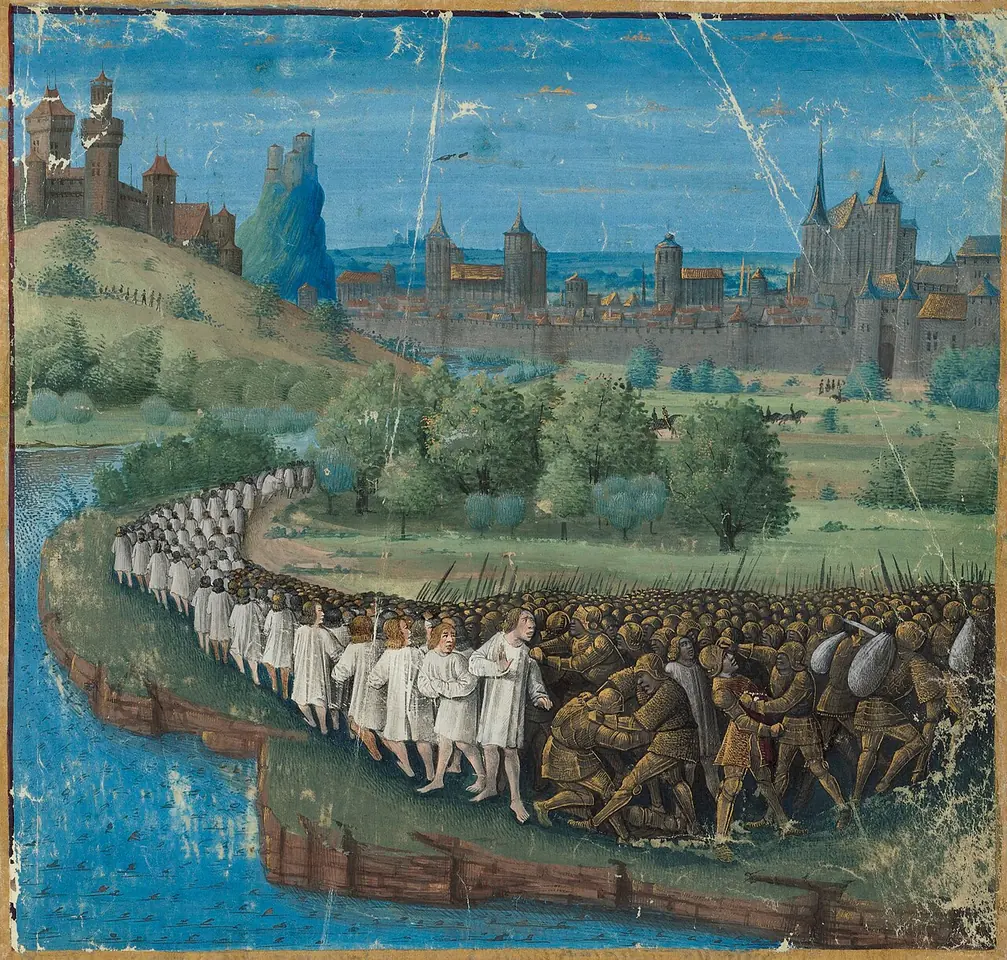
What happened next was a catastrophe. According to the Gesta Francorum, written by a knight who marched with the crusade, "Peter the Hermit had gone to Constantinople a short while before because he was unable to restrain that varied host." His followers raided the country around Nicaea, and in October 1096 a Turkish army fell on them. Most were killed or carried into slavery. Peter, in Constantinople asking the emperor for help, survived. The emperor sent ships to rescue the few who had escaped.
The massacres of the Rhineland Jews
The spring and summer of 1096 also brought one of the darkest chapters of the crusade. Bands of would-be crusaders attacked the Jewish communities of the Rhineland, at Speyer, Worms, Mainz, Cologne and elsewhere, killing many who would not accept baptism. Albert of Aachen places these massacres on a host that gathered "in like fashion" after Peter and the priest Gottschalk had set out, led above all by Count Emicho. Ekkehard of Aura describes the same bands. Modern historians still debate how far Peter's preaching and followers were caught up in the violence.
We should not soften what happened. These were grave sins committed under the sign of the cross, and the Church has asked forgiveness for them. On the Day of Pardon in the Jubilee Year 2000, St. John Paul II prayed: "we are deeply saddened by the behaviour of those who in the course of history have caused these children of yours to suffer, and asking your forgiveness we wish to commit ourselves to genuine brotherhood with the people of the Covenant."
With the crusaders at Antioch and Jerusalem
Peter gathered what was left of his people and, in May 1097, joined the army of the princes under Godfrey of Bouillon near Nicomedia. From then on he had a smaller part, but the chronicles keep catching sight of him.
At the siege of Antioch, in January 1098, hunger in the camp was terrible. The Gesta Francorum reports that "William Carpenter and Peter the Hermit secretly left because of the great sorrow and misery. Tancred pursued and caught them, and brought them back in disgrace." It is an honest record of a man's weakness, and it is worth remembering. Months later the princes trusted him again: they sent Peter, with an interpreter named Herluin, as their envoy to the Turkish commander Kerbogha, who was besieging the crusaders in Antioch. Raymond of Aguilers says the Turk "compelled Peter the Hermit, who was unwilling to bow, to kneel to him."
On July 8, 1099, a week before Jerusalem fell, the whole army walked barefoot in procession around the walls of the Holy City, praying and fasting. On the Mount of Olives, at the place of the Ascension, there was preaching. Albert of Aachen writes that Peter the Hermit and Arnulf of Chocques, a learned and eloquent cleric, preached to the people there, and that their words ended the quarrels that had divided the pilgrims, above all between Tancred and Count Raymond. Hagenmeyer, the most skeptical of Peter's historians, accepted this account as true.
Jerusalem was taken on July 15, 1099. When the army marched out to meet the Egyptians at Ascalon, the Gesta says, Peter stayed in the city to lead the prayers and services for the soldiers' victory.
Prior of Neufmoustier near Huy
After the crusade Peter returned to the West with a group of pilgrims from the diocese of Liège. The chronicler Gilles of Orval, writing in the 1200s, says that Arnulf, then acting as Patriarch of Jerusalem, gave him relics of the Holy Sepulchre and of St. John the Baptist to bring to the bishop of Liège. Near Huy, on the Meuse, Peter founded a church in honor of the Holy Sepulchre and St. John the Baptist, and gathered a small community of canons who lived under the Rule of St. Augustine. Hagenmeyer dates the first stone to August 15, 1100. It was called Neufmoustier, "the new minster," and Peter was its first prior.
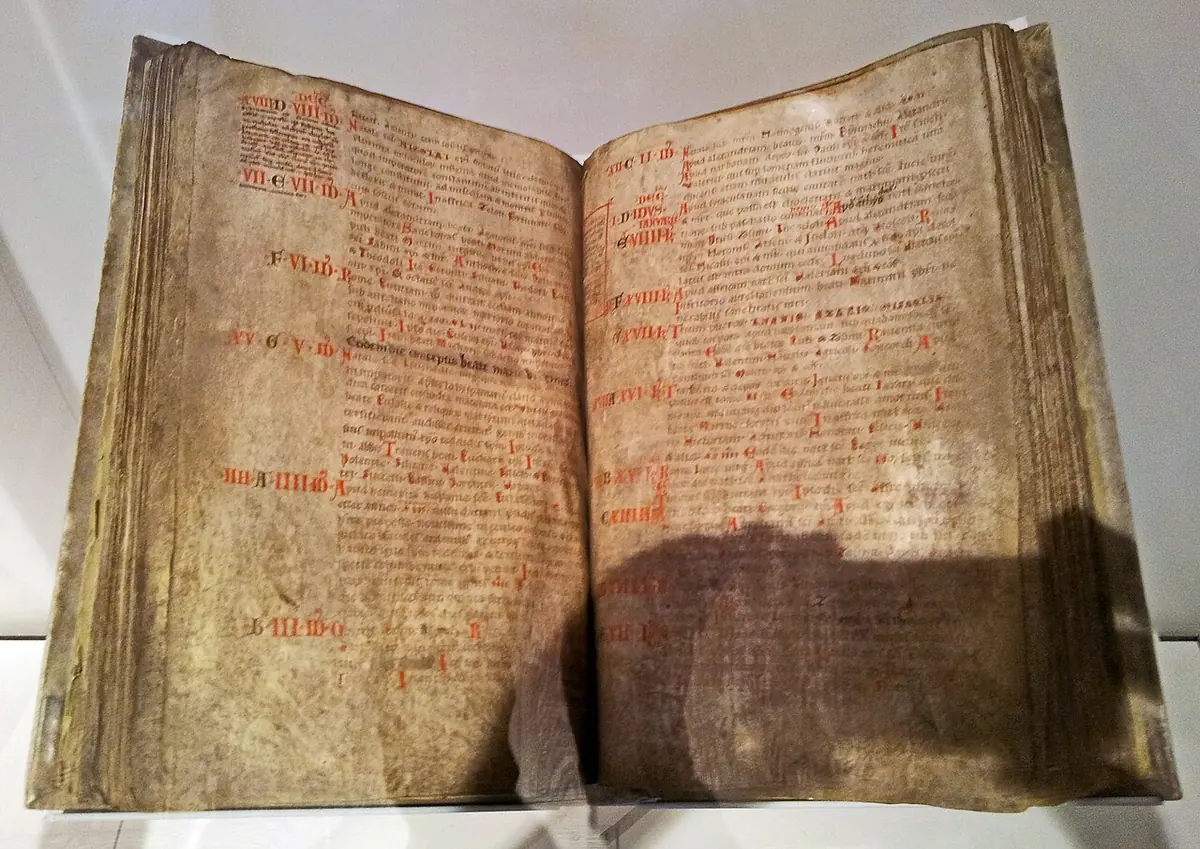
The little church had a special grace attached to it. Gilles of Orval preserved part of a privilege granted with the agreement of the Patriarch Arnulf and the canons of the Holy Sepulchre: pilgrims who had vowed to go to the Sepulchre of the Lord, but who were held back by poverty, delay or sickness, could fulfill their vow at the church of the Holy Sepulchre at Neufmoustier instead, and share in all the good works done there and in Jerusalem.
We know nothing more of Peter's last years. Hagenmeyer wrote that everything later writers said about them "is pure fantasy." He prayed, he governed his community, and he grew old.
The death and tomb of Peter the Hermit
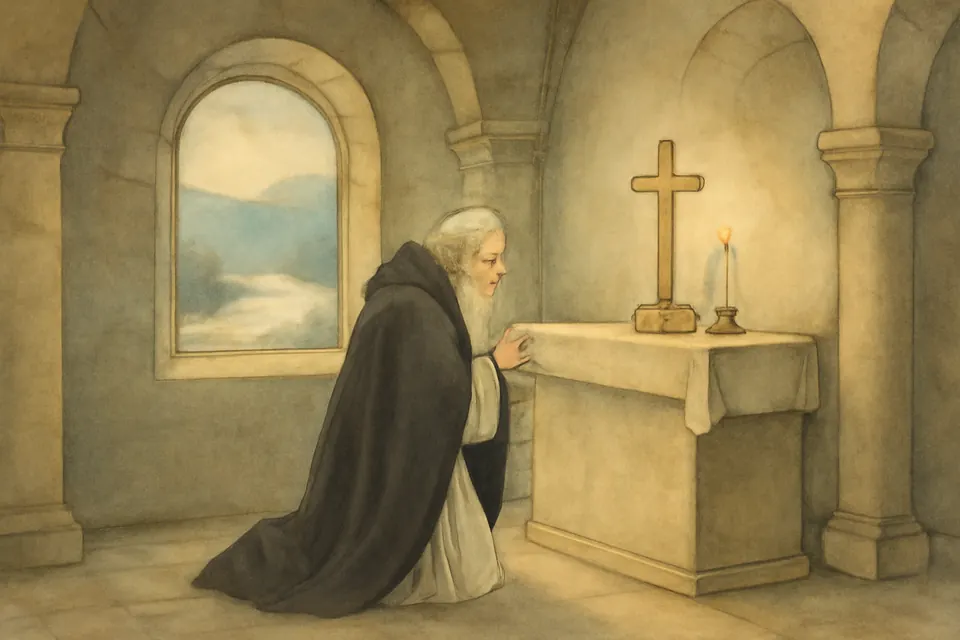
Peter died at Neufmoustier on July 8, 1115, sixteen years to the day after he had preached on the Mount of Olives. Gilles of Orval says simply that, "having finished the course of his life, he closed his last day in a good old age on the eighth of the Ides of July." The clergy and people of Huy gave him a solemn funeral, and he was buried outside the church, on its east side.
On October 12, 1242, the canons moved his remains into the church and placed them in a stone tomb before the altar, with a Latin epitaph that Gilles recorded. It calls him a hermit famous for his merits, who in his life was "truly an Israelite," an echo of Our Lord's words about Nathanael, "an Israelite indeed, in whom there is no guile," and it plays on his name: Peter (Petrus) now lies under a stone (petra), but lives in heaven with Christ the Rock. In 1633, according to the Liège historian Villenfagne, the papal nuncio had his bones enclosed in a casket. When the abbey was sacked and burned in 1793, during the French Revolution, the relics are said to have been destroyed; another account says they were carried to Namur.
The Jesuit Pierre d'Oultreman, whose Life of the Venerable Peter the Hermit (first printed at Mons in 1612) collected every legend he could find, claimed that in 1242 the body was found whole and incorrupt, beard and all. No earlier source says so, and Gilles of Orval, who was present at the translation, does not mention it. We count that story as traditional at best.

In the 19th century the owner of the old abbey grounds built a cross-shaped crypt with a tomb monument and set a sandstone statue of Peter above it, made in 1857. The monument still stands among the remains of the abbey.


Is Peter the Hermit a saint?
No. Peter the Hermit has never been beatified or canonized, and there is no feast of Peter the Hermit in the calendar of the universal Church. He is not a Venerable in the modern sense either: that title belongs to those whose heroic virtue the Pope has formally recognized, and no such decree exists for him.
Older books do call him "venerable." D'Oultreman's biography was titled La vie du Vénérable Pierre l'Ermite, and the Liège writer Bartholomew Fisen, in his 1647 Flores ecclesiae Leodiensis, a collection of lives and praises of the holy people of the diocese of Liège, placed him on July 8, the day of his death. In those centuries "venerable" was a common word of respect for a holy priest or founder, and Gilles of Orval had already called him "this venerable man." It is the reason some calendars and databases still list July 8 for him. We remember him on that day, and we may pray for his soul, but we do not invoke him publicly as a saint.
Legends about Peter the Hermit
So many stories grew up around Peter that Hagenmeyer devoted a whole book, first published in German in 1879, to sorting the true from the false. The most common legends, all traditional, are these:
- That he started the crusades after a vision at the Holy Sepulchre. The crusade was called by Pope Urban II; the vision first appears in Albert of Aachen.
- That he was a knight and a married man before becoming a hermit. No early source says so.
- That he invented the rosary. Polydore Vergil and d'Oultreman claimed it, but Hagenmeyer found nothing to support it. The rosary grew slowly over the Middle Ages.
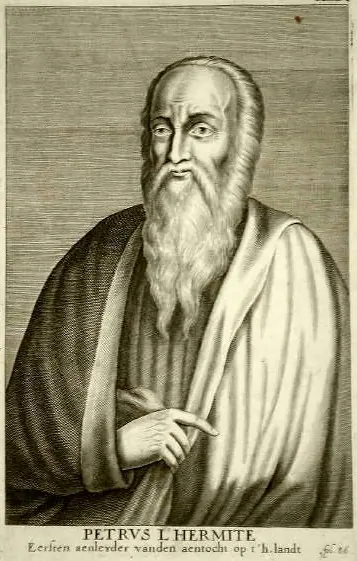
- That he was viceroy of Jerusalem. Engraved portraits of the 1600s give him this title, which no 12th-century writer knew.
- That his body was found incorrupt in 1242. See above.
None of this makes him a fraud. He was a real preacher of real fervor, who shared the crusade's hardships and its faults, failed badly at least once, and ended his days in prayer.
Peter the Hermit in art and memory
Painters and engravers of the 19th century loved Peter the Hermit. He is almost always shown preaching: a thin, bearded figure in a monk's robe holding up a cross, with an eager crowd at his feet. Gustave Doré engraved him for an illustrated history of the crusades. Gillot Saint-Èvre painted his meeting with the Byzantine emperor in 1839. The real Peter, in Guibert's description, went bareheaded and barefoot in a wool shirt and mantle, which is much closer to the medieval miniature at the top of this page than to the friar of Victorian books.
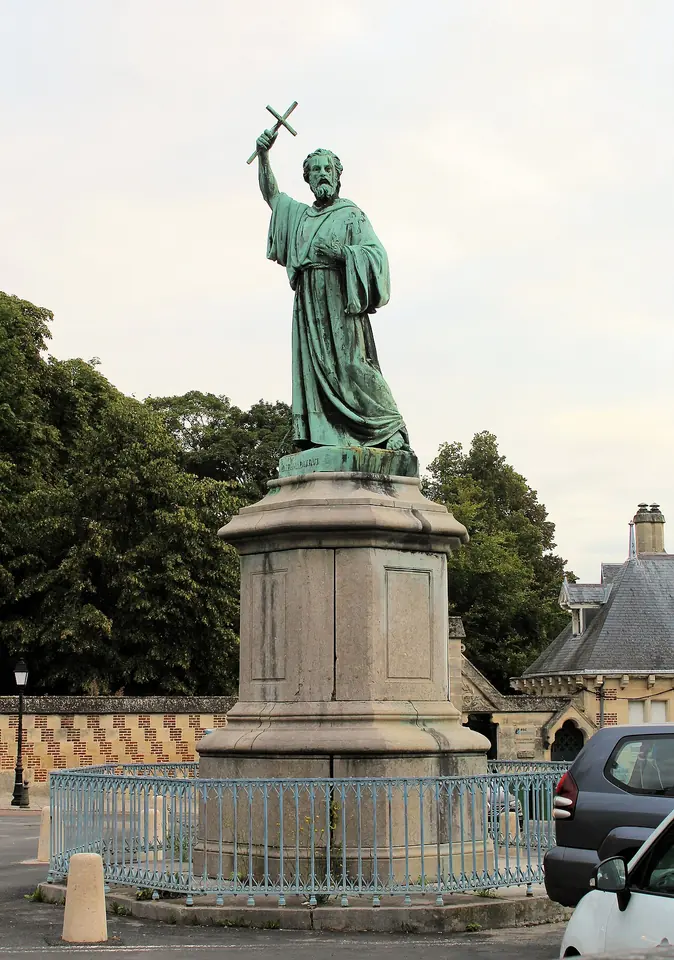
His native city honored him too. On June 29, 1854, Amiens unveiled a bronze statue of Peter by the sculptor Gédéon de Forceville on the Place Saint-Michel, beside the cathedral. He holds up a cross and calls the crowd to follow.
A prayer for those touched by the crusades
There is no approved prayer to Peter the Hermit, since he is not a canonized saint. We can pray for him, and for all those whose lives were changed by the crusade he preached: the pilgrims who died at Civetot, the Jews of the Rhineland, the Christians and Muslims of the East. The Church gave us words for this on the Day of Pardon in 2000, when St. John Paul II prayed:
Lord of the world, Father of all, through your Son you asked us to love our enemies, to do good to those who hate us and to pray for those who persecute us. Yet Christians have often denied the Gospel; yielding to a mentality of power, they have violated the rights of ethnic groups and peoples, and shown contempt for their cultures and religious traditions: be patient and merciful towards us, and grant us your forgiveness! We ask this through Christ our Lord.
And let us pray for the Christians who still live in the Holy Land today, and for peace in Jerusalem, the city Peter walked so far to see. Eternal rest grant unto him, O Lord, and let perpetual light shine upon him.
Frequently asked questions
Who was Peter the Hermit?
A priest and hermit from Amiens, in northern France, who preached the First Crusade after Pope Urban II called for it at Clermont in 1095. He led one of the first great bands of crusaders, the so-called People's Crusade, to Constantinople in 1096, joined the main army, and was present when Jerusalem was taken in 1099. He spent his last years as prior of a priory of the Holy Sepulchre that he founded near Huy, in present-day Belgium.
Is Peter the Hermit a saint?
No. He has never been beatified or canonized, and he has no feast in the calendar of the universal Church. Writers of the 1600s called him "the venerable Peter the Hermit," and a 1647 book on the holy people of the diocese of Liège listed him on July 8, but that was a sign of local respect, not the formal title "Venerable" that the Church gives today after a decree on heroic virtue.
Did Peter the Hermit start the First Crusade?
No. The Catholic Encyclopedia (1911) states plainly that the credit "belongs solely to Pope Urban II," who called the crusade at the Council of Clermont in November 1095, and that Peter began preaching only after that council. The story that Peter's report from Jerusalem moved the pope to act comes from later chroniclers, especially Albert of Aachen and William of Tyre.
What was the People's Crusade?
The first wave of the First Crusade, made up mostly of poor pilgrims, peasants and a few knights, who set out in the spring of 1096 ahead of the princes' armies. Peter led one of the largest bands across Germany, Hungary and the Balkans to Constantinople. In October 1096, while Peter was back in Constantinople asking the emperor for help, the Turks destroyed most of his followers near Civetot in Asia Minor.
When did Peter the Hermit die?
On July 8, 1115, at the priory of Neufmoustier near Huy, which he had founded. The day comes from the 13th-century chronicler Gilles of Orval, who wrote that he "closed his last day in a good old age" on the eighth of the Ides of July; the year comes from a continuation of the chronicle of Sigebert of Gembloux.
Where is Peter the Hermit buried?
He was buried beside his church at Neufmoustier, and on October 12, 1242, his remains were moved inside the church. They are said to have been lost when the abbey was sacked and burned in 1793, during the French Revolution. A 19th-century crypt, tomb and statue in the grounds of the former abbey at Huy mark the place today.
Did Peter the Hermit invent the rosary?
No. Some 16th- and 17th-century writers, among them Polydore Vergil and the Jesuit Pierre d'Oultreman, claimed that he did, but the historian Heinrich Hagenmeyer showed in 1879 that the story has no support in any early source.
Sources
- Catholic Encyclopedia (1911): Peter the Hermit, by Louis Bréhier
- Heinrich Hagenmeyer, Le vrai et le faux sur Pierre l'Hermite (Paris, 1883), Internet Archive. The sermon on the Mount of Olives (Albert of Aachen), the founding of Neufmoustier, his death on July 8, 1115, the 1242 translation, the fate of his remains, and the rosary legend
- Internet Medieval Sourcebook: Peter the Hermit and the Popular Crusade, Collected Accounts. Guibert of Nogent's description of Peter and the accounts of the People's Crusade
- Internet Medieval Sourcebook: The Deeds of the Franks (Gesta Francorum). The attempted flight from Antioch and the embassy to Kerbogha
- Internet Medieval Sourcebook: Anna Comnena, The Alexiad, on the Crusades
- Internet Medieval Sourcebook: Albert of Aix and Ekkehard of Aura, Emico and the Slaughter of the Rhineland Jews
- Internet Medieval Sourcebook: Raymond d'Aguiliers, Historia francorum qui ceperint Jerusalem. Peter forced to kneel before Kerbogha
- The Holy See: Universal Prayer, Confession of Sins and Asking for Forgiveness (Day of Pardon, March 12, 2000)