Prayer to St. Gerard
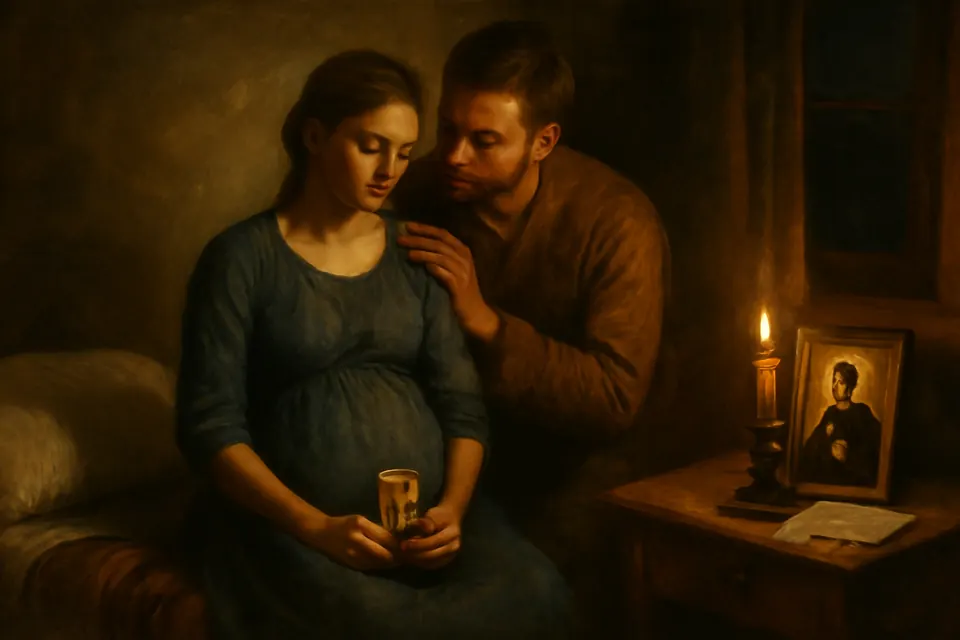
The best-known prayer to St. Gerard is the expectant mother's prayer: it asks him, as "Patron and Protector of expectant mothers," to "shield the child which I now carry, that it may see the light of day and receive the lustral waters of baptism." We pray it through pregnancy and birth, with his novena, and on his feast, October 16.
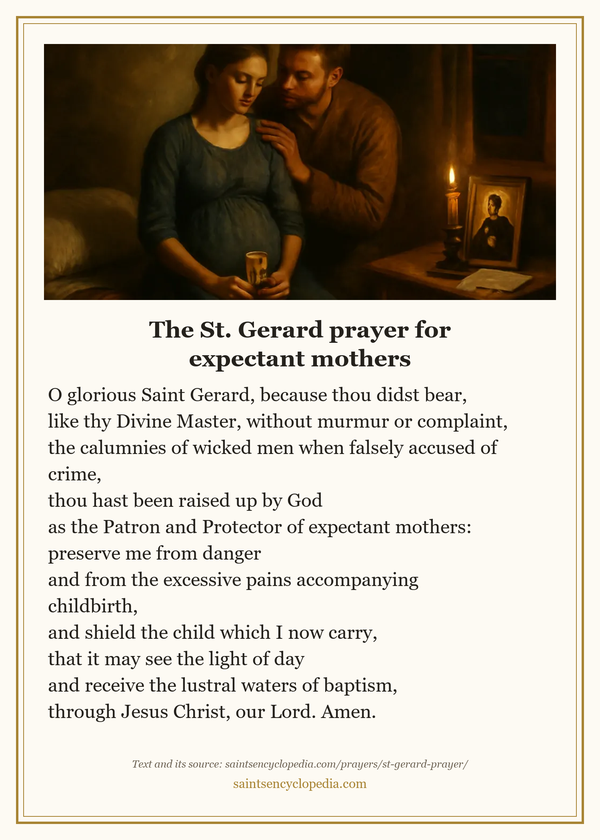 Free printable prayer card 5 × 7 inch PDF, ready to print, frame or tuck in a missal.
Waiting for a baby brings joy and fear together. For more than two centuries Catholic mothers have brought both to St. Gerard Majella, a young Redemptorist lay brother who never married and died at twenty-nine. Here is the prayer they say, the curious history of its words, and the novena prayers printed in his first full English life.
The St. Gerard prayer for expectant mothers
The prayer mothers know best is short and has no known author. It addresses St. Gerard as a "beloved servant of Jesus Christ" and "devoted child of the Mother of God," and asks him to enkindle in our hearts "one spark of that heavenly fire of charity" that burned in his. Then it turns to the reason he is the mothers' saint, and to the mother's own plea. In the form printed by The Family Digest in April 1947, the earliest printing we have found, it reads:
O glorious Saint Gerard, because thou didst bear, like thy Divine Master, without murmur or complaint, the calumnies of wicked men when falsely accused of crime, thou hast been raised up by God as the Patron and Protector of expectant mothers: preserve me from danger and from the excessive pains accompanying childbirth, and shield the child which I now carry, that it may see the light of day and receive the lustral waters of baptism, through Jesus Christ, our Lord. Amen.
The complete prayer, in its usual modern wording, is printed on our pages for St. Gerard Majella and for the patron saints of pregnancy. Mothers pray it every day through the months of waiting, in labor, and in any danger to the child.
Where the words came from
The first half of the mothers' prayer is older than the prayer itself. Fr. F. X. Lasance's Prayer-Book for Religious, first copyrighted in 1904, the year St. Gerard was canonized, prints a "Prayer to Obtain the Protection of St. Francis de Sales." It begins:
Great St. Francis, glorious apostle of Jesus Christ, seraph of the earth, who didst breathe but for the glory of God; perfect imitator of thy meek and humble Saviour, and devoted child of the holy Mother of God!
and further on it asks him to "enkindle in my heart one spark of the heavenly fire of charity which glowed in thine." Someone devoted to St. Gerard borrowed those lovely lines, changed the name, and joined them to a new petition for mothers. Catholic prayer books have always grown this way, one devout hand adding to another. The petition for mother and child is the new part, and it is what makes the prayer St. Gerard's.
What the prayer asks
The prayer gives its own reason why St. Gerard helps mothers. In 1754 a young woman falsely accused him of unchastity. He was forbidden to receive Communion and kept from all contact outside the house, and he bore it in silence. When his friends urged him to defend himself, The Liguorian reported in 1928, he only said, "There is a God. It is for Him to see to it!" Two months later the accuser confessed under oath that she had lied. The prayer sees a link between that silent suffering and his care for mothers, and the Redemptorists have long told it the same way.
Then the mother asks three things: to be kept from danger, to be spared the worst of the pains of childbirth, and that her child may be born alive and baptized. "Lustral" means purifying. The last line is a prayer for the unborn child's whole life, body and soul: that it may "see the light of day" and become a child of God.
Why mothers turn to St. Gerard
His first English biographer, the Redemptorist Fr. O. R. Vassall-Phillips, tells of a day at Senerchia when "a poor mother was dying in pains of childbirth. Saint Gerard's help was implored in her behalf. He prayed for her and saved her life." He goes on:
This is the first time that he is recorded to have assisted a woman in such a necessity, but since his holy death, again and again has his intercession been asked that some mother might be preserved from imminent danger, and her child be safely brought to the cleansing waters of Baptism.
"This seems to be Saint Gerard's special prerogative in Heaven," he concludes, "to help women, about to become mothers, who are recommended to his kindly care, and to bring them safely through their dreaded travail."
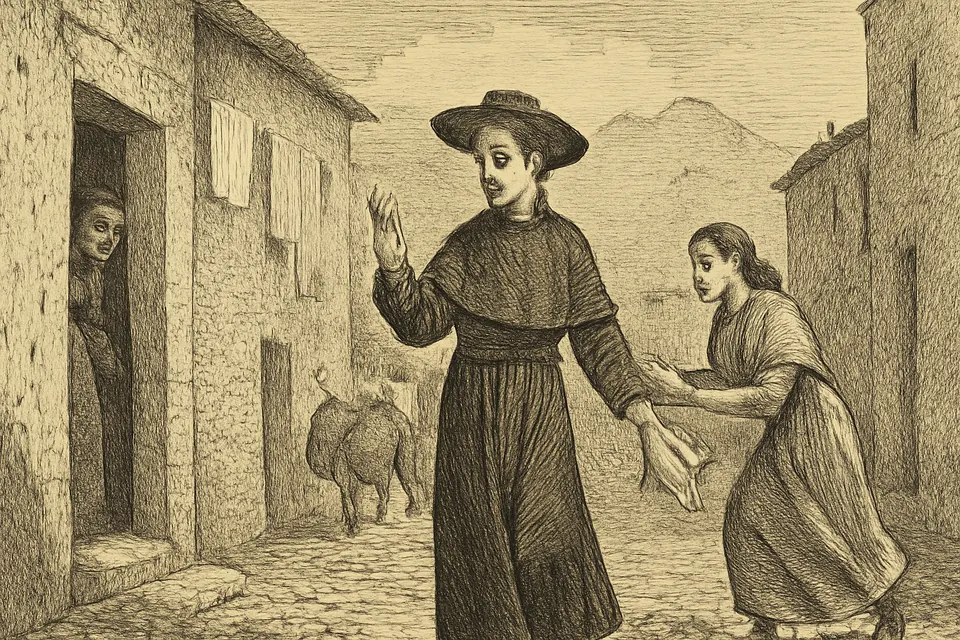
The best-known story is the handkerchief. At Oliveto, a girl ran after Gerard with a handkerchief he had left on a chair. "Keep it," he said, "it will be useful to you some day." Years later, married and near death with her first child, she called for it, and, as The Liguorian tells it, "the danger instantly passed and the child was happily born." The story is traditional, told in the Redemptorists' biographies; it is not one of the miracles approved for his canonization.
In North America the Redemptorists' League of St. Gerard enrolled expectant mothers and sent them medals and prayer leaflets, and many Catholic hospitals named their maternity wards for him. A medal or holy card works no magic. Like every sacramental, it is a sign of the Church's prayer and a reminder to pray.
The novena to St. Gerard
This novena is printed at the end of Vassall-Phillips's Life of Saint Gerard Majella (London, 1915). Each day has its own short prayer, followed by a Hail Mary, a versicle and response, and the prayer of his feast. On the first day:
Saint Gerard, ever full of faith, obtain for us, we pray thee, that believing firmly all that the Church of God proposes to our belief, we may strive to secure through a holy life the joys of eternal happiness. Hail Mary. V. Pray for us, O Blessed Gerard. R. That we may be made worthy of the promises of Christ.
Then, every day, this prayer, which asks God to make us like his crucified Son, as he made Gerard:
Let us Pray. O Almighty and Everlasting God, who didst draw to Thyself the Blessed Gerard even from his tenderest years, making him conformable to the Image of Thy crucified Son, grant, we beseech Thee, that imitating his example we may be made like unto the same Divine Image, through Jesus Christ our Lord. Amen.
The other days, in the book's words, ask for these graces:
- First day: firm faith in all the Church proposes.
- Second day: "Saint Gerard, most generous Saint, who from thy tenderest years didst care so little for the goods of earth," confidence in Jesus Christ alone, "our true treasure."
- Third day: "bright Seraph of love," to love God and our neighbor for His sake.
- Fourth day: "spotless lily of purity," the courage to "strive manfully in our life-long fight."
- Fifth day: "model of holy obedience," cheerful submission to God's will.
- Sixth day: "most perfect imitator of Jesus our Redeemer," humility.
- Seventh day: "unconquered hero, most patient in suffering, do thou, who didst glory in infirmity, and under slander and cruel ignominy didst rejoice to suffer with Christ, obtain for us patience and resignation in our sorrows, that we may bravely bear the cross which is to gain for us the crown of everlasting glory."
- Eighth day: "true lover of Jesus in the Blessed Sacrament of the Altar," the spirit of prayer and love for the Eucharist.
- Ninth day: "most favoured child of Heaven, to whom Mary gave the Infant Jesus in the days of thy childhood," so to love our Blessed Mother "that she may be our joy and consolation in this valley of tears."
An expectant mother can pray this novena with the mothers' prayer each day, adding her own intention. Many pray it in the nine days before his feast, or in the last weeks before a birth.
Prayers from his shrine at Materdomini
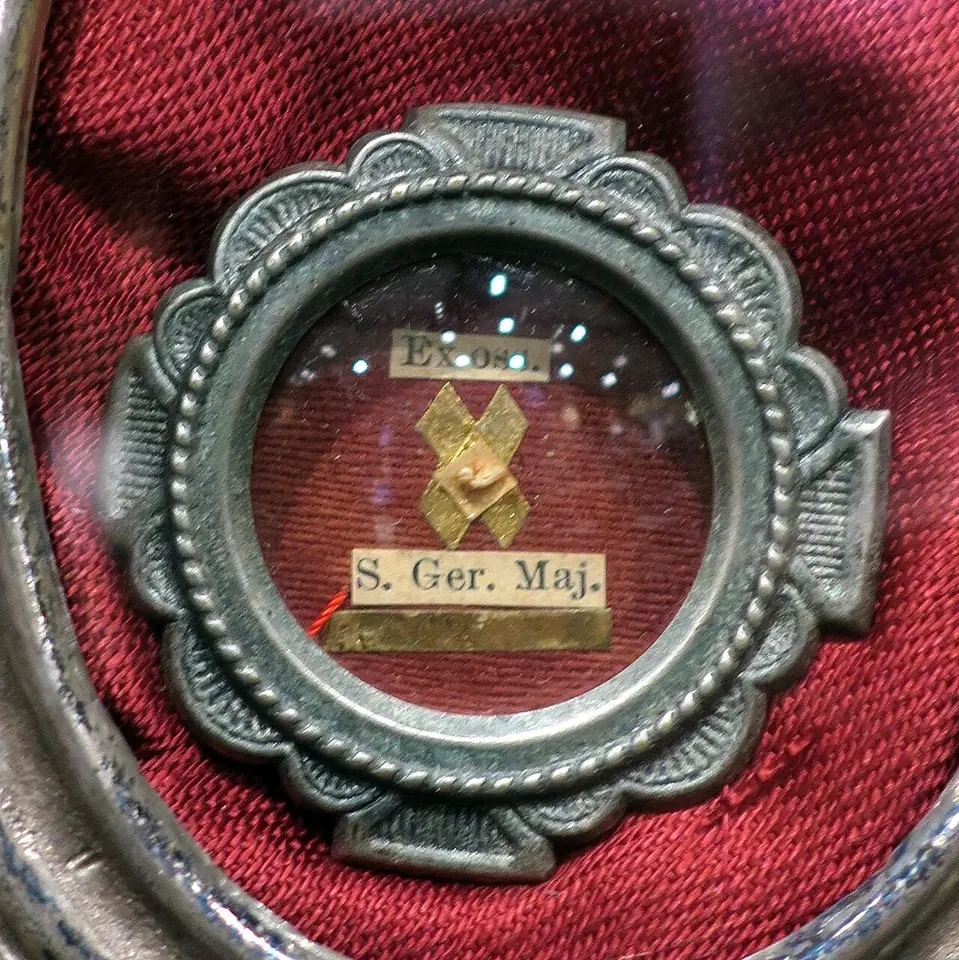
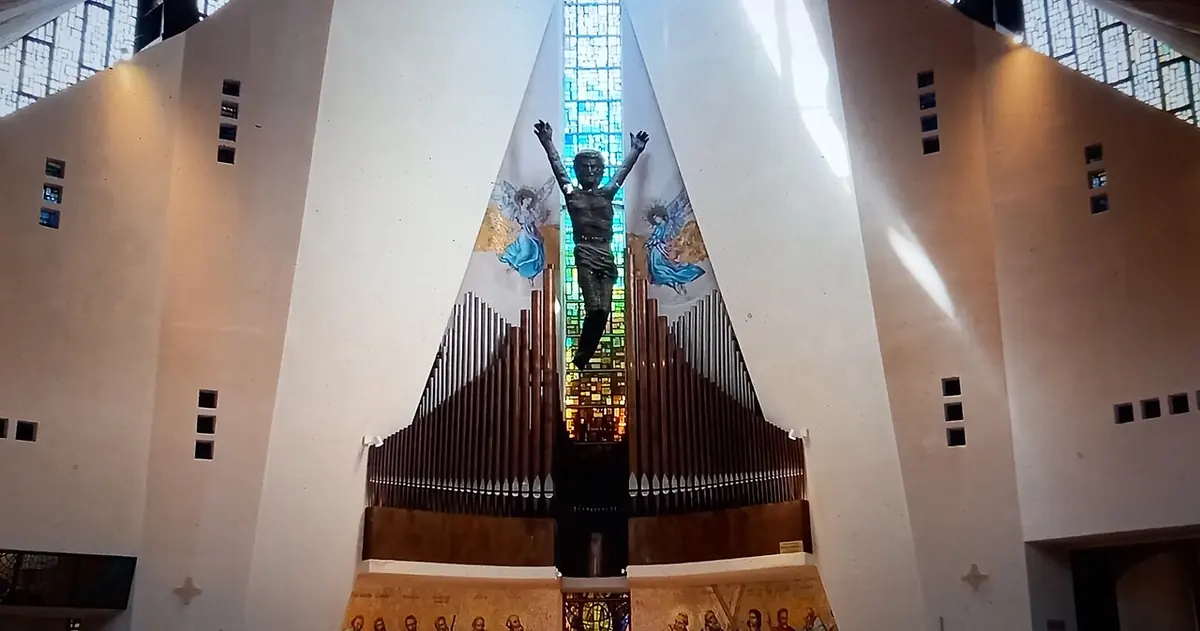
Gerard died at the Redemptorist house of Materdomini, above Caposele in southern Italy, on the night of October 15 to 16, 1755, and his tomb there draws pilgrims, many of them mothers, all year. The sanctuary's prayer page gathers prayers "born of tradition and of the devotion of the faithful": a mother's prayer, the prayer of a mother expecting a child, a prayer per una maternità difficile (for a difficult pregnancy), a prayer for the gift of motherhood, a prayer for life, and an act of entrusting mothers and children to Our Lady and St. Gerard.
Praying to St. Gerard for mothers and the unborn
- During pregnancy: pray the mothers' prayer each day, and ask the father of the child to pray it with you.
- In danger or a hard pregnancy: pray it with the novena, ask your parish for a blessing for mother and child, and ask others to pray.
- When hoping for a child: ask St. Gerard's prayers with trust, and bring the longing to Mass.
- For the unborn everywhere: his feast on October 16 falls in October, which the bishops of the United States keep as Respect Life Month, a good day to pray for every child waiting to be born and every mother afraid.
- After the birth: thank God, and if you can, make the novena again in thanksgiving.
Let us pray: St. Gerard, protector of mothers, pray for us and for our children.
See also the prayer for mothers, the prayer for a newborn, the patron saints of mothers and fertility, and all our prayers.
Frequently asked questions
What is the St. Gerard prayer for pregnancy?
It is a traditional prayer of unknown authorship, printed on holy cards and leaflets for generations. It calls St. Gerard "the Patron and Protector of expectant mothers" and asks him to "preserve me from danger and from the excessive pains accompanying childbirth, and shield the child which I now carry." It was in print by 1947; its opening lines are borrowed from an older prayer to St. Francis de Sales.
Why is St. Gerard the patron of expectant mothers?
In his lifetime he prayed for a mother dying in childbirth at Senerchia, and she lived. A young woman of Oliveto to whom he had left his handkerchief later called for it when she was in danger in labor, and the danger passed. After his death, mothers in southern Italy turned to him so often that a witness at his beatification called him the saint of happy childbirths.
Can I pray to St. Gerard to have a baby?
Yes. Couples hoping for a child ask his prayers too. His sanctuary at Materdomini publishes a Preghiera per il dono della maternità, a prayer for the gift of motherhood, which begins "O san Gerardo, potente intercessore presso Dio." Pray with trust and leave the answer to God.
What does "lustral waters of baptism" mean?
"Lustral" means purifying. The prayer asks that the baby be born safely and be baptized, washed clean of original sin. Asking for a child's baptism has always been part of the Catholic mother's prayer for a safe birth.
When is St. Gerard's feast day?
October 16, the day he died at Materdomini in 1755. He was beatified by Pope Leo XIII in 1893 and canonized by Pope St. Pius X on December 11, 1904.
What is the story of St. Gerard's handkerchief?
A girl ran after Gerard with a handkerchief he had left behind. "Keep it," he said, "it will be useful to you some day." Years later, in danger of death in childbirth, she called for it, and the danger passed. The story is traditional, told in the Redemptorists' biographies, and it is the best-loved reason mothers turn to him.
Sources
- O. R. Vassall-Phillips, C.SS.R., Life of Saint Gerard Majella (London: Burns & Oates, 1915), "Prayers for Novena in Honour of Saint Gerard," Internet Archive
- F. X. Lasance, Prayer-Book for Religious (New York: Benziger, copyright 1904; 1914 printing), "Prayer to Obtain the Protection of St. Francis de Sales," Internet Archive
- The Family Digest, April 1947, "To Saint Gerard Majella," Internet Archive
- The Liguorian, October 1928 (Redemptorist Fathers, Oconomowoc, Wis.), article on St. Gerard and mothers, Internet Archive
- Liguori Publications (Redemptorists): Saint Gerard Majella, adapted from The Mothers' Saint
- Catholic Encyclopedia (1909): St. Gerard Majella
- Santuario San Gerardo Maiella, Materdomini: Preghiere