Julian of Norwich
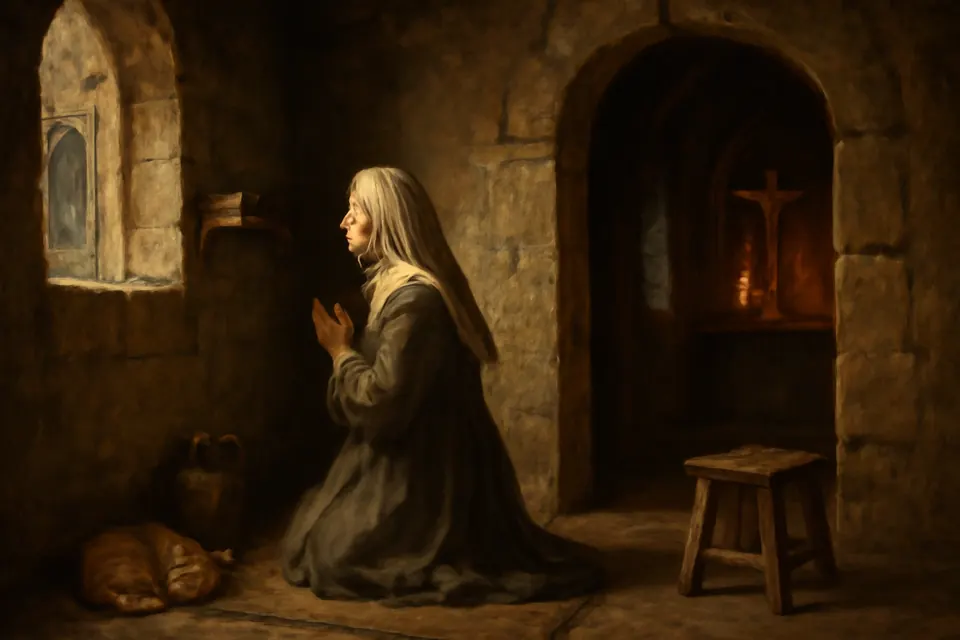
Julian of Norwich (about 1343 to after 1413) was an English anchoress who, while gravely ill on May 13, 1373, received sixteen "showings" of Christ's Passion. Her Revelations of Divine Love, the first book in English known to be written by a woman, gave us "all shall be well." She has never been formally beatified or canonized.
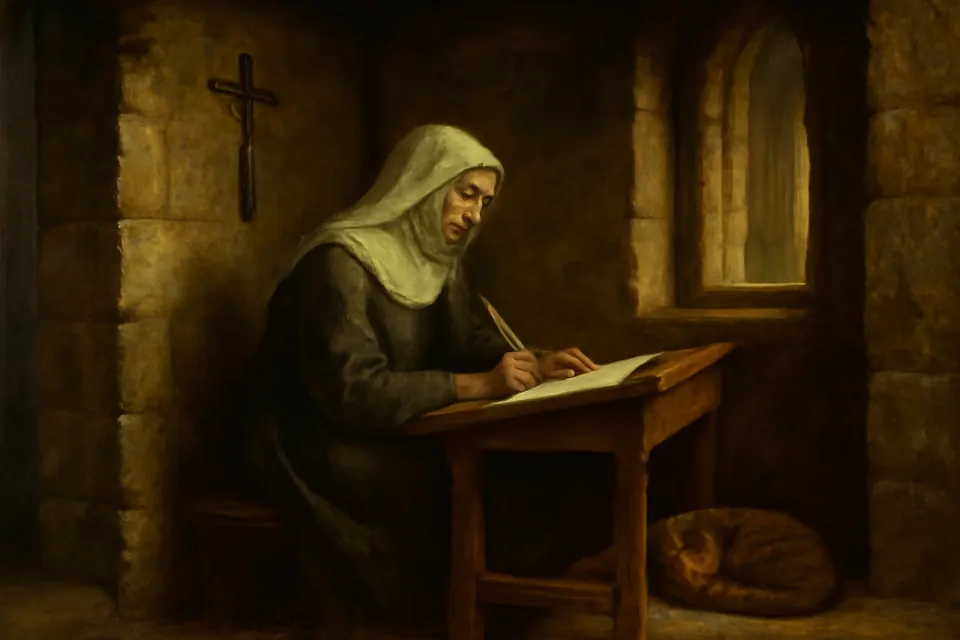
Julian of Norwich was an English woman who lived enclosed in a small cell built against the wall of St. Julian's Church in Norwich, praying, counseling visitors and writing. In May 1373, when she was thirty and a half and lay dying, she received sixteen "showings" of Christ's Passion and of God's love. She spent the next twenty years and more praying over them, and the book she wrote, Revelations of Divine Love, is the first book in English known to have been written by a woman. From it come some of the most consoling words in Christian writing: "all shall be well, and all shall be well, and all manner of thing shall be well."
Pope Benedict XVI devoted a general audience to her in 2010 and called her a mystic "venerated both in the Catholic Church and in the Anglican Communion." Let us learn from her, and ask her prayers, as we go.
Who was Julian of Norwich?
We know very little about her life apart from what she tells us. We do not know her real name; "Julian" is most likely taken from the church where she lived, dedicated to St. Julian. We do not know whether she had been a nun, as the old Catholic Encyclopedia supposed, or a laywoman, perhaps a widow who had lost her family to the plagues that swept Norwich in her youth. Norwich was then the second city of England, a busy, wealthy town of churches and merchants on the river Wensum.
She tells us that she was a "simple creature unlettered," and that before her illness she had asked God for three gifts:
The First was mind of His Passion; the Second was bodily sickness in youth, at thirty years of age; the Third was to have of God's gift three wounds.
The three wounds she wanted were "the wound of very contrition, the wound of kind compassion, and the wound of steadfast longing toward God." She asked for the first two gifts only if they were God's will, and then forgot about them. The third stayed with her.
The showings of May 1373
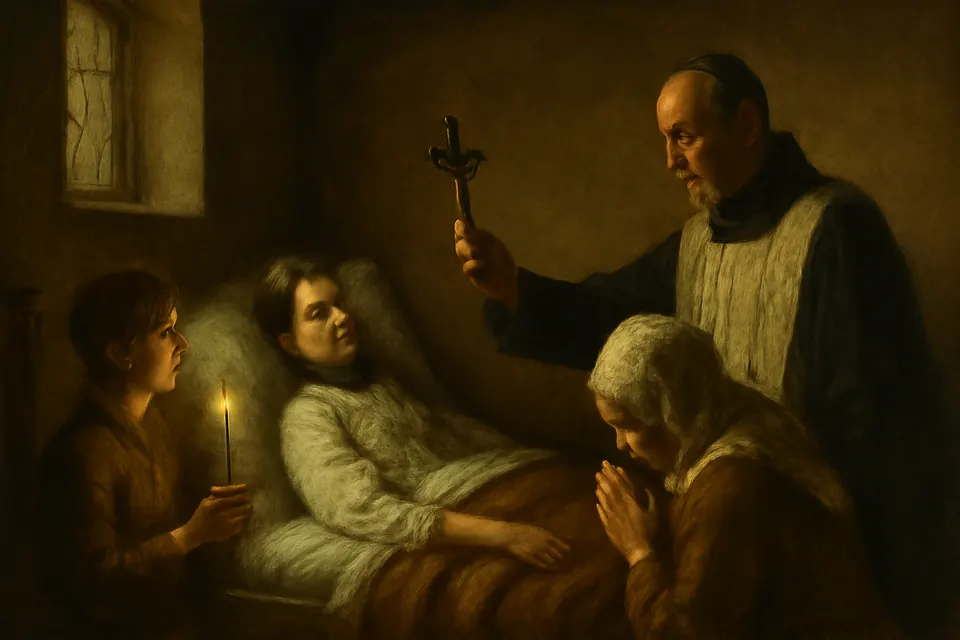
When she was thirty and a half, God sent her the illness she had once asked for. She lay three days and three nights near death and received the last rites. Some days later, sure she would die, she could no longer speak. Her parish priest came and held a crucifix before her eyes:
I have brought thee the Image of thy Maker and Saviour: look thereupon and comfort thee therewith.
As she looked at the cross, the pain left her, and the face on the crucifix began to bleed. Over the next hours she received fifteen showings, and the sixteenth came the following night. Both the Paris and the Sloane manuscripts date them to May 13, 1373, which Benedict XVI called the most likely date.
The showings were of Christ's Passion, of the Blessed Virgin Mary, of the Trinity, of sin and of God's love for the soul. Julian always speaks of them with care. Some were "bodily sight," some were words formed in her understanding, and some were "ghostly sight," that is, spiritual insight. She never claims that they add anything to the faith of the Church. She calls herself a "lover of Holy Church" and asks the reader to take what she writes as part of the "common" faith of all Christians.
The hazelnut
The best-loved image of the whole book comes from the first showing:
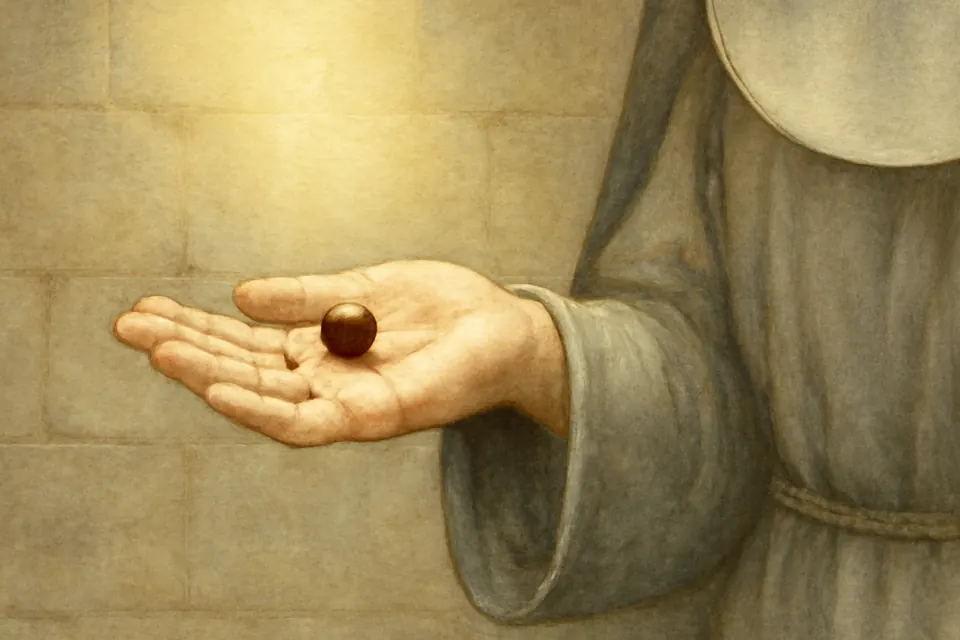
Also in this He shewed me a little thing, the quantity of an hazel-nut, in the palm of my hand; and it was as round as a ball. I looked thereupon with eye of my understanding, and thought: What may this be? And it was answered generally thus: it is all that is made.
She wondered how such a small thing could last without falling into nothing, and was answered, "It lasteth, and ever shall [last] for that God loveth it." In that little thing she saw three truths: God made it, God loves it, God keeps it.
The anchoress of St. Julian's
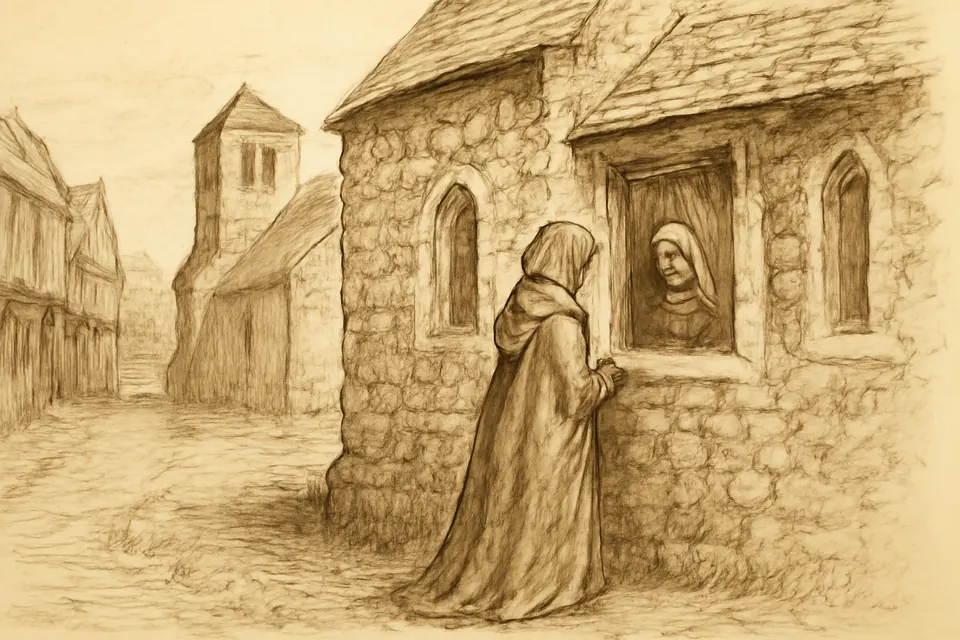
At some point after 1373 Julian was enclosed as an anchoress, a woman who vowed to live the rest of her life in a single cell attached to a church. The bishop sealed the anchoress in with a rite that included prayers from the burial service. A small window opened into the church, so that she could follow the Mass and receive Holy Communion. Another window, covered by a curtain, opened onto the world, so that visitors could come for advice and servants could bring food.
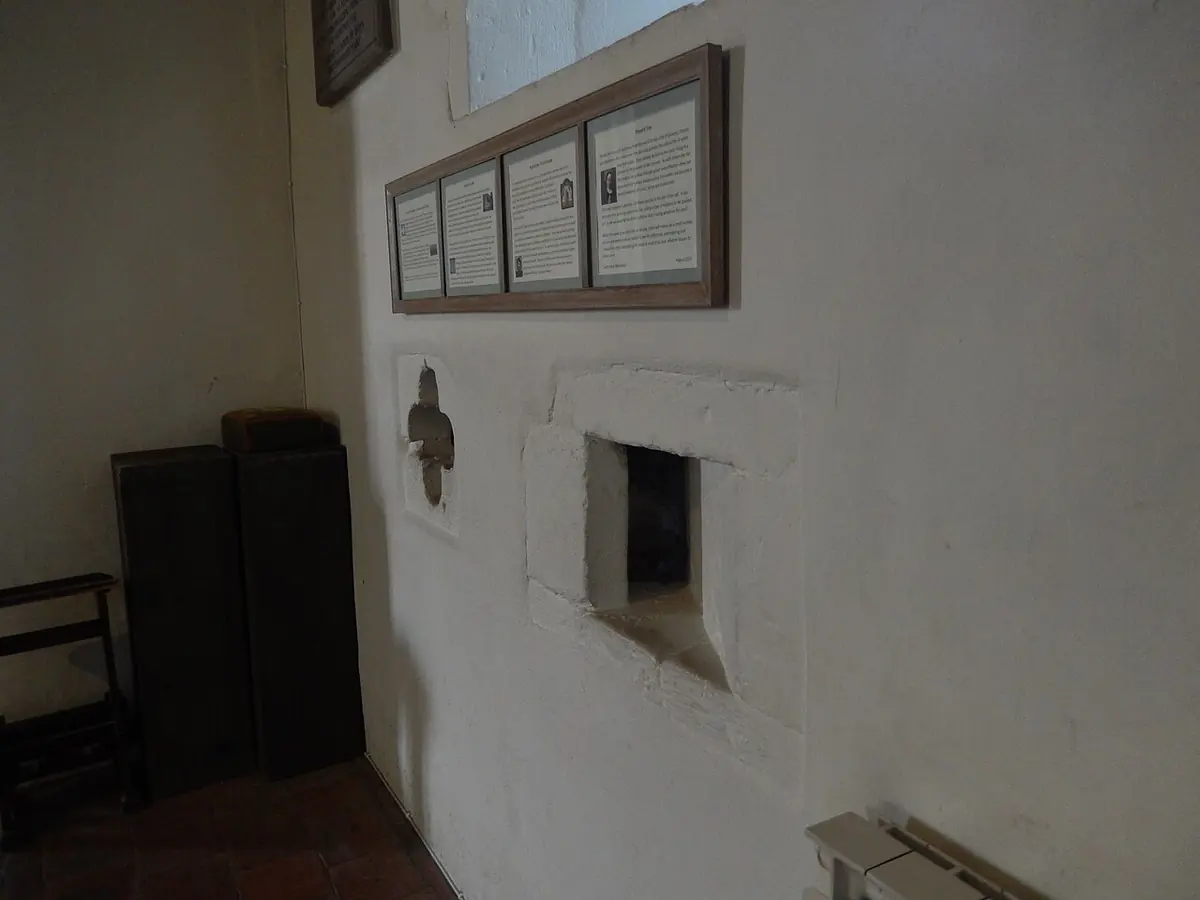
Benedict XVI pointed out that this was "not ... an individualistic choice." People came to the anchoress's window from all over the city. Around 1413 the pilgrim and mystic Margery Kempe traveled to Norwich to ask Julian's advice about her own visions, and her Book records that Julian counseled her for several days and told her to obey God's will and trust in His love. The note at the head of the Amherst manuscript says she was still alive in 1413. We do not know when she died.

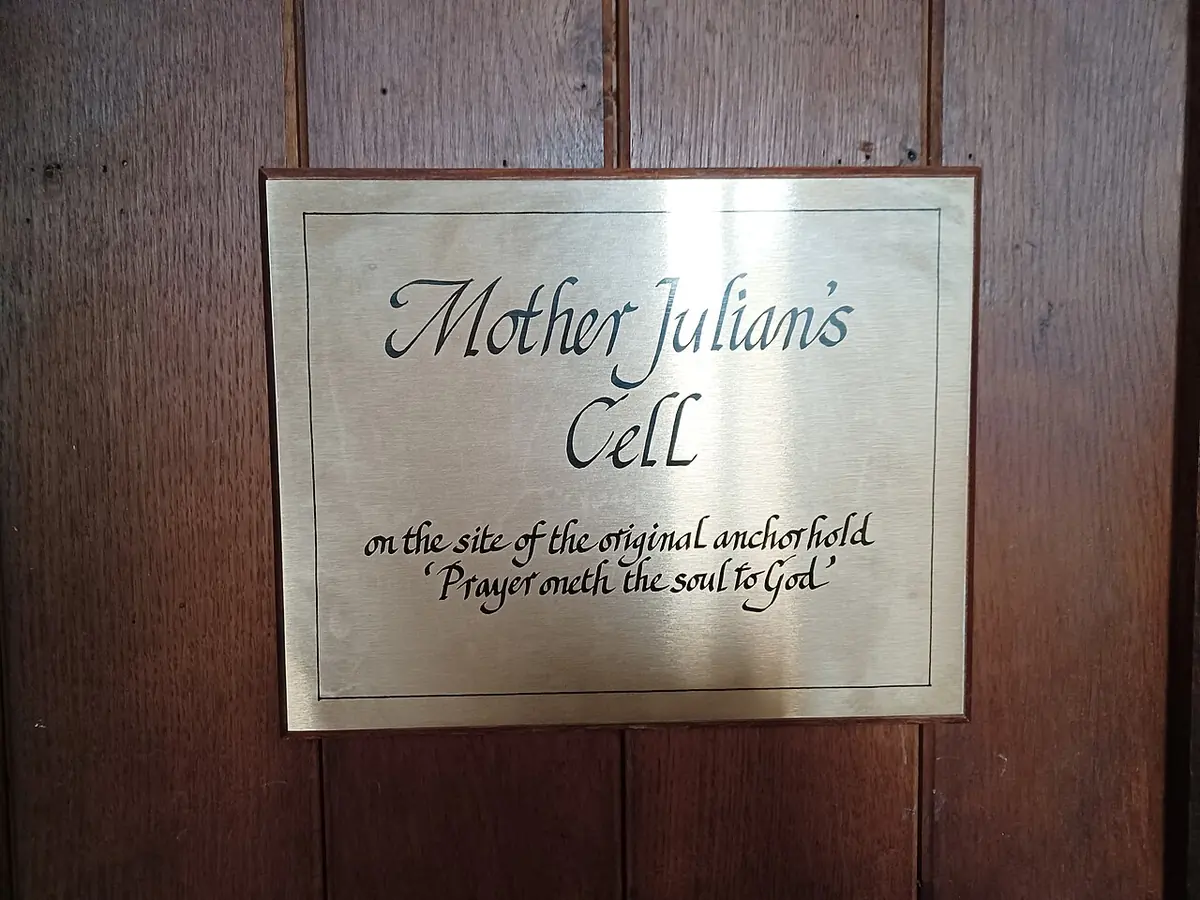
The church was destroyed by bombing in the Second World War and rebuilt afterward. A chapel was built on the site of Julian's cell, and pilgrims from around the world come to pray there.
Revelations of Divine Love: the short and long texts
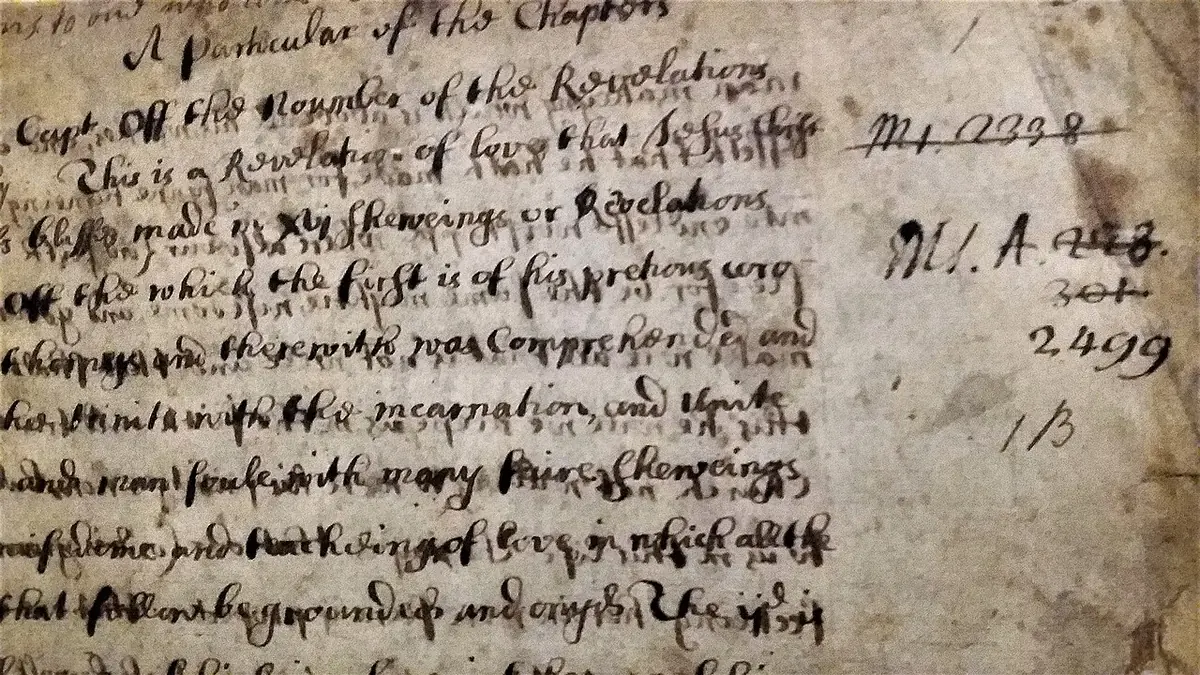
Julian wrote her book twice. The Short Text, about 25 chapters long, seems to have been written fairly soon after the showings. It survives in a single copy, the Amherst manuscript in the British Library, made in the mid-1400s. Its heading names "Julian that is recluse at Norwich and yet is on life" in 1413.
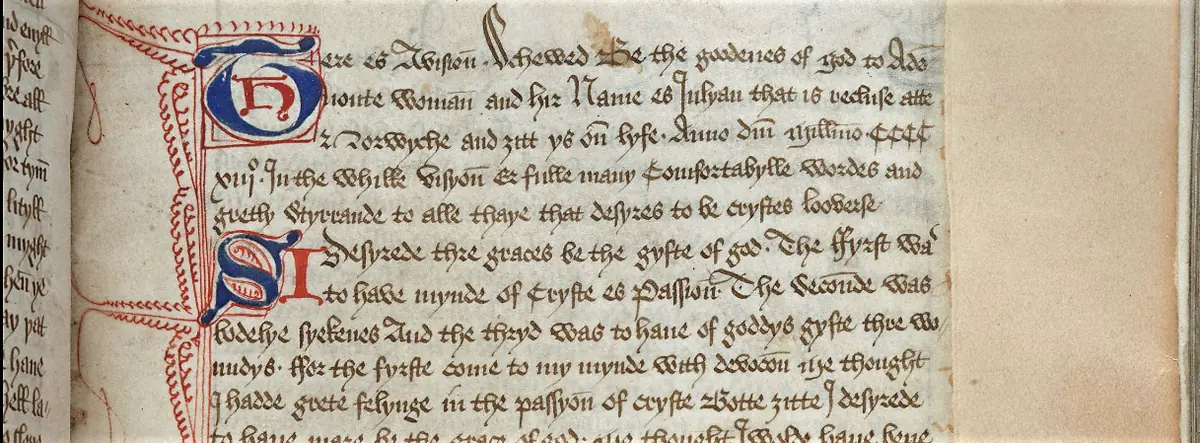
The Long Text, 86 chapters, came after many more years of prayer. "For twenty years after the time of this shewing, save three months, I had teaching inwardly," she writes. It survives in later copies, chiefly a manuscript in the Bibliothèque nationale in Paris and two in the British Library's Sloane collection, all from the 1500s and 1600s, when English Benedictine nuns in exile in France treasured and copied it. The English Benedictine Serenus Cressy printed it for the first time in 1670.
Grace Warrack's modernized edition of 1901 brought Julian to a wide modern readership, and it is the version we quote on this page.
"All shall be well"
The words for which Julian is most famous answer the hardest question a Christian can ask. In the thirteenth showing she wondered why God, in His wisdom, had not prevented sin from the beginning, "for then, methought, all should have been well." Christ answered her:
It behoved that there should be sin; but all shall be well, and all shall be well, and all manner of thing shall be well.
She noticed that the words were said "full tenderly, showing no manner of blame to me nor to any that shall be saved." Sin is real and terrible, she says, and the Passion of Christ shows what it cost. But God will bring good out of it in a way we cannot yet see. She calls it the "Great Deed" that God has kept "hid in His blessed breast," by which "He shall make all things well."
Julian did not take this as a promise that no one would be lost. She was troubled precisely because the Church teaches that some will be condemned, and she held to that teaching. Her answer was trust. In chapter 32 Christ tells her, "That which is impossible to thee is not impossible to me: I shall save my word in all things and I shall make all things well." The Catechism of the Catholic Church (313) quotes her words from this chapter to explain how God's providence brings good even out of evil.
T. S. Eliot brought the line into modern English poetry in Little Gidding (1942), and it has comforted countless people at hospital bedsides and gravesides since.
God's love as a mother's love
Julian's most daring image is that of God's motherly love. "As verily as God is our Father, so verily God is our Mother," she writes, and she speaks above all of Jesus as "our Very Mother," who gives us life, feeds us with Himself in the Eucharist and never lets us go. This is not a new doctrine about God. It is a way of speaking about Christ's tender love that has roots in Scripture: Isaiah's "Can a woman forget her infant?" and Christ's own lament over Jerusalem, where He longed to gather her children "as the hen doth gather her chickens." St. Anselm and others used the same language before her. Benedict XVI called it "one of the most characteristic messages of her mystical theology."
"Love was His meaning"
For fifteen years and more Julian asked what the showings meant. The answer came at last, and she put it in the last chapter of her book:
Wouldst thou learn thy Lord's meaning in this thing? Learn it well: Love was His meaning. Who shewed it thee? Love. What shewed He thee? Love. Wherefore shewed it He? For Love.
"And I saw full surely that ere God made us He loved us," she continues, "which love was never slacked, nor ever shall be."
Julian of Norwich's place in the Church
Julian has never been formally beatified or canonized, and there is no cause for her canonization. She has no feast on the General Roman Calendar. Yet she is honored throughout the Church. Many Catholics speak of her as "Mother Julian," and some, out of long affection, as "Blessed Julian," though that is not an official title. Anglicans and Episcopalians commemorate her on May 8. Many Catholics who honor her keep May 13, the date her manuscripts give for the showings.
In her book she prays a short prayer that she says is the natural longing of every soul, "by the touching of the Holy Ghost." It is a good prayer to make our own:
God, of Thy Goodness, give me Thyself: for Thou art enough to me, and I may nothing ask that is less that may be full worship to Thee; and if I ask anything that is less, ever me wanteth,--but only in Thee I have all.
Let us ask Julian to pray for us, especially when we cannot see how anything could be well. Readers who love her often go on to St. Catherine of Siena, St. Bridget of Sweden and St. Gertrude the Great, women of her own century and the one before who also wrote of what God showed them. Her trust in God's providence also lives on in Brother Lawrence and St. Therese of Lisieux.
Frequently asked questions
What does "all shall be well" mean?
In her thirteenth showing Julian asked why God had allowed sin, and Christ answered, "It behoved that there should be sin; but all shall be well, and all shall be well, and all manner of thing shall be well." It is a promise about God's final victory, not a claim that everyone will be saved. Julian says plainly that she held to the Church's teaching on hell and trusted that God would keep His word in a way she could not yet see. The Catechism quotes her on this point in paragraph 313.
Is Julian of Norwich a saint?
Not formally. She has never been beatified or canonized, and she has no feast in the General Roman Calendar. Still, she is honored in the Church. Pope Benedict XVI gave a whole general audience on her in 2010, the Catechism of the Catholic Church quotes her, and many Catholics call her "Mother Julian" or "Blessed Julian" out of affection.
When is the feast of Julian of Norwich?
She has no official Catholic feast. Anglicans and Episcopalians commemorate her on May 8, and many Catholics who honor her keep May 13, the date the oldest copies of her book give for the showings.
What is the hazelnut in Julian of Norwich?
In the first showing Christ showed her "a little thing, the quantity of an hazel-nut, in the palm of my hand," and told her, "it is all that is made." She wondered how something so small could last, and understood, "It lasteth, and ever shall for that God loveth it." God made it, God loves it and God keeps it.
Was Julian of Norwich a nun?
We do not know. Some older writers, including the Catholic Encyclopedia of 1910, thought she was probably a Benedictine nun of Carrow Priory, which owned St. Julian's Church. Others suggest she was a laywoman, perhaps a widow. All we know for certain is what she tells us in her book and that she later lived enclosed as an anchoress at St. Julian's.
Sources
- Julian of Norwich, Revelations of Divine Love, ed. Grace Warrack (1901), Project Gutenberg. Source of every quotation from the Revelations on this page
- Benedict XVI, General Audience on Julian of Norwich (December 1, 2010)
- Catechism of the Catholic Church, paragraphs 309-314 (Julian of Norwich in paragraph 313)
- Catholic Encyclopedia (1910): Juliana of Norwich. The manuscripts, and the Amherst manuscript's note that she was alive in 1413
- The Julian Shrine, St. Julian's Church, Norwich