Prayer of St. Francis

The Prayer of St. Francis, also called the Peace Prayer, begins "Lord, make me an instrument of your peace." St. Francis of Assisi did not write it. It first appeared, unsigned, in a small French Catholic magazine, La Clochette, in December 1912, and was credited to Francis only in the 1920s. It is still a beautiful prayer in his spirit.
 Free printable prayer card 5 × 7 inch PDF, ready to print, frame or tuck in a missal.
"Lord, make me an instrument of your peace." Millions of people know these words by heart, and they are sung at weddings, funerals and school Masses around the world. St. Francis of Assisi did not write them; they were first printed in Paris in 1912. The prayer is still worth praying, and the story of how it got his name is a small chapter of 20th-century Catholic history. Here is the full text, the French original, and that story.
The Prayer of St. Francis
This is the English form most people know, in use since the middle of the 20th century:
Lord, make me an instrument of your peace. Where there is hatred, let me sow love; where there is injury, pardon; where there is doubt, faith; where there is despair, hope; where there is darkness, light; where there is sadness, joy. O divine Master, grant that I may not so much seek to be consoled as to console; to be understood as to understand; to be loved as to love. For it is in giving that we receive; it is in pardoning that we are pardoned; and it is in dying that we are born to eternal life. Amen.
The original French text of 1912
The prayer first appeared under the title Belle prière à faire pendant la Messe, "A Beautiful Prayer to Say During Mass," in La Clochette, no. 12, December 1912, page 285. This is the text as published by Christian Renoux:
Seigneur, faites de moi un instrument de votre paix. Là où il y a de la haine, que je mette l'amour. Là où il y a l'offense, que je mette le pardon. Là où il y a la discorde, que je mette l'union. Là où il y a l'erreur, que je mette la vérité. Là où il y a le doute, que je mette la foi. Là où il y a le désespoir, que je mette l'espérance. Là où il y a les ténèbres, que je mette votre lumière. Là où il y a la tristesse, que je mette la joie. Ô Maître, que je ne cherche pas tant à être consolé qu'à consoler, à être compris qu'à comprendre, à être aimé qu'à aimer, car c'est en donnant qu'on reçoit, c'est en s'oubliant qu'on trouve, c'est en pardonnant qu'on est pardonné, c'est en mourant qu'on ressuscite à l'éternelle vie.
A literal translation of the French
Our own word-for-word translation shows what the familiar English version left out:
Lord, make me an instrument of your peace. Where there is hatred, let me put love. Where there is offense, let me put pardon. Where there is discord, let me put union. Where there is error, let me put truth. Where there is doubt, let me put faith. Where there is despair, let me put hope. Where there are shadows, let me put your light. Where there is sadness, let me put joy. O Master, let me not so much seek to be consoled as to console, to be understood as to understand, to be loved as to love, for it is in giving that one receives, it is in forgetting oneself that one finds, it is in pardoning that one is pardoned, it is in dying that one rises to eternal life.
Three lines dropped out on the way into English: "where there is discord, union," "where there is error, truth," and "it is in forgetting oneself that one finds." The original also asks for "your light," God's light rather than our own, and it ends on resurrection: "in dying... one rises to eternal life." Many people who pray the prayer regularly add the missing lines back.

Where the Prayer of St. Francis comes from
La Clochette and the Holy Mass League
The research behind what we now know was done by Christian Renoux, a historian at the University of Orléans, who published his findings in a 2001 book, La prière pour la paix attribuée à saint François: une énigme à résoudre ("The Prayer for Peace Attributed to St. Francis: A Riddle to Solve").
The prayer's first known appearance is in La Clochette, "The Little Bell," a small devotional magazine published in Paris by the Ligue de la Sainte-Messe, the Holy Mass League. A French priest, Fr. Esther Bouquerel (1855–1923), founded the league in 1901 to encourage devotion to the Mass. The prayer appeared without any author's name, and its title says what it was for: a prayer to say during Mass. Renoux suggests Fr. Bouquerel himself may have written it, but, in his words, "the identity of the author remains a mystery."

Pope Benedict XV and L'Osservatore Romano
The prayer did not stay obscure for long. In 1915, in the middle of the First World War, the Marquis Stanislas de La Rochethulon sent the French text to Pope Benedict XV. In 1916 an Italian translation appeared in L'Osservatore Romano, the Vatican's daily newspaper. Benedict XV spent his whole pontificate pleading for an end to the war, and a prayer that began "make me an instrument of your peace" fit that moment.

How it got St. Francis's name
Around 1920 a French Franciscan printed the prayer on the back of a holy card with a picture of St. Francis, under the title Prière pour la paix, "Prayer for Peace." He did not say Francis wrote it; the picture simply sat on one side and the prayer on the other. Holy cards travel, and the two became linked.
In 1927 a French Protestant peace movement, the Chevaliers du Prince de la Paix (Knights of the Prince of Peace), founded by Étienne Bach, published the prayer as a prayer of St. Francis. Renoux found no earlier attribution. The first English translation he knows of appeared in 1936 in Living Courageously, a book by the American minister Kirby Page, which credited it plainly to "St. Francis of Assisi." During and after the Second World War the prayer spread across the English-speaking world under that name, Renoux notes, "specially through Francis cardinal Spellman's books," and from there into hymnals and onto holy cards everywhere.
Why it is still a prayer of St. Francis
Knowing the history takes nothing away from the prayer. It was written by a Catholic, for people at Mass, and it fits the saint whose name it carries.
St. Francis of Assisi (about 1181–1226) really was a man of peace. In his Testament, dictated near the end of his life, he wrote: "The Lord revealed to me this salutation, that we should say: 'The Lord give thee peace.'" In 1219, during the Fifth Crusade, he walked from the crusader camp at Damietta, in Egypt, into the enemy camp to preach to Sultan al-Kamil, and the sultan received him with courtesy. In his last years he added a verse to his Canticle of the Creatures to make peace between the bishop and the mayor of Assisi: "Praised be my Lord for those who for Thy love forgive / And weakness bear and tribulation."

The prayer's heart, "it is in giving that we receive... it is in dying that we are born to eternal life," is the Gospel Francis lived: "he that shall lose his life for my sake, shall find it" (Matthew 10:39, Douay-Rheims). He stripped himself of his father's wealth, embraced lepers, and at the end asked to be laid on the bare ground to die. The line the English left out, "it is in forgetting oneself that one finds," could be a summary of his life.
So the honest way to describe it is also the simplest: a 20th-century prayer in the spirit of St. Francis.
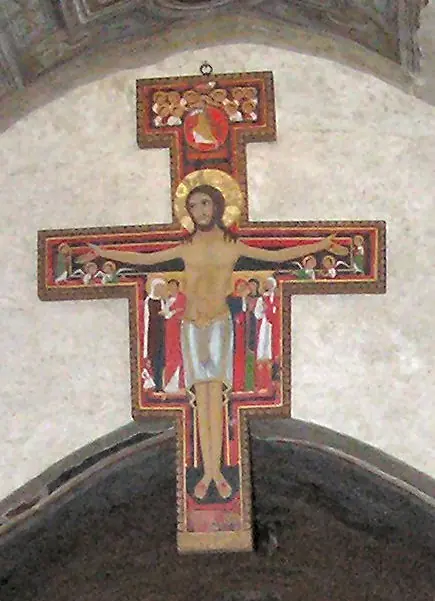
Prayers St. Francis really wrote
If you love the Peace Prayer, it is worth knowing Francis's own prayers, which are shorter and full of Scripture. The best known is the Canticle of the Creatures (also called the Canticle of Brother Sun), which he composed in Italian in 1225, near the end of his life. Paschal Robinson's 1906 translation begins:
Most high, omnipotent, good Lord, Praise, glory and honor and benediction all, are Thine. To Thee alone do they belong, most High, And there is no man fit to mention Thee.
His Praises of God, written on La Verna after he received the stigmata, and the blessing he gave Brother Leo on the same parchment, also survive. The full Canticle and the story of the Brother Leo blessing are on the page for St. Francis of Assisi.
How to pray the Prayer of St. Francis
- During Mass, as its first readers did, especially after Communion.
- In the morning, as an offering of the day: whoever we meet with hatred, injury, doubt or sadness, we ask to bring the opposite.
- When we are in conflict with someone, before speaking to them.
- As an examination of conscience at night: where did I sow love today, and where did I sow the opposite?
- For peace in the world, as Benedict XV's newspaper printed it during the First World War.
We keep the feast of St. Francis on October 4. St. Francis, pray for us, and make us instruments of Christ's peace.
For related prayers, see the Litany of Humility, which asks for the same self-forgetting, and the Anima Christi, another prayer long credited to the wrong saint.
Frequently asked questions
Did St. Francis write the Prayer of St. Francis?
No. The historian Christian Renoux of the University of Orléans traced it to La Clochette ("The Little Bell"), a small magazine of the Holy Mass League in Paris, where it appeared without an author's name in issue no. 12, December 1912. The earliest known attribution to Francis came in 1927, about seven hundred years after his death.
Who wrote the Peace Prayer of St. Francis?
No one knows. Renoux suggests it may have been Fr. Esther Bouquerel (1855–1923), the French priest who founded the Holy Mass League in 1901 and published La Clochette, but this is a guess, not a proven fact.
What are the words of the Prayer of St. Francis?
"Lord, make me an instrument of your peace. Where there is hatred, let me sow love; where there is injury, pardon; where there is doubt, faith; where there is despair, hope; where there is darkness, light; where there is sadness, joy. O divine Master, grant that I may not so much seek to be consoled as to console; to be understood as to understand; to be loved as to love. For it is in giving that we receive; it is in pardoning that we are pardoned; and it is in dying that we are born to eternal life. Amen."
Why is it called the Prayer of St. Francis if he didn't write it?
Around 1920 a French Franciscan printed it on the back of a holy card of St. Francis, titled "Prayer for Peace," without claiming Francis wrote it. In 1927 a French peace movement published it as a prayer of St. Francis, and from then on the name stuck. During and after World War II it spread widely under his name, Renoux notes, especially through Cardinal Francis Spellman's books.
Is \"Make Me a Channel of Your Peace\" the same prayer?
Yes. "Make Me a Channel of Your Peace" is a popular hymn written by Sebastian Temple in 1967, set to the words of this prayer. It is often sung at funerals, weddings and school Masses.
Is it all right to keep calling it the Prayer of St. Francis?
Yes. The name is now traditional, and the prayer fits the man: Francis's own writings are full of peace, self-forgetting and joy, and he greeted everyone with "The Lord give you peace." It is enough to know that it is a 20th-century prayer written in his spirit.