Alcide De Gasperi
Alcide De Gasperi (1881–1954) was an Italian Catholic statesman: prime minister of Italy from 1945 to 1953, founder of the Christian Democrats and one of the fathers of a united Europe. His cause for beatification opened in 1993, so the Church calls him Servant of God. The diocesan phase closed in 2025; he is not yet Venerable.
Who was Alcide De Gasperi?
Alcide De Gasperi was a Catholic layman, husband and father who led Italy out of the ruins of World War II. He founded the Christian Democratic party, was prime minister from 1945 to 1953, and with Robert Schuman and Konrad Adenauer laid the first foundations of a united Europe. Before all that he had been a prisoner of Mussolini and a humble cataloger of books in the Vatican Library.
The Church is studying his life to see whether he lived the Christian virtues to a heroic degree. His cause opened in 1993, so he is called a Servant of God. He is not yet Venerable, Blessed or a saint, and he has no feast day; August 19, the day he died, is when he is remembered. You can read what these titles mean in Venerable and Servant of God.

A boy from the Trentino
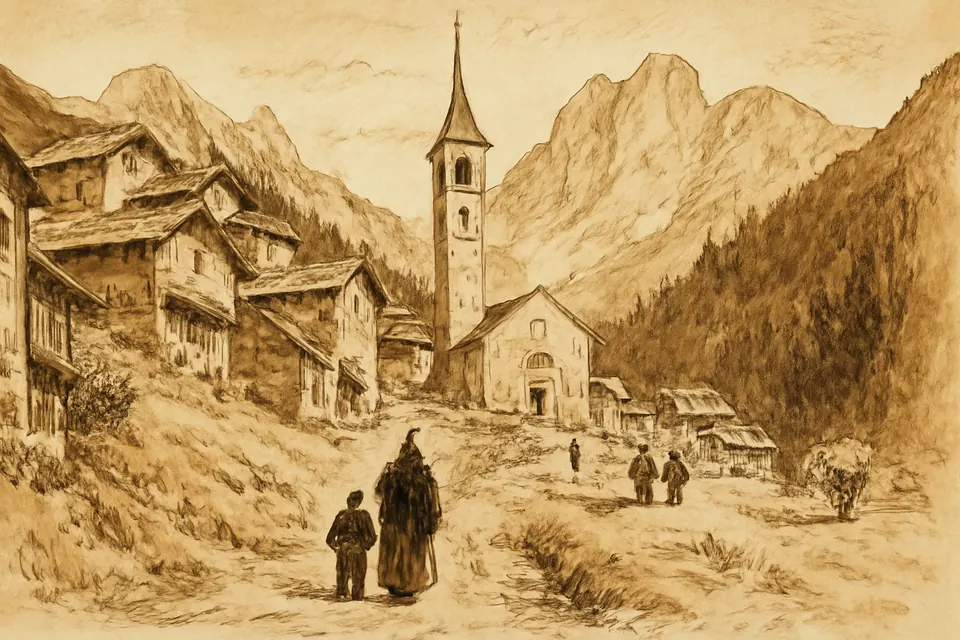
De Gasperi was born on April 3, 1881, in Pieve Tesino, a mountain village in the Trentino, which then belonged to the Austro-Hungarian Empire. He was the first of four children of Amedeo De Gasperi, an officer in the local gendarmerie, and Maria Morandini, a woman of deep faith and strong character. The family was poor and devoutly Catholic. His younger brother Mario went to the seminary and died young in 1906.
A priest, Fr. Vittorio Merler, guided his first studies, and he went on to the bishop's college in Trento. His biographer in the Dizionario Biografico degli Italiani, Piero Craveri, describes his Catholicism as that of the Trentino villages, bound to birth and death, the family hearth and, in De Gasperi's own words, "the voice of the bells, all the good Trentino past, sown with crosses and bell towers."

Vienna and the Catholic movement
In 1900 he went to the University of Vienna, where he earned his degree in 1905 with a thesis on the playwright Carlo Gozzi. Vienna then had a lively Catholic social movement, and the young student threw himself into it through the Catholic student associations. Back home he joined the Trentino People's Party in 1906, was elected to the Trento city council in 1909, and in 1911 went to Vienna again, now as a member of the Austrian parliament for the Fiemme valley.
Between the wars: party, prison and the Vatican Library
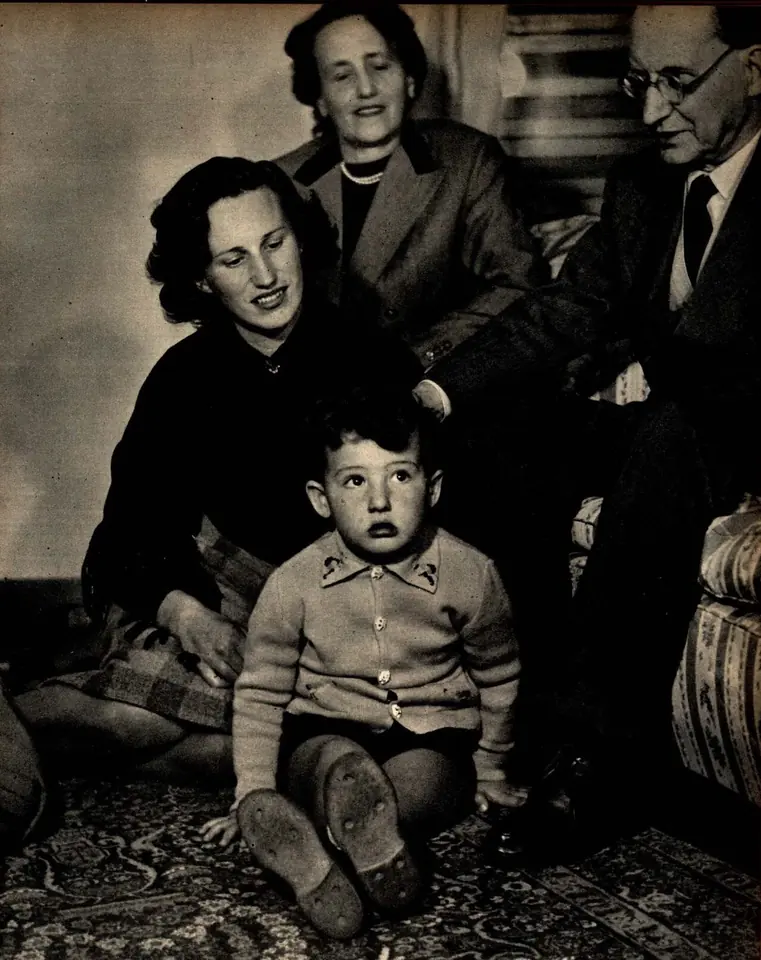
When the Trentino became part of Italy after World War I, De Gasperi entered the Italian parliament. He joined the Italian People's Party founded by Fr. Luigi Sturzo, a party of Christian inspiration, and when Sturzo went into exile after Mussolini's rise to power, De Gasperi took over its leadership. In June 1922 he married Francesca Romani, the sister of a friend from his student days in Vienna. They had four daughters: Maria Romana, Lucia, Cecilia and Paola. Lucia became a religious sister.
As the dictatorship hardened, the party was dissolved. In 1927 De Gasperi was arrested on a train in Florence and put on trial for trying to leave the country secretly. He was sentenced to four years in prison and served sixteen months. It was a hard trial, Craveri writes, not only for a man persecuted by the state but for a man who felt abandoned by his own Church. From his cell he wrote to his wife: "When I receive Communion, it seems that Christ does not answer, but he leaves an imprint on my spirit." (Our translation; the letter is in Lettere dalla prigione, published in 1955.)
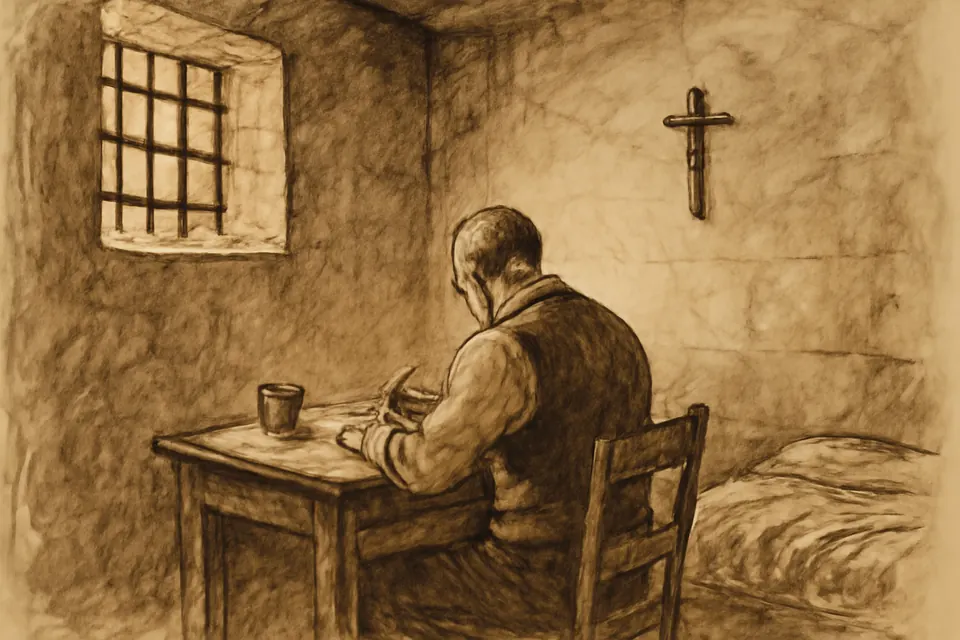
He was released on parole in July 1928 but stayed under police watch until 1933. With no income, he took on translation work, including part of the Italian edition of Ludwig von Pastor's History of the Popes. Then, in March 1929, the Vatican Library hired him as a supernumerary assistant cataloging printed books. The future prime minister spent the Fascist years at a desk among the books of the popes, and about ten years later he became the library's secretary.

Rebuilding Italy
During World War II, in hiding and in secret meetings, Catholic leaders gathered around De Gasperi, and in 1943 they founded the Christian Democratic party. After the liberation of Rome he served as foreign minister, and on December 10, 1945, he became prime minister. He held the office without a break until 1953, through eight governments.
Those years set the shape of modern Italy. Under his leadership the country became a republic, wrote a new constitution, joined the Marshall Plan and became a founding member of NATO. He governed at first with socialists and communists, and after May 1947 only with the parties of the center.
Politics as service
In his lifetime De Gasperi was known as a devout man of great moral integrity, and the cardinal who closed the diocesan inquiry in 2025 spoke of his "rock-solid faith." He also kept a clear line between his faith and the work of the state. In 1952, when Church circles in Rome pressed the Christian Democrats to join with the far right to keep the left from winning the city's elections, he refused. I.Media reports that Pope Pius XII, with whom he had been close, would not receive him afterward. The break hurt him deeply, but he did not leave the Church or turn against her. You can read more about that pope in our page on Pius XII.
A father of Europe
De Gasperi had seen two world wars tear his border homeland apart, and after 1945 he worked for European unity as the surest way to keep the peace. With Robert Schuman of France and Konrad Adenauer of Germany, all three of them Catholic statesmen, he helped found the European Coal and Steel Community in 1951, the first step toward the European Union.
He described the method he trusted in words the European Union still quotes: "The future will not be built through force, nor the desire to conquer, but by the patient application of the democratic method, the constructive spirit of agreement, and by respect for freedom." He received the Charlemagne Prize in 1952, and in 1954 he was elected president of the Common Assembly of the Coal and Steel Community.

His last great project, a European Defense Community, was failing in the French parliament in the summer of 1954, and in his final days he was still urging his colleagues to save it. He died at Sella di Valsugana, in the mountains of his native Trentino, on August 19, 1954, with his family around him.
His tomb in Rome
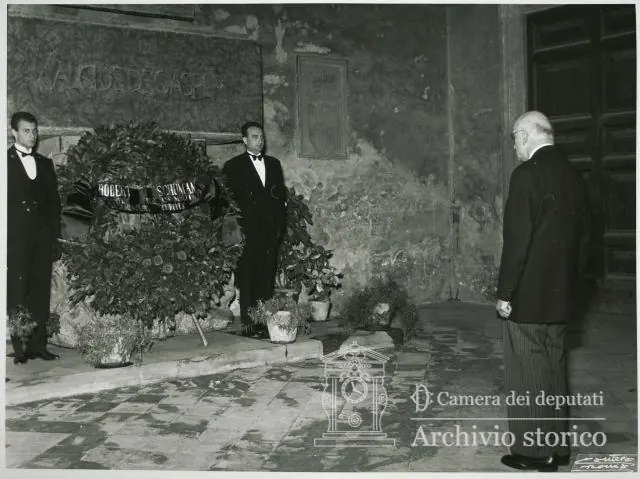
De Gasperi is buried in the portico of the ancient Basilica of San Lorenzo fuori le Mura in Rome. The Latin inscription on his tomb reads: Ei qui pacem Patriamque dilexit lux requietis aeternae affulgeat, "May the light of eternal rest shine on him who loved peace and his country."
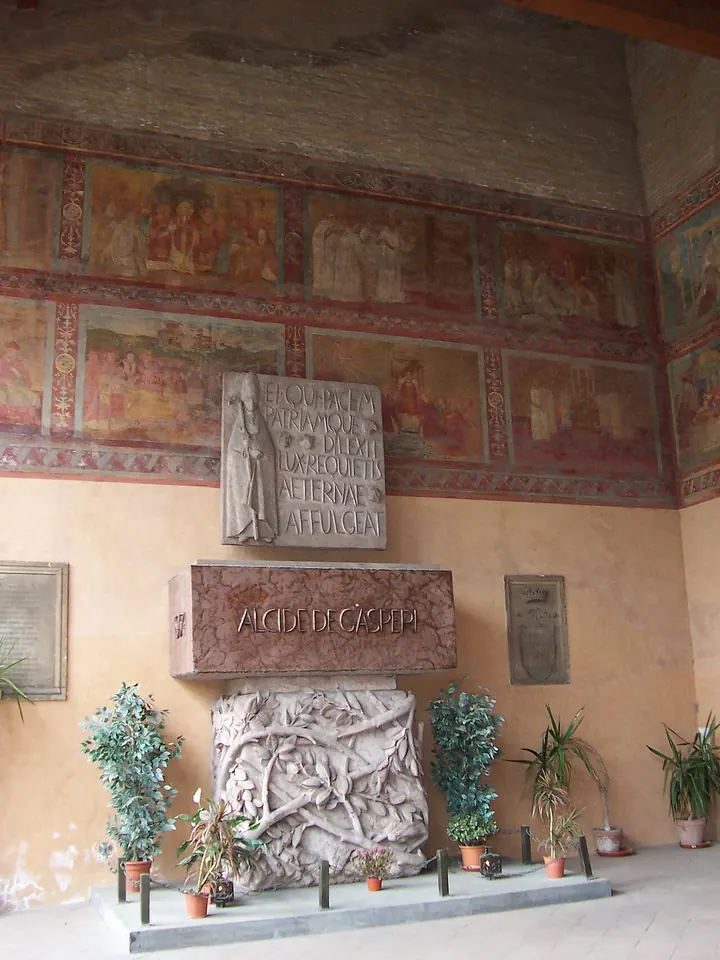
Five years after his death, on October 8, 1959, Robert Schuman came as president of the European Parliamentary Assembly to lay a wreath at the tomb of his old friend.
His cause for beatification
The cause for De Gasperi's beatification opened in 1993 in the Archdiocese of Trento, where he was born. Because so much of the evidence about his life was in Rome, the Dicastery for the Causes of Saints, with the consent of the Archbishop of Trento and the Cardinal Vicar of Rome, moved the cause to the Diocese of Rome. A team of historians began its formal study in 2022 and gathered more than 22,000 documents.
On February 28, 2025, Cardinal Baldassare Reina, the Pope's vicar for Rome, closed the diocesan inquiry at the Lateran Palace. He called De Gasperi "a model for Italian and European politics." The sealed acts, filling 23 boxes, went to the Dicastery for the Causes of Saints. The postulator is Dr. Paolo Vilotta. The next step is the positio, the formal study of his life and virtues. If the Pope approves a decree recognizing his heroic virtues, De Gasperi will be called Venerable, as his friend Robert Schuman already is. Beatification would then need a miracle attributed to his intercession.
Praying with Alcide De Gasperi
Until the Church beatifies him, De Gasperi may not be honored with a public feast or Masses, but we may ask him privately to pray for us, and pray for his cause. His life speaks especially to Catholics in public life, to those treated unjustly, and to anyone who has felt far from God in a dark season, as he did in his prison cell, when Christ seemed silent and still left "an imprint on the spirit."
Let us ask him to pray for all who govern, that they may seek peace and the common good, as we ask St. Thomas More, patron of statesmen and politicians. Other modern Catholics whose causes inspire lay people are St. Pier Giorgio Frassati, the young man of the Italian Catholic movement who became a saint, and Dorothy Day.
Frequently asked questions
Is Alcide De Gasperi a saint?
Not yet. His cause for beatification opened in the Archdiocese of Trento in 1993, which gave him the title Servant of God. The diocesan inquiry, later moved to Rome, closed on February 28, 2025, and the evidence went to the Dicastery for the Causes of Saints. If the Pope recognizes his heroic virtues, he will be called Venerable.
Why is Alcide De Gasperi called a father of Europe?
As Italy's prime minister and foreign minister he worked with Robert Schuman of France and Konrad Adenauer of Germany to found the European Coal and Steel Community in the early 1950s, the first step toward today's European Union. He received the Charlemagne Prize in 1952 and in 1954 was elected president of the Common Assembly of the Coal and Steel Community.
Was Alcide De Gasperi in prison?
Yes. Mussolini's regime arrested him in 1927 on a train in Florence and tried him for trying to leave the country without permission. He was sentenced to four years and served about sixteen months before he was released on parole in July 1928.
Did Alcide De Gasperi work at the Vatican?
Yes. In March 1929, poor and watched by the police, he was hired by the Vatican Library to help catalog printed books. He worked there for the rest of the Fascist period and became its secretary about ten years later.
Where is Alcide De Gasperi buried?
In the portico of the Basilica of San Lorenzo fuori le Mura in Rome. He died on August 19, 1954, at Sella di Valsugana in his native Trentino.
Is Robert Schuman also on the way to sainthood?
Yes. Robert Schuman, De Gasperi's French partner in building Europe, has already been declared Venerable by Pope Francis, one step ahead of De Gasperi.
Sources
- Piero Craveri, De Gasperi, Alcide (Dizionario Biografico degli Italiani, vol. 36, 1988). His family, Vienna, his arrest and sentence, the letter from prison about Communion, his marriage and daughters, and the Vatican Library post
- Fondazione De Gasperi: Alcide De Gasperi. Prime minister from December 10, 1945, the Charlemagne Prize (1952) and the presidency of the ECSC Assembly (1954)
- I.Media (Aleteia): Alcide De Gasperi, a founding father of European Union, on path to sainthood (March 3, 2025). The closing of the diocesan inquiry, the 22,000 documents, and the 1952 break with Pius XII
- ACI Prensa: Concluye la fase diocesana del proceso de beatificación de Alcide De Gasperi (February 28, 2025). The transfer of the cause from Trento to Rome and the postulator, Paolo Vilotta
- European Union: Alcide De Gasperi, an inspired mediator for democracy and freedom in Europe. His words on "the patient application of the democratic method"