St. Juan Diego Coloring Page
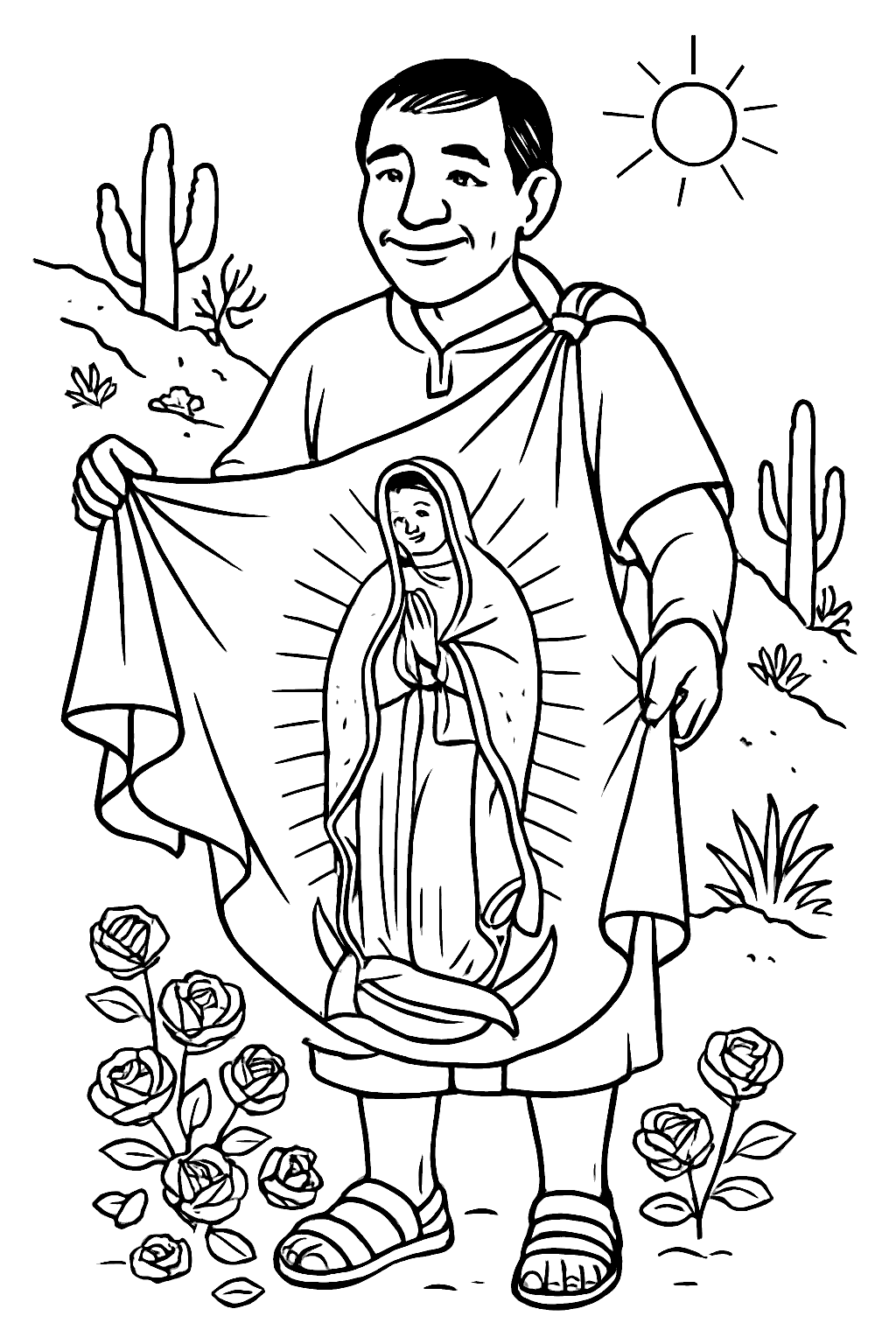
This St. Juan Diego coloring page shows him on Tepeyac Hill in his simple white clothes, opening his cloak as roses tumble out and the image of Our Lady of Guadalupe appears on it. The PDF is free to print. Juan Diego was the Indigenous man to whom Mary appeared in Mexico in 1531.

The story of St. Juan Diego
Almost 500 years ago, in Mexico, there lived a humble farmer named Juan Diego. His name in his own language, Cuauhtlatoatzin, means "talking eagle." He had become a Christian, and he loved to walk to church to learn about Jesus.
Early one December morning in 1531, as he walked past a hill called Tepeyac, he heard beautiful music, like birds singing. Then a lovely Lady called him by name. She was the Virgin Mary, the mother of Jesus! She asked him to go to the bishop and ask for a church to be built on that hill.
Juan Diego went, but the bishop was not sure. He asked for a sign. A few days later Mary told Juan Diego to climb to the top of the hill and pick the flowers there. It was winter, and nothing should have been blooming. But the hilltop was full of roses! Juan Diego gathered them in his cloak, called a tilma, and carried them to the bishop.
When he opened his cloak, the roses tumbled out, and everyone fell to their knees. On the cloak was a beautiful picture of Mary, the one we call Our Lady of Guadalupe. You can still see that tilma in Mexico City today.
St. Juan Diego spent the rest of his life in a little house beside Mary's chapel, praying and telling visitors what he had seen. In 2002 Pope John Paul II made him a saint, the first Indigenous saint of the Americas.
What to color
- His tilma (cloak): tan or cream. It was made of rough plant fibers, a poor man's cloak.
- The image of Mary: a blue-green mantle with gold stars, a rose-colored dress and golden rays all around.
- The roses: red and pink, for the sign of Mary's love that came in winter.
- His clothes and sandals: white and brown, the plain clothes of a hardworking man.
- Tepeyac Hill: brown rocks, green cactus and a bright sun.
A prayer to pray together
Pope St. John Paul II ended his homily on the day Juan Diego became a saint with a prayer to him. Here are some of its words:
Beloved Juan Diego, "the talking eagle"! Show us the way that leads to the "Dark Virgin" of Tepeyac, that she may receive us in the depths of her heart, for she is the loving, compassionate Mother who guides us to the true God. Amen.
Children can pray simply: St. Juan Diego, pray for us, and help us bring others to Mary and Jesus.
Ideas for families and classrooms
- Color this page on December 9, his feast, and the Our Lady of Guadalupe page on December 12.
- Fold a paper cloak and fill it with tissue-paper roses.
- Talk about it: Juan Diego was a poor, ordinary man. Why do you think Mary chose him?
- Bring roses or flowers to a statue or picture of Mary at church or at home.
- Find Mexico on a map and say a Hail Mary for the people of Mexico.
Read the full story: St. Juan Diego Cuauhtlatoatzin in the encyclopedia.
Frequently asked questions
What colors should I use for St. Juan Diego?
His clothes were plain white cotton, and his cloak was a rough tan or cream color. Color the roses red and pink, and give Our Lady on his cloak a blue-green mantle with gold stars and a rose-colored dress, as on the real image.
Why are roses falling from Juan Diego's cloak?
The bishop asked for a sign. Mary told Juan Diego to gather flowers on the top of the hill, though it was December. He found beautiful roses, carried them in his cloak, and when he opened it before the bishop, her picture was on it.
When is St. Juan Diego's feast day?
December 9, the day Mary first appeared to him in 1531. Our Lady of Guadalupe's feast comes three days later, on December 12.
Is this coloring page free for schools?
Yes. Print as many copies as you need for your home, classroom or parish.